
Flag quizzes are a fun way to test your knowledge of countries and their flags. Whether for school, trivia nights, or personal learning, they combine education with entertainment. Free online templates make it easy to create and use these quizzes, offering features like pre-made questions, flag images, and scoring systems. You can choose from three main formats:
- Form-Based Quizzes: Simple, self-paced, and easy to grade.
- Interactive Game-Style Quizzes: Add timers, leaderboards, and live participation for a competitive edge.
- Printable Flashcards: Perfect for offline use and hands-on learning.
Platforms like Flag Emoji Quizzes also let users explore flags by region, providing instant feedback and retake options. Teachers, families, and individuals can customize quizzes to suit different age groups, regions, or learning goals. Start with small, focused quizzes and expand as needed to make geography lessons engaging and effective.
Create Online Flag Quiz Game Explained In 5 Minutes
Want the full printable classroom pack?
Take the flag reference from your screen to an offline pack for lessons, practice, and quiz time.
- Printable atlas with 230+ high-resolution flag flats
- Four regional quizzes with answer keys
- Flag Bingo boards and caller sheet
Types of Free Flag Quiz Templates
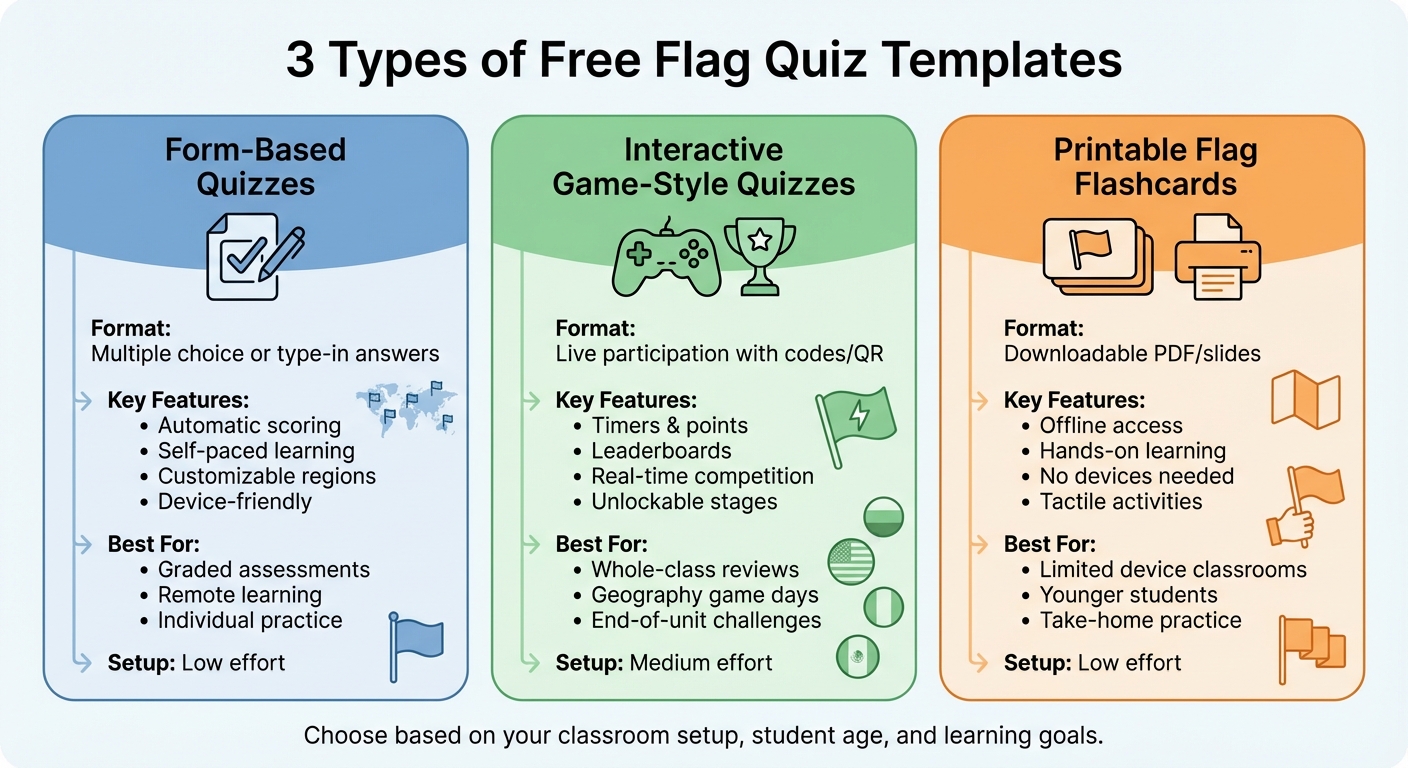
Three Types of Flag Quiz Templates Comparison Chart
Free flag quiz templates come in three main formats, each tailored to different teaching and learning needs. These formats include form-based quizzes, interactive game-style quizzes, and printable flag flashcards. Whether you’re looking for a self-paced activity, a lively classroom challenge, or a hands-on learning tool, these templates offer flexible options.
Form-Based Quizzes
Form-based quizzes present a flag image and ask participants to either choose the correct country from multiple options or type in their answer. These quizzes are designed for ease of use, automatically scoring and summarizing responses, which saves teachers from manual grading. They also allow for some customization, like adjusting the number of flags or focusing on specific regions. For instance, teachers might limit the quiz to North American flags for younger students or expand it to include all 197 world flags for advanced learners. These quizzes work well for self-paced practice, graded assessments, or even remote learning, as they can be accessed on any device.
Interactive Game-Style Quizzes
Interactive game-style quizzes bring an exciting twist to flag identification. By incorporating elements like timers, points, leaderboards, and real-time participation, these quizzes transform learning into an engaging competition. Many platforms allow students to join live sessions using codes or QR codes, adding a layer of interactivity. Features like unlockable stages and leaderboards foster friendly competition, making these quizzes perfect for activities like whole-class reviews, geography game days, or end-of-unit challenges. The fast-paced and dynamic nature of these quizzes keeps students actively involved and motivated.
Printable Flag Flashcards
Printable flag flashcards offer a hands-on approach to learning. Available as downloadable PDFs or slide decks, these flashcards can be printed and cut into individual cards for various offline activities. Teachers can use them for matching games, show-and-tell, or peer quizzes. These flashcards are especially useful in classrooms with limited devices, for younger students who benefit from tactile learning, or as take-home materials for family practice. Tools that export designs as PDFs make it easy to create and print these resources without needing internet access.
Next, we’ll dive into how Flag Emoji Quizzes bring interactive regional features and customization options to the table for diverse learning experiences.
Flag Emoji Quizzes: An Online Resource
Flag Emoji Quizzes offers a fun and interactive way to learn about countries through their flags. This free, browser-based platform uses flag emojis in self-paced quizzes, providing instant feedback to learners. It’s a great tool for U.S. classrooms, families, and individuals, expanding the range of free flag quiz templates with dynamic, region-specific challenges.
Interactive Regional Quizzes
The quizzes are neatly organized by region – North America, South America, Europe, Asia, Africa, and Oceania. Each quiz presents a flag emoji, and users either choose the correct country from multiple-choice options or type in the answer. For instance, the North America quiz covers 23 countries, including Canada, Mexico, and the United States, while the Europe quiz features 50 countries, such as France, Germany, and the United Kingdom. This setup is especially useful for U.S. students learning about specific continents or for adults preparing for travel or citizenship exams. Teachers can integrate these quizzes into lessons, focusing on flags from regions like North America during a unit on neighboring countries or European flags while studying the European Union.
Immediate Feedback and Retake Options
One of the platform’s standout features is its immediate feedback. After each answer, users are told whether they were correct and shown the right country if they were wrong. This helps learners quickly address any mistakes and strengthens their memory of the flag-to-country connection. The quizzes can be restarted as often as needed, making it easy to practice until mastery is achieved. For example, a student might retake the Asia quiz several times to feel more confident before moving on to another region.
Uses for Different Audiences
This platform’s flexibility makes it suitable for a wide range of users. Teachers in the U.S. can project a regional quiz in class, encouraging students to participate individually or as a group. It can serve as a warm-up activity, an exit ticket, or a review game during geography lessons. Teachers might also assign quizzes, like South America or Africa, as homework or extra credit, asking students to document their scores. Families can turn the quizzes into a trivia night activity, using a shared device to guess flags together. This not only makes learning fun but also helps children connect flags to countries they hear about in the news or during travel. For individual learners – whether middle schoolers preparing for geography bees or adults studying for citizenship exams – the platform offers convenient, bite-sized practice sessions on any modern device, perfect for study breaks or commutes.
sbb-itb-c170c49
Customizing Flag Quiz Templates
Customizing free flag quiz templates can make learning more engaging and interactive, catering to a variety of learners.
Adjusting for Different Age Groups
Tailor flag quizzes to match the abilities of different age groups by tweaking the complexity of questions and formats. For younger students, such as those in grades 2–5, use large, clear flag images and simple multiple-choice questions with only 2–3 options. Keep these quizzes short – around 10–15 flags – and focus on familiar countries like the United States, Canada, and Mexico. Adding colorful and visually appealing elements can help maintain their interest.
For middle schoolers, consider regional quizzes with a mix of multiple-choice questions, timed challenges, and map-matching activities. High school students, on the other hand, can handle more comprehensive quizzes that include all 197 world flags. Open-ended questions where they type the country names can add an extra layer of difficulty. For adults, particularly in trivia games or corporate training, incorporate features like timers, leaderboards, and difficulty levels to keep things exciting while aligning with event branding.
You can also organize these quizzes by region to make them even more effective.
Organizing by Region
Breaking down quizzes by continent is a great way to align with geography lessons commonly taught in U.S. schools. This method allows learners to focus on one region at a time before moving on to a global review. Design shorter, region-specific quizzes with 10–15 questions, which can fit neatly into a 10–15 minute activity block. This leaves enough time for discussion within a typical 45–55 minute class period.
For an even more focused approach, you can group countries into subregions. Many quiz platforms let you create separate sections or pages for each region, enabling students to either follow a sequence or jump to specific areas they’re studying.
Setting Up for U.S. Classrooms
Once you’ve adjusted the content by age group, format the quiz to suit the structure of U.S. classrooms. With geography or social studies classes often limited to 30–45 minutes, quizzes should be designed to take only 5–15 minutes, including setup, participation, and review. Use browser-based tools compatible with common classroom devices.
For classrooms with limited devices, project the quiz on a central screen using tools like Mentimeter or TriviaMaker. Students can respond using hand signals, paper answer sheets, or shared devices. To track scores, integrate tools like Google Sheets or Excel for easy management. To support English learners or students with learning differences, include visual aids such as labeled map thumbnails, reduce answer choices, and use high-contrast themes with clear, readable fonts. These small adjustments can make a big difference in maintaining an inclusive and effective learning environment.
Conclusion
Flag quiz templates are a fantastic way to make geography lessons more engaging, whether you’re teaching in a U.S. classroom, hosting a family game night, or learning independently. Options range from form-based quizzes for graded assessments to interactive game platforms for live competitions, printable flashcards for offline practice, and even flag emoji quizzes for quick, mobile-friendly reviews. These templates are ready to use but can easily be tailored to suit your audience.
To get started, keep it simple. Begin with a small, focused quiz – like 10 North American flags for younger students or a timed 30-flag challenge for high schoolers. Test it out with a brief trial session and adjust as needed. For U.S. classrooms with 45–55 minute periods, aim for quizzes that take just 5–15 minutes, leaving room for discussion and review. Tracking scores over time can also help monitor progress and keep students motivated.
For a more structured approach, consider organizing quizzes by continent – North America, South America, Europe, Asia, Africa, and Oceania. This method allows learners to master one region before moving on to a global review, aligning well with typical U.S. geography curricula. Tools like Flag Emoji Quizzes (https://flagemoji.com) make this easy by offering regionally organized quizzes with instant feedback. Combining recognition tasks (like matching flags) with recall tasks (such as typing names) can further enhance learning as students advance.
FAQs
How do I make flag quizzes suitable for different age groups?
To create flag quizzes that cater to different age groups, it’s important to tweak the content and presentation to suit the audience. For younger participants, stick to simple questions and pair them with colorful visuals and fun facts about the flags or their countries. This approach keeps the experience educational and entertaining. For older participants, you can raise the challenge by including more detailed questions or trivia that dives deeper into history or symbolism. Adding interactive elements like hints, timers, or progress tracking can also make the quizzes more engaging and enjoyable for all ages.
What are the advantages of using interactive flag quizzes?
Interactive flag quizzes are a lively and entertaining way to explore flags from across the globe. By transforming learning into a game, they add an element of fun that can spark curiosity and keep you motivated.
What makes these quizzes even more effective is how they encourage active participation. With instant feedback, you can immediately spot what you’ve mastered and what needs more attention. This hands-on approach not only strengthens your memory but also helps you build confidence as you improve over time.
How can printable flag flashcards make learning more effective?
Printable flag flashcards are a fantastic tool for learning, blending visual cues with hands-on interaction to help learners identify and remember flags more effectively. By using physical flashcards, learners engage in active recall – a proven technique to boost memory and retention.
What makes these flashcards great is their versatility. They’re suitable for all age groups, turning studying into a fun, interactive experience that caters to various learning styles.
Related Blog Posts
- Interactive Flag Games for Geography Students
- World Flags Quiz Generator
- Flag Recognition Test
- Flag Knowledge Checker
Free Printable: Flags of the World Reference Card
Get a beautiful printable poster with 50 flag emojis, Unicode codes, and fun facts. Perfect for classrooms and desks!
No spam, ever. Unsubscribe anytime.