
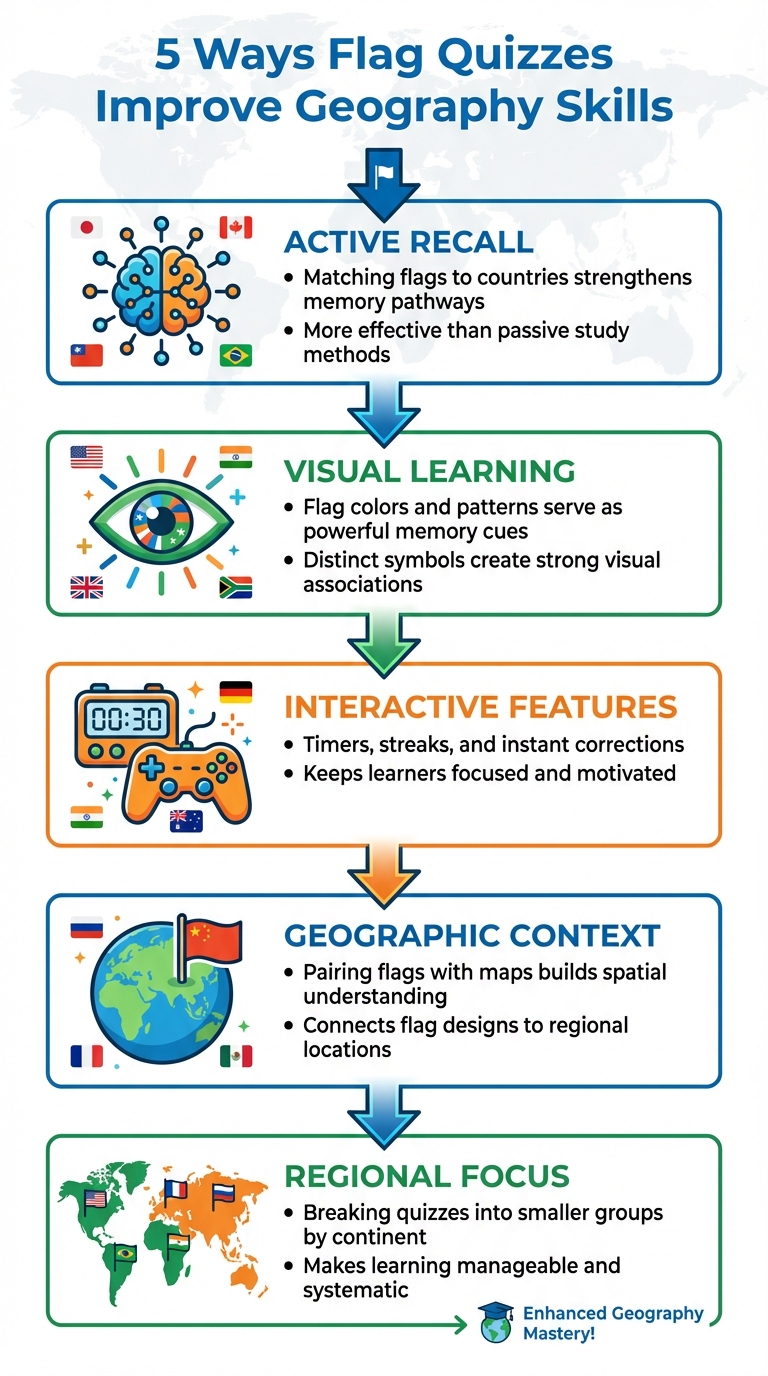
Flag quizzes make learning geography engaging and effective by combining visual recognition, memory recall, and interactive feedback. They transform the process of memorizing flags and locations into a fun activity, helping you retain information longer. Here’s why they work:
- Active Recall: Matching flags to countries strengthens memory pathways better than passive study methods.
- Visual Learning: Flags’ colors and patterns serve as powerful memory cues.
- Interactive Features: Timers, streaks, and instant corrections keep you focused and motivated.
- Geographic Context: Pairing flags with maps builds spatial understanding and connects designs to regions.
- Regional Focus: Breaking quizzes into smaller groups (e.g., by continent) makes learning manageable and systematic.
Flag quizzes don’t just teach you about flags – they help you understand the world through patterns, histories, and relationships between nations. Whether you’re a student or just curious about geography, they’re an enjoyable way to sharpen your skills.
5 Ways Flag Quizzes Improve Geography Skills
How Flag Quizzes Improve Memory and Recognition
Flag quizzes are a powerful tool for improving both memory and geographic recognition. By matching flags to their respective countries, you engage in active recall. Combined with visual patterns, instant feedback, and timed challenges, this process strengthens neural pathways and helps move information from short-term to long-term memory more effectively than traditional study techniques.
Want the full printable classroom pack?
Take the flag reference from your screen to an offline pack for lessons, practice, and quiz time.
- Printable atlas with 230+ high-resolution flag flats
- Four regional quizzes with answer keys
- Flag Bingo boards and caller sheet
Visual Learning and Long-Term Memory
Flags are packed with distinct colors, symbols, and patterns, making them excellent visual cues. When you try to recall a tricky flag, your brain goes beyond passive recognition and engages in active recall, which is much more effective for memory retention.
Features like repetitive challenges, varied question types, and streak mechanics make the learning experience dynamic. These tools help reinforce information and ensure it sticks. Adaptive quizzes, which focus on flags you find most difficult, are especially useful for efficient review, turning each session into a productive learning opportunity.
Different quiz formats add depth to the learning process. For example, basic matching exercises help with recognition, while tasks that involve arranging a flag’s colors in the right order require deeper recall. This variety strengthens your memory by engaging multiple cognitive processes.
Connecting Flags to Geographic Regions
Understanding flags becomes even more meaningful when paired with geographic context. For instance, identifying the flag of Kiribati while locating it on a map of the Pacific creates a dual connection – linking the flag’s design with its location. This dual association makes both the flag and its geographic region easier to remember.
Region-specific quizzes take this a step further. By focusing on flags from one continent at a time – like mastering African flags before moving to another region – you start to notice recurring patterns. These shared design elements not only make the learning process smoother but also sharpen your ability to recognize broader trends across different countries.
sbb-itb-c170c49
Learning Geography Through Regional Flag Quizzes
Organizing Learning by Continent
Using regional flag quizzes is a smart way to make geography less intimidating. Instead of trying to memorize nearly 200 flags all at once, breaking them down by continent makes the process much more manageable. For example, South America has only 12 flags, and Oceania has 14. Tackling smaller groups like these helps you focus without feeling overwhelmed.
Studying flags by continent also builds what’s called "map-first memory." This means you start to see how countries are positioned relative to one another and notice patterns, like shared design elements among neighboring nations. For instance, working through all 54 African flags together can reveal clusters of similarities while also helping you connect them to their geographic locations. Tools like Flag Emoji Quizzes organize flags by regions – North America, South America, Europe, Asia, Africa, and Oceania – so you can focus on learning one continent at a time.
This step-by-step approach not only builds confidence but also prepares you for larger challenges. Pairing regional focus with instant feedback creates a powerful method for learning.
Learning from Immediate Feedback
Regional practice lays the groundwork, but immediate feedback is what truly speeds up learning. When you make a mistake, getting the correct answer right away ensures you don’t repeat the same error. For example, if you misidentify Bhutan’s flag or mix up Eswatini with another African country, the quiz shows you the correct answer immediately. This prevents bad habits from forming.
What’s even better is the chance to retake quizzes right after receiving feedback. This repetition helps cement the correct answers in your memory while they’re still fresh. By combining instant corrections with visual cues, you’re more likely to retain the information long-term.
How to Get Started with Flag Quizzes
Using Flag Emoji Quizzes: A Step-by-Step Guide
Getting started with Flag Emoji Quizzes is pretty simple. Head to the site and pick a region that catches your interest – whether it’s North America, South America, Europe, Asia, Africa, or Oceania. If you’re new to this, starting with smaller regions can make it easier before diving into continents with a larger number of flags.
Once you’ve chosen a region, the quiz will show you flags alongside a list of country names. Your job? Match each flag to the right country. The platform gives instant feedback: correct answers light up in green, and wrong ones are marked in red. This immediate response helps you avoid reinforcing mistakes.
After finishing a quiz, take a closer look at the answers you got wrong. When you make an error, the correct answer pops up right away, making it easier to learn from it. You can even retake the quiz right away to cement those answers while they’re still fresh in your mind. Creating a free account allows you to save your progress and keep track of how you’re improving.
Monitoring Your Progress and Building Skills
Tracking your progress is a great way to stay motivated and pinpoint areas that need work. Keep an eye on your match accuracy – this is the percentage of flags you correctly identify. Start by aiming for perfect scores on smaller regional quizzes before moving on to harder ones.
Pay extra attention to flags you often miss, like Bhutan, Eswatini, and Kiribati. If these keep tripping you up, spend some time practicing in the regions where they appear. Set small goals, like mastering one continent each week, and retake quizzes until you consistently get everything right. This focused practice helps you build confidence and prepares you for tackling the full world quiz that includes flags from every continent.
Conclusion: The Benefits of Learning Geography with Flag Quizzes
Flag quizzes are a powerful way to sharpen geography skills. They use visual memory and pattern recognition, turning national flags into "anchors" that help you recall countries, regions, and their connections. Unlike passive methods like reading, quizzes actively engage your brain, reinforcing information for long-term retention.
The way flag quizzes are organized also helps you understand geography better. By grouping flags regionally – whether by continent or design themes like Nordic crosses or Pan-African colors – they highlight spatial relationships between countries. This structured approach keeps learning manageable and avoids mental burnout, with short sessions of around 10 questions, which is considered ideal for maintaining focus.
Another major advantage is immediate feedback, which corrects mistakes on the spot. This prevents reinforcing incorrect answers and helps you solidify knowledge while it’s still fresh.
Gamified features like streaks, timers, and accuracy scores make the process more engaging. These elements turn repetitive practice into something fun, encouraging consistent learning without feeling like a chore. Over time, this builds a habit that leads to mastery.
Beyond memorizing flags, this method fosters a deeper understanding of cultural context. Learning why certain regions share specific flag colors or exploring the history behind a nation’s symbols adds meaning to the process, making it easier to remember. Whether you’re studying for an exam or just want to expand your knowledge of the world, flag quizzes provide an effective and interactive way to achieve your goals.
FAQs
How often should I take flag quizzes to remember them long-term?
To keep flag information fresh in your mind, make a habit of taking quizzes regularly – aim for daily or at least several times a week. This consistent practice strengthens your memory and helps you hold onto what you’ve learned over time.
What’s the best way to stop mixing up similar-looking flags?
To tell apart flags that look similar, focus on what makes each one stand out – like specific colors, symbols, or patterns. Look closely at details such as emblems, the way stripes are arranged, or unique color pairings. Using tools like interactive flag quizzes (such as those on Flag Emoji Quizzes) can be a fun way to sharpen your memory. These quizzes give instant feedback and point out small differences, making it easier to learn. With consistent practice, you’ll become more confident in identifying even the trickiest flags.
Should I learn flags by continent or the whole world at once?
Learning flags by continent is an effective way to break the task into manageable chunks, making it easier to notice regional similarities. Starting with continents like North America or Europe is a great way to gain confidence, as these regions often have distinct and recognizable flags. For those seeking a bigger challenge, diving into all the flags worldwide offers a chance to appreciate the variety and richness of global designs. Your approach depends on your goals – studying continent by continent can be a smart path to eventually knowing every flag.
Related Blog Posts
- Interactive Flag Games for Geography Students
- Flag Quiz Templates: Free Options Online
- Flag Knowledge Checker
- North American Flags Quiz: Test Your Knowledge
Free Printable: Flags of the World Reference Card
Get a beautiful printable poster with 50 flag emojis, Unicode codes, and fun facts. Perfect for classrooms and desks!
No spam, ever. Unsubscribe anytime.