
Timed quizzes are one of the most effective ways to boost memory and learning. Research shows that testing yourself – especially under time constraints – helps you recall information better than simply rereading material. This method, known as the testing effect, strengthens neural connections and combats the "fluency illusion", where rereading creates a false sense of mastery. Adding time pressure enhances focus and makes retrieval more effortful, which leads to stronger, longer-lasting memories.
Here’s what makes timed quizzes so effective:
- Active Recall: Quizzing forces your brain to retrieve information, reinforcing memory.
- Time Pressure: Increases focus and strengthens neural pathways.
- Immediate Feedback: Corrects mistakes instantly, helping you learn faster.
- Repetition: Spaced practice solidifies long-term retention.
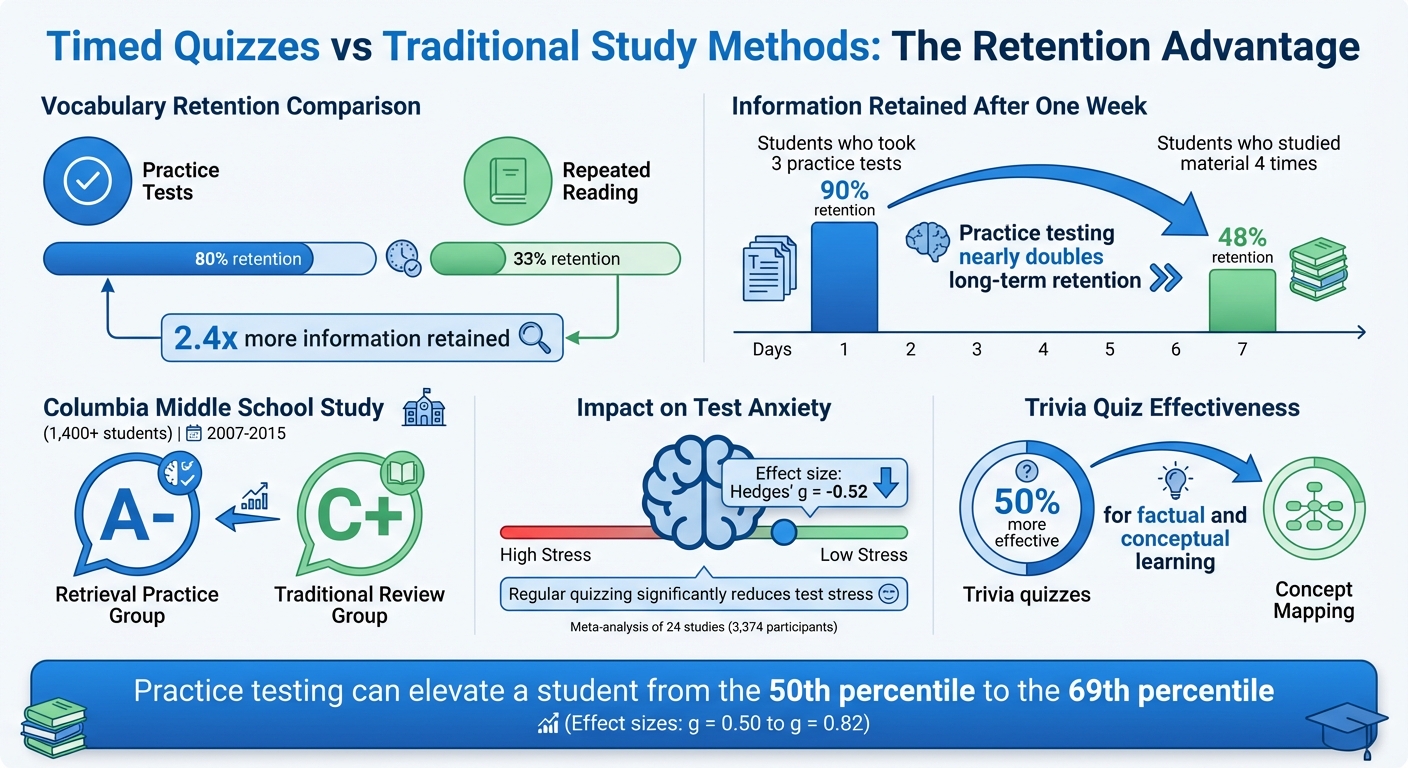
Studies back this up. For example, students who used practice tests retained 80% of material, compared to just 33% with rereading. Timed quizzes also reduce test anxiety and improve performance by building familiarity with high-pressure situations.
Want the full printable classroom pack?
Take the flag reference from your screen to an offline pack for lessons, practice, and quiz time.
- Printable atlas with 230+ high-resolution flag flats
- Four regional quizzes with answer keys
- Flag Bingo boards and caller sheet
If you’re learning something like flag geography, tools like Flag Emoji Quizzes combine these principles with engaging features like regional categories and instant feedback to make learning effective and fun.
How Timed Quizzes Improve Memory: The Science
The Testing Effect
The testing effect shows that actively recalling information from memory reinforces it much more effectively than simply rereading the material. When you quiz yourself, your brain works to retrieve and reconstruct the information, creating multiple neural connections instead of relying on a single, fragile memory trace formed by rereading.
Studies back this up. For example, students who took three practice tests retained 90% of the information after a week, while those who just studied the material four times retained only 48%. Large-scale analyses of hundreds of experiments report effect sizes between g = 0.50 and g = 0.82, depending on factors like timing and feedback. In simple terms, this means practice testing can elevate a student from the 50th percentile to the 69th percentile.
Testing also combats the "fluency illusion", where rereading gives a false sense of mastery without guaranteeing actual recall. As Bjork & Bjork explain in Psychology and the Real World:
"Conditions that slow the apparent rate of learning often optimize long-term retention and transfer."
Adding time limits to quizzes amplifies this effect by making retrieval more effortful, which strengthens memory even further.
How Time Pressure Affects Cognitive Processing
Introducing a time limit turns a quiz into an exercise in what researchers call effortful retrieval. The challenge of recalling information under pressure reinforces neural connections. This difficulty isn’t a drawback – it’s what makes the process so effective. Studies show that harder, time-pressured retrievals lead to stronger memories than easy, untimed ones.
Time pressure also sharpens focus. With a ticking clock, distractions fade, and attention zeroes in on the task. This heightened focus not only helps encode the information more effectively but also makes future recall more efficient. Brain imaging studies using functional MRI reveal that retrieval under these conditions activates both the anterior and posterior hippocampus, a level of engagement passive study methods simply can’t achieve.
Another fascinating phenomenon is the hypercorrection effect. When you confidently answer a timed question incorrectly, the resulting surprise triggers a strong encoding signal in your brain. Paired with immediate feedback, this "prediction error" helps your brain prioritize the correct answer moving forward. A timer doesn’t just test your knowledge – it reshapes how you learn.
sbb-itb-c170c49
Test your memory with this game from Johns Hopkins

Research Findings on Timed Quizzes
Timed Quizzes vs Traditional Study Methods: Retention Rate Comparison
Studies show that timed quizzes, like those found in Flag Emoji Quizzes, can significantly boost memory and improve learning outcomes.
Practice Tests Improve Retention
Practice tests are a game-changer for retention. Research highlights that students using practice tests to recall vocabulary retain 80% of the material, compared to only 33% through repeated reading. That’s more than twice the retention, simply by changing the approach to studying.
Between 2007 and 2015, researchers Mark McDaniel, Henry Roediger III, and Kathleen McDermott conducted a study at Columbia Middle School in Illinois. They worked with nine teachers and over 1,400 students, comparing traditional review methods – where material was presented and reviewed multiple times – with retrieval practice using clicker devices. The results? Students quizzed three times earned an A- on unit tests, while those in the review group scored a C+. Even more impressive, the quizzed students retained the information far better over an eight-month period.
Jeffrey Karpicke, a Professor of Cognitive Psychology at Purdue University, explains why retrieval practice is so effective:
"Recalling information we’ve already stored in memory is a more powerful learning event than storing that information in the first place. Retrieval is ultimately the process that makes new memories stick."
Beyond improving memory, these benefits extend to reducing stress during tests.
Timed Quizzes Build Stress Resilience
Frequent quizzing has been shown to lower test anxiety. A meta-analysis of 24 studies involving 3,374 participants found that practice tests reduce test anxiety, with an effect size of Hedges’ g = -0.52. This suggests that regular, low-pressure quizzes help students handle stress more effectively.
In October 2013, professors James Pennebaker and Samuel Gosling from the University of Texas at Austin introduced daily online quizzes with immediate feedback for 901 students. Their findings were striking: students who took these quizzes earned grades about half a letter higher than a comparison group of 935 students from earlier semesters. Even more notable, the achievement gap between students from different socioeconomic backgrounds was cut in half. Samuel Gosling emphasized:
"Repeated testing is a powerful practice that directly enhances learning and thinking skills, and it can be especially helpful to students who start off with a weaker academic background."
When quizzes are designed as trivia, they also bring another advantage – greater engagement.
Trivia Quizzes Increase Engagement
Trivia-style quizzes transform studying into an interactive experience. This format encourages participation because it feels more like playing a game than traditional studying. And when students are actively involved, they process information more deeply, leading to longer-lasting retention.
Research shows that trivia quizzes are about 50% more effective at promoting both factual and conceptual learning compared to methods like concept mapping. The secret lies in the active recall process, which strengthens neural connections as students retrieve information. As Mark McDaniel, a Psychology Professor at Washington University in St. Louis, explained:
"We used to call it ‘the testing effect’ until we got smart and realized that no teacher or parent would want to touch a technique that had the word ‘test’ in it."
Using Timed Quizzes for Flag Geography Learning
Timed quizzes can make a big difference when it comes to learning flags and geography. They’re especially helpful for distinguishing between flags that look almost identical – like Ireland and Ivory Coast or Chad and Romania. By applying timed practice techniques, you can turn broad research into effective strategies for mastering flag geography.
How Immediate Feedback Helps Learning
Immediate feedback is a game-changer for flag quizzes. When you confidently pick the wrong flag and see the correct answer right away, your brain flags that moment as crucial information. This process fixes incorrect associations and reinforces the right flag-country match. Instead of just reviewing a list, you’re actively engaging – testing yourself, making mistakes, and learning from them. Tools like Flag Emoji Quizzes provide instant answers after each question, helping you quickly correct any misconceptions.
Regional Quizzes for Targeted Learning
Breaking flag quizzes into regions – like North America, Europe, Asia, Africa, South America, and Oceania – makes learning more manageable and effective. Research shows that focusing on smaller groups, such as 10–15 countries within a specific region, reduces mental overload and helps you spot patterns. For example, studying European flags reveals common themes, like the Nordic crosses in Denmark, Sweden, Norway, Finland, and Iceland or the horizontal tricolors in Germany, Austria, and the Netherlands. These visual patterns act as memory anchors, making it easier to distinguish individual flags without overwhelming yourself by trying to memorize them all at once.
Retaking Quizzes to Improve Retention
Repetition is key to building long-term memory. Studies suggest that recalling information 3 to 5 times at spaced intervals helps move it into long-term storage. Retaking regional quizzes reinforces flag-country connections by strengthening neural pathways. Each time you recall a flag, you’re solidifying that memory. With Flag Emoji Quizzes, you can easily integrate this spaced repetition method into your routine, squeezing in just a few minutes of practice each day to lock in what you’ve learned.
Conclusion
Timed quizzes are a powerful tool for building stronger, longer-lasting memories. Research shows that practice testing can more than double retention rates compared to simply rereading material.
Adding time pressure to quizzes doesn’t just test knowledge – it sharpens focus and strengthens recall. This is especially helpful for tasks like distinguishing between similar flag designs. Each time you connect a flag to its corresponding country, you’re reinforcing that memory and making it stick.
Flag Emoji Quizzes is built on this scientific foundation. The platform incorporates proven strategies to make timed quizzes more effective: immediate feedback to take advantage of the hypercorrection effect, regional categories to reduce mental overload, and spaced repetition to counteract the forgetting curve. As Jeffrey Karpicke, a Cognitive Psychology Professor at Purdue University, explains:
"Recalling information we’ve already stored in memory is a more powerful learning event than storing that information in the first place."
FAQs
What’s the best time limit for a timed quiz?
The best time limit for a timed quiz strikes a balance between encouraging quick thinking and maintaining engagement. Studies indicate that allowing 30 seconds to a few minutes per question works well. This range supports memory retention while minimizing stress. Tailoring the time limit to match the quiz’s difficulty can further improve the overall experience.
How often should I retake quizzes to remember flags long-term?
To remember flags over the long term, try retaking quizzes at spaced intervals. Begin a few days after your initial attempt, then gradually extend the time between sessions to weeks. This approach, called spaced repetition, is a proven way to improve memory retention over time.
Should I focus on regional flag quizzes or mix all regions together?
Focusing on quizzes that center around regional flags can be a great way to sharpen your memory. Why? Because they provide a specific context, which aligns with research showing that targeted learning – like spaced and varied testing – can boost retention. While mixing flags from different regions can be helpful too, sticking to a particular region offers a balanced challenge. This makes regional quizzes especially effective for both learning and recall.
Related Blog Posts
- Interactive Flag Games for Geography Students
- Flag Quiz Templates: Free Options Online
- How Flag Quizzes Improve Geography Skills
- North American Flags Quiz: Test Your Knowledge
Free Printable: Flags of the World Reference Card
Get a beautiful printable poster with 50 flag emojis, Unicode codes, and fun facts. Perfect for classrooms and desks!
No spam, ever. Unsubscribe anytime.