
How To
How To
Time needed: 1 minute
Want the full printable classroom pack?
Take the flag reference from your screen to an offline pack for lessons, practice, and quiz time.
- Printable atlas with 230+ high-resolution flag flats
- Four regional quizzes with answer keys
- Flag Bingo boards and caller sheet
How to copy and paste the Flag of Democratic Republic of the Congo Emoji to any device.
- Copy the Congolese Flag Emoji
Go to flagemoji.com and press the copy button (above). This works on any device.
- Paste the Emoji
Go to your email/iMessage/SMS texting service/document and paste the emoji.
For mobile devices
— double-tap or tap-hold, then paste should appear. Tap it.
For desktop and laptops on Apple devices
— command-P / ⌘-P
For desktop and laptops on Windows devices
— control-p
Codes
Emoji Codes
Flag emojis are unicode symbols, like any other letter or number on your keyboard. This means you can copy and paste the emoji itself into your code, whatever the language (click the button above).
They actually count as two characters: the two-letter country code (the ISO international standard). The unicode and shortcode both represent country data which devices can interpret and display the emoji.
| Country Code | Unicode | Shortcode |
| CD | U+1F1E8 U+1F1E9 | :flag_CD: :CD: |
Emoji shortcodes are used on some platforms as a way for users to type in emojis from the keyboard. If you type the emoji shortcode on Github or Slack, the emoji will appear.
*The official name of the emoji is only the country name, not ‘Democratic Republic of the Congo Flag’, for example.
Description
Description
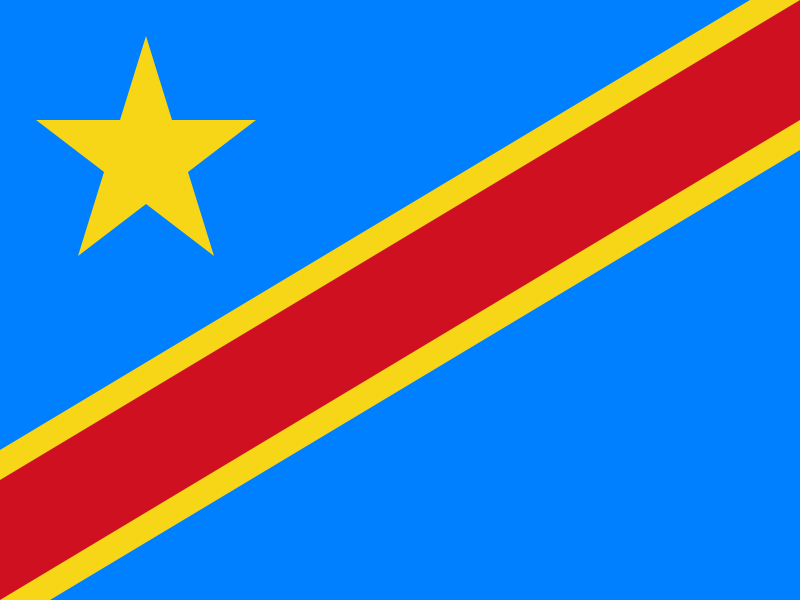
The flag of the Democratic Republic of the Congo is made up of a sky blue field divided diagonally from the lower hoist corner to the upper fly corner by a red stripe bordered by two narrow yellow stripes. A yellow, five-pointed star appears in the upper hoist corner. Blue represents peace and hope, red the blood of the country’s martyrs, and yellow the country’s wealth and prosperity. The star symbolizes unity and the brilliant future for the country.
Formerly called Zaire; the capital is Kinshasa.
Map
Map
Check out the map of Monaco!
Weather
Anthem
National Anthem
| Title | Debout Congolaise (Arise Congolese) |
| Composer | Joseph Lutumba / Simon-Pierre Boka di Mpasi Londi |
FAQ
FAQs
Democratic Republic of the Congo achieved independence from Belgium on June 30, 1960.
Blue represents peace and hope, red the blood of the country’s martyrs, and yellow the country’s wealth and prosperity.
The flag of the Democratic Republic of the Congo was officially adopted on May 17, 1997.
Democratic Republic of the Congo is governed as a Semi-Presidential Republic.
Discover more fun facts of Botswana.
Printable
Printable Congolese Flag
Print another really cool flag. Why not the flag of Belarus?
The flag of the Democratic Republic of the Congo is a testament to the nation’s complex political history, reflecting periods of colonialism, independence, authoritarian rule, and democratic restoration. The current design, adopted on February 18, 2006, features a sky blue field with a single yellow star positioned in the upper left canton, complemented by a bold red diagonal stripe bordered with yellow fimbriation running from the lower hoist to the upper fly. This striking composition represents peace (blue), blood of martyrs (red), national wealth (yellow), and the nation’s future (the star), each element carrying profound symbolic weight rooted in the country’s tumultuous past.
The origins of the Congo’s flag design trace back to 1877 and the colonial era under King Leopold II of Belgium. Following the Brussels Geographic Conference in 1876, Leopold II established the Association Internationale du Congo to expand European interests in Central Africa under the guise of humanitarian development. The resulting flag—a blue field adorned with a single gold star—symbolized a “shining light in the Dark Continent,” drawing inspiration from the historical kingdom of Congo in Angola. This design represented Leopold II’s vision as the Congo Free State, which became his personal possession at the Berlin Conference in 1885. The blue and gold combination persisted through the colonial period until Belgian formal annexation in 1908, representing centuries of external control over the Congolese people. The colonial era witnessed profound brutality, including forced labor for rubber, palm oil, and ivory extraction, accompanied by systematic violence against those who failed to meet quotas—a dark chapter that would later inform the symbolism of the independence flag.
When the Belgian Congo gained independence on June 30, 1960, the nation reimagined its flag as a statement of liberation and self-determination. The new design retained the blue background but replaced the solitary gold star with six yellow stars arranged along the hoist side, representing the nation’s original six provinces. This transformation marked a symbolic break from colonial rule and reasserted Congolese identity and sovereignty. The flag of independent Congo became a powerful emblem of Pan-African pride during an era when numerous African nations were shaking off colonial bonds. However, this period of democratic expression proved brief and fragile, setting the stage for the radical changes that would follow.
The first major alteration to the independence flag occurred between 1963 and 1966, when the design evolved to include the iconic diagonal red stripe with yellow borders that would define Congolese nationalism for decades. This modified design, officially adopted in 1966, reduced the six provincial stars to a single yellow star in the upper left corner and introduced the diagonal stripe running from lower hoist to upper fly. The revised symbolism explicitly acknowledged the sacrifices made during the independence struggle: the red stripe represented “the blood of the country’s martyrs,” the yellow represented national wealth and resources, the blue symbolized hope for peace and progress, and the solitary star embodied national unity and the nation’s bright future. This flag design would remain in use until 1971, becoming deeply associated with the early post-independence period under Prime Minister Patrice Lumumba and President Joseph Kasavubu, as well as the subsequent military government of Lieutenant General Joseph-Désiré Mobutu.
A dramatic transformation occurred on October 27, 1971, when President Mobutu Sese Seko, following his 1965 military coup, renamed the country the Republic of Zaire and introduced an entirely new national flag. Breaking completely with the Congo’s colonial and early independence heritage, Mobutu’s flag featured a light green field bearing a distinctive yellow circle containing a silhouetted arm and torch. This design represented Mobutu’s vision of a unified African nation and symbolized the spirit of revolutionary change and enlightenment. The green and gold color scheme was intended to reflect African identity and the nation’s natural wealth. However, this 26-year period under the Zaire flag coincided with one of Africa’s most notoriously corrupt and oppressive regimes, marked by widespread human rights abuses, economic mismanagement, and the systematic theft of national resources. The flag that symbolized Mobutu’s vision of progress instead became associated with decades of despotism and decline.
The restoration of the Congo’s original independence flag on May 17, 1997, marked a pivotal moment in the nation’s history. When Laurent-Désiré Kabila led a revolutionary coalition that overthrew Mobutu’s regime, his first act was to restore the flag that had symbolized genuine independence and national pride. Kabila, an admirer of Congo’s first Prime Minister Patrice Lumumba, understood the profound symbolic power of this choice. The return of the blue field with the red diagonal stripe and yellow star represented not merely aesthetic preference but a deliberate rejection of Mobutu’s autocratic legacy and a pledge to reconnect with the nation’s original democratic aspirations. Though the restored 1960 flag no longer accurately reflected Congo’s administrative structure—the country now had eight provinces rather than the six represented by the original stars—the symbolic resonance of returning to authentic Congolese identity transcended administrative precision. For many Congolese citizens, the flag’s restoration represented hope for genuine democratic reform and a return to principles of national sovereignty.
The most recent significant change to the Democratic Republic of Congo’s flag occurred in February 2006, following the ratification of a new constitution in December 2005. Rather than introducing an entirely new design, this transition refined the restored flag by modifying the background color from royal blue to sky blue and establishing more precise technical specifications for the design. The yellow star was positioned in a calculated circle 65 centimeters in diameter, with the diagonal red stripe standardized at 16 centimeters wide and bordered with 5-centimeter yellow fimbriation on all sides. This 2006 design represents a deliberate architectural echo of the flag used between 1966 and 1971, drawing a direct line from the nation’s early post-independence period through to the present day. The choice to emphasize continuity with the immediate post-colonial era, rather than the colonial period or the Mobutu regime, reflects the DRC’s ongoing effort to construct a national identity rooted in independence, sovereignty, and democratic aspiration. Today’s flag stands as a visual chronicle of the Congolese journey—from colonial subjugation through liberation, authoritarian consolidation, and the difficult but persistent struggle toward genuine democratic governance and national self-determination.
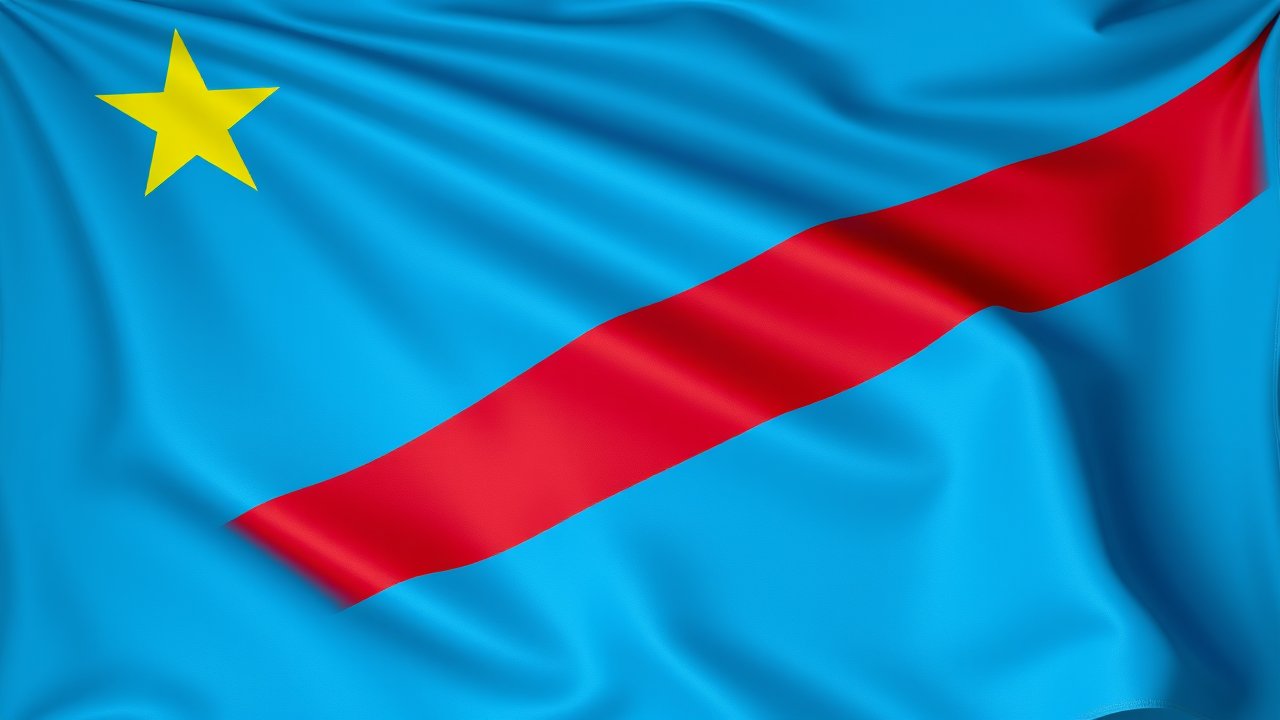
3D Glossy Render — Sky blue field with a diagonal red stripe bordered in yellow and a yellow star in the upper left. The flag of Congo (Democratic Republic) as a photorealistic 3D render. Sky blue field with a diagonal red stripe bordered in yellow and a yellow star in the upper left. The flag fabric hangs or drapes naturally but preserves exact proportions, colors, and all symbols perfectly — completely faithful to the real Congo (Democratic Republic) flag. Dramatic studio lighting, glossy silk material, soft shadows, subsurface scattering, perfect specular highlights. No text, no letters, no words, no writing of any kind.
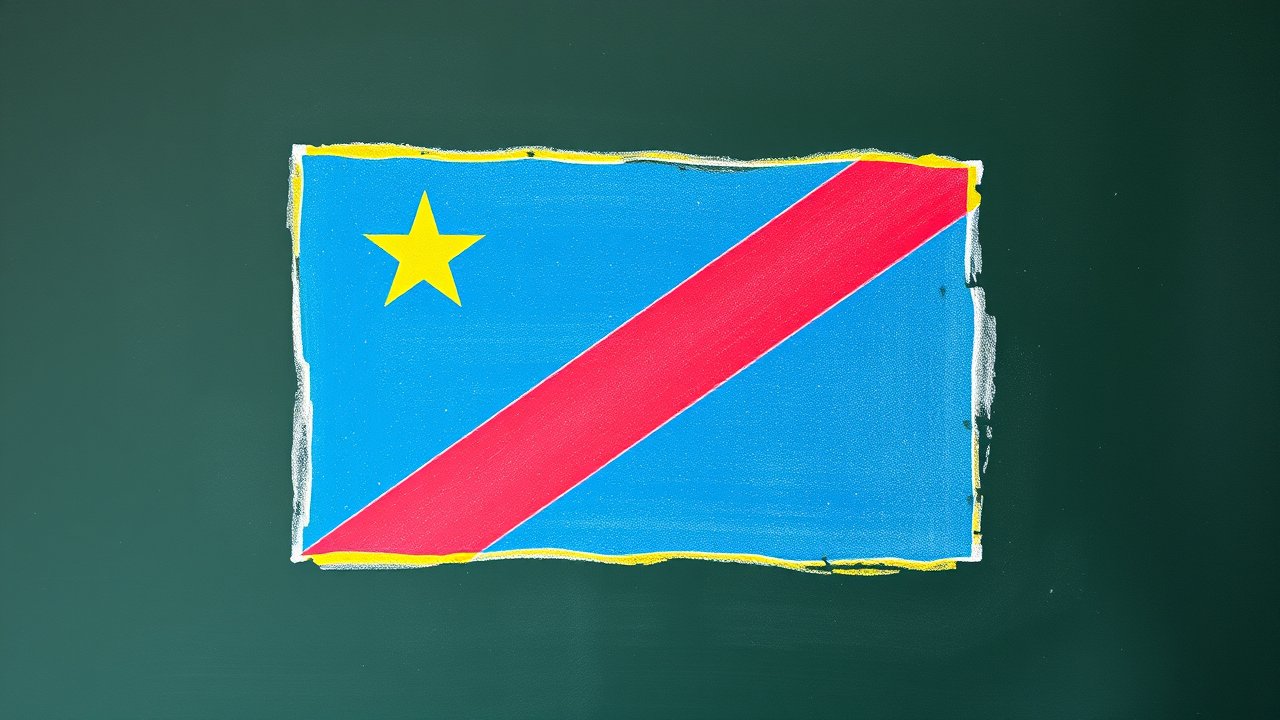
Chalk on Blackboard — Sky blue field with a diagonal red stripe bordered in yellow and a yellow star in the upper left. The flag of Congo (Democratic Republic) drawn in chalk on a real blackboard. Sky blue field with a diagonal red stripe bordered in yellow and a yellow star in the upper left. Authentic blackboard — dark slate green surface with chalk dust and smudge marks. Soft, dusty white and colored chalk lines, imperfect edges, hand-drawn quality. Chalk dust particles visible in the air. The flag is immediately recognizable. No text, no letters, no words, no writing of any kind.
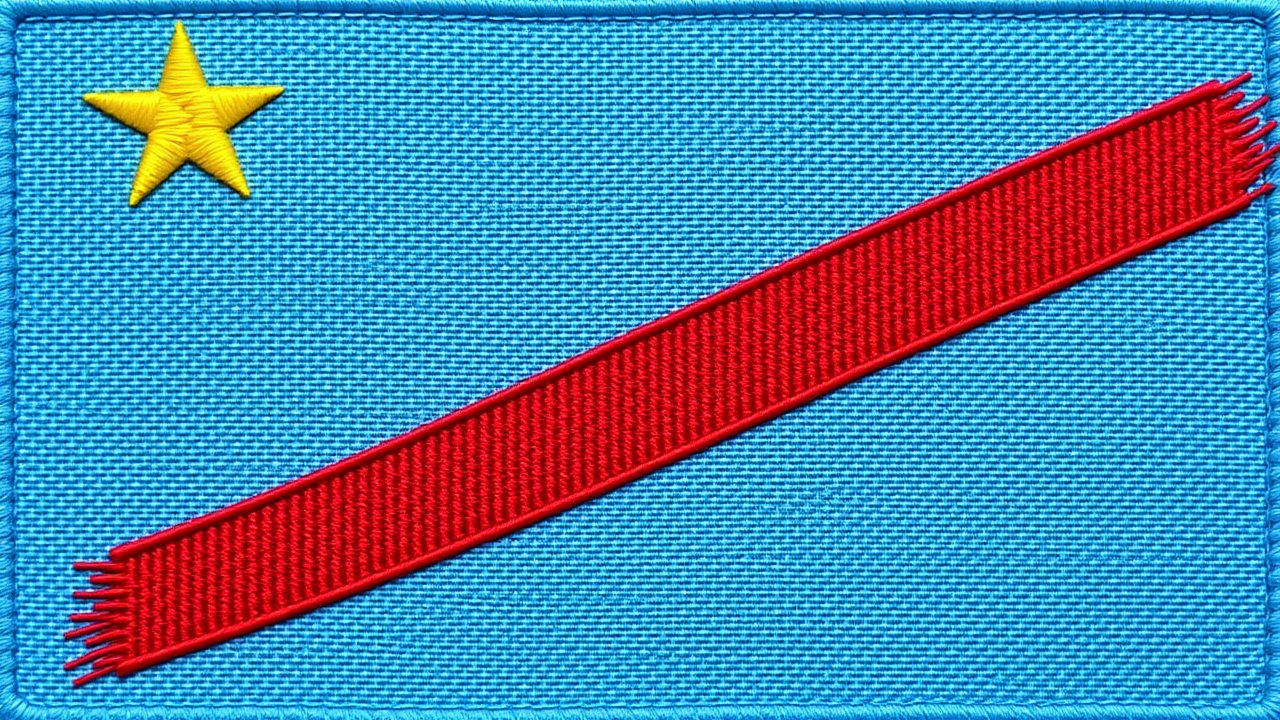
Embroidered Textile — Sky blue field with a diagonal red stripe bordered in yellow and a yellow star in the upper left. The flag of Congo (Democratic Republic) as intricate embroidery on linen fabric. Sky blue field with a diagonal red stripe bordered in yellow and a yellow star in the upper left. Dense satin stitches, French knots, chain stitch detail. The flag design is completely faithful — exact colors, geometry, and all symbols faithfully stitched, immediately recognizable as the Congo (Democratic Republic) flag. Visible thread texture, dimensional quality, warm handcrafted feel. No text, no letters, no words, no writing of any kind.

Flagpole in Capital — Sky blue field with a diagonal red stripe bordered in yellow and a yellow star in the upper left. Photorealistic photograph of the Congo (Democratic Republic) flag flying on a tall flagpole in front of an iconic government building in the capital city. Sky blue field with a diagonal red stripe bordered in yellow and a yellow star in the upper left. The flag ripples naturally in the wind, colors vivid and exact. Documentary photography style, sharp and realistic. Grand architecture in the background. Blue sky, dramatic clouds. No text, no letters, no words, no writing of any kind.

Golden Hour Reflection — Sky blue field with a diagonal red stripe bordered in yellow and a yellow star in the upper left. Photorealistic photograph of the Congo (Democratic Republic) flag reflected in still water at golden hour. Sky blue field with a diagonal red stripe bordered in yellow and a yellow star in the upper left. The flag flies on a pole at the water’s edge, its reflection shimmering on the surface below. Warm amber and orange sunset light. The flag colors and design are faithful and vivid. Serene, cinematic landscape photography. No text, no letters, no words, no writing of any kind.
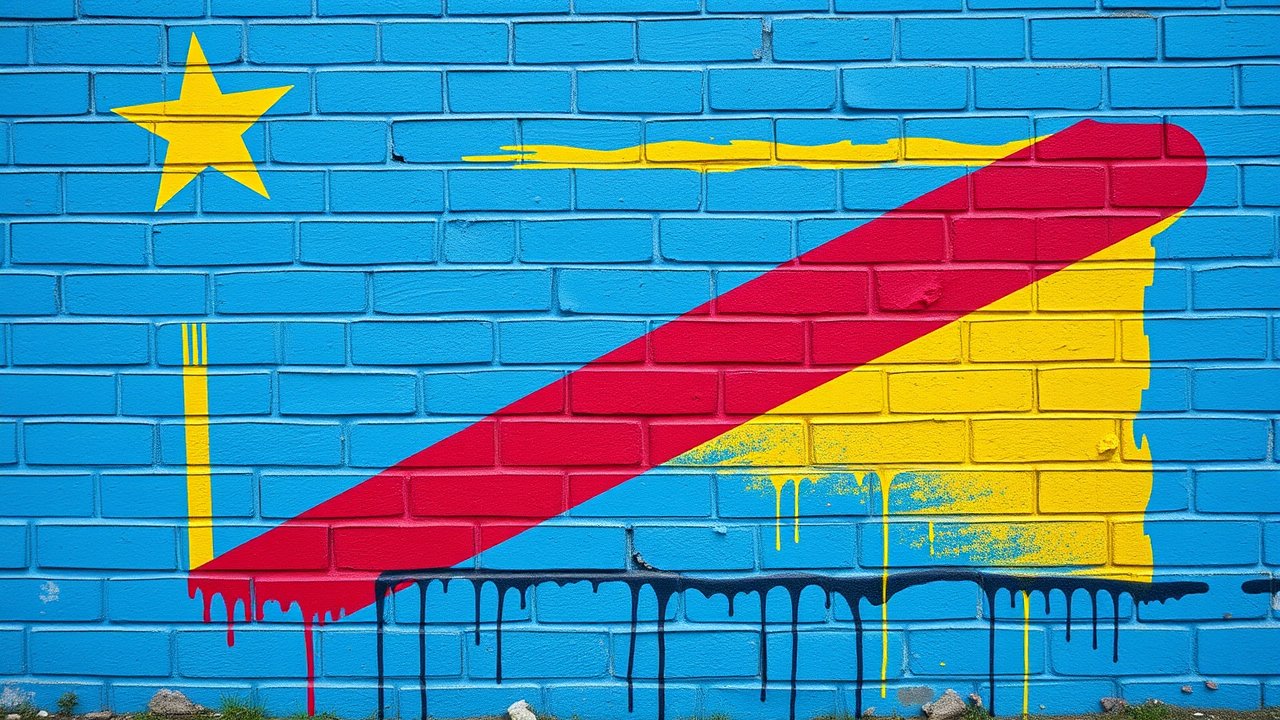
Street Art / Graffiti — Sky blue field with a diagonal red stripe bordered in yellow and a yellow star in the upper left. The flag of Congo (Democratic Republic) as vibrant street art spray-painted on a brick wall. Sky blue field with a diagonal red stripe bordered in yellow and a yellow star in the upper left. Bold spray paint, dripping edges, stencil layers, overspray halos. The flag design is faithful and immediately recognizable — exact colors and symbols, just rendered in spray paint on urban concrete. No text, no letters, no words, no writing of any kind. No tags, no graffiti lettering.
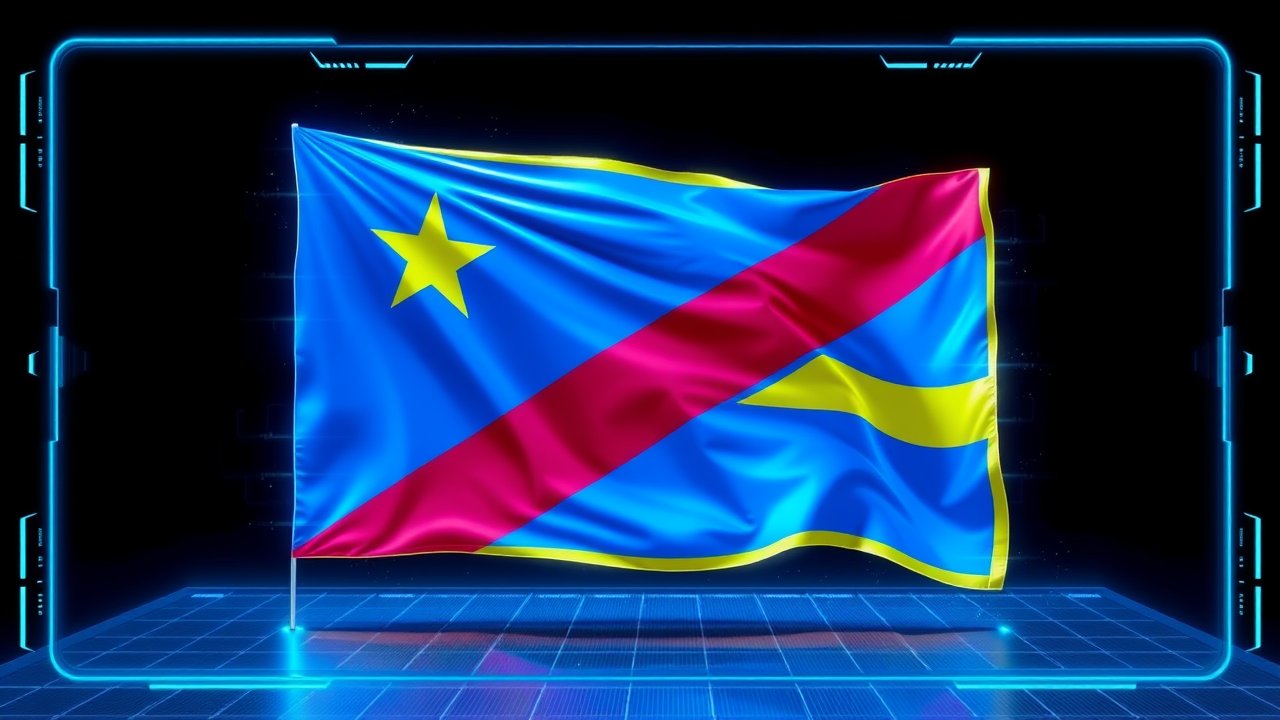
Sci-Fi Hologram — Sky blue field with a diagonal red stripe bordered in yellow and a yellow star in the upper left. The flag of Congo (Democratic Republic) projected as a futuristic holographic display. Sky blue field with a diagonal red stripe bordered in yellow and a yellow star in the upper left. Translucent blue-white projection with scan lines, floating in dark space. Glitching edges, particle effects, data streams. The flag design is completely faithful and recognizable. Cyberpunk HUD elements framing the projection. No text, no letters, no words, no writing of any kind.
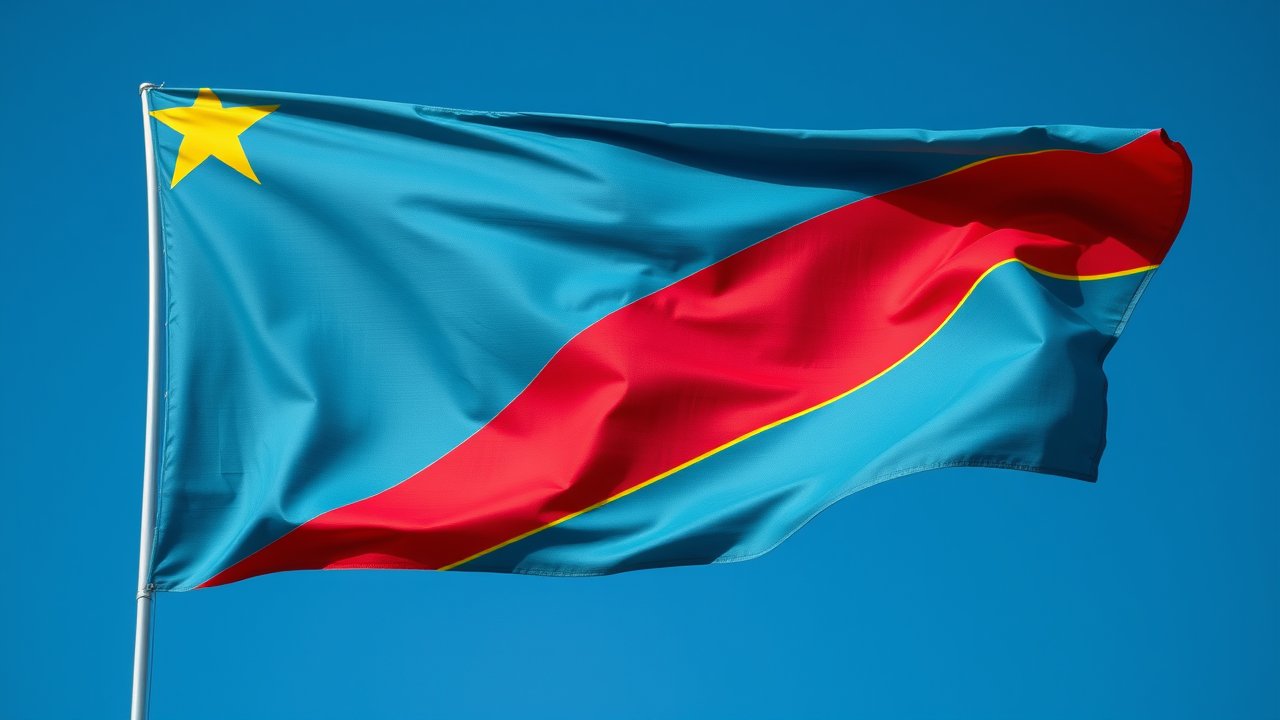
Hyperrealistic Wind — Sky blue field with a diagonal red stripe bordered in yellow and a yellow star in the upper left. Ultra-hyperrealistic photograph of the Congo (Democratic Republic) flag caught in a dramatic gust of wind. Sky blue field with a diagonal red stripe bordered in yellow and a yellow star in the upper left. Macro-level fabric detail — individual threads visible, fabric folds and tension lines crisp. Colors and design completely faithful to the real Congo (Democratic Republic) flag. High-speed shutter, razor-sharp focus, studio lighting. No text, no letters, no words, no writing of any kind.
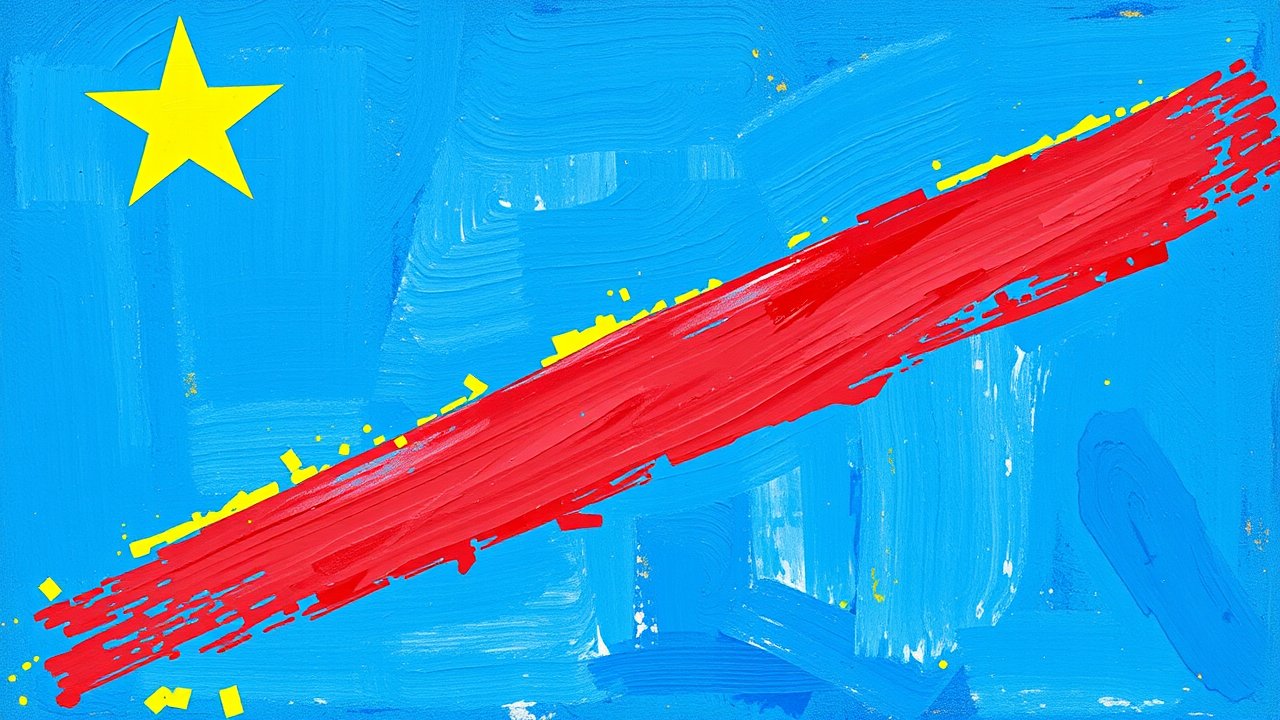
Impressionist Oil — Sky blue field with a diagonal red stripe bordered in yellow and a yellow star in the upper left. The flag of Congo (Democratic Republic) painted in French Impressionist oil on canvas. Sky blue field with a diagonal red stripe bordered in yellow and a yellow star in the upper left. Thick impasto brushstrokes, dappled light, vibrant broken color technique in the style of Monet. The flag is instantly recognizable — colors and design faithful to the real Congo (Democratic Republic) flag, interpreted with impressionist light and texture. No text, no letters, no words, no writing of any kind.

Lego Bricks — Sky blue field with a diagonal red stripe bordered in yellow and a yellow star in the upper left. The flag of Congo (Democratic Republic) built from Lego bricks, photographed as a real physical construction. Sky blue field with a diagonal red stripe bordered in yellow and a yellow star in the upper left. Visible studs and brick seams, slight plastic sheen. Standard Lego colors approximate the flag’s palette. Built on a gray Lego baseplate. Dramatic angle showing the three-dimensional brick texture. No text, no letters, no words, no writing of any kind.

Low-Poly Geometric — Sky blue field with a diagonal red stripe bordered in yellow and a yellow star in the upper left. The flag of Congo (Democratic Republic) constructed from low-polygon geometric triangles. Sky blue field with a diagonal red stripe bordered in yellow and a yellow star in the upper left. Aggressively faceted — each region broken into many visible triangular faces with subtle color variation across each polygon, creating real depth and dimensionality even in flat-color areas of the flag. Crystal-like, contemporary computational design. The flag is completely faithful and immediately recognizable. No text, no letters, no words, no writing of any kind.
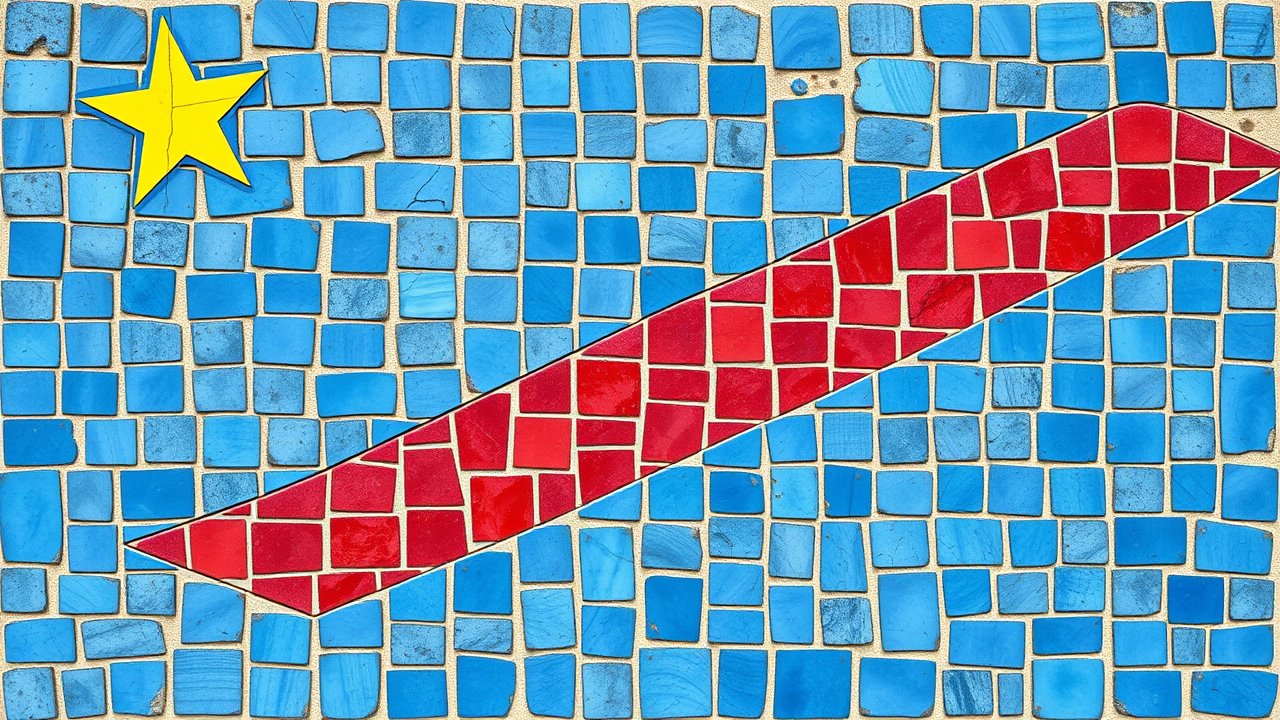
Mosaic Tiles — Sky blue field with a diagonal red stripe bordered in yellow and a yellow star in the upper left. The flag of Congo (Democratic Republic) assembled as a Roman-style mosaic. Sky blue field with a diagonal red stripe bordered in yellow and a yellow star in the upper left. The flag is completely faithful to the real Congo (Democratic Republic) flag — exact proportions, colors, and all symbols, rendered in thousands of small stone and glass tesserae. Visible grout lines, rich earthy tones mixed with brilliant glass, slight historical weathering. No text, no letters, no words, no writing of any kind.
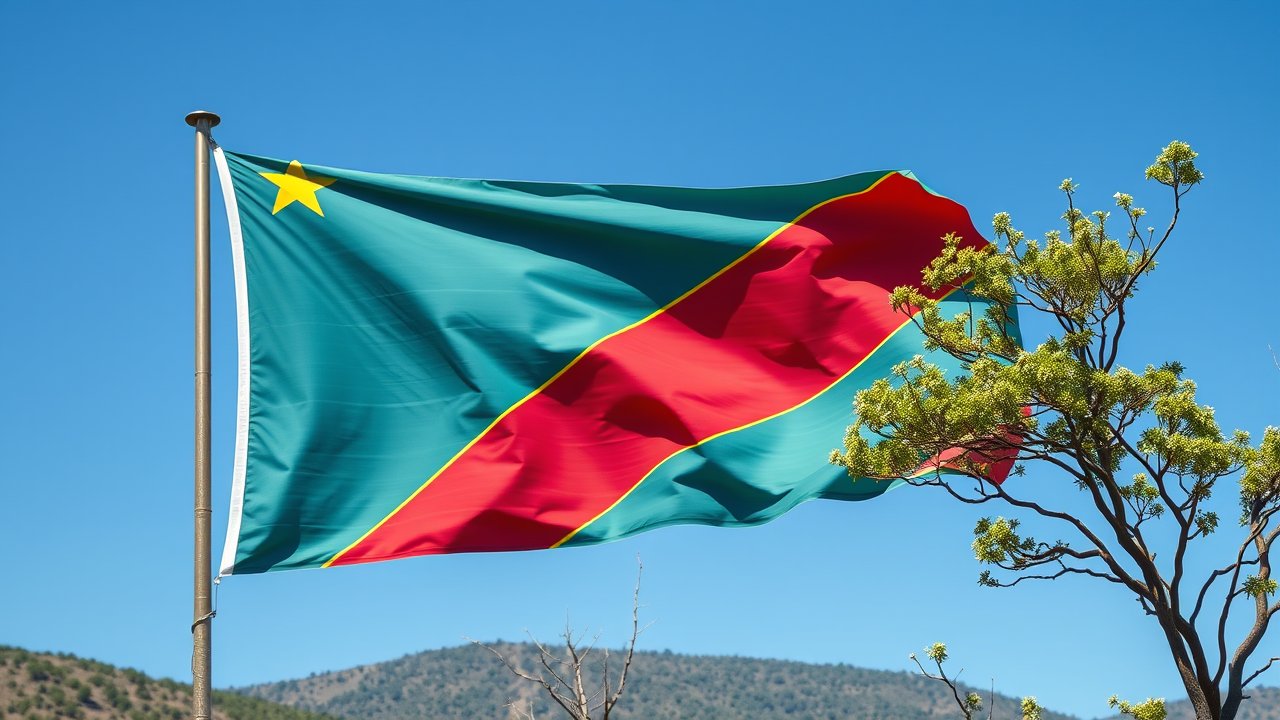
Native Landscape — Sky blue field with a diagonal red stripe bordered in yellow and a yellow star in the upper left. Photorealistic photograph of the Congo (Democratic Republic) flag flying in an iconic natural landscape native to Congo (Democratic Republic) — the terrain, flora, and environment characteristic of that country. Sky blue field with a diagonal red stripe bordered in yellow and a yellow star in the upper left. The flag is prominent and its colors are faithful and vivid. Remote, uninhabited wilderness. National Geographic photography style. No text, no letters, no words, no writing of any kind.
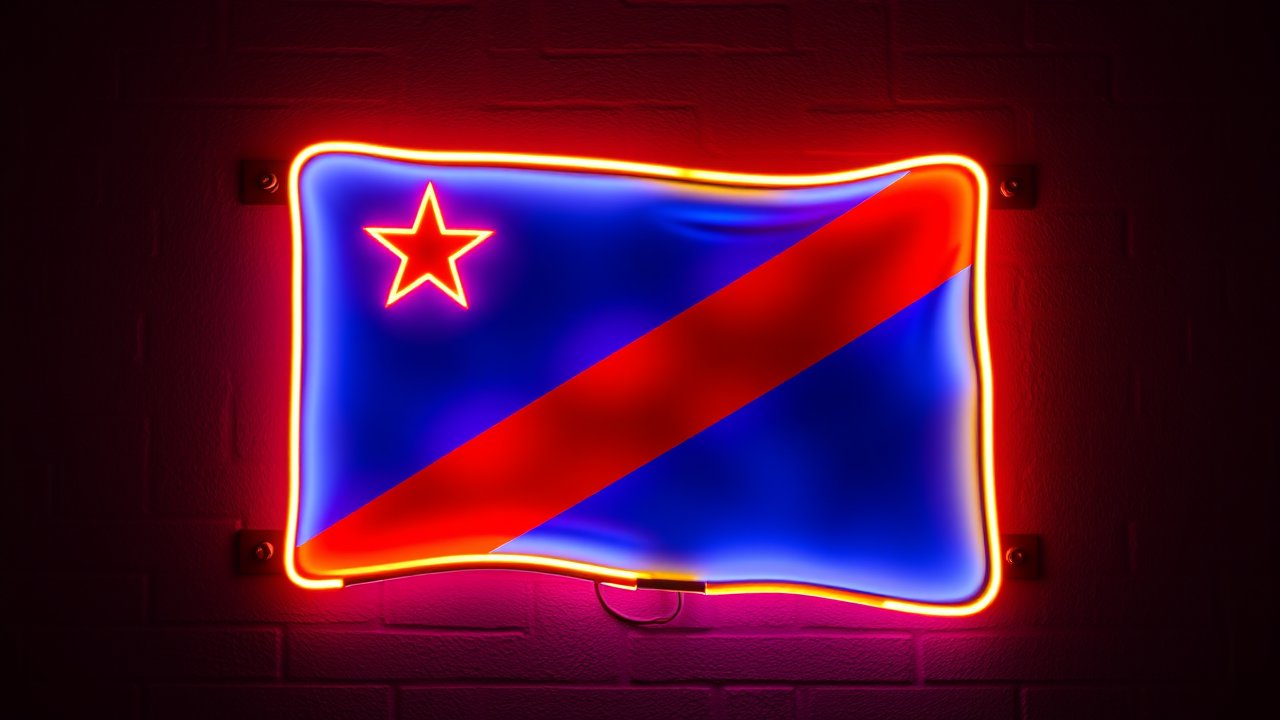
Neon Sign — Sky blue field with a diagonal red stripe bordered in yellow and a yellow star in the upper left. The flag of Congo (Democratic Republic) recreated as a real neon sign mounted on a dark wall. Sky blue field with a diagonal red stripe bordered in yellow and a yellow star in the upper left. Glowing glass neon tubes bent into the flag’s shapes — the colors of the flag rendered in actual neon light. Visible glass tube bends, metal mounting brackets on the wall. Warm neon glow and light bloom. Real neon, not digital. Photographed in a dark room. No text, no letters, no words, no writing of any kind.
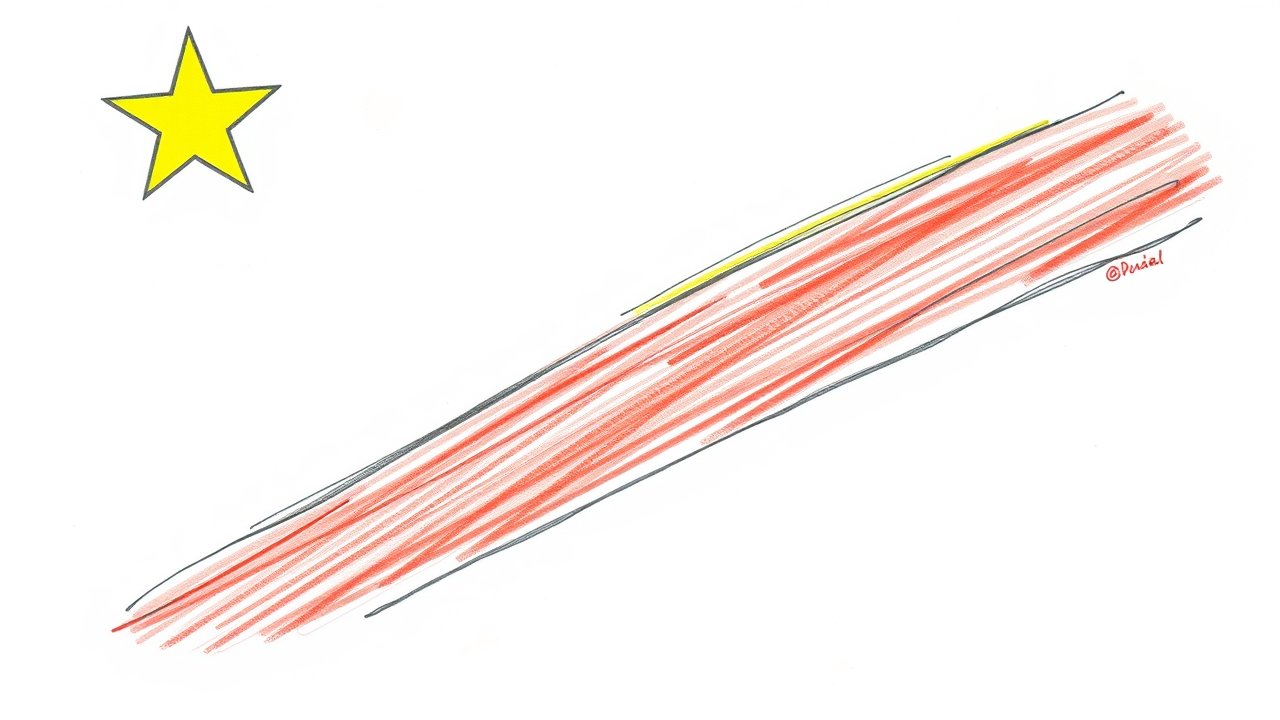
Pencil Sketch — Sky blue field with a diagonal red stripe bordered in yellow and a yellow star in the upper left. The flag of Congo (Democratic Republic) as a bold, confident pencil sketch. Sky blue field with a diagonal red stripe bordered in yellow and a yellow star in the upper left. Strong graphite lines on cream paper — not delicate but bold and decisive. Heavy pressure on key outlines, dramatic cross-hatching for deep shadows and shading. Immediately recognizable as the Congo (Democratic Republic) flag. Artist’s confident hand, not tentative. No text, no letters, no words, no writing of any kind.

Pixel Art — Sky blue field with a diagonal red stripe bordered in yellow and a yellow star in the upper left. The flag of Congo (Democratic Republic) as detailed 16-bit pixel art. Sky blue field with a diagonal red stripe bordered in yellow and a yellow star in the upper left. Crisp pixel grid, limited palette with careful dithering, nostalgic retro game aesthetic. Clean grid-aligned design with subtle shading. Every element of the flag faithfully reproduced in pixels. No text, no letters, no words, no writing of any kind.

Stained Glass — Sky blue field with a diagonal red stripe bordered in yellow and a yellow star in the upper left. The flag of Congo (Democratic Republic) rendered as an ornate stained glass window. Sky blue field with a diagonal red stripe bordered in yellow and a yellow star in the upper left. The design is completely faithful to the real Congo (Democratic Republic) flag — exact colors, geometry, and all symbols preserved. Brilliant jewel-toned glass pieces separated by dark lead came lines. Warm sunlight streaming through, casting colored light. Gothic cathedral craftsmanship. No text, no letters, no words, no writing of any kind.
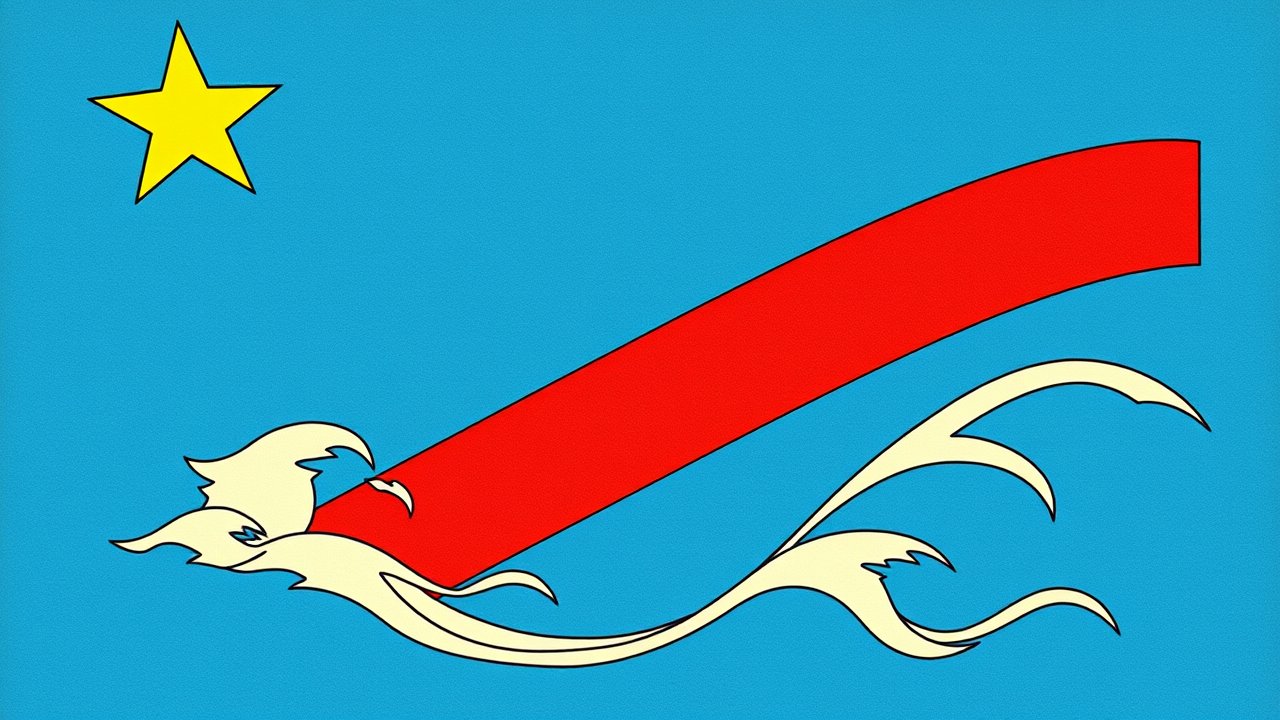
Ukiyo-e Woodblock — Sky blue field with a diagonal red stripe bordered in yellow and a yellow star in the upper left. The flag of Congo (Democratic Republic) as a traditional Japanese ukiyo-e woodblock print. Sky blue field with a diagonal red stripe bordered in yellow and a yellow star in the upper left. Bold outlines, flat areas of rich color, flowing organic forms. Wind and waves incorporated into the composition. Printed on washi paper with visible wood grain texture. The flag is the central focus and instantly recognizable. No text, no letters, no words, no writing of any kind.
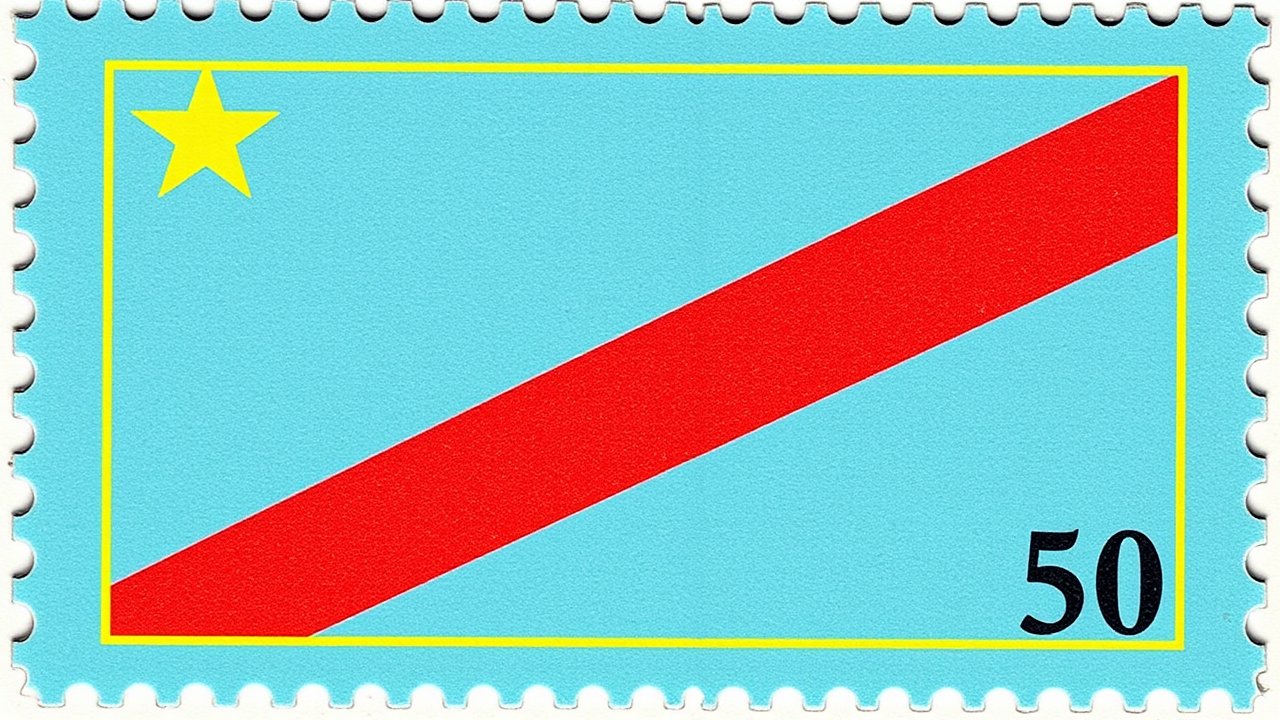
Vintage Postage Stamp — Sky blue field with a diagonal red stripe bordered in yellow and a yellow star in the upper left. The flag of Congo (Democratic Republic) as a vintage 1950s postage stamp. Sky blue field with a diagonal red stripe bordered in yellow and a yellow star in the upper left. The flag fills most of the stamp — it is the primary subject, faithfully rendered in fine engraved intaglio style. Perforated edges, aged paper with slight foxing. The stamp may show a denomination numeral only — absolutely no other text or country names.
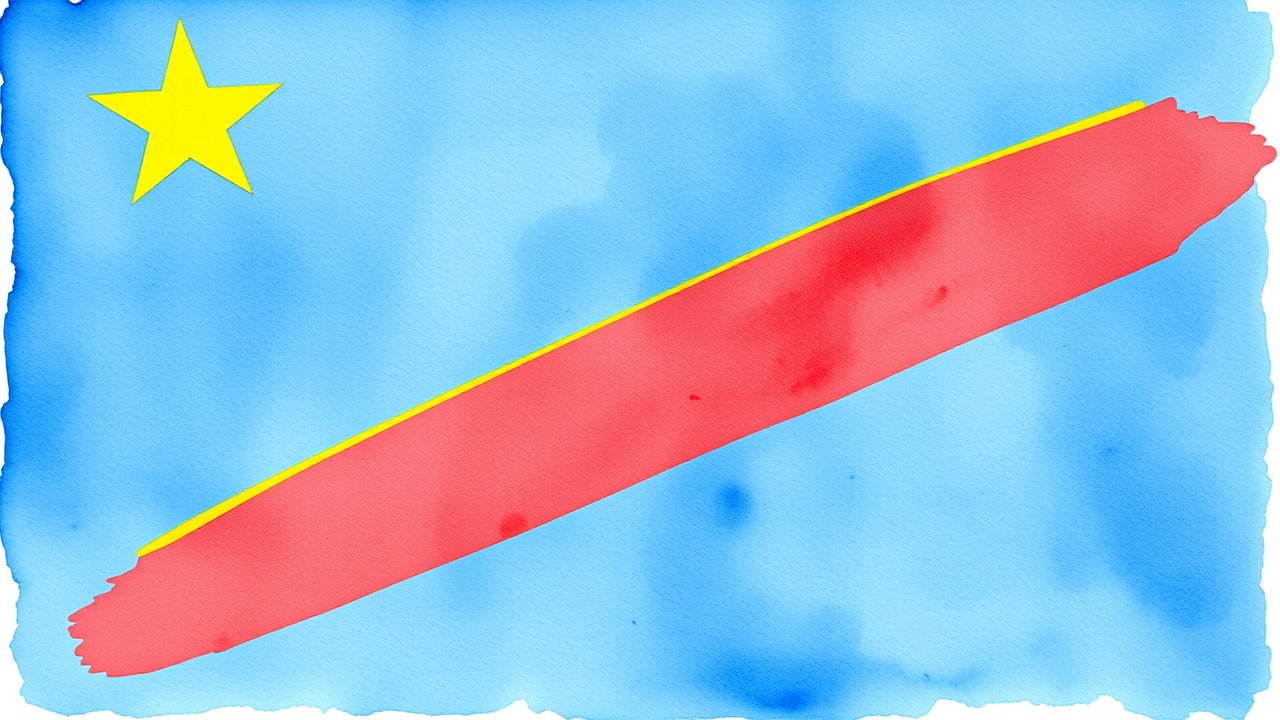
Watercolor — Sky blue field with a diagonal red stripe bordered in yellow and a yellow star in the upper left. The flag of Congo (Democratic Republic) painted in loose, expressive watercolor. Sky blue field with a diagonal red stripe bordered in yellow and a yellow star in the upper left. Wet-on-wet technique with soft color bleeds, visible brushstrokes, natural paper texture. Delicate splashes and drips at the edges. Luminous, translucent layers of pigment. No text, no letters, no words, no writing of any kind.
The flag of the Democratic Republic of the Congo is a testament to the nation’s complex political history, reflecting periods of colonialism, independence, authoritarian rule, and democratic restoration. The current design, adopted on February 18, 2006, features a sky blue field with a single yellow star positioned in the upper left canton, complemented by a bold red diagonal stripe bordered with yellow fimbriation running from the lower hoist to the upper fly. This striking composition represents peace (blue), blood of martyrs (red), national wealth (yellow), and the nation’s future (the star), each element carrying profound symbolic weight rooted in the country’s tumultuous past.
The origins of the Congo’s flag design trace back to 1877 and the colonial era under King Leopold II of Belgium. Following the Brussels Geographic Conference in 1876, Leopold II established the Association Internationale du Congo to expand European interests in Central Africa under the guise of humanitarian development. The resulting flag—a blue field adorned with a single gold star—symbolized a “shining light in the Dark Continent,” drawing inspiration from the historical kingdom of Congo in Angola. This design represented Leopold II’s vision as the Congo Free State, which became his personal possession at the Berlin Conference in 1885. The blue and gold combination persisted through the colonial period until Belgian formal annexation in 1908, representing centuries of external control over the Congolese people. The colonial era witnessed profound brutality, including forced labor for rubber, palm oil, and ivory extraction, accompanied by systematic violence against those who failed to meet quotas—a dark chapter that would later inform the symbolism of the independence flag.
When the Belgian Congo gained independence on June 30, 1960, the nation reimagined its flag as a statement of liberation and self-determination. The new design retained the blue background but replaced the solitary gold star with six yellow stars arranged along the hoist side, representing the nation’s original six provinces. This transformation marked a symbolic break from colonial rule and reasserted Congolese identity and sovereignty. The flag of independent Congo became a powerful emblem of Pan-African pride during an era when numerous African nations were shaking off colonial bonds. However, this period of democratic expression proved brief and fragile, setting the stage for the radical changes that would follow.
The first major alteration to the independence flag occurred between 1963 and 1966, when the design evolved to include the iconic diagonal red stripe with yellow borders that would define Congolese nationalism for decades. This modified design, officially adopted in 1966, reduced the six provincial stars to a single yellow star in the upper left corner and introduced the diagonal stripe running from lower hoist to upper fly. The revised symbolism explicitly acknowledged the sacrifices made during the independence struggle: the red stripe represented “the blood of the country’s martyrs,” the yellow represented national wealth and resources, the blue symbolized hope for peace and progress, and the solitary star embodied national unity and the nation’s bright future. This flag design would remain in use until 1971, becoming deeply associated with the early post-independence period under Prime Minister Patrice Lumumba and President Joseph Kasavubu, as well as the subsequent military government of Lieutenant General Joseph-Désiré Mobutu.
A dramatic transformation occurred on October 27, 1971, when President Mobutu Sese Seko, following his 1965 military coup, renamed the country the Republic of Zaire and introduced an entirely new national flag. Breaking completely with the Congo’s colonial and early independence heritage, Mobutu’s flag featured a light green field bearing a distinctive yellow circle containing a silhouetted arm and torch. This design represented Mobutu’s vision of a unified African nation and symbolized the spirit of revolutionary change and enlightenment. The green and gold color scheme was intended to reflect African identity and the nation’s natural wealth. However, this 26-year period under the Zaire flag coincided with one of Africa’s most notoriously corrupt and oppressive regimes, marked by widespread human rights abuses, economic mismanagement, and the systematic theft of national resources. The flag that symbolized Mobutu’s vision of progress instead became associated with decades of despotism and decline.
The restoration of the Congo’s original independence flag on May 17, 1997, marked a pivotal moment in the nation’s history. When Laurent-Désiré Kabila led a revolutionary coalition that overthrew Mobutu’s regime, his first act was to restore the flag that had symbolized genuine independence and national pride. Kabila, an admirer of Congo’s first Prime Minister Patrice Lumumba, understood the profound symbolic power of this choice. The return of the blue field with the red diagonal stripe and yellow star represented not merely aesthetic preference but a deliberate rejection of Mobutu’s autocratic legacy and a pledge to reconnect with the nation’s original democratic aspirations. Though the restored 1960 flag no longer accurately reflected Congo’s administrative structure—the country now had eight provinces rather than the six represented by the original stars—the symbolic resonance of returning to authentic Congolese identity transcended administrative precision. For many Congolese citizens, the flag’s restoration represented hope for genuine democratic reform and a return to principles of national sovereignty.
The most recent significant change to the Democratic Republic of Congo’s flag occurred in February 2006, following the ratification of a new constitution in December 2005. Rather than introducing an entirely new design, this transition refined the restored flag by modifying the background color from royal blue to sky blue and establishing more precise technical specifications for the design. The yellow star was positioned in a calculated circle 65 centimeters in diameter, with the diagonal red stripe standardized at 16 centimeters wide and bordered with 5-centimeter yellow fimbriation on all sides. This 2006 design represents a deliberate architectural echo of the flag used between 1966 and 1971, drawing a direct line from the nation’s early post-independence period through to the present day. The choice to emphasize continuity with the immediate post-colonial era, rather than the colonial period or the Mobutu regime, reflects the DRC’s ongoing effort to construct a national identity rooted in independence, sovereignty, and democratic aspiration. Today’s flag stands as a visual chronicle of the Congolese journey—from colonial subjugation through liberation, authoritarian consolidation, and the difficult but persistent struggle toward genuine democratic governance and national self-determination.
Free Printable: Flags of the World Reference Card
Get a beautiful printable poster with 50 flag emojis, Unicode codes, and fun facts. Perfect for classrooms and desks!
No spam, ever. Unsubscribe anytime.