How To
How To
Time needed: 1 minute
Want the full printable classroom pack?
Take the flag reference from your screen to an offline pack for lessons, practice, and quiz time.
- Printable atlas with 230+ high-resolution flag flats
- Four regional quizzes with answer keys
- Flag Bingo boards and caller sheet
How to copy and paste the Flag of Morocco Emoji to any device.
- Copy the Moroccan Flag Emoji
Go to flagemoji.com and press the copy button (above). This works on any device.
- Paste the Emoji
Go to your email/iMessage/SMS texting service/document and paste the emoji.
For mobile devices
— double-tap or tap-hold, then paste should appear. Tap it.
For desktop and laptops on Apple devices
— command-P / ⌘-P
For desktop and laptops on Windows devices
— control-p
Codes
Emoji Codes
Flag emojis are unicode symbols, like any other letter or number on your keyboard. This means you can copy and paste the emoji itself into your code, whatever the language (click the button above).
They actually count as two characters: the two-letter country code (the ISO international standard). The unicode and shortcode both represent country data which devices can interpret and display the emoji.
| Country Code | Unicode | Shortcode |
| MA | U+1F1F2 U+1F1E6 | :flag_MA: :MA: |
Emoji shortcodes are used on some platforms as a way for users to type in emojis from the keyboard. If you type the emoji shortcode on Github or Slack, the emoji will appear.
*The official name of the emoji is only the country name, not ‘Morocco Flag’, for example.
Description
Description
The flag of Morocco is composed of three horizontal bands of blue (top), red (triple width), and blue. The red band is edged in white. On the hoist side of the red band is a white disk with a red five-pointed star. The broad red band symbolizes revolutionary traditions. The narrow white bands stand for purity, strength, and dignity. The blue bands signify sovereignty, peace, and friendship. The red star represents socialism.
Map
Map
Check out the map of New Zealand!
Weather
Anthem
National Anthem
| Title | Hymne Cherifien (Hymn of the Sharif) |
| Composer | Ali Squalli Houssaini / Leo Morgan |
FAQ
FAQs
Morocco officially gained independence on March 2, 1956.
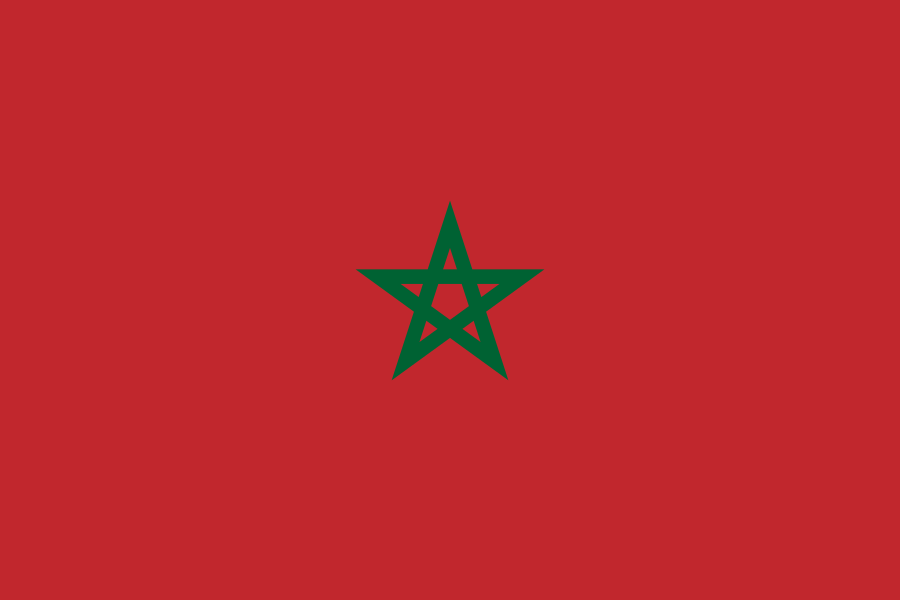
The Morocco’s flag deep red color is symbolic of the descendents of the prophet Muhammad, and the Seal of Solomon green star is centered.
The flag of Morocco was officially adopted on November 17, 1915.
Morocco is governed by a parliamentary constitutional monarchy.
Discover more fun facts of Samoa.
Printable
Printable Moroccan Flag
Print another really cool flag. Why not the flag of Czech Republic?
The flag of Morocco stands as a powerful symbol of the nation’s rich Islamic heritage, historical sovereignty, and complex political evolution through colonial and post-colonial periods. The current design—a bright red field with a green five-pointed star positioned at its center—represents a synthesis of ancient Islamic traditions, Berber cultural identity, and the enduring legacy of the Alawid dynasty that has ruled Morocco since 1666. Understanding Morocco’s flag requires examining both its visual symbolism and its fascinating historical journey from pre-colonial times through modern independence.
Before the formal adoption of the modern flag design, the Alawid dynasty, which claimed descent from the Prophet Muhammad through Fatima and Ali, ruled Morocco under a distinctive solid red flag. This crimson banner served as the dynasty’s emblem for nearly 250 years, beginning with the dynasty’s establishment in 1666. The choice of red was deliberate and symbolically loaded: it referenced the Sharifs of Mecca and reinforced the dynasty’s claimed connection to Islamic tradition and prophetic lineage. During this era, Morocco’s maritime vessels flew variations of these red flags as they navigated Mediterranean and Atlantic trade routes, establishing a visual identity recognized across the region’s commercial and diplomatic circles.
The modern design of Morocco’s flag emerged through an unexpected historical circumstance: French colonial intervention. On November 17, 1915, during the period when Morocco existed under French and Spanish protectorates, Sultan Yusef formalized the current flag design through an official dahir (decree). The French administration modified Morocco’s traditional plain red maritime flag by adding a green pentagram—an ancient five-pointed star symbol—to its center. Though introduced under colonial pressure, this modification proved enduring, ultimately becoming the definitive symbol of Moroccan national identity and independence after the country regained sovereignty. The precise geometry was later formalized: the flag features a 2:3 width-to-length ratio, with the green star prominently centered and inscribed within geometric proportions that were officially specified under King Mohammed VI in 2005.
The symbolism embedded in Morocco’s flag reflects layers of cultural and religious meaning that resonate deeply within Islamic, Berber, and historical Mediterranean contexts. The red background carries multiple significance: it represents the Alawid dynasty’s centuries of rule and the dynasty’s asserted connection to Islamic prophetic tradition; it symbolizes the blood of Morocco’s ancestors and the nation’s unity; and it evokes the deep historical association between Morocco and the Islamic world that extends back to the seventh century. The red field thus functions as a visual genealogy, anchoring contemporary Morocco to its dynastic past while honoring the sacrifices of those who fought for national autonomy and dignity.
The green five-pointed star holds equally profound symbolic weight, operating simultaneously at Islamic, esoteric, and Berber cultural levels. Known as the Seal of Solomon—or the Pentacle of Solomon—this ancient symbol has roots stretching across multiple cultures and religious traditions, predating its popularization in Western contexts. In Moroccan Islamic tradition, the five points of the star represent the five pillars of Islam: the Shahada (profession of faith), Salat (ritual prayer), Zakat (charitable alms), Sawm (fasting during Ramadan), and Hajj (pilgrimage to Mecca). Beyond its Islamic resonance, the pentagram carries Berber cultural significance within Morocco’s composite identity, functioning as a protective emblem and a symbol of power, good fortune, and spiritual authority. The selection of green—a color deeply associated with Islam throughout the Middle East and North Africa—reinforces the star’s religious significance while emphasizing Morocco’s place within the broader Islamic world.
Morocco’s flag experienced significant restrictions during the colonial period that nevertheless shaped its eventual international prominence. From 1915 until Morocco’s independence in 1956, the flag’s use was carefully circumscribed by colonial authorities: it was permitted for inland display within Morocco but prohibited from use on maritime vessels, a deliberate policy designed to assert colonial dominance over Moroccan sovereignty. This restriction lasted approximately four decades, creating a pointed historical irony: the flag modified by colonial decree became forbidden from the very maritime sphere where it had traditionally flown. The prohibition itself became a rallying symbol for Moroccan nationalist sentiment, as independence movements invested the flag with additional symbolic weight as an emblem of deferred sovereignty and national aspirations.
The path to unrestricted use of Morocco’s flag culminated with the nation’s independence in 1956, a watershed moment in North African history. Upon regaining sovereignty, Morocco immediately authorized its flag for both national and maritime use, fully realizing the design’s original purpose across all contexts of national representation. The flag thus transitioned from a symbol of constrained nationality under colonialism to an unrestricted emblem of independent statehood, its green star and red field now permitted to wave from government buildings, military installations, maritime vessels, and public spaces throughout the nation. This transformation was particularly symbolically significant: the very flag that colonial authorities had restricted to landlocked use now became the maritime banner of a restored nation-state.
Recent decades have witnessed official refinement and celebration of Morocco’s flag design and historical significance. In 2005, King Mohammed VI issued formal constitutional specifications governing the flag’s precise dimensions, colors, and proportions. These specifications established that the flag must feature bright red (following precise color standards) paired with palm green, maintaining the traditional 2:3 ratio while providing exact geometric parameters for the star’s size, positioning, and inscribed circle. This modernization reflected contemporary international standards for flag specifications while honoring the design’s historical integrity. The specifications represent governmental recognition that the flag, while ancient in its symbolic roots, requires contemporary formal definition to ensure consistency in all contexts of national representation.
Morocco’s flag achieved a notable contemporary distinction in 2010, when a massive flag measuring 60,409.78 square meters was displayed in Dakhla, earning certification from Guinness World Records as the largest flag ever draped. This record-setting achievement underscored Morocco’s pride in its national symbol and demonstrated the flag’s enduring capacity to mobilize collective identity and national sentiment. The flag’s scale transformed it into a geographical landmark visible from considerable distances, visibly asserting Moroccan sovereignty and cultural pride across the Western Saharan landscape.
The flag of Morocco thus represents far more than a geometric combination of colors and shapes: it embodies centuries of Islamic tradition, dynastic continuity, anti-colonial resistance, Berber cultural identity, and post-independence sovereignty. From its origins as a solid red banner under the Alawid dynasty through its modification during French colonialism to its triumphant unrestricted use following independence, Morocco’s flag has accumulated historical meaning with each era. The green five-pointed star, representing both Islam’s five pillars and ancient esoteric tradition, converges with the red field to create a symbol that simultaneously honors Morocco’s past, asserts its present independence, and projects its cultural influence into the contemporary world. Few national flags carry such dense layers of historical significance and cultural resonance, making Morocco’s banner a particularly rich subject of vexillological study and national pride.
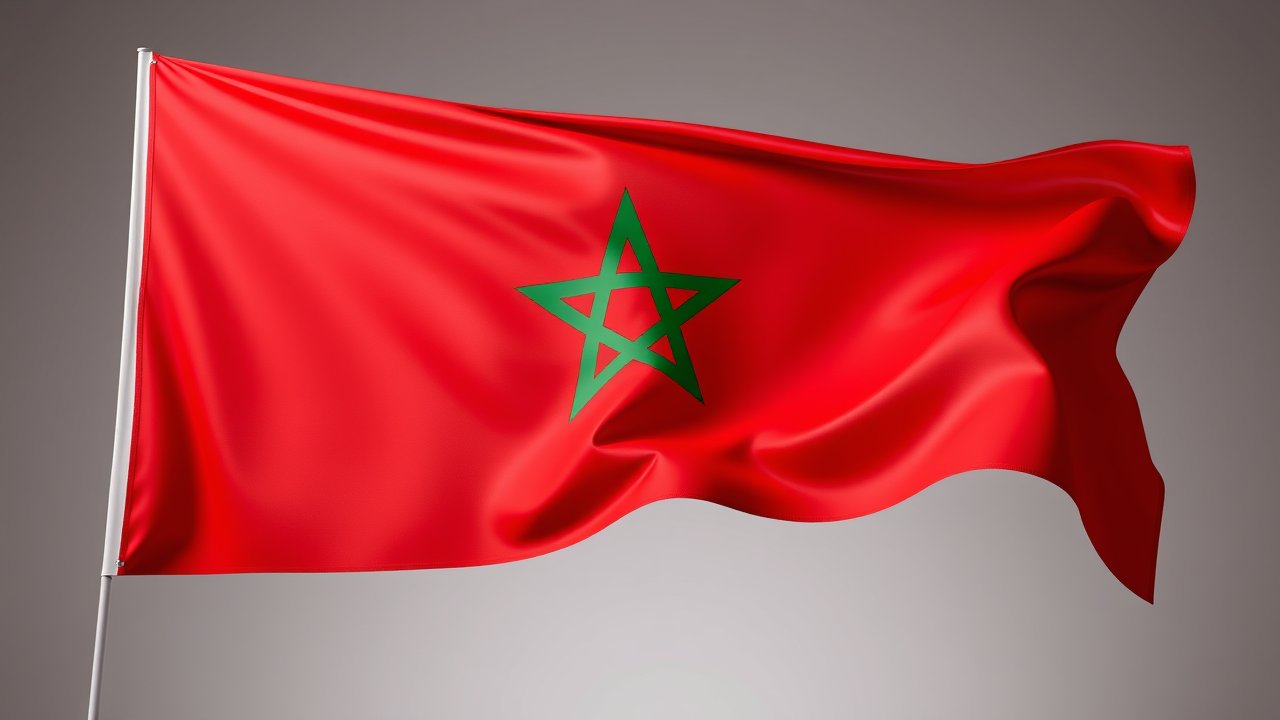
3D Glossy Render — Red field with a green five-pointed star (pentacle) centered. The flag of Morocco as a photorealistic 3D render. Red field with a green five-pointed star (pentacle) centered. The flag fabric hangs or drapes naturally but preserves exact proportions, colors, and all symbols perfectly — completely faithful to the real Morocco flag. Dramatic studio lighting, glossy silk material, soft shadows, subsurface scattering, perfect specular highlights. No text, no letters, no words, no writing of any kind.
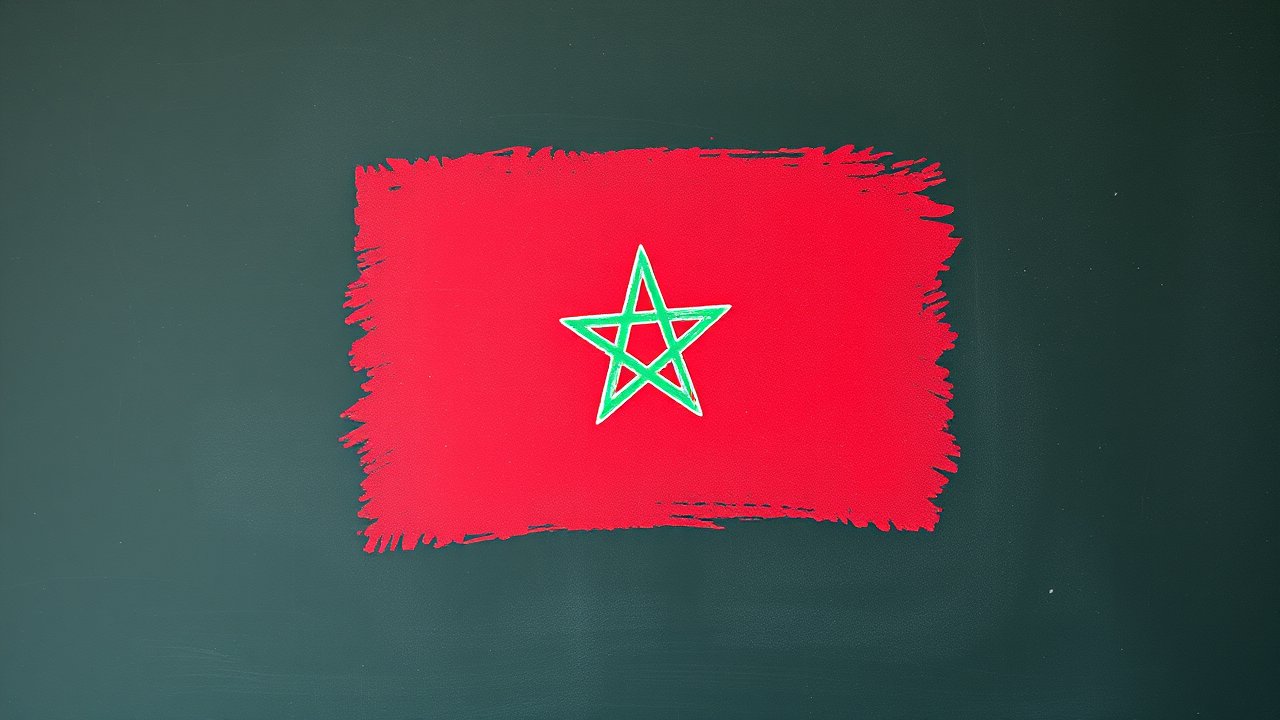
Chalk on Blackboard — Red field with a green five-pointed star (pentacle) centered. The flag of Morocco drawn in chalk on a real blackboard. Red field with a green five-pointed star (pentacle) centered. Authentic blackboard — dark slate green surface with chalk dust and smudge marks. Soft, dusty white and colored chalk lines, imperfect edges, hand-drawn quality. Chalk dust particles visible in the air. The flag is immediately recognizable. No text, no letters, no words, no writing of any kind.
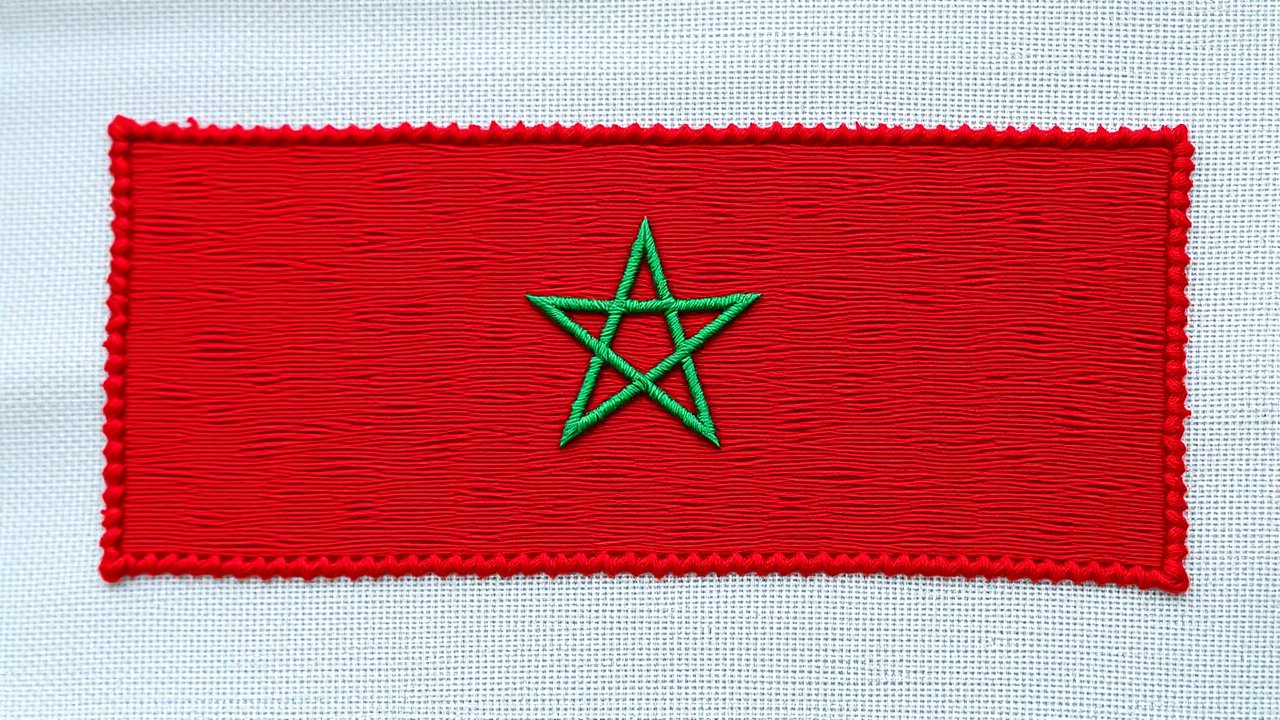
Embroidered Textile — Red field with a green five-pointed star (pentacle) centered. The flag of Morocco as intricate embroidery on linen fabric. Red field with a green five-pointed star (pentacle) centered. Dense satin stitches, French knots, chain stitch detail. The flag design is completely faithful — exact colors, geometry, and all symbols faithfully stitched, immediately recognizable as the Morocco flag. Visible thread texture, dimensional quality, warm handcrafted feel. No text, no letters, no words, no writing of any kind.
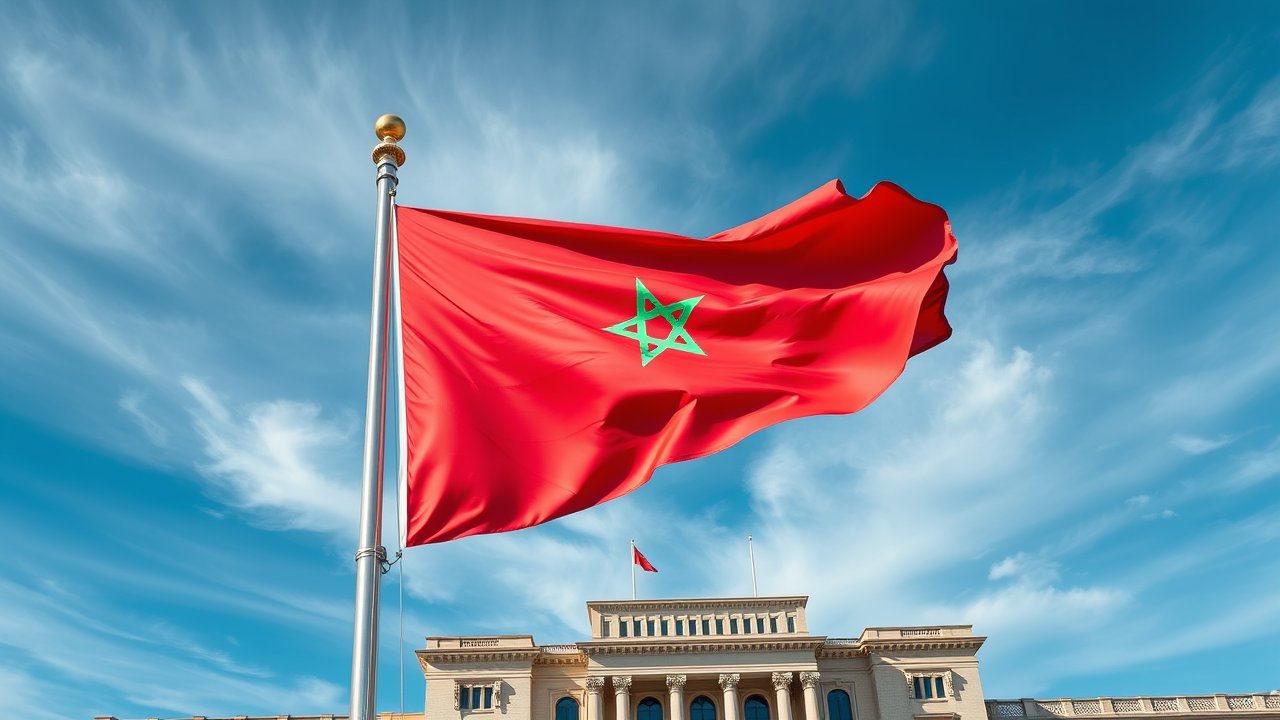
Flagpole in Capital — Red field with a green five-pointed star (pentacle) centered. Photorealistic photograph of the Morocco flag flying on a tall flagpole in front of an iconic government building in the capital city. Red field with a green five-pointed star (pentacle) centered. The flag ripples naturally in the wind, colors vivid and exact. Documentary photography style, sharp and realistic. Grand architecture in the background. Blue sky, dramatic clouds. No text, no letters, no words, no writing of any kind.
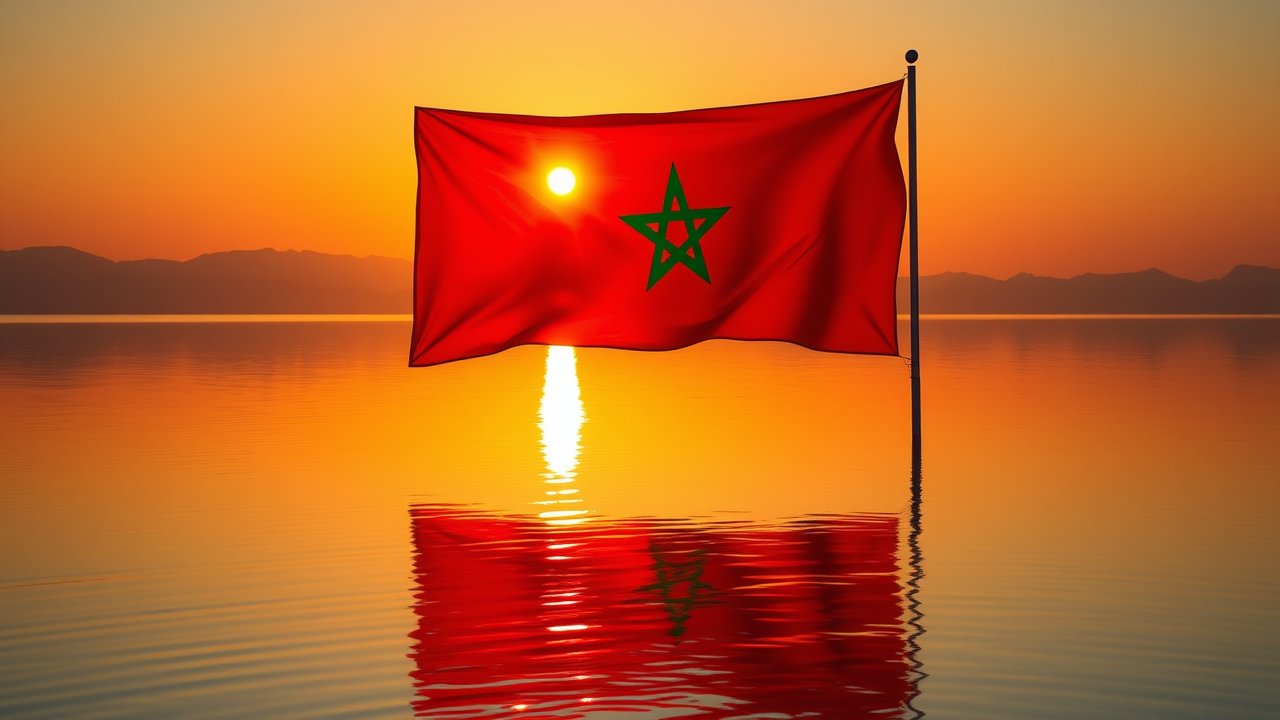
Golden Hour Reflection — Red field with a green five-pointed star (pentacle) centered. Photorealistic photograph of the Morocco flag reflected in still water at golden hour. Red field with a green five-pointed star (pentacle) centered. The flag flies on a pole at the water’s edge, its reflection shimmering on the surface below. Warm amber and orange sunset light. The flag colors and design are faithful and vivid. Serene, cinematic landscape photography. No text, no letters, no words, no writing of any kind.
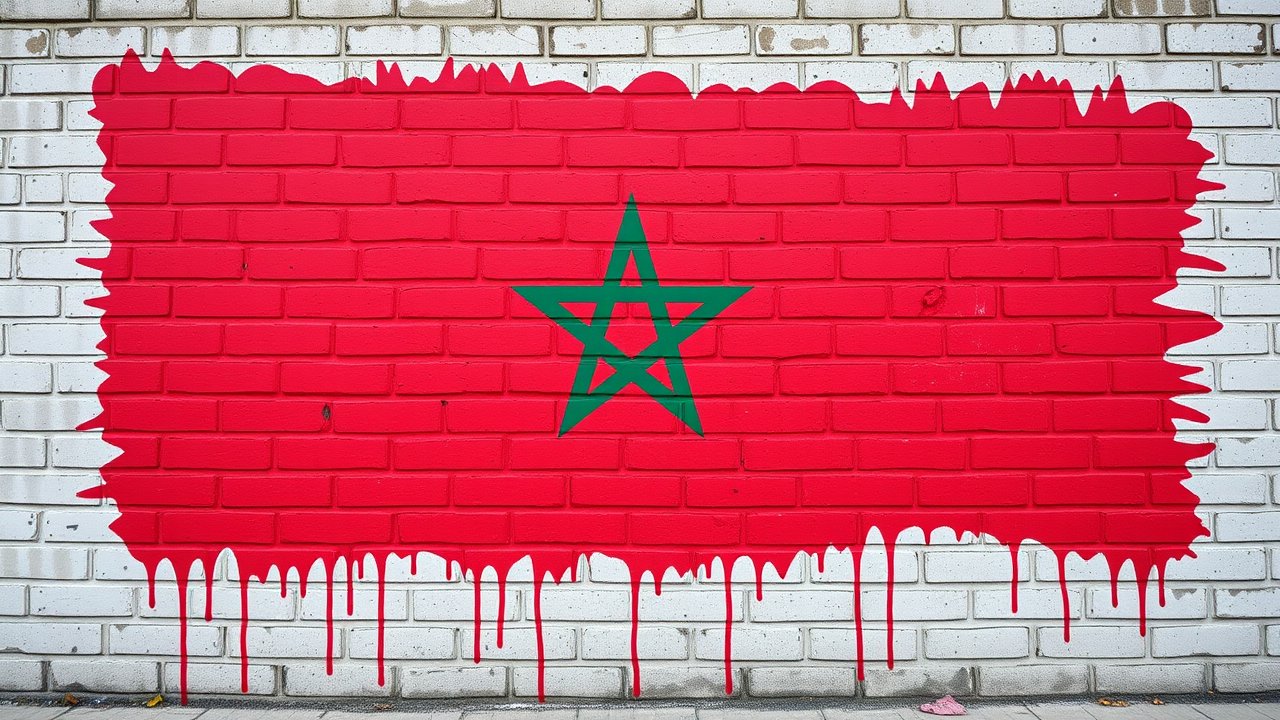
Street Art / Graffiti — Red field with a green five-pointed star (pentacle) centered. The flag of Morocco as vibrant street art spray-painted on a brick wall. Red field with a green five-pointed star (pentacle) centered. Bold spray paint, dripping edges, stencil layers, overspray halos. The flag design is faithful and immediately recognizable — exact colors and symbols, just rendered in spray paint on urban concrete. No text, no letters, no words, no writing of any kind. No tags, no graffiti lettering.
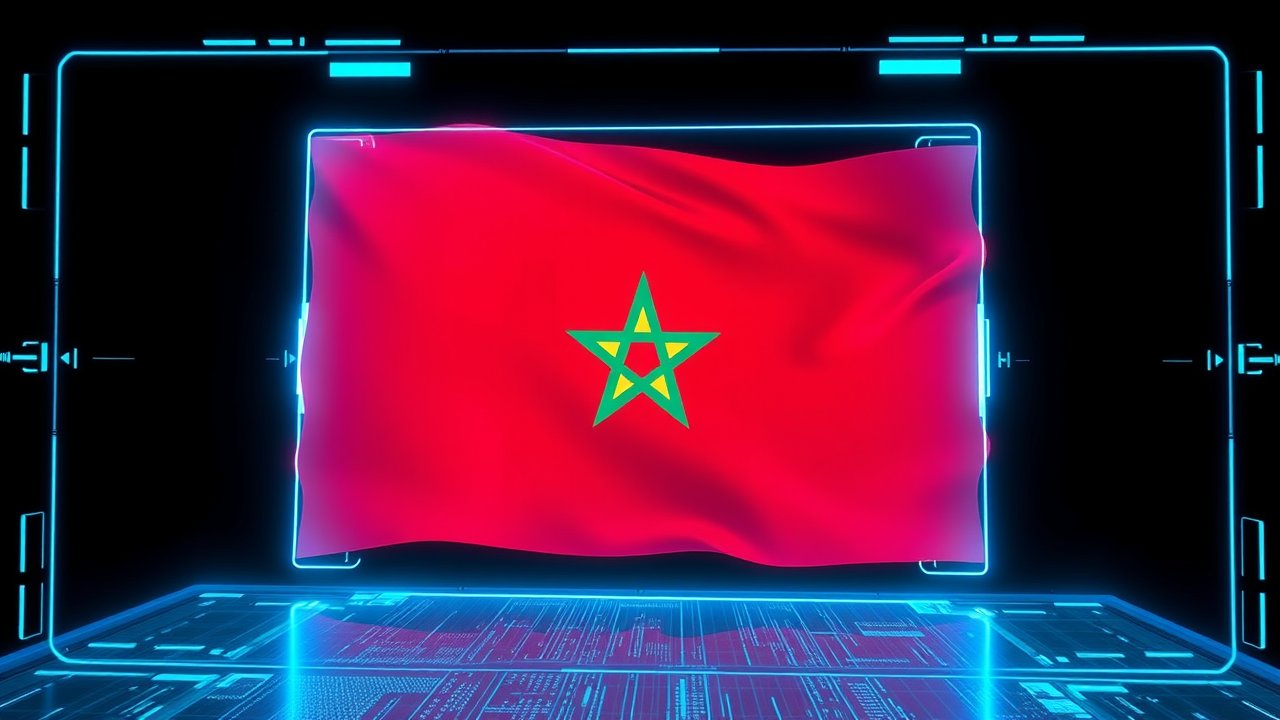
Sci-Fi Hologram — Red field with a green five-pointed star (pentacle) centered. The flag of Morocco projected as a futuristic holographic display. Red field with a green five-pointed star (pentacle) centered. Translucent blue-white projection with scan lines, floating in dark space. Glitching edges, particle effects, data streams. The flag design is completely faithful and recognizable. Cyberpunk HUD elements framing the projection. No text, no letters, no words, no writing of any kind.
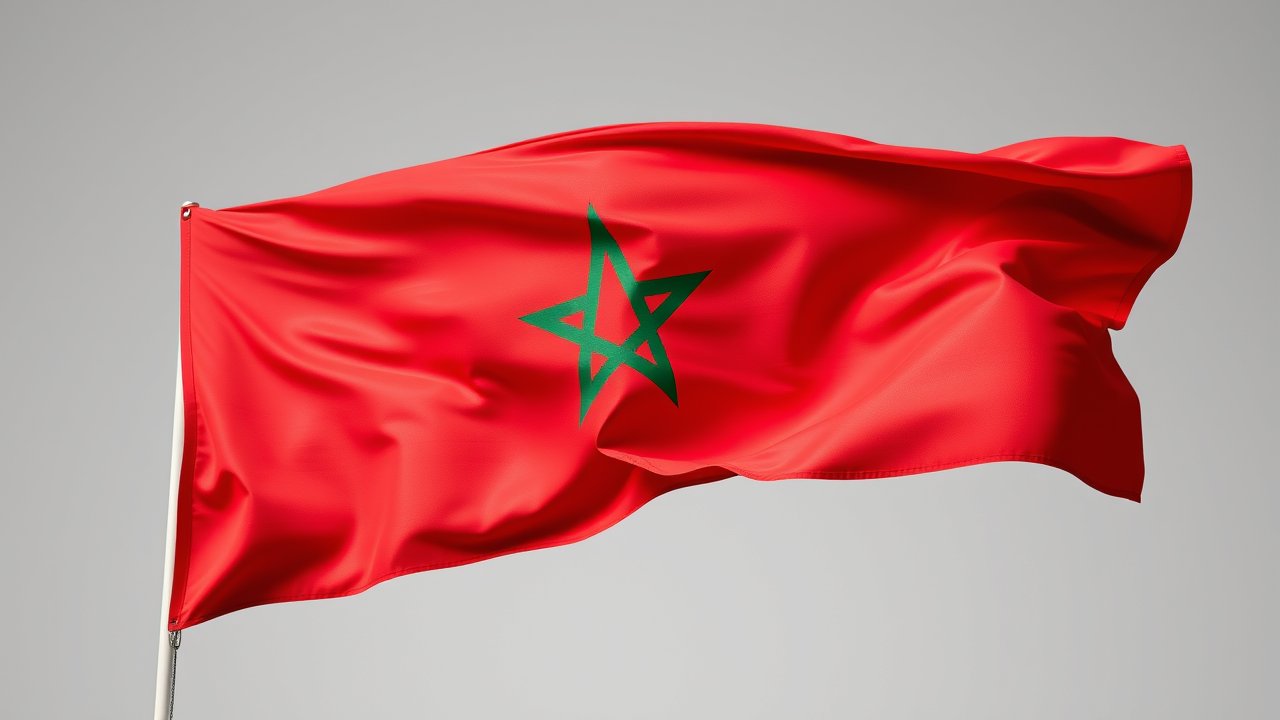
Hyperrealistic Wind — Red field with a green five-pointed star (pentacle) centered. Ultra-hyperrealistic photograph of the Morocco flag caught in a dramatic gust of wind. Red field with a green five-pointed star (pentacle) centered. Macro-level fabric detail — individual threads visible, fabric folds and tension lines crisp. Colors and design completely faithful to the real Morocco flag. High-speed shutter, razor-sharp focus, studio lighting. No text, no letters, no words, no writing of any kind.
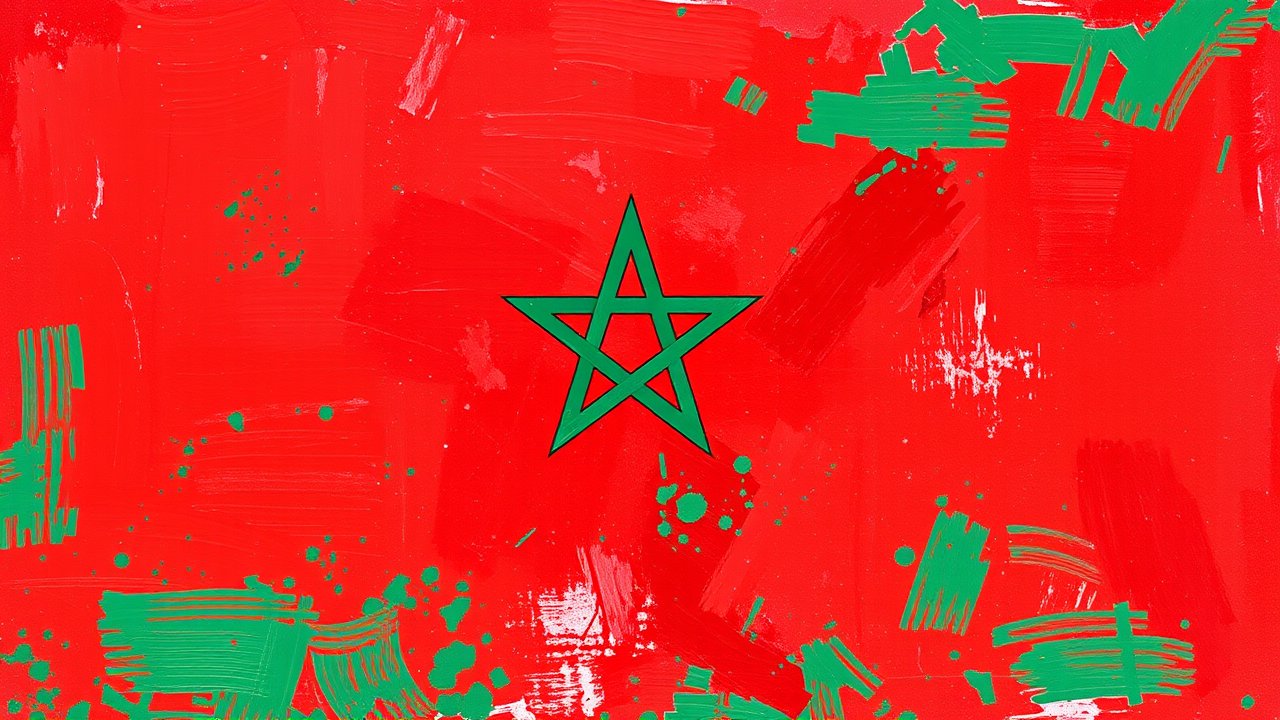
Impressionist Oil — Red field with a green five-pointed star (pentacle) centered. The flag of Morocco painted in French Impressionist oil on canvas. Red field with a green five-pointed star (pentacle) centered. Thick impasto brushstrokes, dappled light, vibrant broken color technique in the style of Monet. The flag is instantly recognizable — colors and design faithful to the real Morocco flag, interpreted with impressionist light and texture. No text, no letters, no words, no writing of any kind.
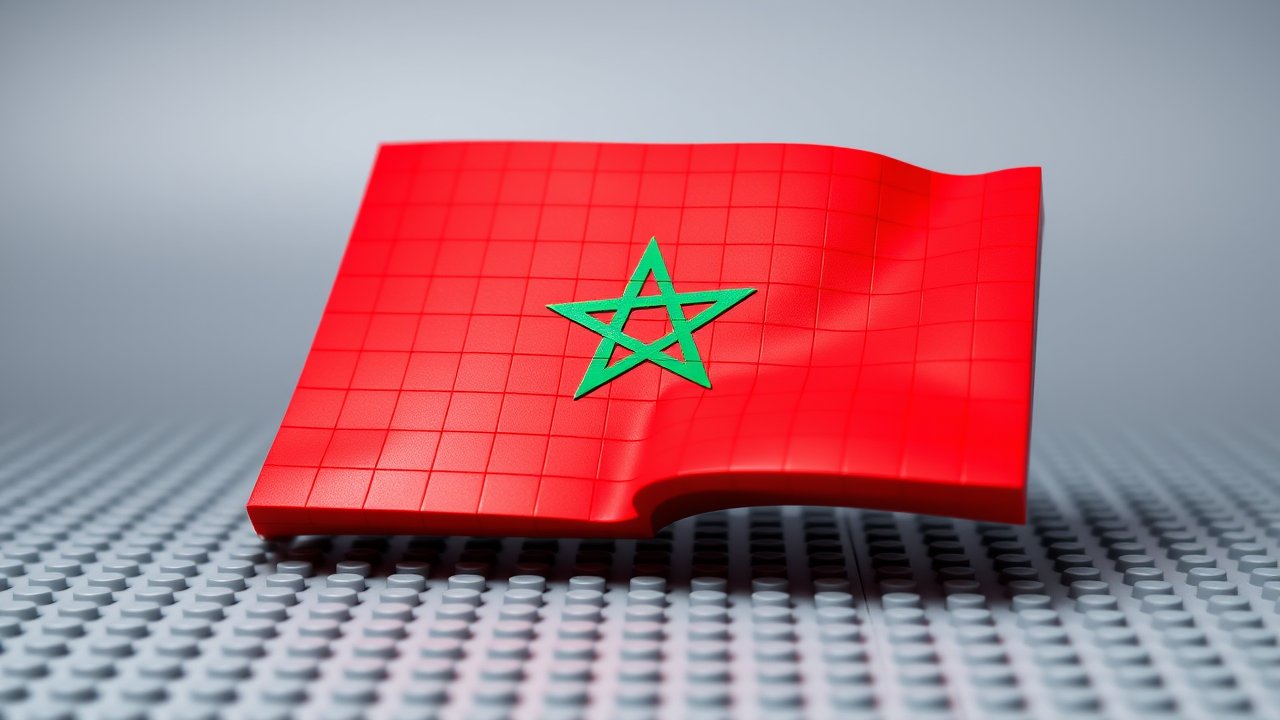
Lego Bricks — Red field with a green five-pointed star (pentacle) centered. The flag of Morocco built from Lego bricks, photographed as a real physical construction. Red field with a green five-pointed star (pentacle) centered. Visible studs and brick seams, slight plastic sheen. Standard Lego colors approximate the flag’s palette. Built on a gray Lego baseplate. Dramatic angle showing the three-dimensional brick texture. No text, no letters, no words, no writing of any kind.
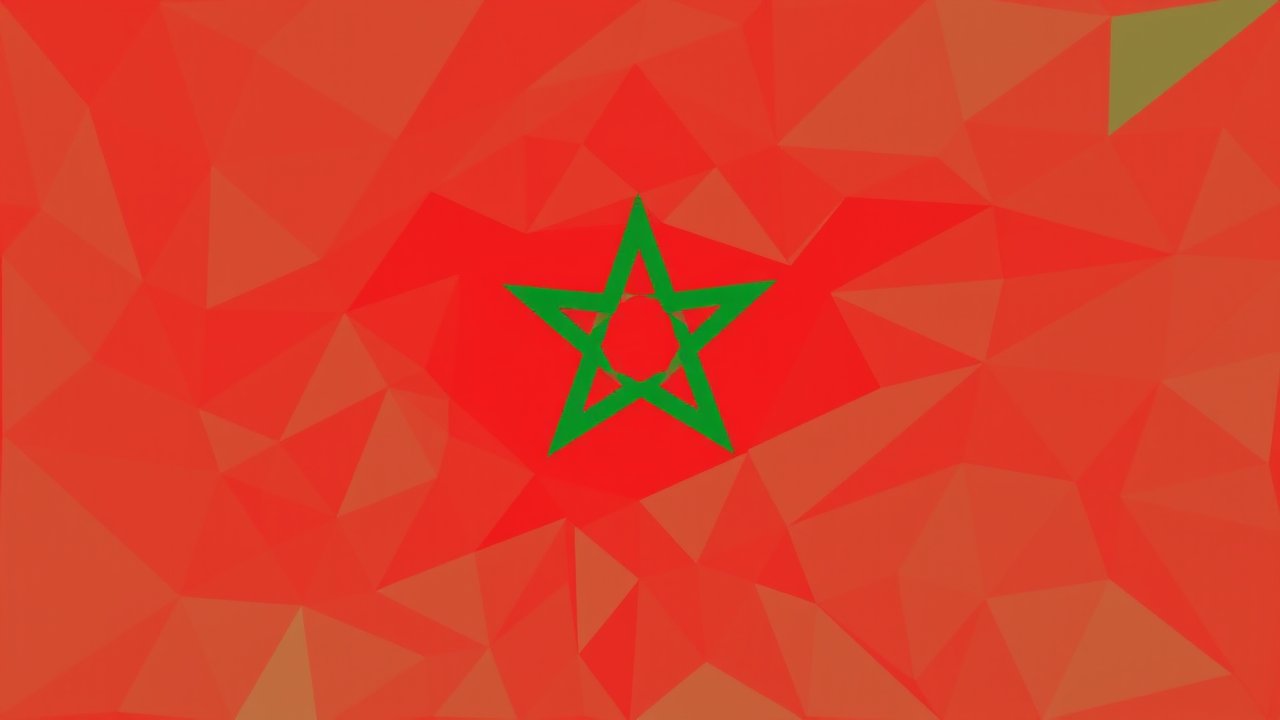
Low-Poly Geometric — Red field with a green five-pointed star (pentacle) centered. The flag of Morocco constructed from low-polygon geometric triangles. Red field with a green five-pointed star (pentacle) centered. Aggressively faceted — each region broken into many visible triangular faces with subtle color variation across each polygon, creating real depth and dimensionality even in flat-color areas of the flag. Crystal-like, contemporary computational design. The flag is completely faithful and immediately recognizable. No text, no letters, no words, no writing of any kind.
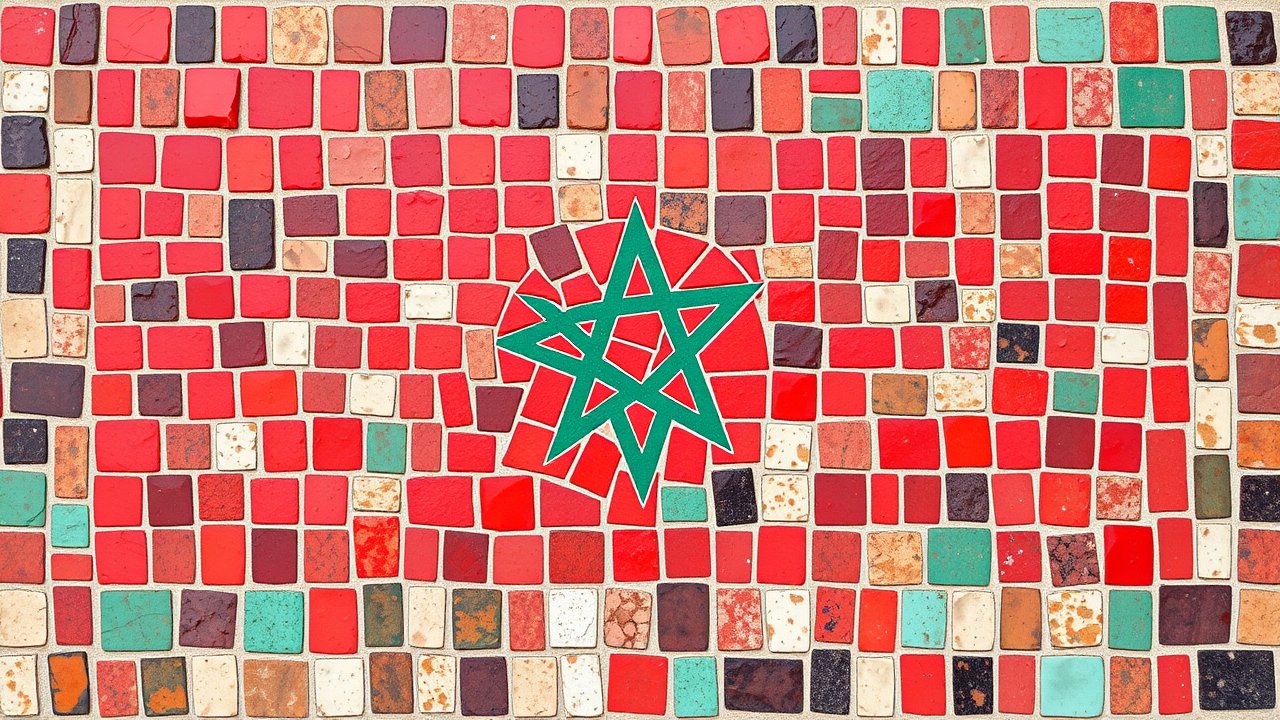
Mosaic Tiles — Red field with a green five-pointed star (pentacle) centered. The flag of Morocco assembled as a Roman-style mosaic. Red field with a green five-pointed star (pentacle) centered. The flag is completely faithful to the real Morocco flag — exact proportions, colors, and all symbols, rendered in thousands of small stone and glass tesserae. Visible grout lines, rich earthy tones mixed with brilliant glass, slight historical weathering. No text, no letters, no words, no writing of any kind.
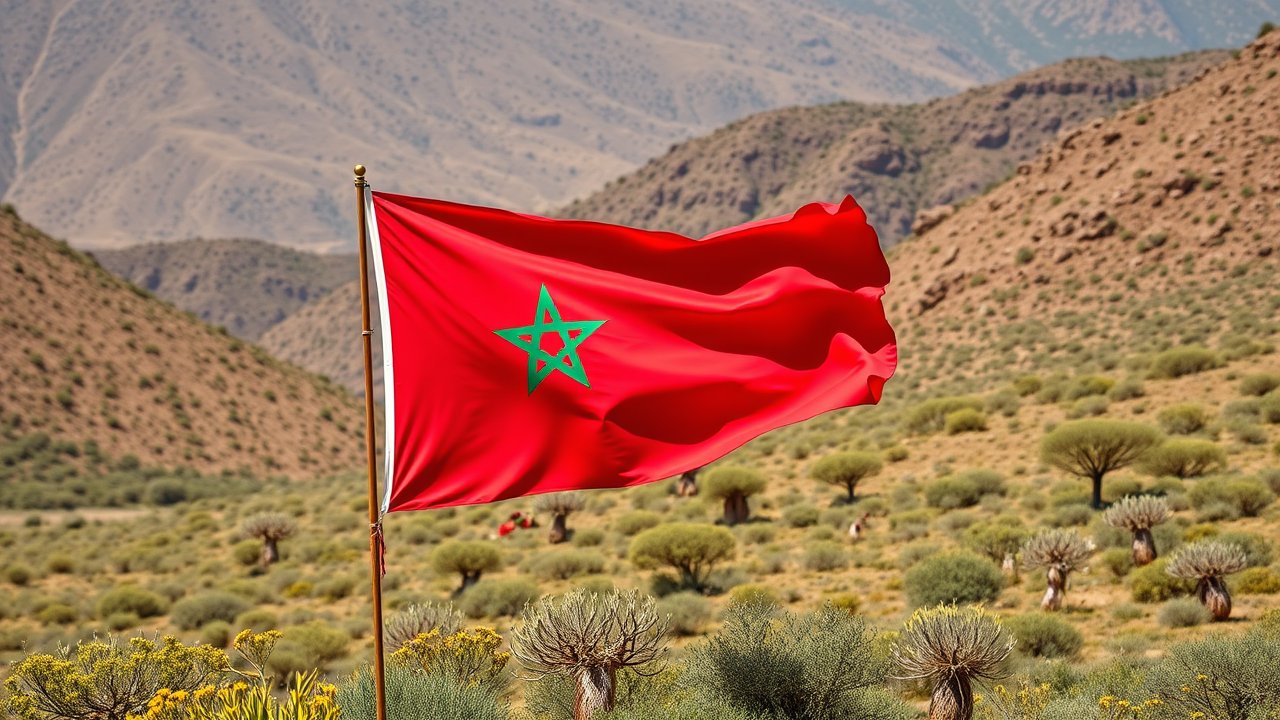
Native Landscape — Red field with a green five-pointed star (pentacle) centered. Photorealistic photograph of the Morocco flag flying in an iconic natural landscape native to Morocco — the terrain, flora, and environment characteristic of that country. Red field with a green five-pointed star (pentacle) centered. The flag is prominent and its colors are faithful and vivid. Remote, uninhabited wilderness. National Geographic photography style. No text, no letters, no words, no writing of any kind.
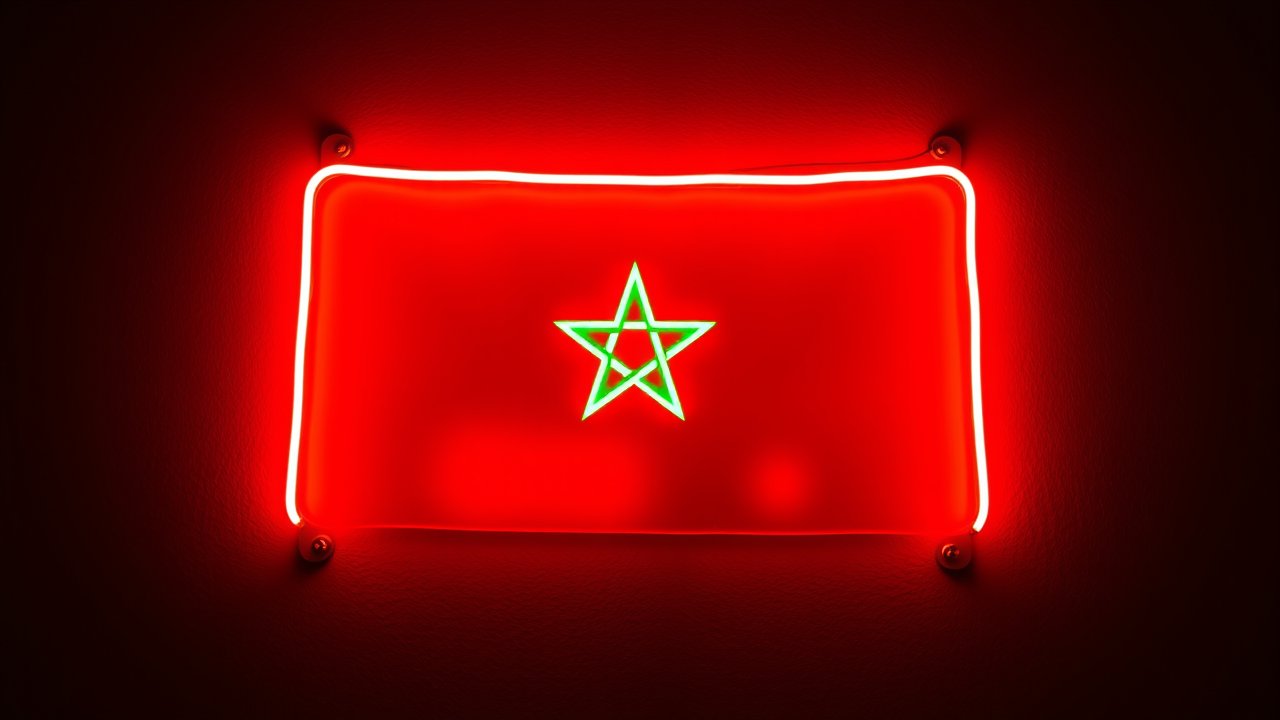
Neon Sign — Red field with a green five-pointed star (pentacle) centered. The flag of Morocco recreated as a real neon sign mounted on a dark wall. Red field with a green five-pointed star (pentacle) centered. Glowing glass neon tubes bent into the flag’s shapes — the colors of the flag rendered in actual neon light. Visible glass tube bends, metal mounting brackets on the wall. Warm neon glow and light bloom. Real neon, not digital. Photographed in a dark room. No text, no letters, no words, no writing of any kind.
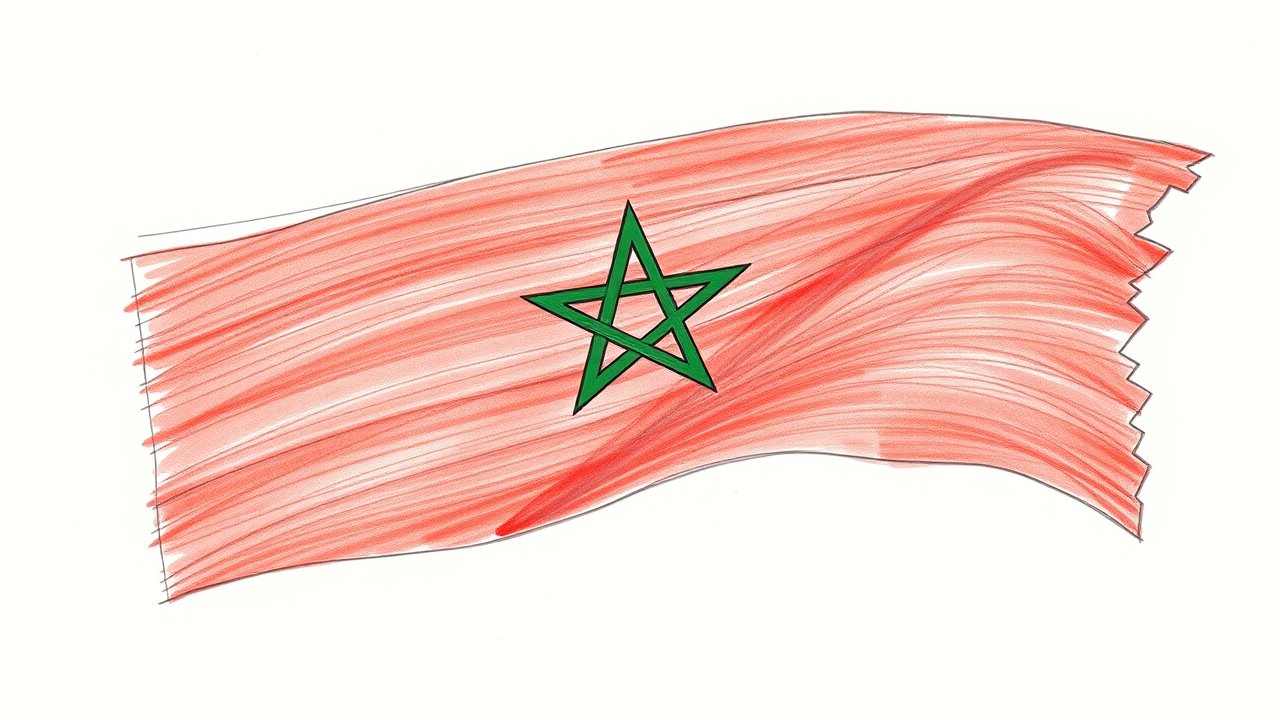
Pencil Sketch — Red field with a green five-pointed star (pentacle) centered. The flag of Morocco as a bold, confident pencil sketch. Red field with a green five-pointed star (pentacle) centered. Strong graphite lines on cream paper — not delicate but bold and decisive. Heavy pressure on key outlines, dramatic cross-hatching for deep shadows and shading. Immediately recognizable as the Morocco flag. Artist’s confident hand, not tentative. No text, no letters, no words, no writing of any kind.
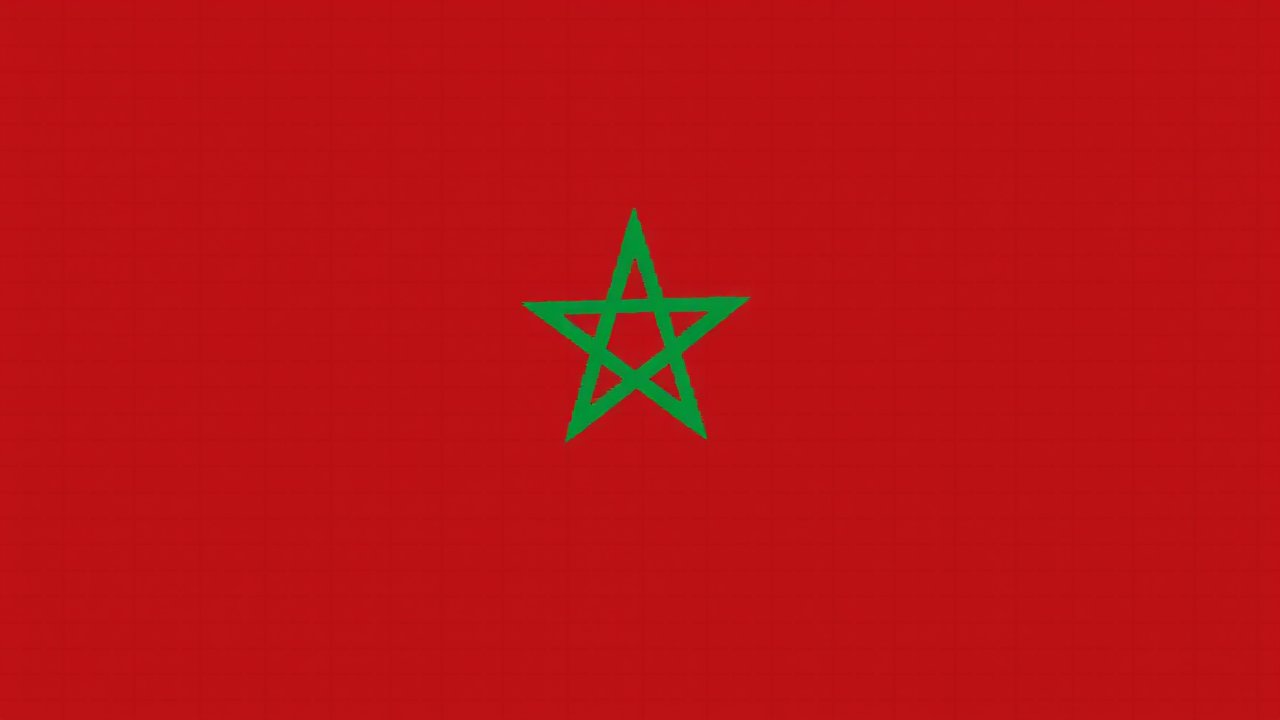
Pixel Art — Red field with a green five-pointed star (pentacle) centered. The flag of Morocco as detailed 16-bit pixel art. Red field with a green five-pointed star (pentacle) centered. Crisp pixel grid, limited palette with careful dithering, nostalgic retro game aesthetic. Clean grid-aligned design with subtle shading. Every element of the flag faithfully reproduced in pixels. No text, no letters, no words, no writing of any kind.
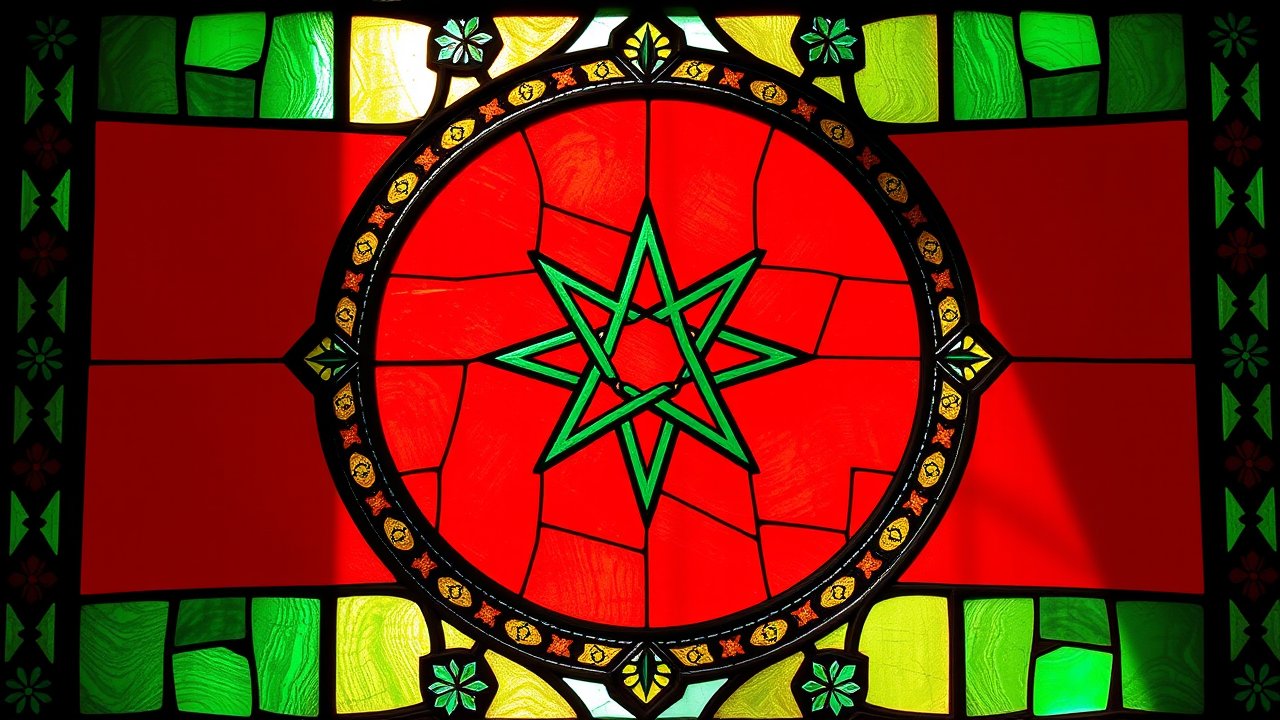
Stained Glass — Red field with a green five-pointed star (pentacle) centered. The flag of Morocco rendered as an ornate stained glass window. Red field with a green five-pointed star (pentacle) centered. The design is completely faithful to the real Morocco flag — exact colors, geometry, and all symbols preserved. Brilliant jewel-toned glass pieces separated by dark lead came lines. Warm sunlight streaming through, casting colored light. Gothic cathedral craftsmanship. No text, no letters, no words, no writing of any kind.
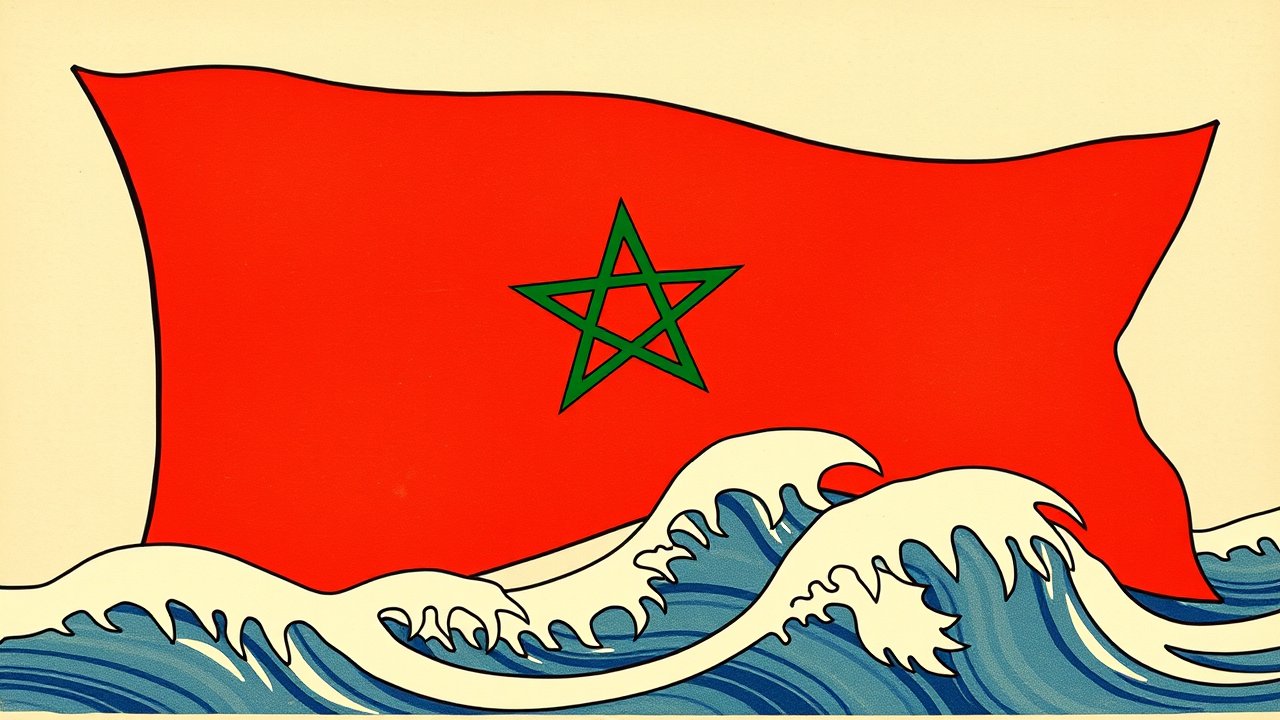
Ukiyo-e Woodblock — Red field with a green five-pointed star (pentacle) centered. The flag of Morocco as a traditional Japanese ukiyo-e woodblock print. Red field with a green five-pointed star (pentacle) centered. Bold outlines, flat areas of rich color, flowing organic forms. Wind and waves incorporated into the composition. Printed on washi paper with visible wood grain texture. The flag is the central focus and instantly recognizable. No text, no letters, no words, no writing of any kind.
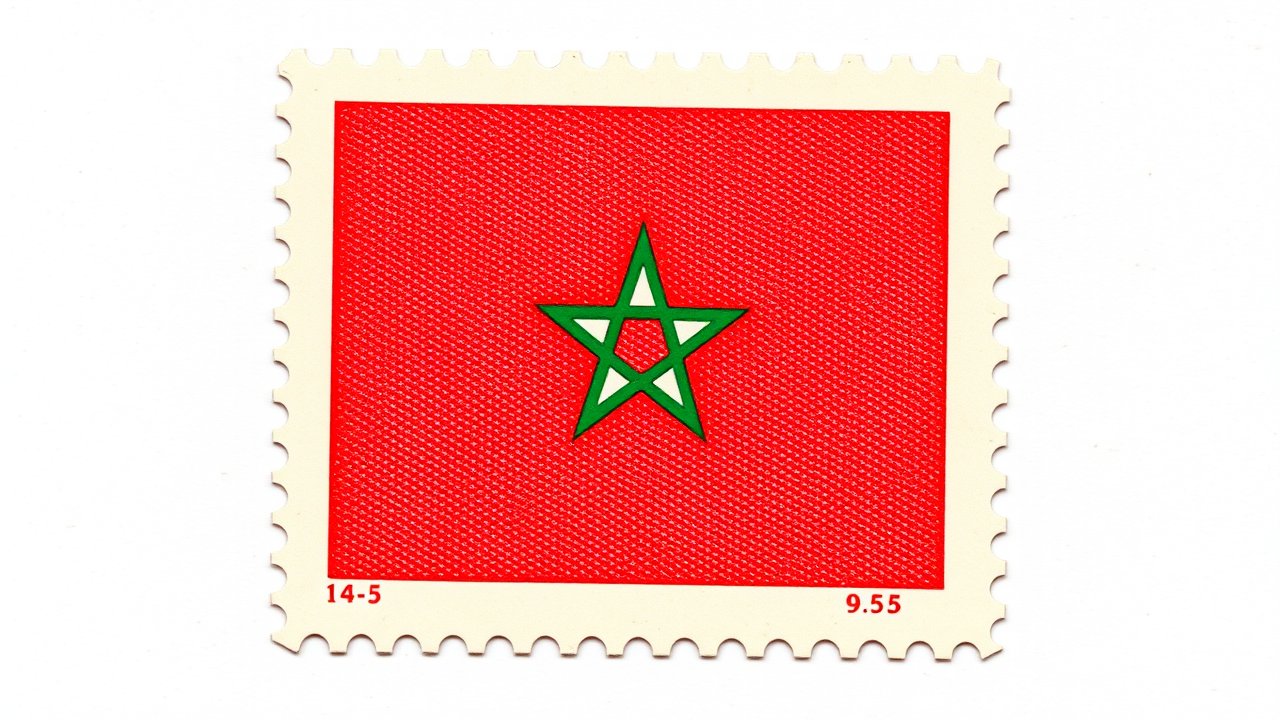
Vintage Postage Stamp — Red field with a green five-pointed star (pentacle) centered. The flag of Morocco as a vintage 1950s postage stamp. Red field with a green five-pointed star (pentacle) centered. The flag fills most of the stamp — it is the primary subject, faithfully rendered in fine engraved intaglio style. Perforated edges, aged paper with slight foxing. The stamp may show a denomination numeral only — absolutely no other text or country names.
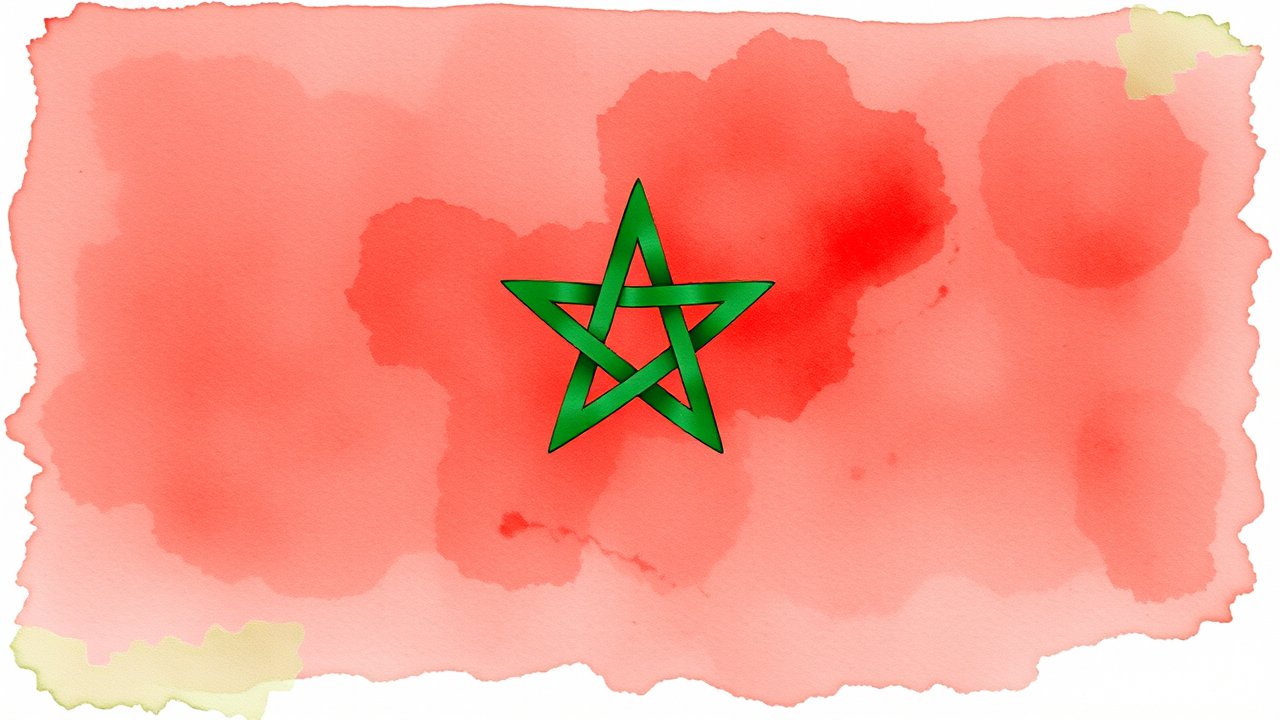
Watercolor — Red field with a green five-pointed star (pentacle) centered. The flag of Morocco painted in loose, expressive watercolor. Red field with a green five-pointed star (pentacle) centered. Wet-on-wet technique with soft color bleeds, visible brushstrokes, natural paper texture. Delicate splashes and drips at the edges. Luminous, translucent layers of pigment. No text, no letters, no words, no writing of any kind.
The flag of Morocco stands as a powerful symbol of the nation’s rich Islamic heritage, historical sovereignty, and complex political evolution through colonial and post-colonial periods. The current design—a bright red field with a green five-pointed star positioned at its center—represents a synthesis of ancient Islamic traditions, Berber cultural identity, and the enduring legacy of the Alawid dynasty that has ruled Morocco since 1666. Understanding Morocco’s flag requires examining both its visual symbolism and its fascinating historical journey from pre-colonial times through modern independence.
Before the formal adoption of the modern flag design, the Alawid dynasty, which claimed descent from the Prophet Muhammad through Fatima and Ali, ruled Morocco under a distinctive solid red flag. This crimson banner served as the dynasty’s emblem for nearly 250 years, beginning with the dynasty’s establishment in 1666. The choice of red was deliberate and symbolically loaded: it referenced the Sharifs of Mecca and reinforced the dynasty’s claimed connection to Islamic tradition and prophetic lineage. During this era, Morocco’s maritime vessels flew variations of these red flags as they navigated Mediterranean and Atlantic trade routes, establishing a visual identity recognized across the region’s commercial and diplomatic circles.
The modern design of Morocco’s flag emerged through an unexpected historical circumstance: French colonial intervention. On November 17, 1915, during the period when Morocco existed under French and Spanish protectorates, Sultan Yusef formalized the current flag design through an official dahir (decree). The French administration modified Morocco’s traditional plain red maritime flag by adding a green pentagram—an ancient five-pointed star symbol—to its center. Though introduced under colonial pressure, this modification proved enduring, ultimately becoming the definitive symbol of Moroccan national identity and independence after the country regained sovereignty. The precise geometry was later formalized: the flag features a 2:3 width-to-length ratio, with the green star prominently centered and inscribed within geometric proportions that were officially specified under King Mohammed VI in 2005.
The symbolism embedded in Morocco’s flag reflects layers of cultural and religious meaning that resonate deeply within Islamic, Berber, and historical Mediterranean contexts. The red background carries multiple significance: it represents the Alawid dynasty’s centuries of rule and the dynasty’s asserted connection to Islamic prophetic tradition; it symbolizes the blood of Morocco’s ancestors and the nation’s unity; and it evokes the deep historical association between Morocco and the Islamic world that extends back to the seventh century. The red field thus functions as a visual genealogy, anchoring contemporary Morocco to its dynastic past while honoring the sacrifices of those who fought for national autonomy and dignity.
The green five-pointed star holds equally profound symbolic weight, operating simultaneously at Islamic, esoteric, and Berber cultural levels. Known as the Seal of Solomon—or the Pentacle of Solomon—this ancient symbol has roots stretching across multiple cultures and religious traditions, predating its popularization in Western contexts. In Moroccan Islamic tradition, the five points of the star represent the five pillars of Islam: the Shahada (profession of faith), Salat (ritual prayer), Zakat (charitable alms), Sawm (fasting during Ramadan), and Hajj (pilgrimage to Mecca). Beyond its Islamic resonance, the pentagram carries Berber cultural significance within Morocco’s composite identity, functioning as a protective emblem and a symbol of power, good fortune, and spiritual authority. The selection of green—a color deeply associated with Islam throughout the Middle East and North Africa—reinforces the star’s religious significance while emphasizing Morocco’s place within the broader Islamic world.
Morocco’s flag experienced significant restrictions during the colonial period that nevertheless shaped its eventual international prominence. From 1915 until Morocco’s independence in 1956, the flag’s use was carefully circumscribed by colonial authorities: it was permitted for inland display within Morocco but prohibited from use on maritime vessels, a deliberate policy designed to assert colonial dominance over Moroccan sovereignty. This restriction lasted approximately four decades, creating a pointed historical irony: the flag modified by colonial decree became forbidden from the very maritime sphere where it had traditionally flown. The prohibition itself became a rallying symbol for Moroccan nationalist sentiment, as independence movements invested the flag with additional symbolic weight as an emblem of deferred sovereignty and national aspirations.
The path to unrestricted use of Morocco’s flag culminated with the nation’s independence in 1956, a watershed moment in North African history. Upon regaining sovereignty, Morocco immediately authorized its flag for both national and maritime use, fully realizing the design’s original purpose across all contexts of national representation. The flag thus transitioned from a symbol of constrained nationality under colonialism to an unrestricted emblem of independent statehood, its green star and red field now permitted to wave from government buildings, military installations, maritime vessels, and public spaces throughout the nation. This transformation was particularly symbolically significant: the very flag that colonial authorities had restricted to landlocked use now became the maritime banner of a restored nation-state.
Recent decades have witnessed official refinement and celebration of Morocco’s flag design and historical significance. In 2005, King Mohammed VI issued formal constitutional specifications governing the flag’s precise dimensions, colors, and proportions. These specifications established that the flag must feature bright red (following precise color standards) paired with palm green, maintaining the traditional 2:3 ratio while providing exact geometric parameters for the star’s size, positioning, and inscribed circle. This modernization reflected contemporary international standards for flag specifications while honoring the design’s historical integrity. The specifications represent governmental recognition that the flag, while ancient in its symbolic roots, requires contemporary formal definition to ensure consistency in all contexts of national representation.
Morocco’s flag achieved a notable contemporary distinction in 2010, when a massive flag measuring 60,409.78 square meters was displayed in Dakhla, earning certification from Guinness World Records as the largest flag ever draped. This record-setting achievement underscored Morocco’s pride in its national symbol and demonstrated the flag’s enduring capacity to mobilize collective identity and national sentiment. The flag’s scale transformed it into a geographical landmark visible from considerable distances, visibly asserting Moroccan sovereignty and cultural pride across the Western Saharan landscape.
The flag of Morocco thus represents far more than a geometric combination of colors and shapes: it embodies centuries of Islamic tradition, dynastic continuity, anti-colonial resistance, Berber cultural identity, and post-independence sovereignty. From its origins as a solid red banner under the Alawid dynasty through its modification during French colonialism to its triumphant unrestricted use following independence, Morocco’s flag has accumulated historical meaning with each era. The green five-pointed star, representing both Islam’s five pillars and ancient esoteric tradition, converges with the red field to create a symbol that simultaneously honors Morocco’s past, asserts its present independence, and projects its cultural influence into the contemporary world. Few national flags carry such dense layers of historical significance and cultural resonance, making Morocco’s banner a particularly rich subject of vexillological study and national pride.
Related Products
Quality nylon Moroccan flag.
Complete guide to Morocco.
Entertaining memoir of life in Morocco.
As an Amazon Associate, we earn from qualifying purchases.
Free Printable: Flags of the World Reference Card
Get a beautiful printable poster with 50 flag emojis, Unicode codes, and fun facts. Perfect for classrooms and desks!
No spam, ever. Unsubscribe anytime.