
How To
How To
Time needed: 1 minute
Want the full printable classroom pack?
Take the flag reference from your screen to an offline pack for lessons, practice, and quiz time.
- Printable atlas with 230+ high-resolution flag flats
- Four regional quizzes with answer keys
- Flag Bingo boards and caller sheet
How to copy and paste the Flag of Sri Lanka Emoji to any device.
- Copy the Sri Lankan Flag Emoji
Go to flagemoji.com and press the copy button (above). This works on any device.
- Paste the Emoji
Go to your email/iMessage/SMS texting service/document and paste the emoji.
For mobile devices
— double-tap or tap-hold, then paste should appear. Tap it.
For desktop and laptops on Apple devices
— command-P / ⌘-P
For desktop and laptops on Windows devices
— control-p
Codes
Emoji Codes
Flag emojis are unicode symbols, like any other letter or number on your keyboard. This means you can copy and paste the emoji itself into your code, whatever the language (click the button above).
They actually count as two characters: the two-letter country code (the ISO international standard). The unicode and shortcode both represent country data which devices can interpret and display the emoji.
| Country Code | Unicode | Shortcode |
| LK | U+1F1F1 U+1F1F0 | :flag_LK: :LK: |
Emoji shortcodes are used on some platforms as a way for users to type in emojis from the keyboard. If you type the emoji shortcode on Github or Slack, the emoji will appear.
*The official name of the emoji is only the country name, not ‘Sri Lanka Flag’, for example.
Description
Description
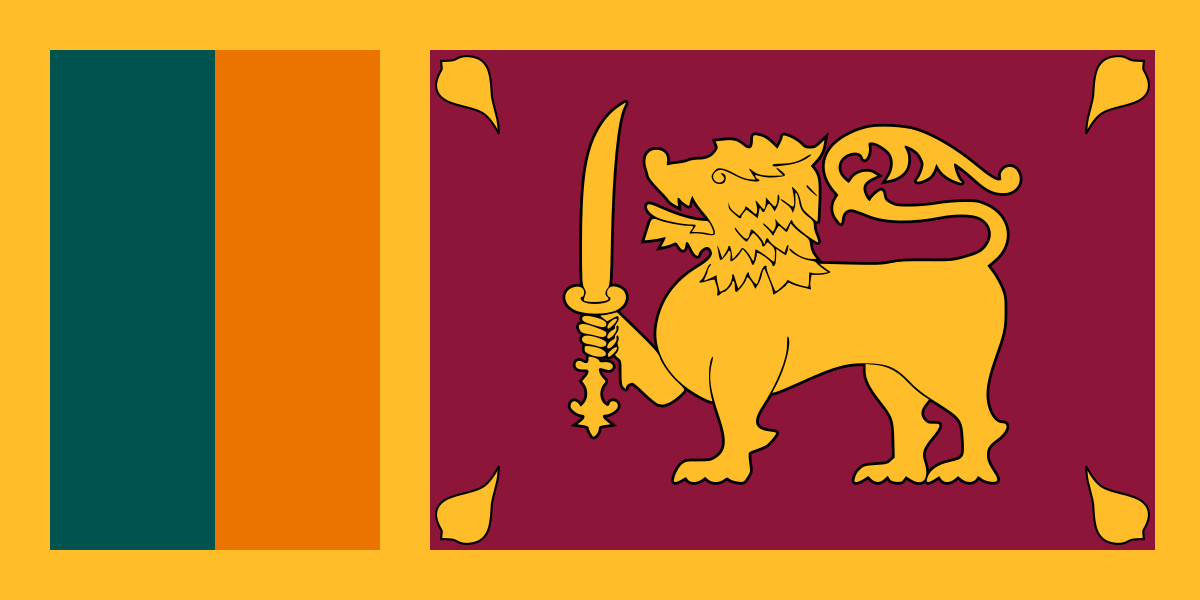
The flag of Sri Lanka is made up of yellow with two panels. The smaller hoist-side panel has two equal vertical bands of green (hoist side) and orange. The other larger panel depicts a yellow lion holding a sword on a maroon rectangular field that also displays a yellow bo leaf in each corner. The yellow field appears as a border around the entire flag and extends between the two panels. The lion represents Sinhalese ethnicity, the strength of the nation, and bravery. The sword demonstrates the sovereignty of the nation. The four bo leaves—symbolizing Buddhism and its influence on the country—stand for the four virtues of kindness, friendliness, happiness, and equanimity. Orange signifies Sri Lankan Tamils, green Sri Lankan Moors, and maroon the Sinhalese majority. Yellow denotes other ethnic groups. This flag is also referred to as the Lion Flag.
Map
Map
Check out the map of Liberia!
Weather
Anthem
National Anthem
| Title | Sri Lanka Matha (Mother Sri Lanka) |
| Composer | Ananda Samarkone |
FAQ
FAQs
Sri Lanka’s Independence Day is celebrated annually on February 4th to commemorate the country’s political independence from British rule in 1948.
Orange signifies Sri Lankan Tamils, green Sri Lankan Moors, and maroon the Sinhalese majority. Yellow denotes other ethnic groups. The flag is also referred to as the Lion Flag.
The Sri Lankan flag was formally adopted on December 17, 1978.
Sri Lanka is governed by a presidential republic.
Discover more fun facts of Cambodia.
Printable
Printable Sri Lankan Flag
Print another really cool flag. Why not the flag of Cyprus?
Flag History and Symbolism of Sri Lanka
The national flag of Sri Lanka is one of the world’s oldest flags, with roots extending back more than two thousand years into the island’s ancient past. The flag’s distinctive design—featuring a golden lion holding a curved sword (kastane) against a maroon background, surrounded by four stylized bo leaves and flanked by vertical green and orange stripes—represents a unique synthesis of Buddhist heritage and modern multiculturalism that reflects the nation’s complex identity and diverse communities.
Ancient Origins and the Lion Symbol
The lion has appeared on Sri Lankan banners and standards for over two millennia, tracing its significance to Buddhist mythology and the founding narratives of the Sinhala people. According to the Mahavamsa, an ancient Buddhist chronicle, the Sinhala race descended from Prince Vijaya, whose father, King Sinhabahu, was born of a liaison between a lion and a human princess. This mythological connection established the lion as a symbol of Sinhala identity and royal authority. Archaeological evidence supports this ancient tradition; the earliest known depiction of a Sri Lankan lion flag appears in Cave 2 at Dambulla Viharaya, where King Dutugemunu is depicted around 162 BCE carrying a banner bearing a lion figure holding a sword in its right forepaw. This iconography remained central to Sri Lankan royal standards throughout the medieval period, appearing on the flags of the Kingdom of Gampola (c. 1341–1408), the Kingdom of Kotte (c. 1412–1597), the Kingdom of Sitawaka (c. 1521–1594), and most notably the Kingdom of Kandy (c. 1798–1815), the last independent Sinhala kingdom.
Colonial Era and the Loss of the Lion Flag
The Kandyan Convention of 1815 marked a watershed moment in Sri Lankan history. The British conquered the final independent kingdom and replaced the royal lion standard with the Union Flag, effectively suppressing a symbol that had endured for centuries. The original Kandyan lion flag, however, was not destroyed but rather transferred to England’s Royal Hospital Chelsea, where it remained during the entire colonial period. The loss of the lion flag symbolized the end of native rule and the imposition of British imperial authority over the island. During the colonial period, Ceylon—as the island was then known—did maintain its own flag design from 1875 to 1948, but this lacked the cultural resonance and historical depth of the ancient lion banner.
Independence and Restoration of the Lion Flag
The restoration of the lion flag occurred at a pivotal moment in Sri Lankan history. When Ceylon achieved independence on February 4, 1948, the nation’s first Prime Minister, D.S. Senanayake, reinstated the ancient lion flag as the symbol of national sovereignty. This decision was not merely ceremonial; it represented a reclamation of pre-colonial identity and a rejection of colonial symbolism. The rediscovery of the original lion flag at the Royal Hospital Chelsea during the independence movement had sparked renewed interest in this historical emblem and inspired its revival. The 1948 Lion Flag consisted of the maroon background with the golden lion and kastane sword, bearing the lion standard’s original medieval design.
Design Modernization: Inclusion of Minority Communities
In 1951, the government formed a National Flag Committee to modernize the flag’s design to represent Sri Lanka’s diverse population. This led to a significant modification: two vertical stripes were added to the flag’s left side—an orange stripe representing the Tamil community and a green stripe representing the Muslim community. These additions reflected the political commitment to inclusion and recognized that Sri Lanka was not solely a Sinhala Buddhist nation but rather a multi-ethnic, multi-religious state. A golden-yellow border was also incorporated, symbolizing other minority communities including the Malays, Burghers, Indigenous Veddas, and Sri Lankan Chinese. The maroon lion field continued to represent the Sinhala majority, while the colored stripes created a visual representation of national unity across religious and ethnic lines.
Religious and Philosophical Symbolism: The Bo Leaves
The most significant design evolution occurred in 1972, when the flag underwent further modernization. In place of the four spearheads that had previously adorned the corners, four stylized bo leaves were introduced, each representing one of Buddhism’s four cardinal virtues. These bo leaves symbolize metta (loving-kindness), karuna (compassion), mudita (appreciative joy), and upekkha (equanimity). The bo leaf itself carries profound religious significance in Buddhism, as it is the sacred tree under which Buddha attained enlightenment at Bodh Gaya. By incorporating the bo leaves, the flag embedded Buddhist spiritual principles directly into the nation’s foremost symbol, acknowledging the deep influence of Buddhism on Sri Lankan culture and values. The current design of these leaves was refined in 1978 to appear more natural and refined. A final significant design element is the kastane sword held by the lion, which represents sovereignty and national strength.
Modern Flag and Continuing Symbolism
The flag in its current form, formally adopted on May 22, 1972, represents a carefully balanced symbol of Sri Lankan identity. The predominant maroon field and central lion acknowledge the Sinhala Buddhist heritage that forms the cultural foundation of the nation, while the orange and green stripes provide equal visual prominence to Tamil and Muslim communities. The golden border and bo leaves extend the symbolism to encompass all of Sri Lanka’s religious and ethnic minorities, while the bo leaves themselves embed Buddhist values at the heart of the national symbol. This design reflects the nation’s aspirations toward pluralism and coexistence, even as it acknowledges historical and cultural hierarchies.
Notable Facts and Modern Context
Sri Lanka’s flag is unique among world flags for its combination of ancient historical symbolism with modern design elements addressing contemporary pluralism. The flag’s colors—maroon, gold, green, and orange—are all historically significant, with maroon being a traditional color of Sinhala kingship, while green and orange represent the green of Islam and the saffron/orange of Hinduism and Tamil culture. The flag’s design demonstrates how symbols can evolve to reflect changing political realities while maintaining historical continuity. The lion flag’s survival through two thousand years of history, from ancient kingdoms through colonial suppression and into modern independence, underscores its central importance to Sri Lankan national identity and serves as a powerful reminder of the nation’s determination to preserve its cultural heritage while building an inclusive modern state.
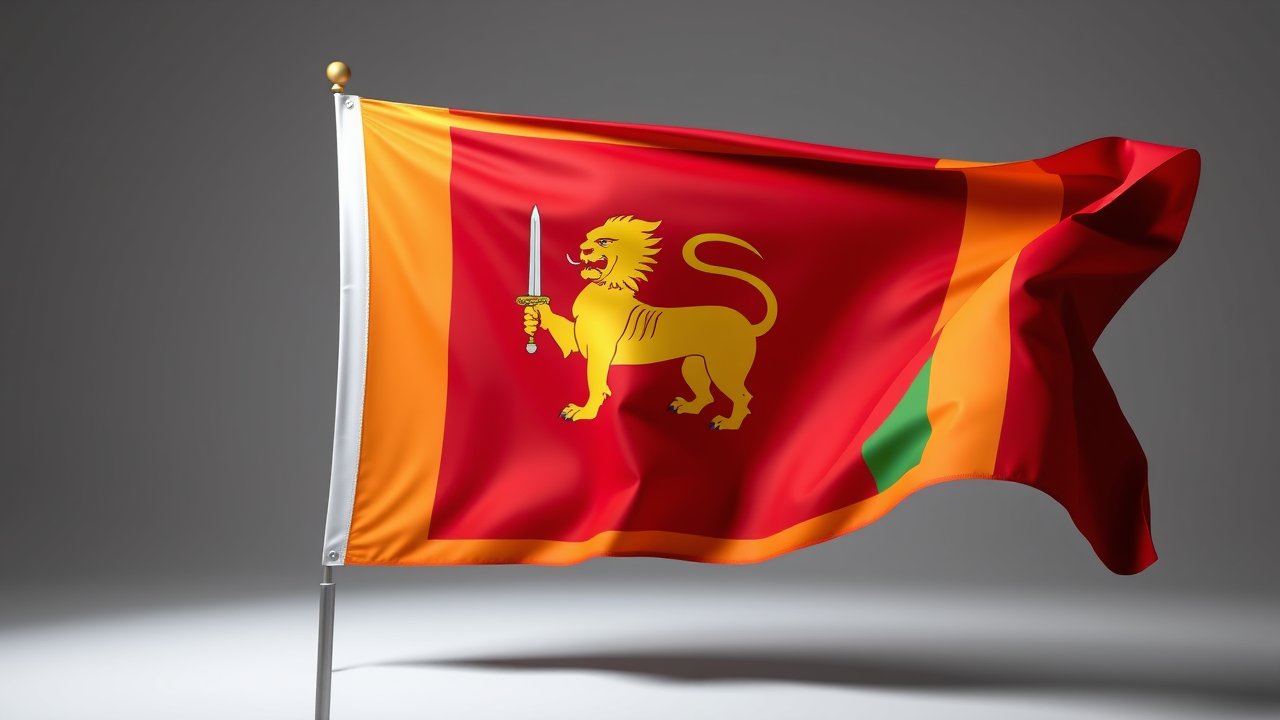
3D Glossy Render — Dark red field with a golden lion holding a sword, bordered by green and orange vertical stripes at the hoist. The flag of Sri Lanka as a photorealistic 3D render. Dark red field with a golden lion holding a sword, bordered by green and orange vertical stripes at the hoist. The flag fabric hangs or drapes naturally but preserves exact proportions, colors, and all symbols perfectly — completely faithful to the real Sri Lanka flag. Dramatic studio lighting, glossy silk material, soft shadows, subsurface scattering, perfect specular highlights. No text, no letters, no words, no writing of any kind.
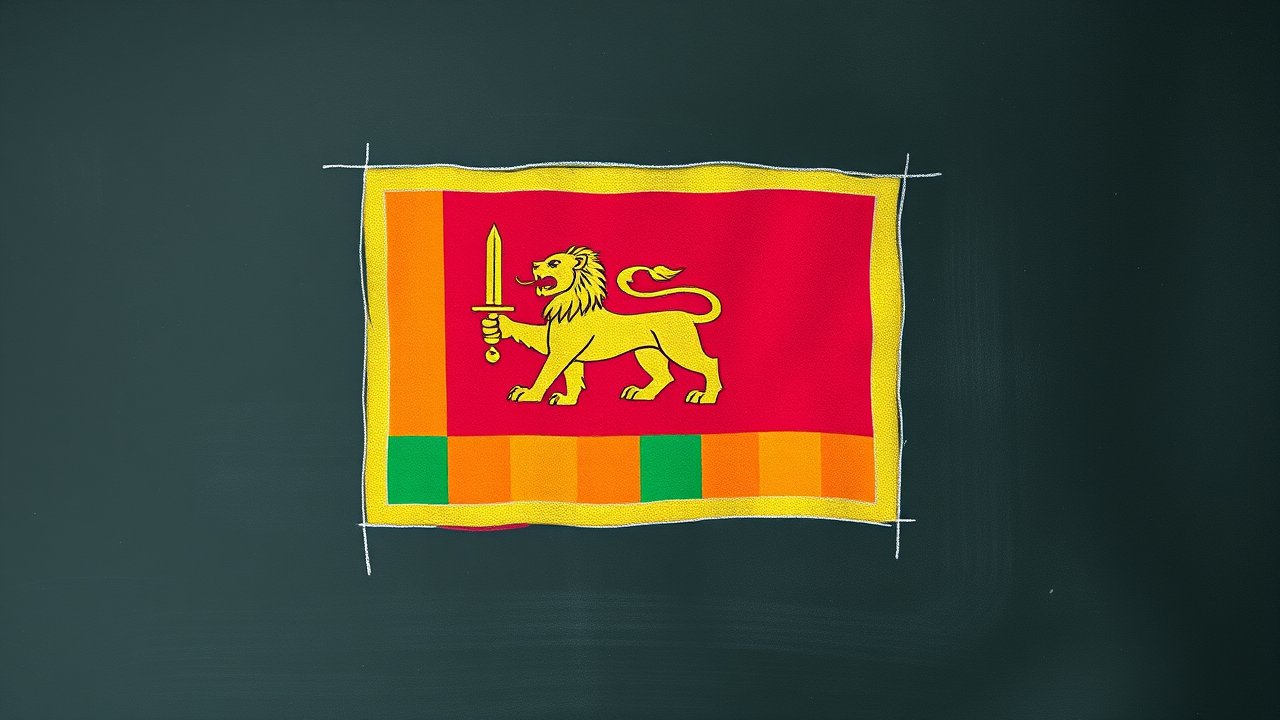
Chalk on Blackboard — Dark red field with a golden lion holding a sword, bordered by green and orange vertical stripes at the hoist. The flag of Sri Lanka drawn in chalk on a real blackboard. Dark red field with a golden lion holding a sword, bordered by green and orange vertical stripes at the hoist. Authentic blackboard — dark slate green surface with chalk dust and smudge marks. Soft, dusty white and colored chalk lines, imperfect edges, hand-drawn quality. Chalk dust particles visible in the air. The flag is immediately recognizable. No text, no letters, no words, no writing of any kind.
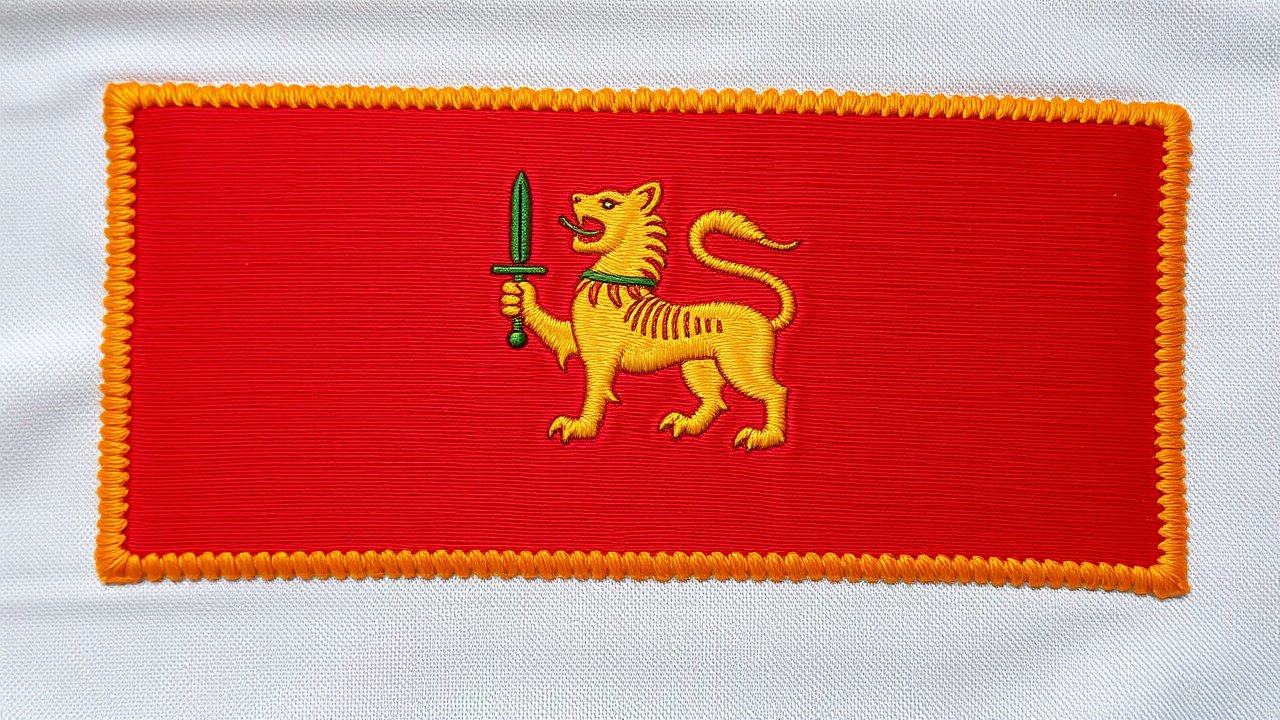
Embroidered Textile — Dark red field with a golden lion holding a sword, bordered by green and orange vertical stripes at the hoist. The flag of Sri Lanka as intricate embroidery on linen fabric. Dark red field with a golden lion holding a sword, bordered by green and orange vertical stripes at the hoist. Dense satin stitches, French knots, chain stitch detail. The flag design is completely faithful — exact colors, geometry, and all symbols faithfully stitched, immediately recognizable as the Sri Lanka flag. Visible thread texture, dimensional quality, warm handcrafted feel. No text, no letters, no words, no writing of any kind.
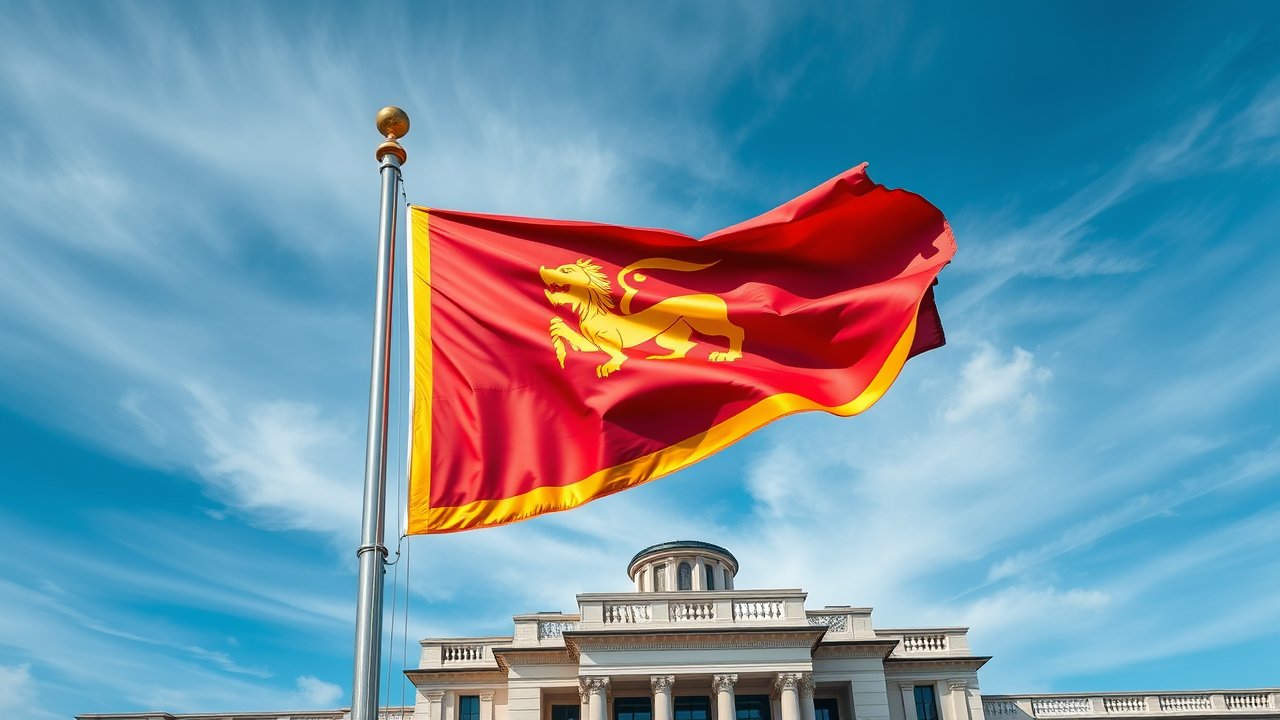
Flagpole in Capital — Dark red field with a golden lion holding a sword, bordered by green and orange vertical stripes at the hoist. Photorealistic photograph of the Sri Lanka flag flying on a tall flagpole in front of an iconic government building in the capital city. Dark red field with a golden lion holding a sword, bordered by green and orange vertical stripes at the hoist. The flag ripples naturally in the wind, colors vivid and exact. Documentary photography style, sharp and realistic. Grand architecture in the background. Blue sky, dramatic clouds. No text, no letters, no words, no writing of any kind.
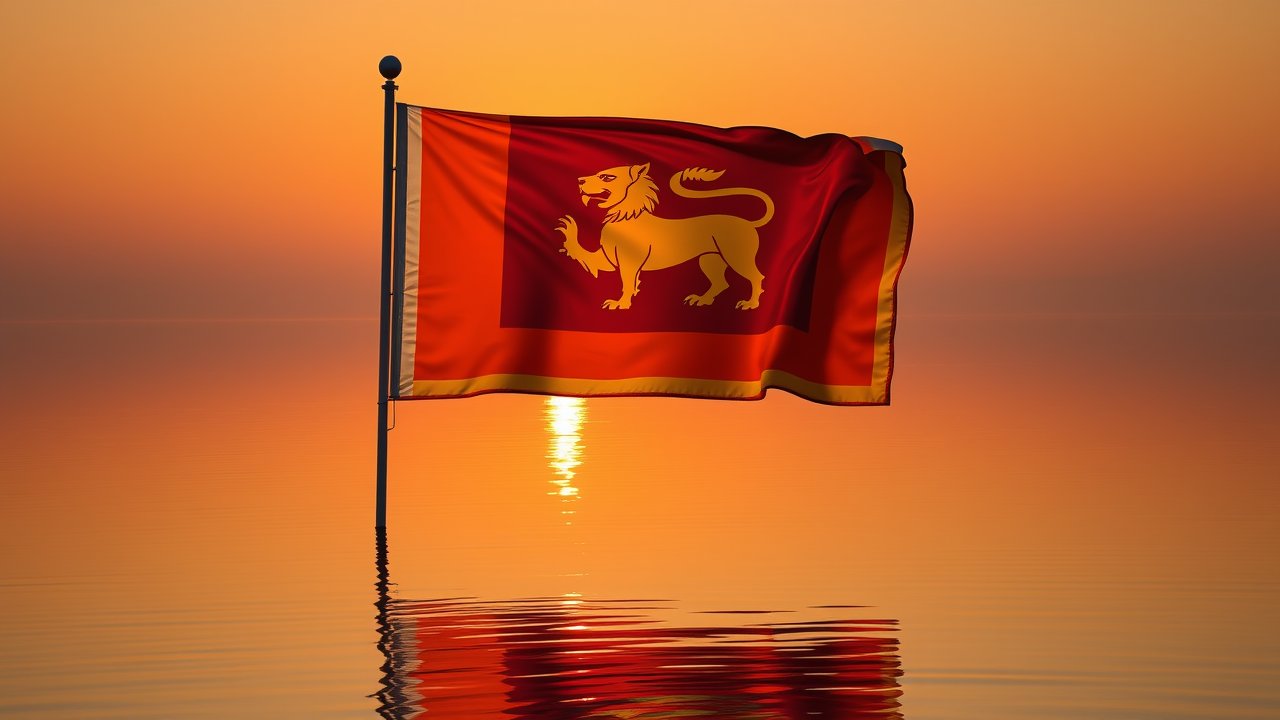
Golden Hour Reflection — Dark red field with a golden lion holding a sword, bordered by green and orange vertical stripes at the hoist. Photorealistic photograph of the Sri Lanka flag reflected in still water at golden hour. Dark red field with a golden lion holding a sword, bordered by green and orange vertical stripes at the hoist. The flag flies on a pole at the water’s edge, its reflection shimmering on the surface below. Warm amber and orange sunset light. The flag colors and design are faithful and vivid. Serene, cinematic landscape photography. No text, no letters, no words, no writing of any kind.
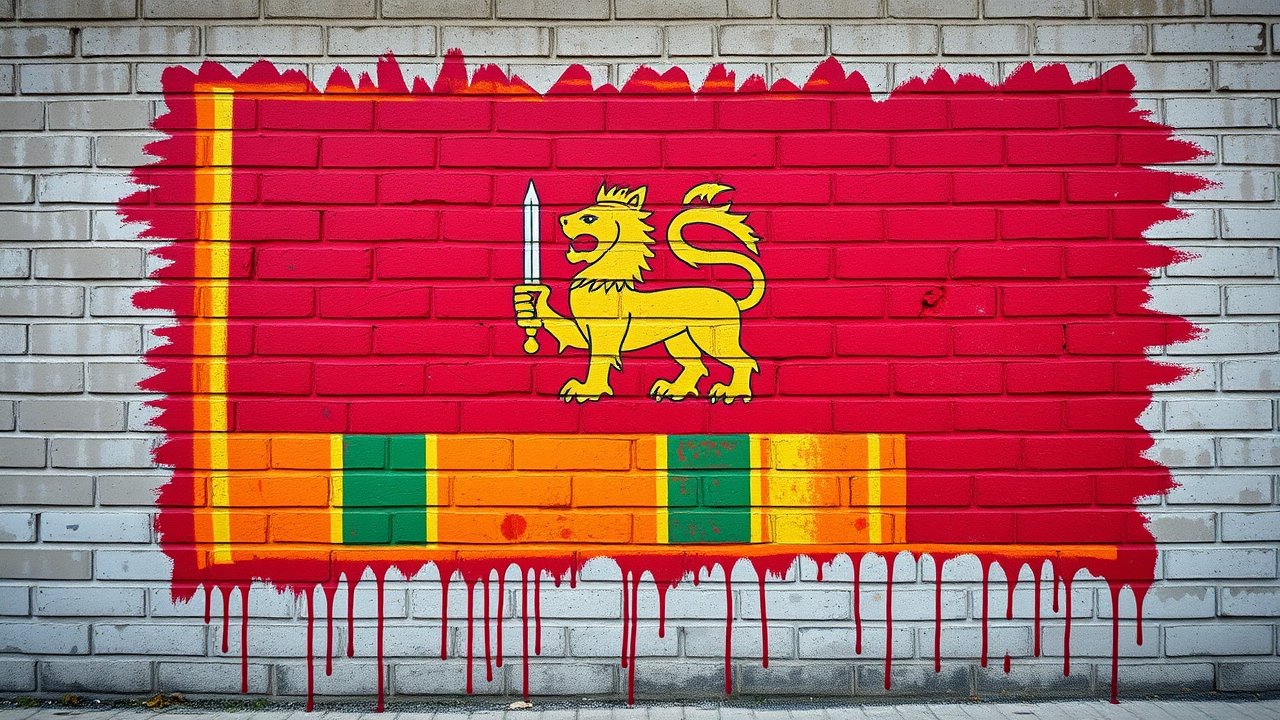
Street Art / Graffiti — Dark red field with a golden lion holding a sword, bordered by green and orange vertical stripes at the hoist. The flag of Sri Lanka as vibrant street art spray-painted on a brick wall. Dark red field with a golden lion holding a sword, bordered by green and orange vertical stripes at the hoist. Bold spray paint, dripping edges, stencil layers, overspray halos. The flag design is faithful and immediately recognizable — exact colors and symbols, just rendered in spray paint on urban concrete. No text, no letters, no words, no writing of any kind. No tags, no graffiti lettering.
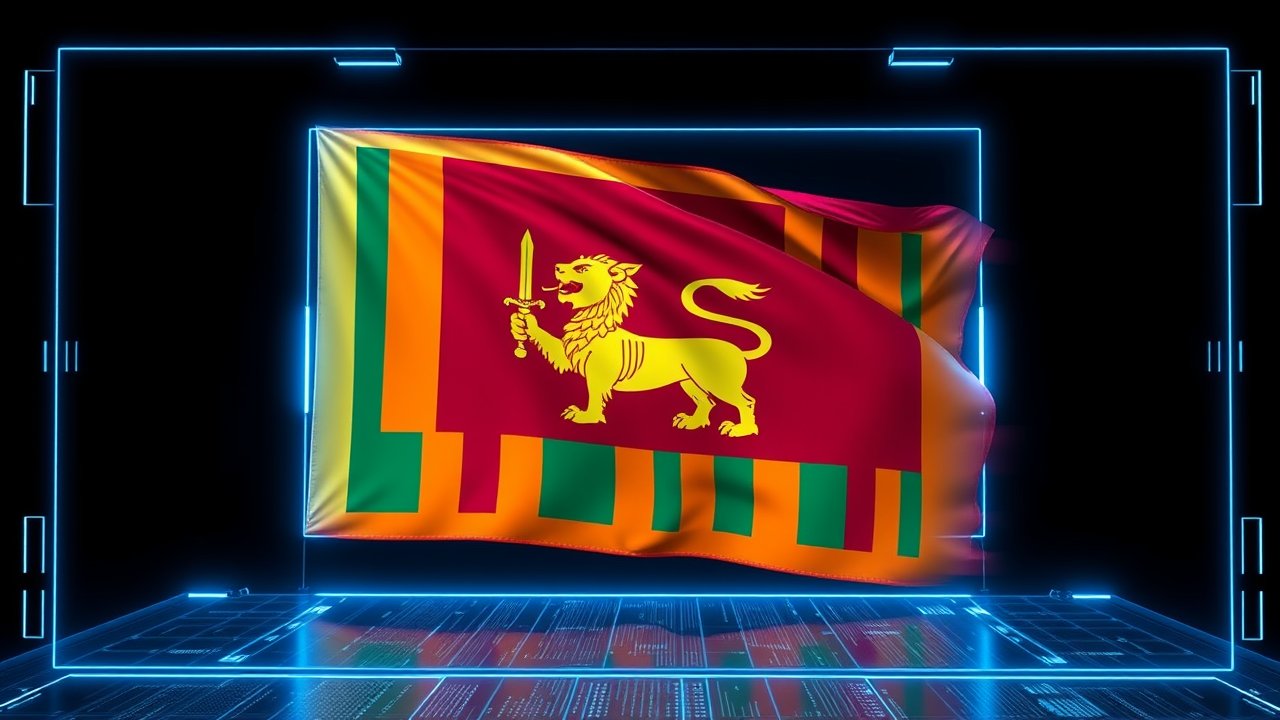
Sci-Fi Hologram — Dark red field with a golden lion holding a sword, bordered by green and orange vertical stripes at the hoist. The flag of Sri Lanka projected as a futuristic holographic display. Dark red field with a golden lion holding a sword, bordered by green and orange vertical stripes at the hoist. Translucent blue-white projection with scan lines, floating in dark space. Glitching edges, particle effects, data streams. The flag design is completely faithful and recognizable. Cyberpunk HUD elements framing the projection. No text, no letters, no words, no writing of any kind.
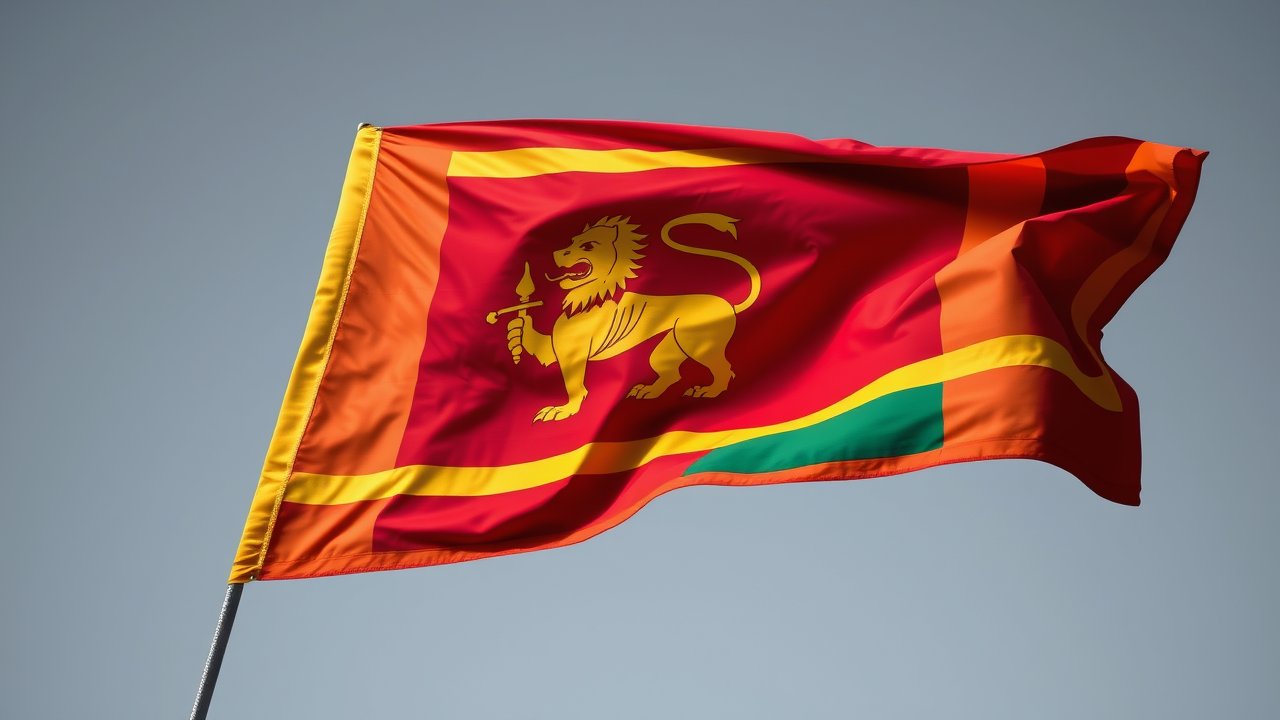
Hyperrealistic Wind — Dark red field with a golden lion holding a sword, bordered by green and orange vertical stripes at the hoist. Ultra-hyperrealistic photograph of the Sri Lanka flag caught in a dramatic gust of wind. Dark red field with a golden lion holding a sword, bordered by green and orange vertical stripes at the hoist. Macro-level fabric detail — individual threads visible, fabric folds and tension lines crisp. Colors and design completely faithful to the real Sri Lanka flag. High-speed shutter, razor-sharp focus, studio lighting. No text, no letters, no words, no writing of any kind.
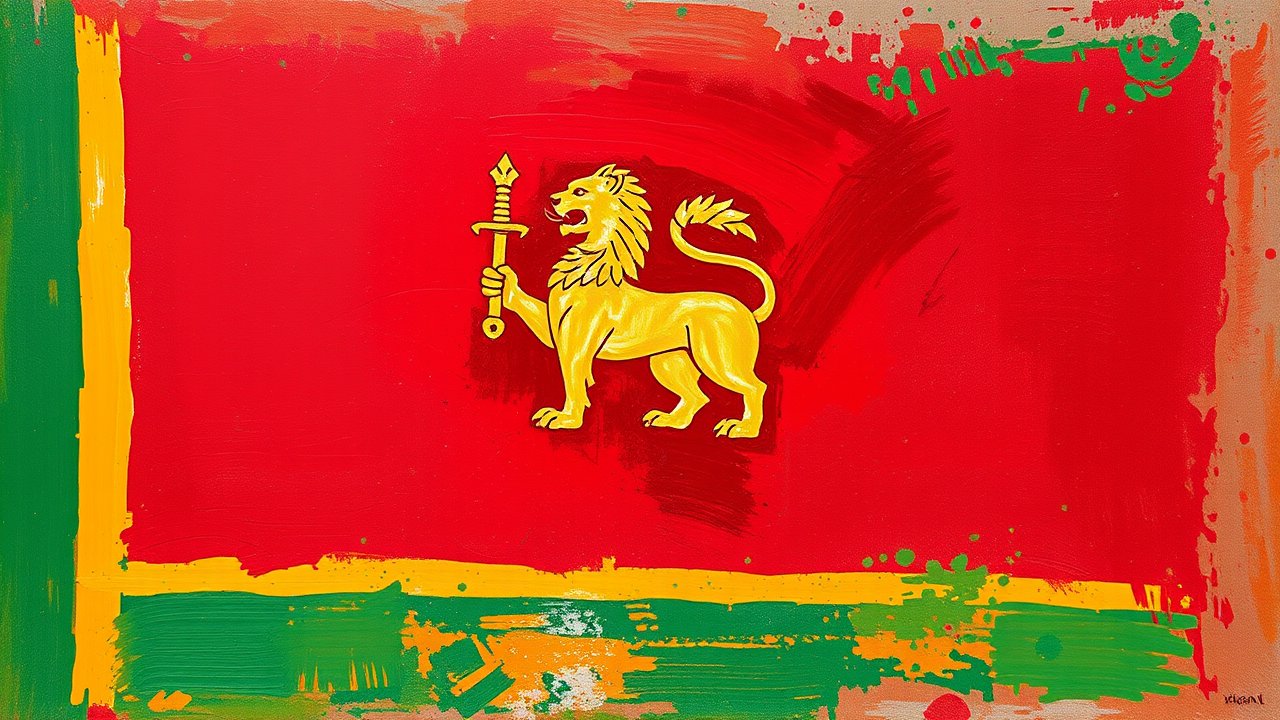
Impressionist Oil — Dark red field with a golden lion holding a sword, bordered by green and orange vertical stripes at the hoist. The flag of Sri Lanka painted in French Impressionist oil on canvas. Dark red field with a golden lion holding a sword, bordered by green and orange vertical stripes at the hoist. Thick impasto brushstrokes, dappled light, vibrant broken color technique in the style of Monet. The flag is instantly recognizable — colors and design faithful to the real Sri Lanka flag, interpreted with impressionist light and texture. No text, no letters, no words, no writing of any kind.
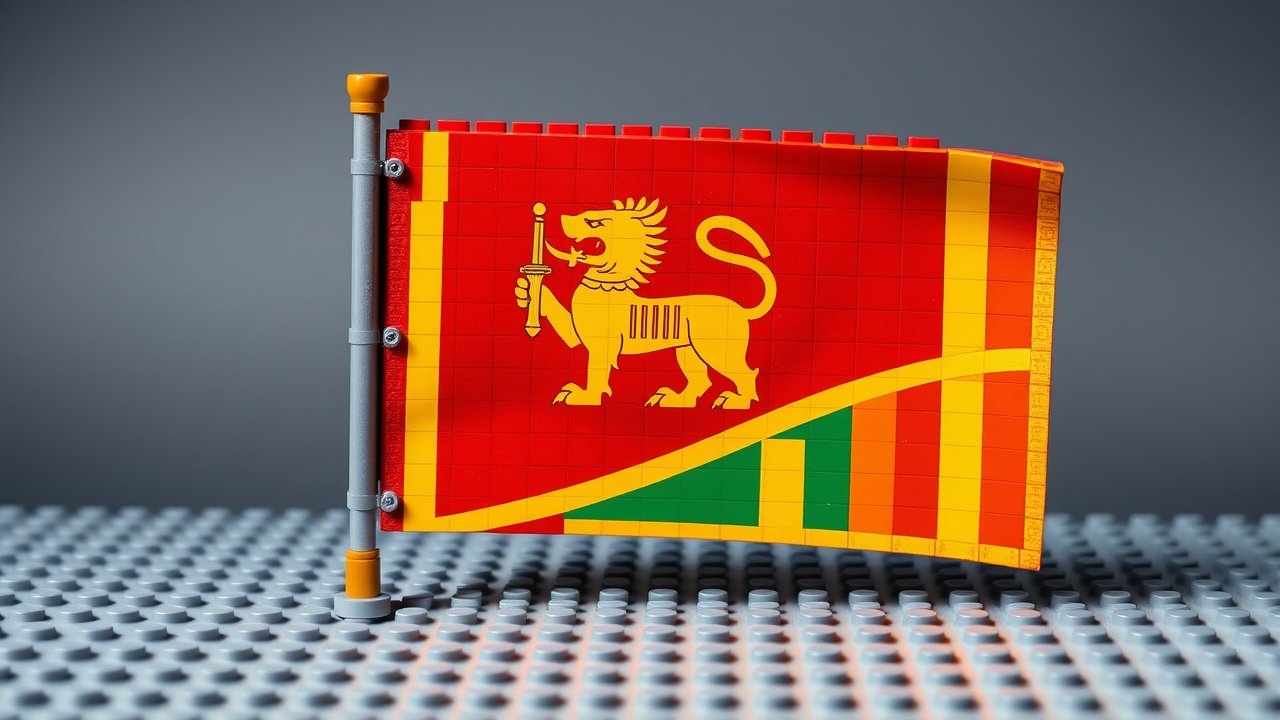
Lego Bricks — Dark red field with a golden lion holding a sword, bordered by green and orange vertical stripes at the hoist. The flag of Sri Lanka built from Lego bricks, photographed as a real physical construction. Dark red field with a golden lion holding a sword, bordered by green and orange vertical stripes at the hoist. Visible studs and brick seams, slight plastic sheen. Standard Lego colors approximate the flag’s palette. Built on a gray Lego baseplate. Dramatic angle showing the three-dimensional brick texture. No text, no letters, no words, no writing of any kind.
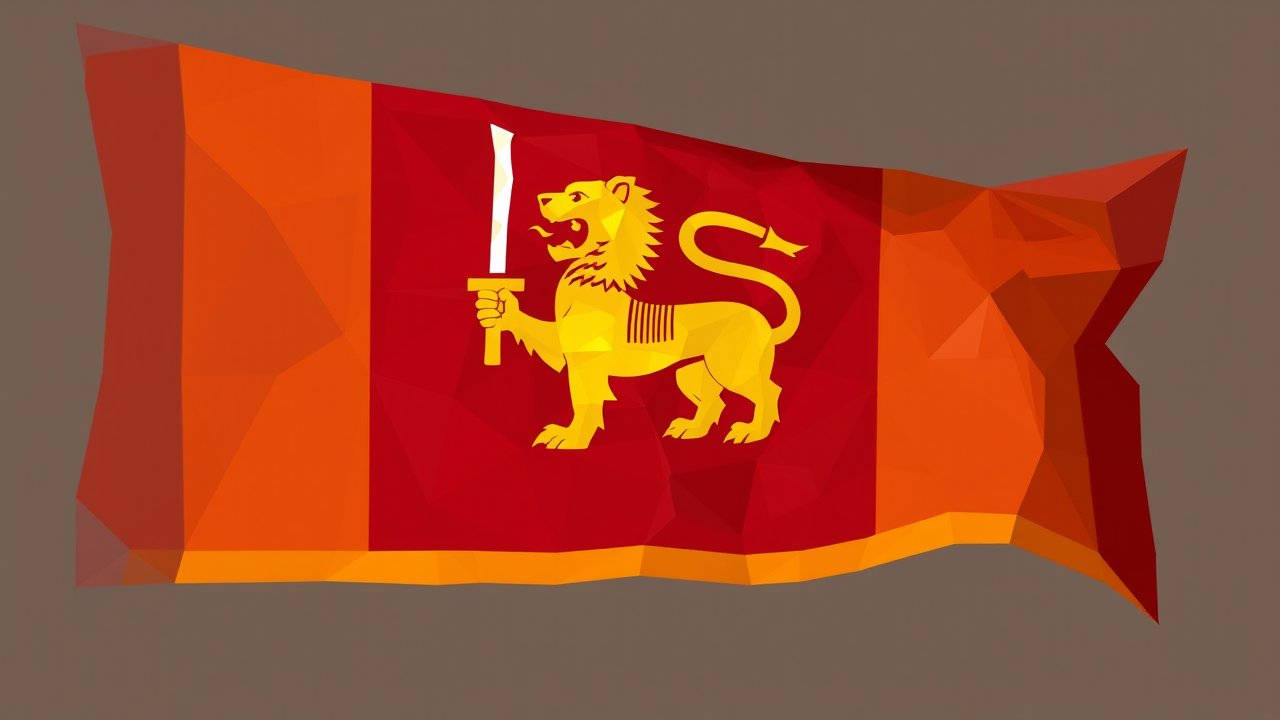
Low-Poly Geometric — Dark red field with a golden lion holding a sword, bordered by green and orange vertical stripes at the hoist. The flag of Sri Lanka constructed from low-polygon geometric triangles. Dark red field with a golden lion holding a sword, bordered by green and orange vertical stripes at the hoist. Aggressively faceted — each region broken into many visible triangular faces with subtle color variation across each polygon, creating real depth and dimensionality even in flat-color areas of the flag. Crystal-like, contemporary computational design. The flag is completely faithful and immediately recognizable. No text, no letters, no words, no writing of any kind.
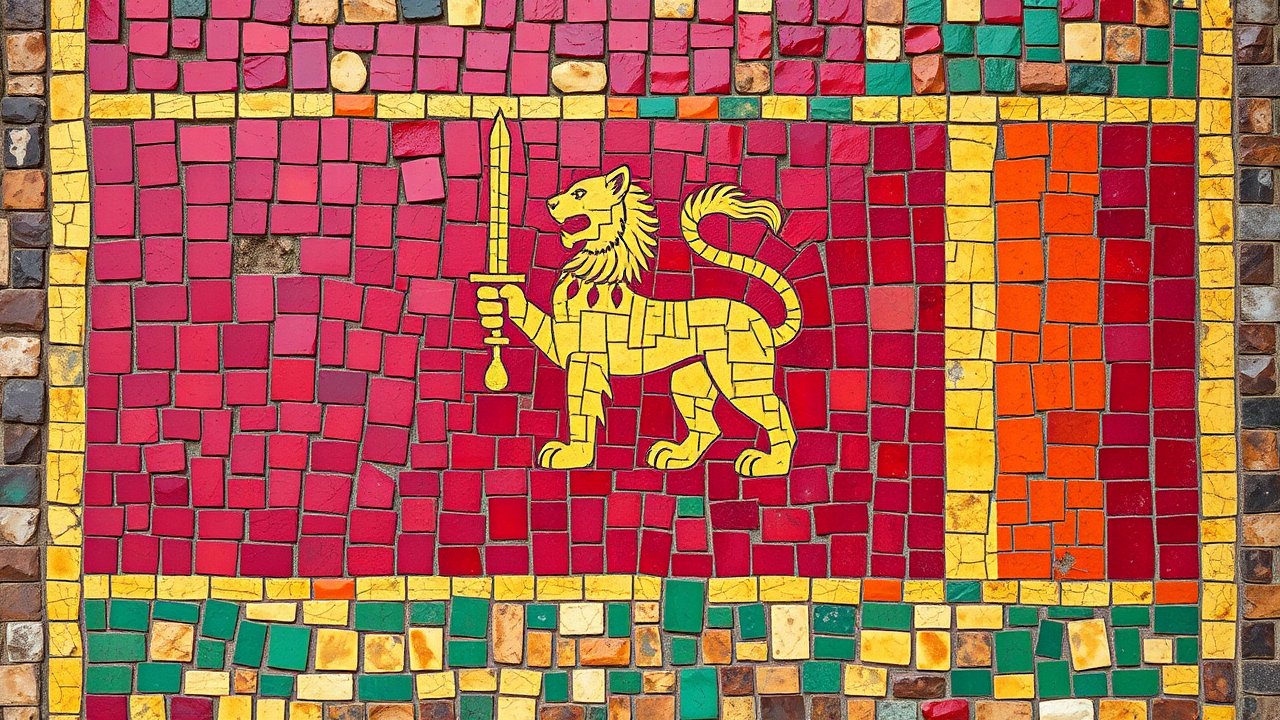
Mosaic Tiles — Dark red field with a golden lion holding a sword, bordered by green and orange vertical stripes at the hoist. The flag of Sri Lanka assembled as a Roman-style mosaic. Dark red field with a golden lion holding a sword, bordered by green and orange vertical stripes at the hoist. The flag is completely faithful to the real Sri Lanka flag — exact proportions, colors, and all symbols, rendered in thousands of small stone and glass tesserae. Visible grout lines, rich earthy tones mixed with brilliant glass, slight historical weathering. No text, no letters, no words, no writing of any kind.
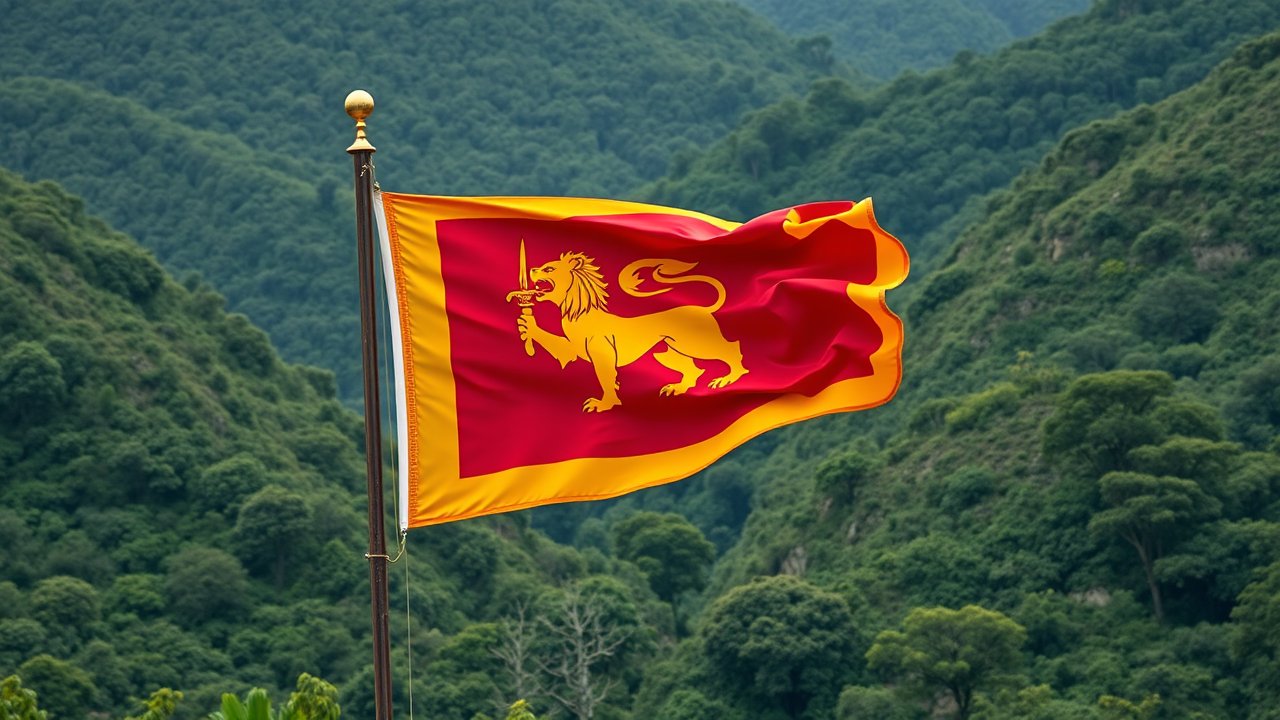
Native Landscape — Dark red field with a golden lion holding a sword, bordered by green and orange vertical stripes at the hoist. Photorealistic photograph of the Sri Lanka flag flying in an iconic natural landscape native to Sri Lanka — the terrain, flora, and environment characteristic of that country. Dark red field with a golden lion holding a sword, bordered by green and orange vertical stripes at the hoist. The flag is prominent and its colors are faithful and vivid. Remote, uninhabited wilderness. National Geographic photography style. No text, no letters, no words, no writing of any kind.
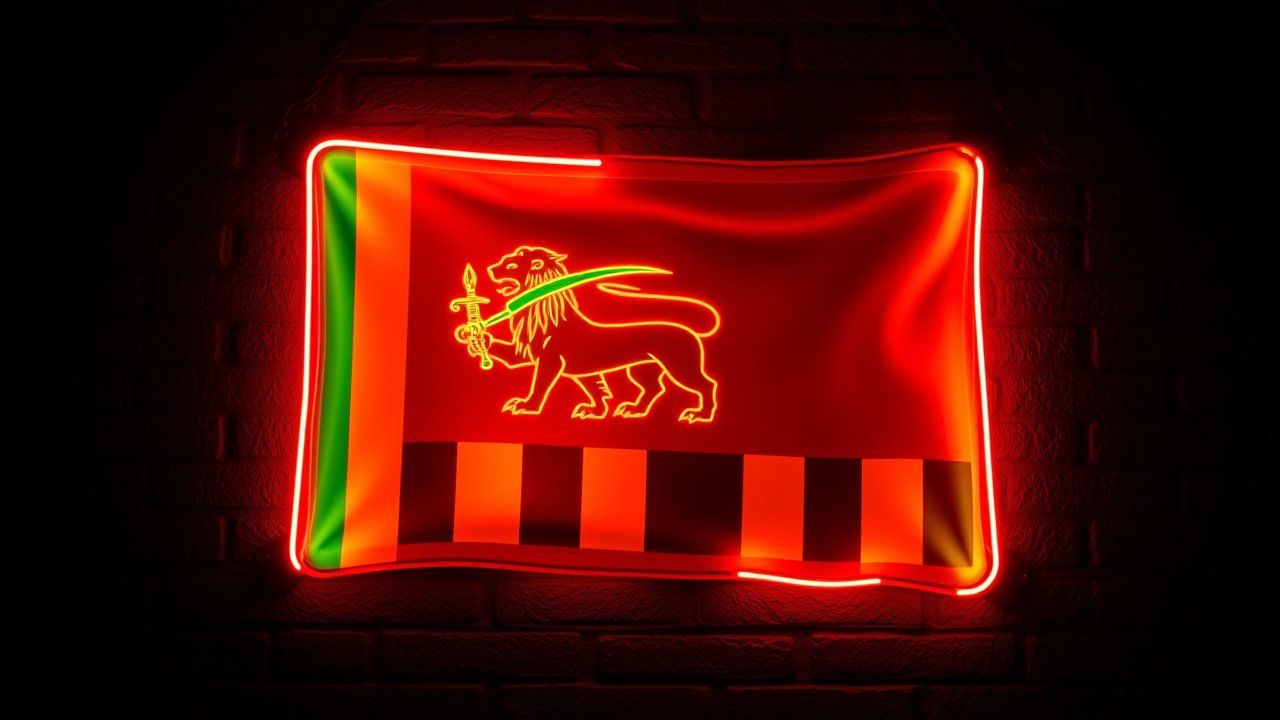
Neon Sign — Dark red field with a golden lion holding a sword, bordered by green and orange vertical stripes at the hoist. The flag of Sri Lanka recreated as a real neon sign mounted on a dark wall. Dark red field with a golden lion holding a sword, bordered by green and orange vertical stripes at the hoist. Glowing glass neon tubes bent into the flag’s shapes — the colors of the flag rendered in actual neon light. Visible glass tube bends, metal mounting brackets on the wall. Warm neon glow and light bloom. Real neon, not digital. Photographed in a dark room. No text, no letters, no words, no writing of any kind.
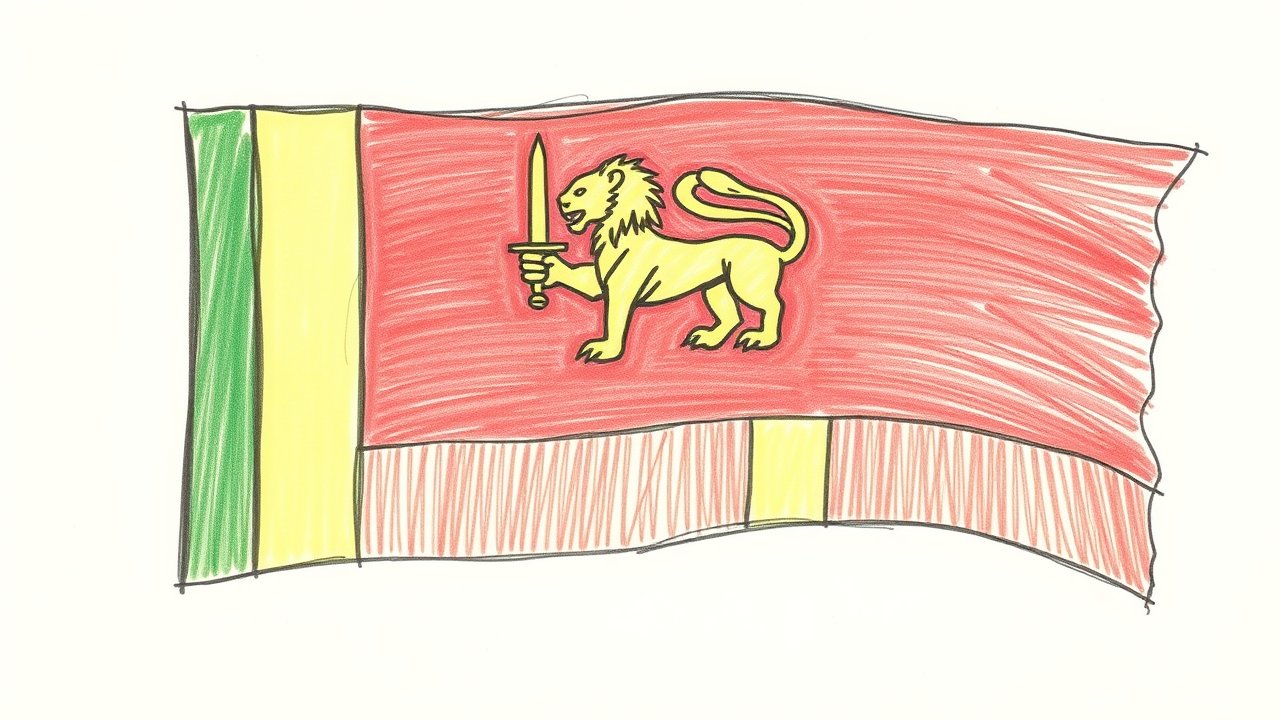
Pencil Sketch — Dark red field with a golden lion holding a sword, bordered by green and orange vertical stripes at the hoist. The flag of Sri Lanka as a bold, confident pencil sketch. Dark red field with a golden lion holding a sword, bordered by green and orange vertical stripes at the hoist. Strong graphite lines on cream paper — not delicate but bold and decisive. Heavy pressure on key outlines, dramatic cross-hatching for deep shadows and shading. Immediately recognizable as the Sri Lanka flag. Artist’s confident hand, not tentative. No text, no letters, no words, no writing of any kind.
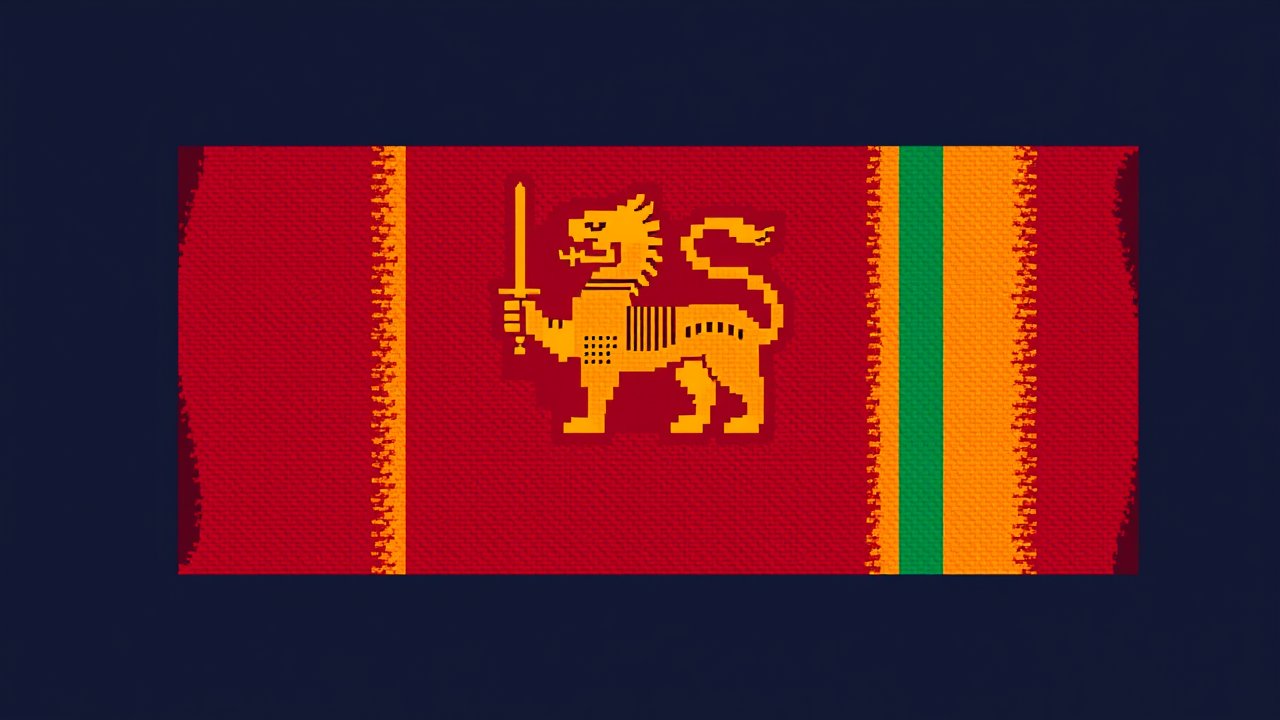
Pixel Art — Dark red field with a golden lion holding a sword, bordered by green and orange vertical stripes at the hoist. The flag of Sri Lanka as detailed 16-bit pixel art. Dark red field with a golden lion holding a sword, bordered by green and orange vertical stripes at the hoist. Crisp pixel grid, limited palette with careful dithering, nostalgic retro game aesthetic. Clean grid-aligned design with subtle shading. Every element of the flag faithfully reproduced in pixels. No text, no letters, no words, no writing of any kind.
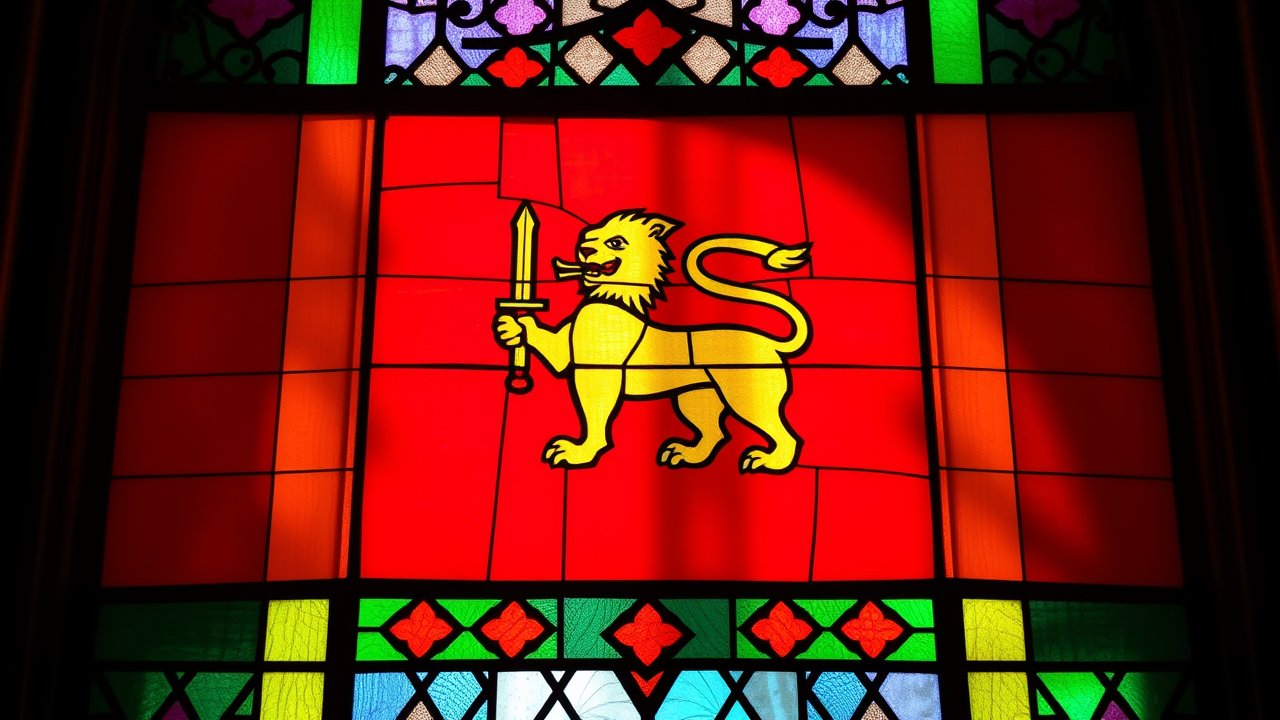
Stained Glass — Dark red field with a golden lion holding a sword, bordered by green and orange vertical stripes at the hoist. The flag of Sri Lanka rendered as an ornate stained glass window. Dark red field with a golden lion holding a sword, bordered by green and orange vertical stripes at the hoist. The design is completely faithful to the real Sri Lanka flag — exact colors, geometry, and all symbols preserved. Brilliant jewel-toned glass pieces separated by dark lead came lines. Warm sunlight streaming through, casting colored light. Gothic cathedral craftsmanship. No text, no letters, no words, no writing of any kind.
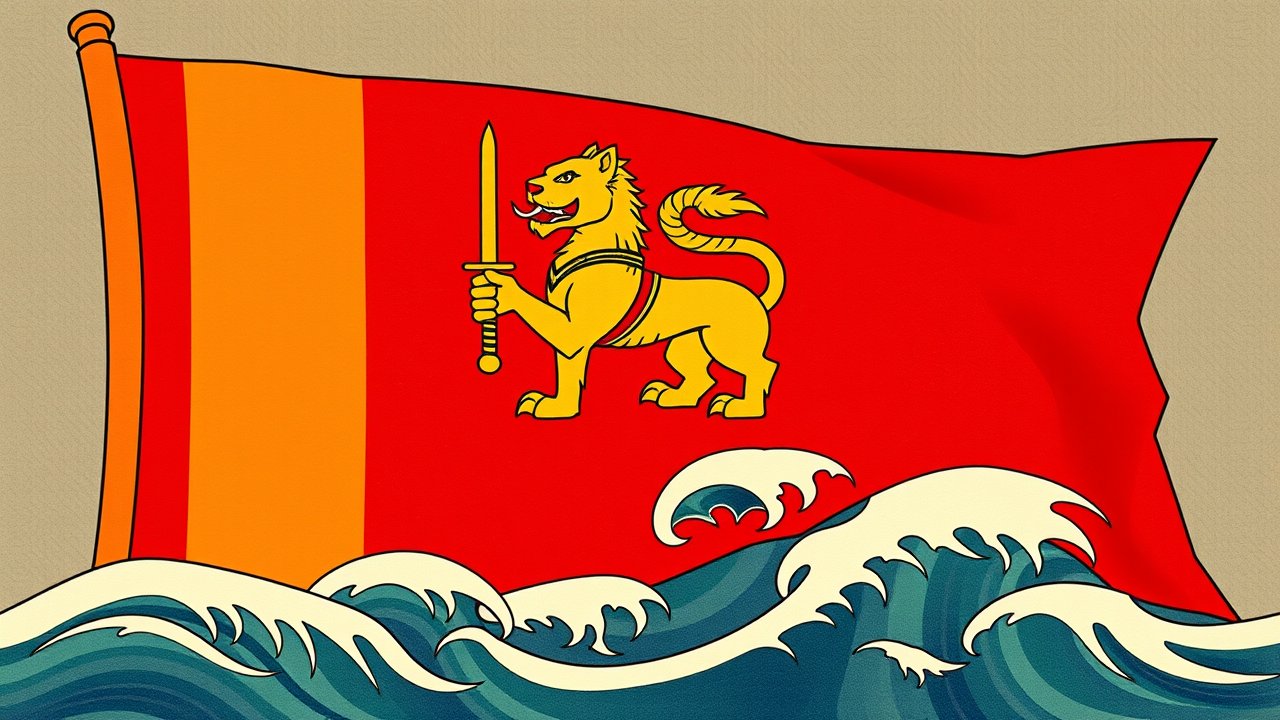
Ukiyo-e Woodblock — Dark red field with a golden lion holding a sword, bordered by green and orange vertical stripes at the hoist. The flag of Sri Lanka as a traditional Japanese ukiyo-e woodblock print. Dark red field with a golden lion holding a sword, bordered by green and orange vertical stripes at the hoist. Bold outlines, flat areas of rich color, flowing organic forms. Wind and waves incorporated into the composition. Printed on washi paper with visible wood grain texture. The flag is the central focus and instantly recognizable. No text, no letters, no words, no writing of any kind.
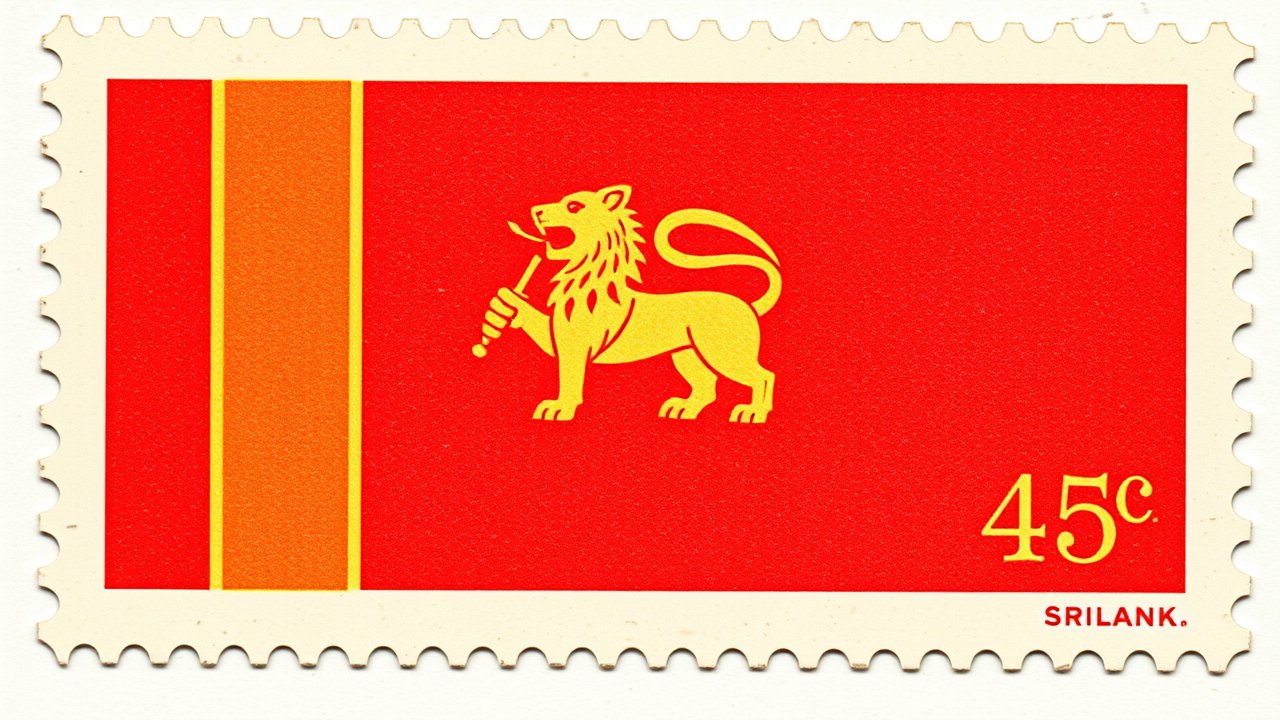
Vintage Postage Stamp — Dark red field with a golden lion holding a sword, bordered by green and orange vertical stripes at the hoist. The flag of Sri Lanka as a vintage 1950s postage stamp. Dark red field with a golden lion holding a sword, bordered by green and orange vertical stripes at the hoist. The flag fills most of the stamp — it is the primary subject, faithfully rendered in fine engraved intaglio style. Perforated edges, aged paper with slight foxing. The stamp may show a denomination numeral only — absolutely no other text or country names.
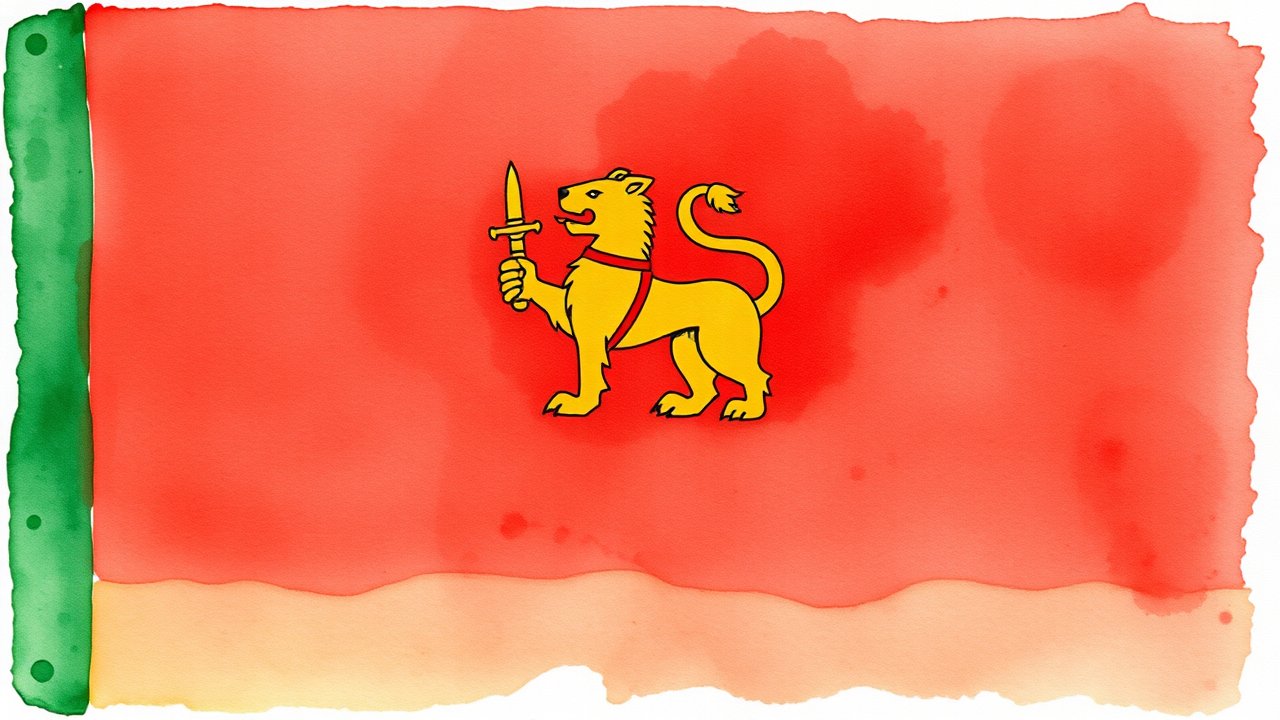
Watercolor — Dark red field with a golden lion holding a sword, bordered by green and orange vertical stripes at the hoist. The flag of Sri Lanka painted in loose, expressive watercolor. Dark red field with a golden lion holding a sword, bordered by green and orange vertical stripes at the hoist. Wet-on-wet technique with soft color bleeds, visible brushstrokes, natural paper texture. Delicate splashes and drips at the edges. Luminous, translucent layers of pigment. No text, no letters, no words, no writing of any kind.
Flag History and Symbolism of Sri Lanka
The national flag of Sri Lanka is one of the world’s oldest flags, with roots extending back more than two thousand years into the island’s ancient past. The flag’s distinctive design—featuring a golden lion holding a curved sword (kastane) against a maroon background, surrounded by four stylized bo leaves and flanked by vertical green and orange stripes—represents a unique synthesis of Buddhist heritage and modern multiculturalism that reflects the nation’s complex identity and diverse communities.
Ancient Origins and the Lion Symbol
The lion has appeared on Sri Lankan banners and standards for over two millennia, tracing its significance to Buddhist mythology and the founding narratives of the Sinhala people. According to the Mahavamsa, an ancient Buddhist chronicle, the Sinhala race descended from Prince Vijaya, whose father, King Sinhabahu, was born of a liaison between a lion and a human princess. This mythological connection established the lion as a symbol of Sinhala identity and royal authority. Archaeological evidence supports this ancient tradition; the earliest known depiction of a Sri Lankan lion flag appears in Cave 2 at Dambulla Viharaya, where King Dutugemunu is depicted around 162 BCE carrying a banner bearing a lion figure holding a sword in its right forepaw. This iconography remained central to Sri Lankan royal standards throughout the medieval period, appearing on the flags of the Kingdom of Gampola (c. 1341–1408), the Kingdom of Kotte (c. 1412–1597), the Kingdom of Sitawaka (c. 1521–1594), and most notably the Kingdom of Kandy (c. 1798–1815), the last independent Sinhala kingdom.
Colonial Era and the Loss of the Lion Flag
The Kandyan Convention of 1815 marked a watershed moment in Sri Lankan history. The British conquered the final independent kingdom and replaced the royal lion standard with the Union Flag, effectively suppressing a symbol that had endured for centuries. The original Kandyan lion flag, however, was not destroyed but rather transferred to England’s Royal Hospital Chelsea, where it remained during the entire colonial period. The loss of the lion flag symbolized the end of native rule and the imposition of British imperial authority over the island. During the colonial period, Ceylon—as the island was then known—did maintain its own flag design from 1875 to 1948, but this lacked the cultural resonance and historical depth of the ancient lion banner.
Independence and Restoration of the Lion Flag
The restoration of the lion flag occurred at a pivotal moment in Sri Lankan history. When Ceylon achieved independence on February 4, 1948, the nation’s first Prime Minister, D.S. Senanayake, reinstated the ancient lion flag as the symbol of national sovereignty. This decision was not merely ceremonial; it represented a reclamation of pre-colonial identity and a rejection of colonial symbolism. The rediscovery of the original lion flag at the Royal Hospital Chelsea during the independence movement had sparked renewed interest in this historical emblem and inspired its revival. The 1948 Lion Flag consisted of the maroon background with the golden lion and kastane sword, bearing the lion standard’s original medieval design.
Design Modernization: Inclusion of Minority Communities
In 1951, the government formed a National Flag Committee to modernize the flag’s design to represent Sri Lanka’s diverse population. This led to a significant modification: two vertical stripes were added to the flag’s left side—an orange stripe representing the Tamil community and a green stripe representing the Muslim community. These additions reflected the political commitment to inclusion and recognized that Sri Lanka was not solely a Sinhala Buddhist nation but rather a multi-ethnic, multi-religious state. A golden-yellow border was also incorporated, symbolizing other minority communities including the Malays, Burghers, Indigenous Veddas, and Sri Lankan Chinese. The maroon lion field continued to represent the Sinhala majority, while the colored stripes created a visual representation of national unity across religious and ethnic lines.
Religious and Philosophical Symbolism: The Bo Leaves
The most significant design evolution occurred in 1972, when the flag underwent further modernization. In place of the four spearheads that had previously adorned the corners, four stylized bo leaves were introduced, each representing one of Buddhism’s four cardinal virtues. These bo leaves symbolize metta (loving-kindness), karuna (compassion), mudita (appreciative joy), and upekkha (equanimity). The bo leaf itself carries profound religious significance in Buddhism, as it is the sacred tree under which Buddha attained enlightenment at Bodh Gaya. By incorporating the bo leaves, the flag embedded Buddhist spiritual principles directly into the nation’s foremost symbol, acknowledging the deep influence of Buddhism on Sri Lankan culture and values. The current design of these leaves was refined in 1978 to appear more natural and refined. A final significant design element is the kastane sword held by the lion, which represents sovereignty and national strength.
Modern Flag and Continuing Symbolism
The flag in its current form, formally adopted on May 22, 1972, represents a carefully balanced symbol of Sri Lankan identity. The predominant maroon field and central lion acknowledge the Sinhala Buddhist heritage that forms the cultural foundation of the nation, while the orange and green stripes provide equal visual prominence to Tamil and Muslim communities. The golden border and bo leaves extend the symbolism to encompass all of Sri Lanka’s religious and ethnic minorities, while the bo leaves themselves embed Buddhist values at the heart of the national symbol. This design reflects the nation’s aspirations toward pluralism and coexistence, even as it acknowledges historical and cultural hierarchies.
Notable Facts and Modern Context
Sri Lanka’s flag is unique among world flags for its combination of ancient historical symbolism with modern design elements addressing contemporary pluralism. The flag’s colors—maroon, gold, green, and orange—are all historically significant, with maroon being a traditional color of Sinhala kingship, while green and orange represent the green of Islam and the saffron/orange of Hinduism and Tamil culture. The flag’s design demonstrates how symbols can evolve to reflect changing political realities while maintaining historical continuity. The lion flag’s survival through two thousand years of history, from ancient kingdoms through colonial suppression and into modern independence, underscores its central importance to Sri Lankan national identity and serves as a powerful reminder of the nation’s determination to preserve its cultural heritage while building an inclusive modern state.
Free Printable: Flags of the World Reference Card
Get a beautiful printable poster with 50 flag emojis, Unicode codes, and fun facts. Perfect for classrooms and desks!
No spam, ever. Unsubscribe anytime.