

How To
How To
Time needed: 1 minute
Want the full printable classroom pack?
Take the flag reference from your screen to an offline pack for lessons, practice, and quiz time.
- Printable atlas with 230+ high-resolution flag flats
- Four regional quizzes with answer keys
- Flag Bingo boards and caller sheet
How to copy and paste the Flag of Austria Emoji to any device.
- Copy the Austrian Flag Emoji
Go to flagemoji.com and press the copy button (above). This works on any device.
- Paste the Emoji
Go to your email/iMessage/SMS texting service/document and paste the emoji.
For mobile devices
— double-tap or tap-hold, then paste should appear. Tap it.
For desktop and laptops on Apple devices
— command-P / ⌘-P
For desktop and laptops on Windows devices
— control-p
Codes
Emoji Codes
Flag emojis are unicode symbols, like any other letter or number on your keyboard. This means you can copy and paste the emoji itself into your code, whatever the language (click the button above).
They actually count as two characters: the two-letter country code (the ISO international standard). The unicode and shortcode both represent country data which devices can interpret and display the emoji.
| Country Code | Unicode | Shortcode |
| AT | U+1F1E6 U+1F1F9 | :flag_AT: :AT: |
Emoji shortcodes are used on some platforms as a way for users to type in emojis from the keyboard. If you type the emoji shortcode on Github or Slack, the emoji will appear.
*The official name of the emoji is only the country name, not ‘Austria Flag’, for example.
Description
Description
The flag of Austria is composed of three equal horizontal bands; red (top), white, and red. The flag design is one of the oldest national banners in the world. According to tradition, in 1191, following a fierce battle in the Third Crusade, Duke Leopold V of Austria’s white tunic became completely blood-spattered. Upon removal of his wide belt or sash, a white band was revealed. The red-white-red color combination was subsequently adopted as his banner.
Map
Map
Check out the map of Trinidad and Tobago!
Weather
Anthem
National Anthem
| Title | Bundeshymne (Federal Hymn) |
| Composer | Paula von Preradovic / Wolfgang Amadeus Mozart or Johann Holzer |
FAQ
FAQs
Austria regained their status as an independent and sovereign nation on October 26, 1955.
The red and white flag was designed to resemble the bloodstained white coat worn by the Duke of Austria during a fierce battle.
The current version of the Austrian flag was adopted on April 27, 1984.
Austria’s government type is Federal Parliamentary Republic.
Discover more fun facts of Qatar.
Printable
Printable Austrian Flag
Print another really cool flag. Why not the flag of Chile?
Austria’s flag stands as one of the world’s oldest national symbols still in continuous use, with documented origins tracing back to 1230 when the distinctive red-white-red design first appeared on an official seal of Lilienfeld Abbey under Duke Frederick II, the last ruler of the Babenberg dynasty. This ancient triband—featuring three equal horizontal stripes with red on top and bottom and white in the centre—represents more than seven centuries of Austrian identity and has survived multiple dynasties, empire collapses, occupations, and political upheavals to remain the nation’s official flag today. The antiquity of Austria’s flag rivals that of only a handful of other national symbols worldwide, making it a particularly venerable emblem of European heritage and continuity through dramatic historical transformations.
The symbolism of Austria’s tricolour is deeply embedded in legend, medieval history, and modern political identity. According to one widely-circulated medieval tradition, the design originated from Duke Leopold V following his participation in the Crusades’ Siege of Acre in 1191, during which his white tunic became completely drenched in blood during fierce combat. According to this account, when he removed his belt after the battle, the cloth beneath remained white, creating the striking red-white-red contrast that would define Austrian identity for centuries to come. While modern historians scrutinize the accuracy of this legendary narrative, with scholarly evidence suggesting a later formalization around 1230 rather than 1191, the story has proven remarkably resilient in Austrian national consciousness and remains widely known and celebrated. Beyond the legendary accounts, the vibrant red in the flag traditionally symbolises the courage, strength, resilience, and sacrifice of the Austrian people throughout their complex and often turbulent history, encompassing medieval conflicts, Renaissance cultural flourishing, Habsburg expansionism, and modern nation-building. The pristine white band conversely represents peace, integrity, honesty, and—more recently—Austria’s formal declaration of permanent neutrality proclaimed in the Austrian State Treaty of 1955, when the nation solemnly renounced military alliances and pledged to remain politically and militarily independent, a commitment that has fundamentally shaped Austrian foreign policy and international relations for nearly seven decades.
The flag’s complex journey through European history directly reflects Austria’s own dramatically shifting political landscape and territorial evolution across more than two millennia. During the medieval and early modern periods under Babenberg and subsequent Habsburg rule, the red-white-red triband served as a coat of arms of the dynasty’s hereditary lands in Central Europe, gradually and organically becoming inseparable from Austrian regional and cultural identity as the House of Habsburg consolidated its power across diverse territories. For centuries, Habsburg emperors carried the colours into negotiations and battles across the continent, and the triband became associated with the stability and extensive reach of the empire. This fundamental relationship transformed catastrophically with the military defeat and dissolution of the Austro-Hungarian Empire in 1918 after World War I, when the multicoloured black-yellow imperial flag representing the vast multinational realm became obsolete and powerless. The newly formed First Austrian Republic, seeking to establish a distinct national identity separate from its imperial past and reduced territorial boundaries, immediately and symbolically readopted the red-white-red triband as its national flag, thereby reclaiming and repurposing the ancient colours as an emblem of rebirth, independence, and democratic renewal.
This restored flag design continued through the volatile interwar period of the 1920s and 1930s, and remarkably persisted even through the Nazi occupation and Anschluss of 1938-1945, when the swastika and Nazi emblems dominated the territories under German control. Following Austria’s liberation by Allied forces and the reestablishment of sovereignty, the flag was formally and symbolically readopted on May 1, 1945, marking the nation’s return to independence and becoming a powerful visual representation of Austrian resilience and reclaimed nationhood. In the decades that followed, particularly after the Austrian State Treaty of 1955 officially restored full independence and mandated permanent neutrality, the flag evolved into a symbol not just of national identity but of Austria’s distinctive position as a neutral nation committed to peace in a divided Europe during the Cold War. This neutrality provision proved so integral to Austrian national identity that it continues to define the country’s foreign policy and international standing to the present day, remaining deeply embedded in the Austrian Constitution. A refinement to standardize the flag’s specifications occurred in 2018, when official government decrees established that the precise shade of red be designated as Pantone 186 C, ensuring absolute consistency in the flag’s representation across all official government documents, diplomatic correspondence, military uniforms, and international contexts.
The Austrian flag’s elegant yet distinctive design consists of three equal horizontal bands in the proportion ratio of 2:3 (width to height), with the top and bottom stripes rendered in bold, unmistakable red and the central band in clean, bright white. This straightforward triband configuration places Austria among the world’s most recognizable national flags, yet Austria’s particular combination of red and white, with its precise shades and proportions, remains wholly unique and instantly identifiable among the family of European nations. The flag’s geometric simplicity and bold colour contrast have contributed significantly to its longevity and effectiveness as a national symbol; unlike flags featuring complex heraldry, intricate coat of arms, detailed national emblems, or symbolic imagery that can become dated, lose cultural relevance, or prove difficult to reproduce, Austria’s uncomplicated triband has remained strikingly contemporary and emotionally powerful across more than seven centuries of continuous use. The flag appears prominently and frequently at official state ceremonies, adorns government and public buildings throughout the nation, features prominently in public demonstrations of patriotism and national pride, and serves as a unifying visual emblem during major international sporting events like the Olympic Games and FIFA World Cups, where it rallies Austrian athletes and citizens alike. The flag’s remarkable resilience and adaptability have allowed it to maintain its core symbolic power and meaning while gracefully accommodating changing aesthetics, artistic conventions, and modern contexts throughout the centuries, ensuring its continued relevance to contemporary Austrians while honouring centuries of historical tradition.
Sources: Wikipedia – Flag of Austria; Britannica – Flag of Austria; Fahnen-Gärtner – History of the Austrian Flag; World Population Review – Austria Flag; Visit Austria – Austria Flag; World Atlas – Flags, Symbols & Currency of Austria; Unacademy – Austrian Flag’s History and Meaning
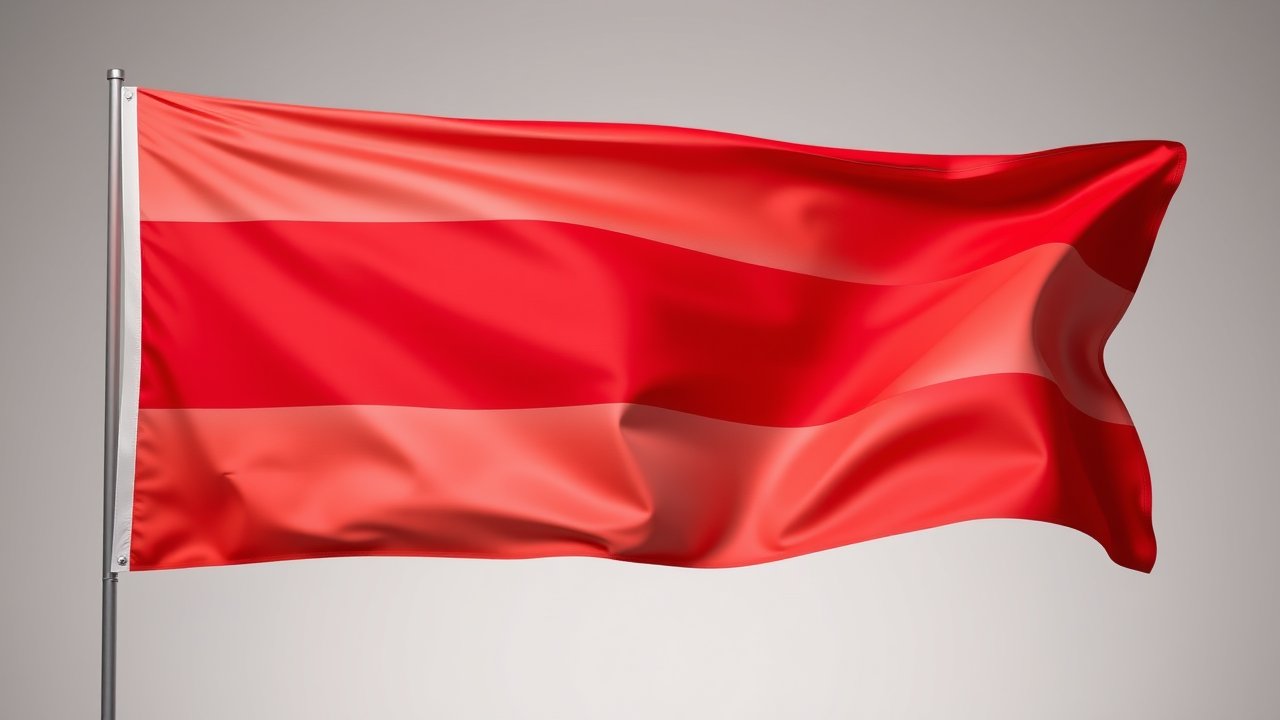
3D Glossy Render — Three horizontal stripes of red, white, and red. The flag of Austria as a photorealistic 3D render. Three horizontal stripes of red, white, and red. The flag fabric hangs or drapes naturally but preserves exact proportions, colors, and all symbols perfectly — completely faithful to the real Austria flag. Dramatic studio lighting, glossy silk material, soft shadows, subsurface scattering, perfect specular highlights. No text, no letters, no words, no writing of any kind.

Chalk on Blackboard — Three horizontal stripes of red, white, and red. The flag of Austria drawn in chalk on a real blackboard. Three horizontal stripes of red, white, and red. Authentic blackboard — dark slate green surface with chalk dust and smudge marks. Soft, dusty white and colored chalk lines, imperfect edges, hand-drawn quality. Chalk dust particles visible in the air. The flag is immediately recognizable. No text, no letters, no words, no writing of any kind.
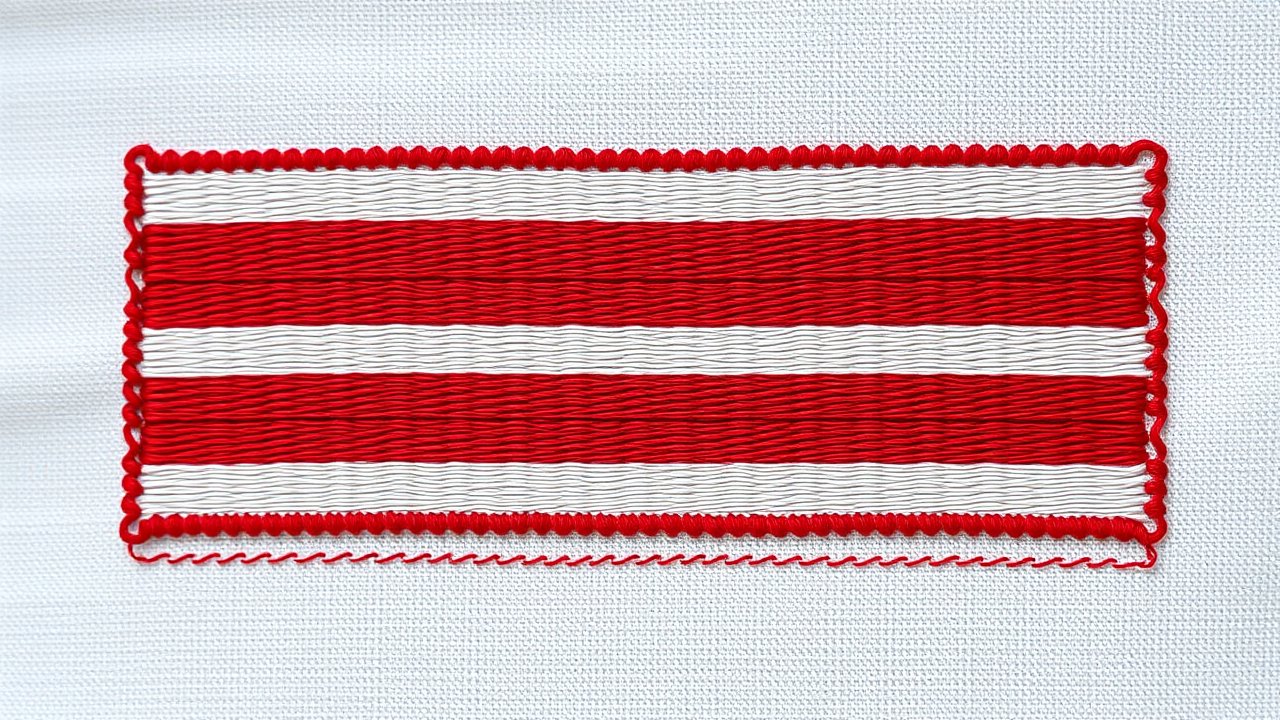
Embroidered Textile — Three horizontal stripes of red, white, and red. The flag of Austria as intricate embroidery on linen fabric. Three horizontal stripes of red, white, and red. Dense satin stitches, French knots, chain stitch detail. The flag design is completely faithful — exact colors, geometry, and all symbols faithfully stitched, immediately recognizable as the Austria flag. Visible thread texture, dimensional quality, warm handcrafted feel. No text, no letters, no words, no writing of any kind.
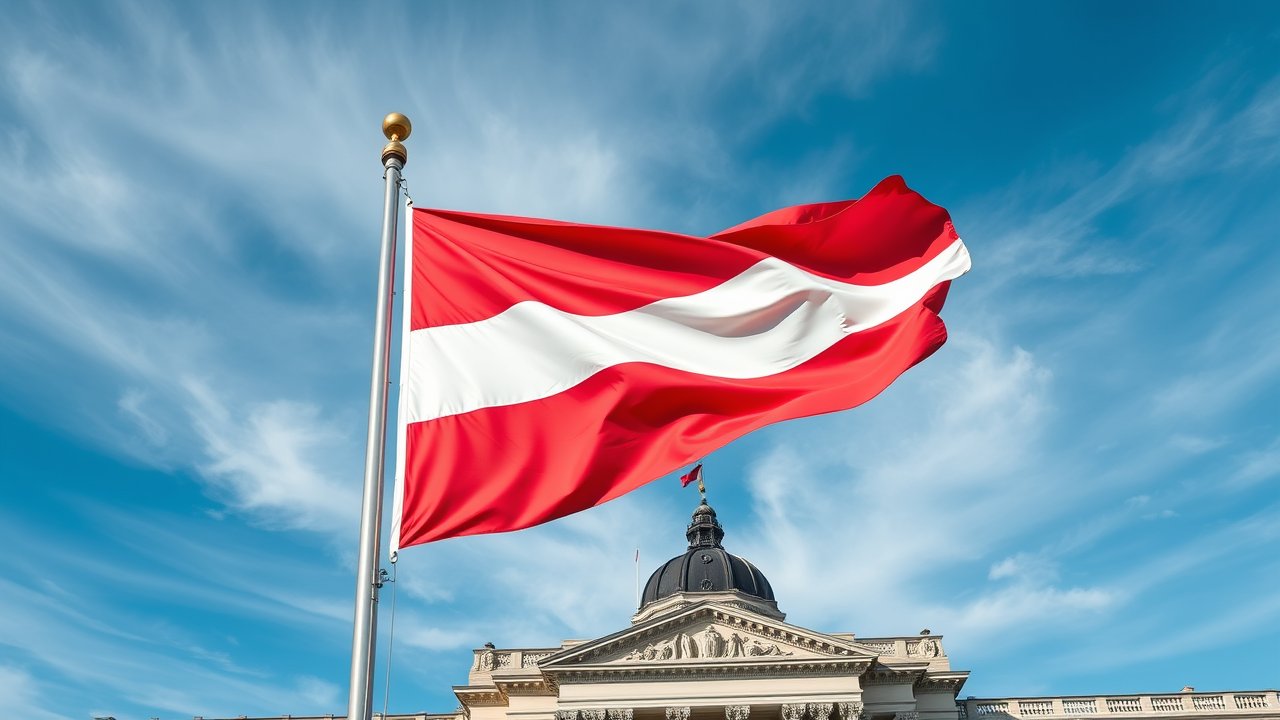
Flagpole in Capital — Three horizontal stripes of red, white, and red. Photorealistic photograph of the Austria flag flying on a tall flagpole in front of an iconic government building in the capital city. Three horizontal stripes of red, white, and red. The flag ripples naturally in the wind, colors vivid and exact. Documentary photography style, sharp and realistic. Grand architecture in the background. Blue sky, dramatic clouds. No text, no letters, no words, no writing of any kind.
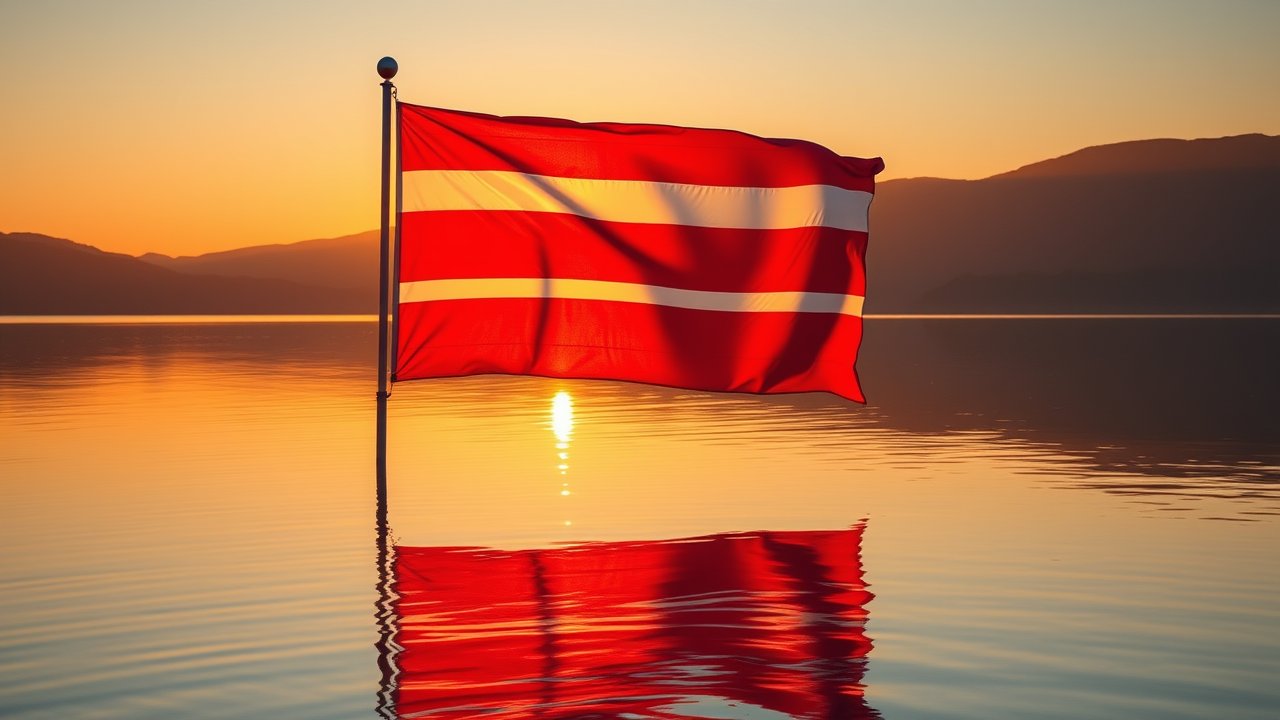
Golden Hour Reflection — Three horizontal stripes of red, white, and red. Photorealistic photograph of the Austria flag reflected in still water at golden hour. Three horizontal stripes of red, white, and red. The flag flies on a pole at the water’s edge, its reflection shimmering on the surface below. Warm amber and orange sunset light. The flag colors and design are faithful and vivid. Serene, cinematic landscape photography. No text, no letters, no words, no writing of any kind.
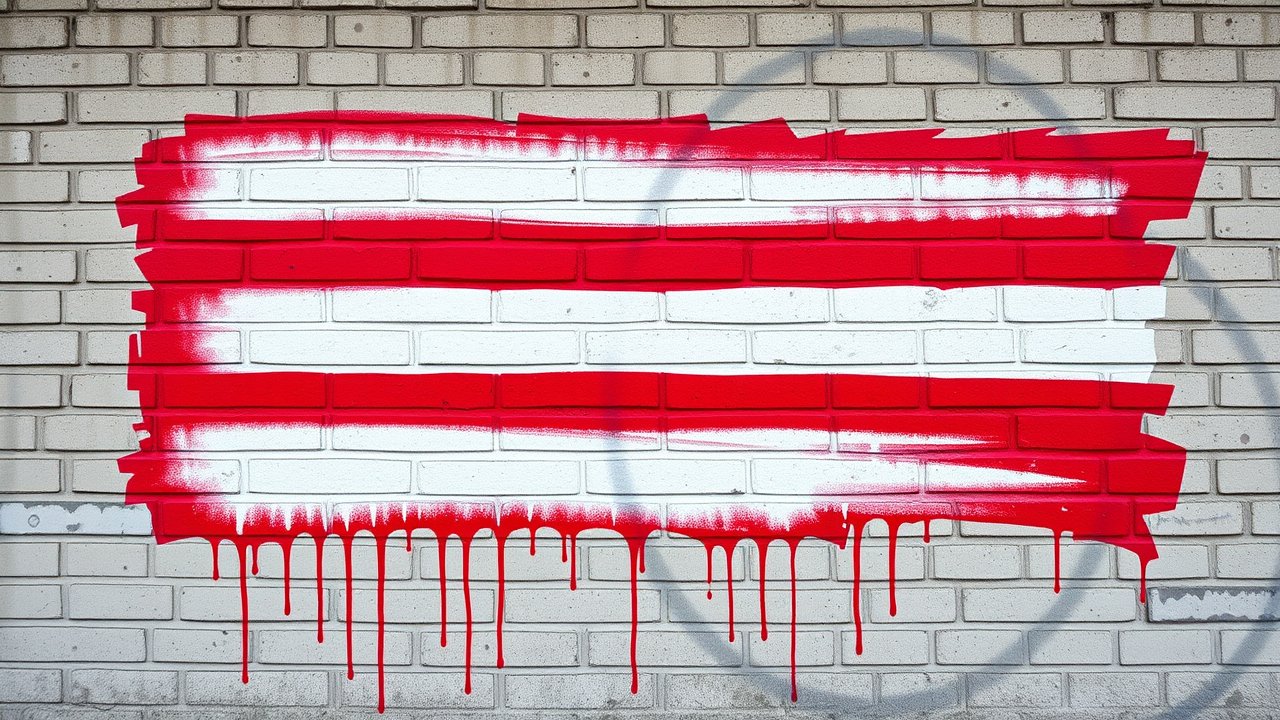
Street Art / Graffiti — Three horizontal stripes of red, white, and red. The flag of Austria as vibrant street art spray-painted on a brick wall. Three horizontal stripes of red, white, and red. Bold spray paint, dripping edges, stencil layers, overspray halos. The flag design is faithful and immediately recognizable — exact colors and symbols, just rendered in spray paint on urban concrete. No text, no letters, no words, no writing of any kind. No tags, no graffiti lettering.
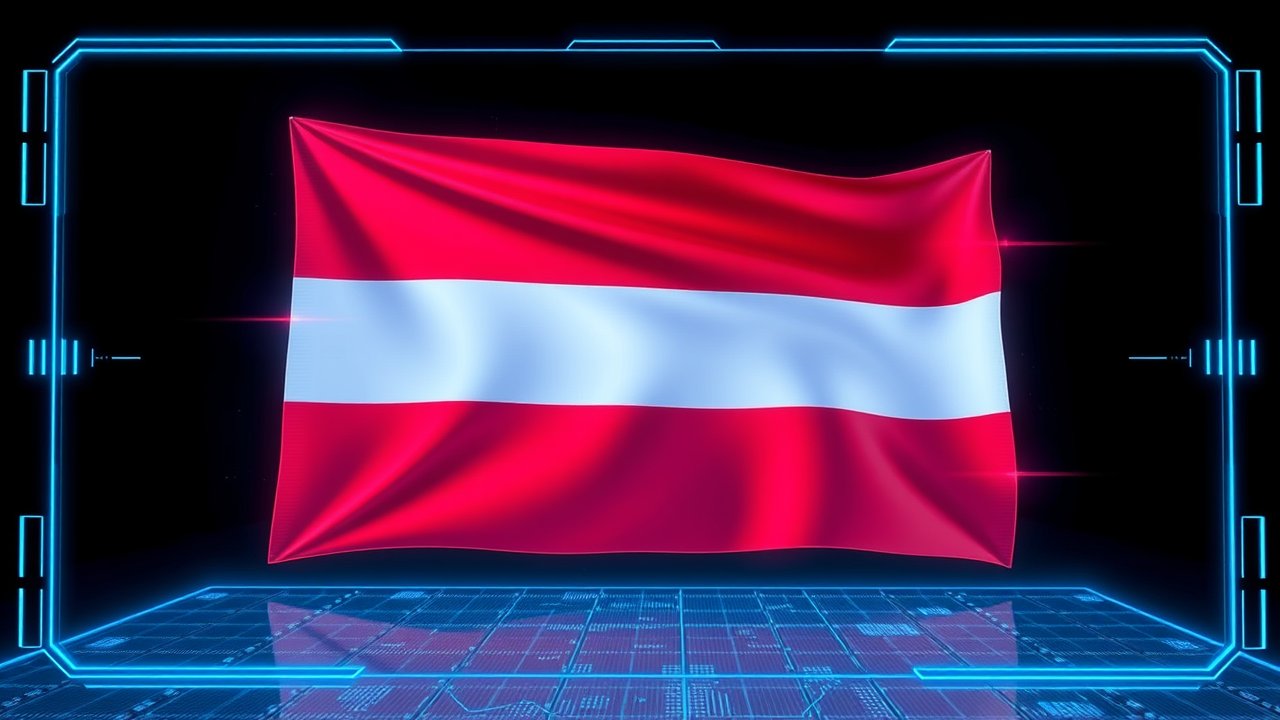
Sci-Fi Hologram — Three horizontal stripes of red, white, and red. The flag of Austria projected as a futuristic holographic display. Three horizontal stripes of red, white, and red. Translucent blue-white projection with scan lines, floating in dark space. Glitching edges, particle effects, data streams. The flag design is completely faithful and recognizable. Cyberpunk HUD elements framing the projection. No text, no letters, no words, no writing of any kind.
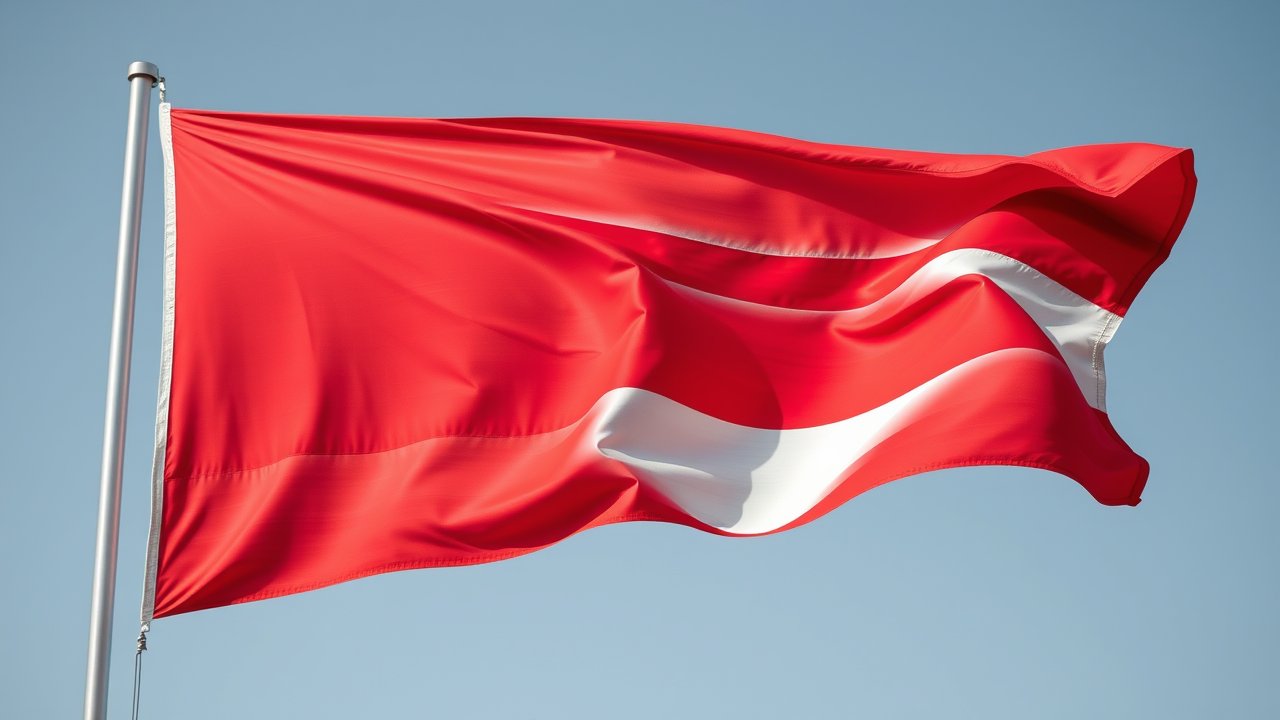
Hyperrealistic Wind — Three horizontal stripes of red, white, and red. Ultra-hyperrealistic photograph of the Austria flag caught in a dramatic gust of wind. Three horizontal stripes of red, white, and red. Macro-level fabric detail — individual threads visible, fabric folds and tension lines crisp. Colors and design completely faithful to the real Austria flag. High-speed shutter, razor-sharp focus, studio lighting. No text, no letters, no words, no writing of any kind.
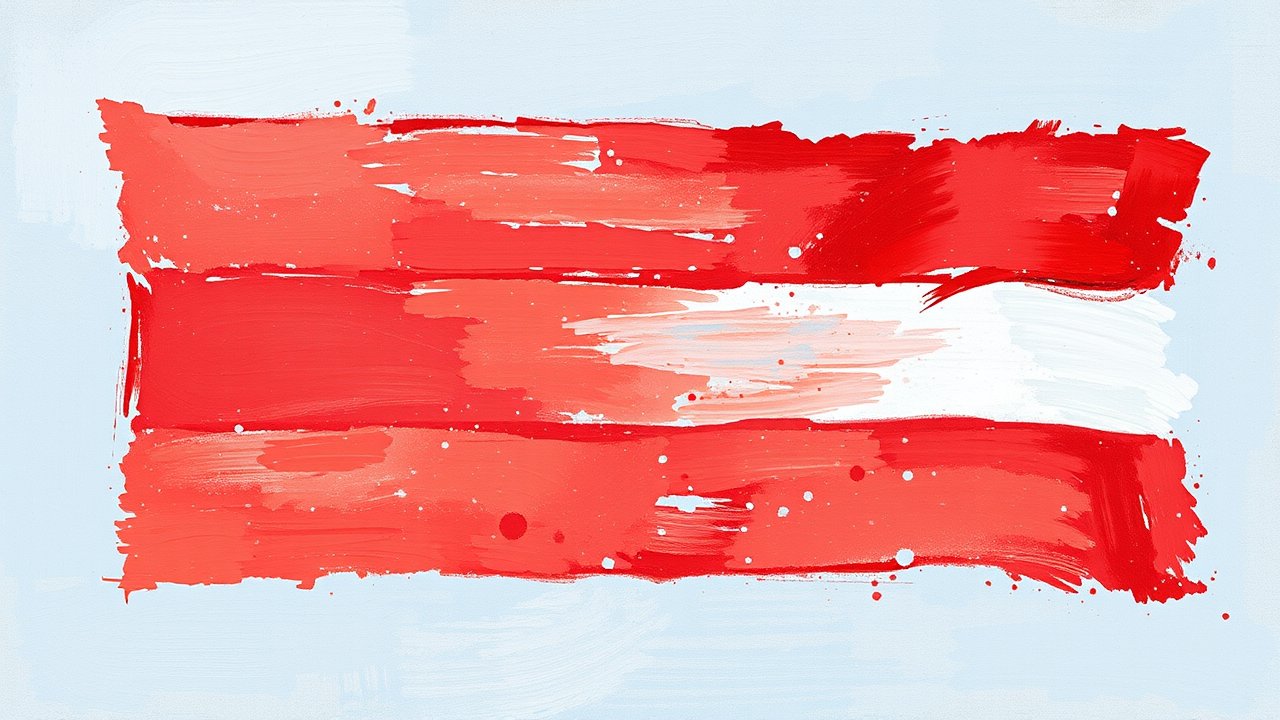
Impressionist Oil — Three horizontal stripes of red, white, and red. The flag of Austria painted in French Impressionist oil on canvas. Three horizontal stripes of red, white, and red. Thick impasto brushstrokes, dappled light, vibrant broken color technique in the style of Monet. The flag is instantly recognizable — colors and design faithful to the real Austria flag, interpreted with impressionist light and texture. No text, no letters, no words, no writing of any kind.

Lego Bricks — Three horizontal stripes of red, white, and red. The flag of Austria built from Lego bricks, photographed as a real physical construction. Three horizontal stripes of red, white, and red. Visible studs and brick seams, slight plastic sheen. Standard Lego colors approximate the flag’s palette. Built on a gray Lego baseplate. Dramatic angle showing the three-dimensional brick texture. No text, no letters, no words, no writing of any kind.

Low-Poly Geometric — Three horizontal stripes of red, white, and red. The flag of Austria constructed from low-polygon geometric triangles. Three horizontal stripes of red, white, and red. Aggressively faceted — each region broken into many visible triangular faces with subtle color variation across each polygon, creating real depth and dimensionality even in flat-color areas of the flag. Crystal-like, contemporary computational design. The flag is completely faithful and immediately recognizable. No text, no letters, no words, no writing of any kind.

Mosaic Tiles — Three horizontal stripes of red, white, and red. The flag of Austria assembled as a Roman-style mosaic. Three horizontal stripes of red, white, and red. The flag is completely faithful to the real Austria flag — exact proportions, colors, and all symbols, rendered in thousands of small stone and glass tesserae. Visible grout lines, rich earthy tones mixed with brilliant glass, slight historical weathering. No text, no letters, no words, no writing of any kind.

Native Landscape — Three horizontal stripes of red, white, and red. Photorealistic photograph of the Austria flag flying in an iconic natural landscape native to Austria — the terrain, flora, and environment characteristic of that country. Three horizontal stripes of red, white, and red. The flag is prominent and its colors are faithful and vivid. Remote, uninhabited wilderness. National Geographic photography style. No text, no letters, no words, no writing of any kind.

Neon Sign — Three horizontal stripes of red, white, and red. The flag of Austria recreated as a real neon sign mounted on a dark wall. Three horizontal stripes of red, white, and red. Glowing glass neon tubes bent into the flag’s shapes — the colors of the flag rendered in actual neon light. Visible glass tube bends, metal mounting brackets on the wall. Warm neon glow and light bloom. Real neon, not digital. Photographed in a dark room. No text, no letters, no words, no writing of any kind.
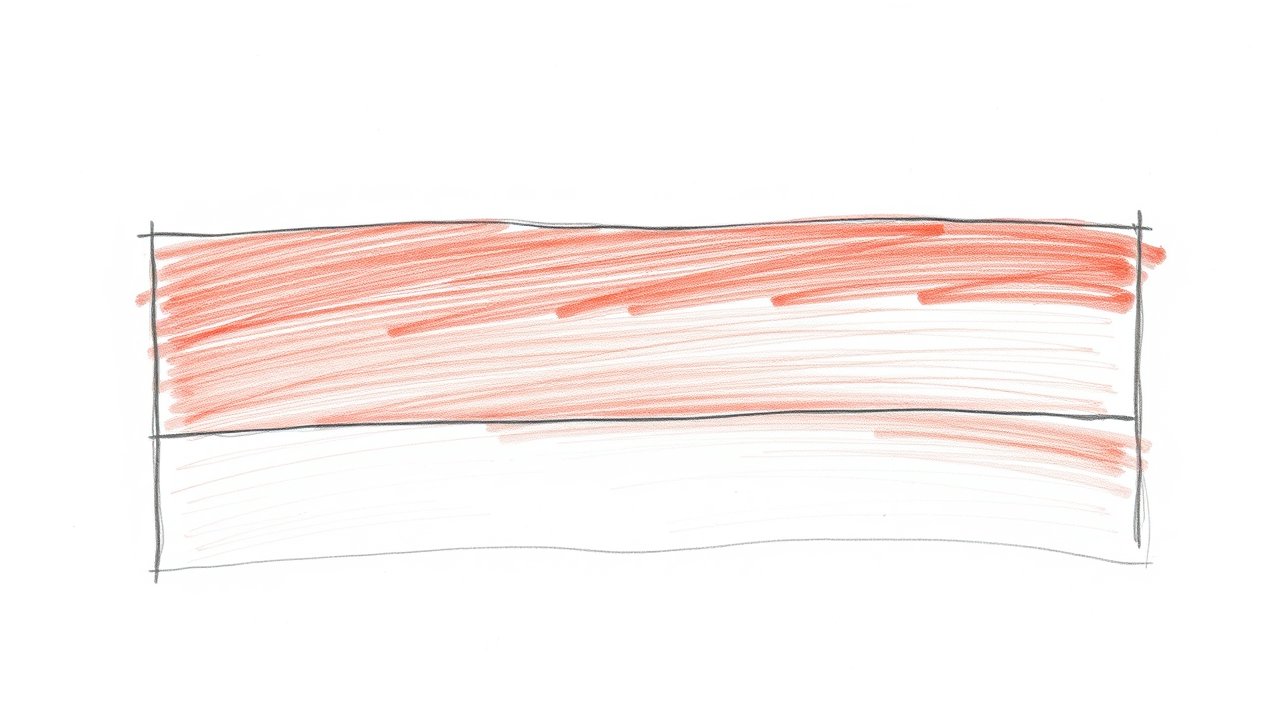
Pencil Sketch — Three horizontal stripes of red, white, and red. The flag of Austria as a bold, confident pencil sketch. Three horizontal stripes of red, white, and red. Strong graphite lines on cream paper — not delicate but bold and decisive. Heavy pressure on key outlines, dramatic cross-hatching for deep shadows and shading. Immediately recognizable as the Austria flag. Artist’s confident hand, not tentative. No text, no letters, no words, no writing of any kind.
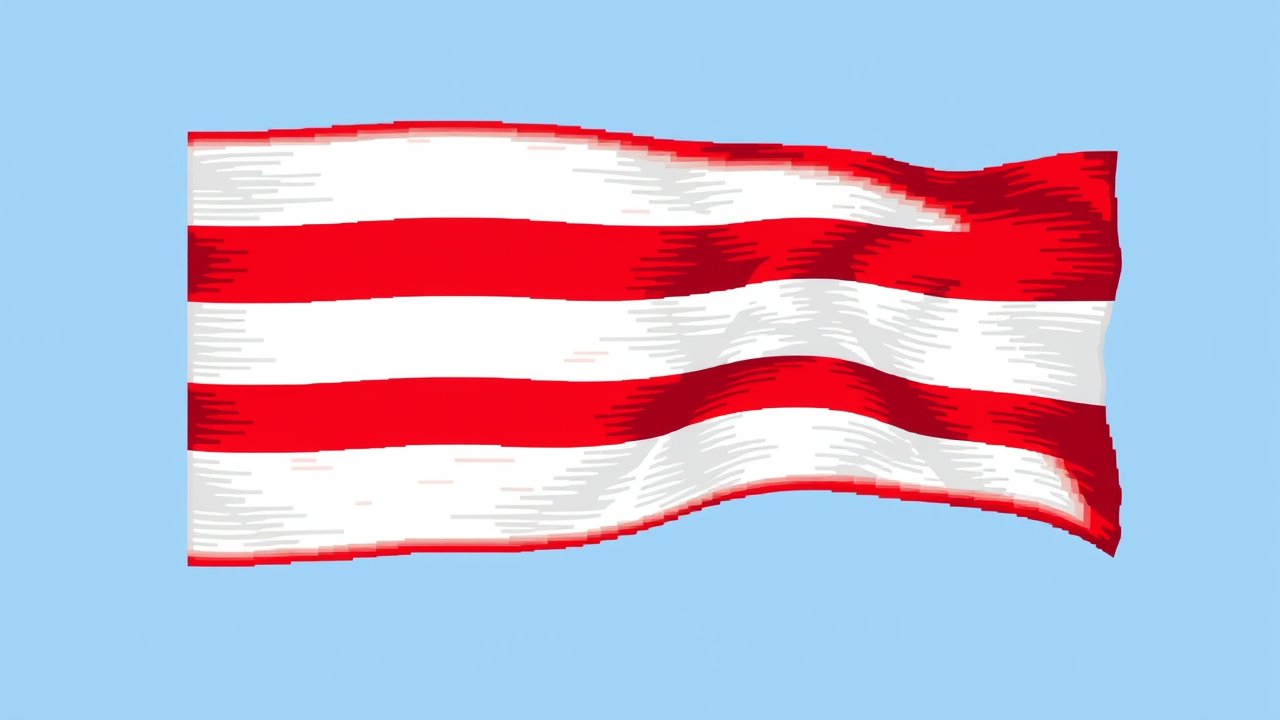
Pixel Art — Three horizontal stripes of red, white, and red. The flag of Austria as detailed 16-bit pixel art. Three horizontal stripes of red, white, and red. Crisp pixel grid, limited palette with careful dithering, nostalgic retro game aesthetic. Clean grid-aligned design with subtle shading. Every element of the flag faithfully reproduced in pixels. No text, no letters, no words, no writing of any kind.

Stained Glass — Three horizontal stripes of red, white, and red. The flag of Austria rendered as an ornate stained glass window. Three horizontal stripes of red, white, and red. The design is completely faithful to the real Austria flag — exact colors, geometry, and all symbols preserved. Brilliant jewel-toned glass pieces separated by dark lead came lines. Warm sunlight streaming through, casting colored light. Gothic cathedral craftsmanship. No text, no letters, no words, no writing of any kind.
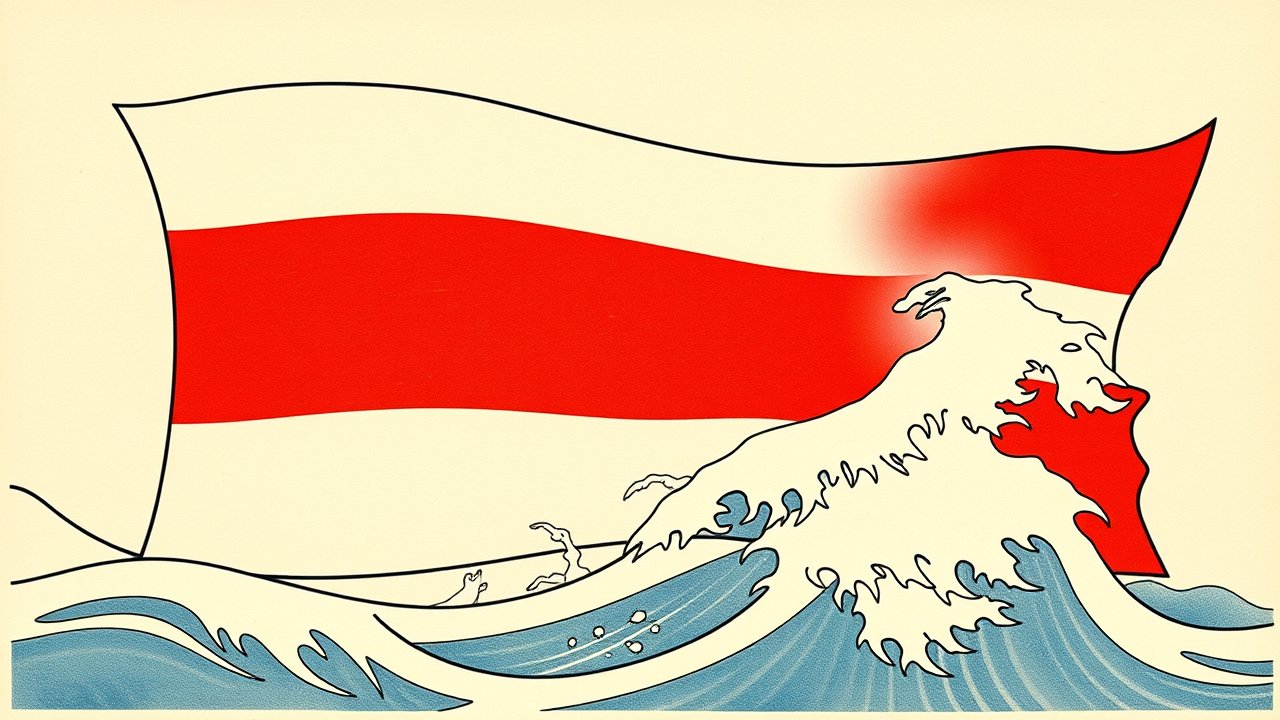
Ukiyo-e Woodblock — Three horizontal stripes of red, white, and red. The flag of Austria as a traditional Japanese ukiyo-e woodblock print. Three horizontal stripes of red, white, and red. Bold outlines, flat areas of rich color, flowing organic forms. Wind and waves incorporated into the composition. Printed on washi paper with visible wood grain texture. The flag is the central focus and instantly recognizable. No text, no letters, no words, no writing of any kind.
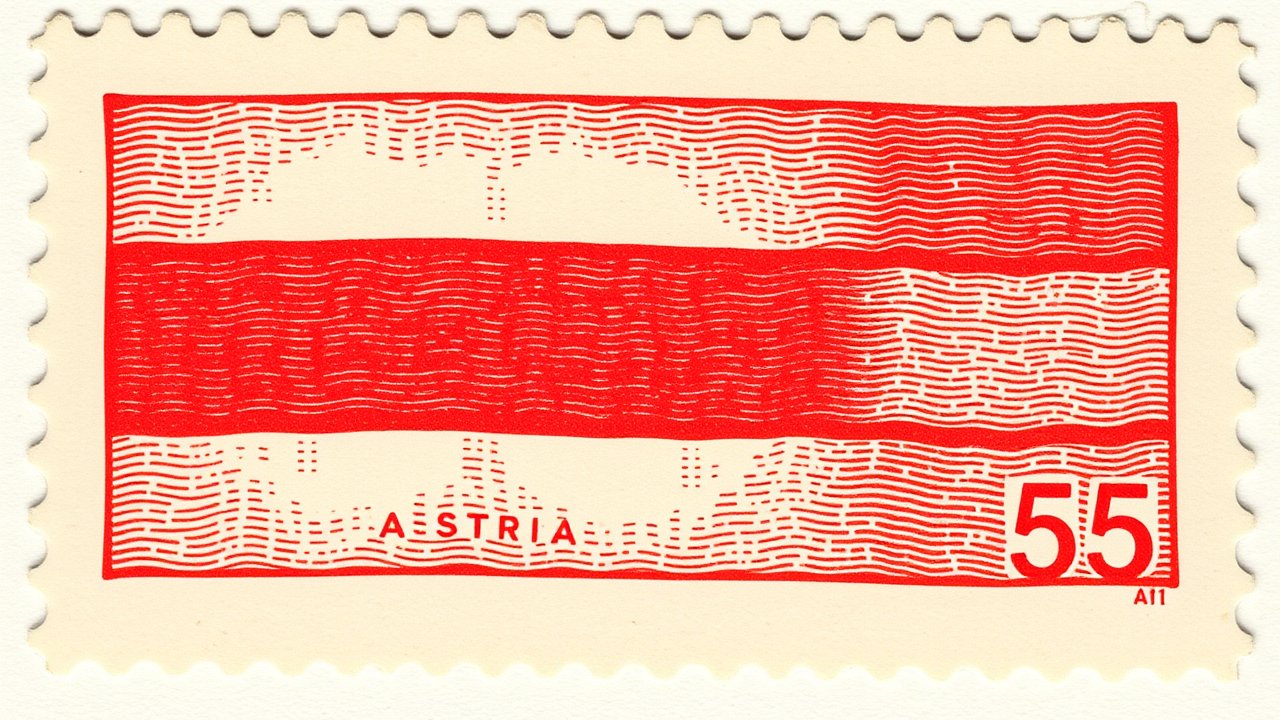
Vintage Postage Stamp — Three horizontal stripes of red, white, and red. The flag of Austria as a vintage 1950s postage stamp. Three horizontal stripes of red, white, and red. The flag fills most of the stamp — it is the primary subject, faithfully rendered in fine engraved intaglio style. Perforated edges, aged paper with slight foxing. The stamp may show a denomination numeral only — absolutely no other text or country names.
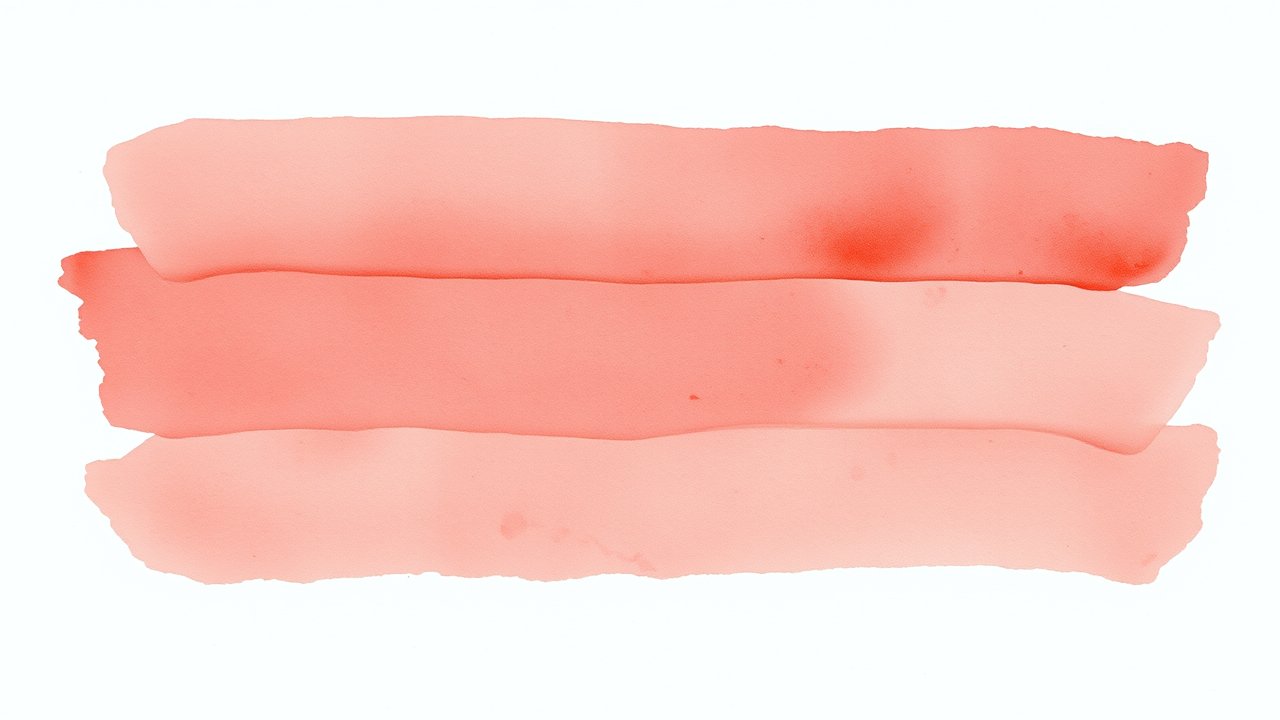
Watercolor — Three horizontal stripes of red, white, and red. The flag of Austria painted in loose, expressive watercolor. Three horizontal stripes of red, white, and red. Wet-on-wet technique with soft color bleeds, visible brushstrokes, natural paper texture. Delicate splashes and drips at the edges. Luminous, translucent layers of pigment. No text, no letters, no words, no writing of any kind.
Austria’s flag stands as one of the world’s oldest national symbols still in continuous use, with documented origins tracing back to 1230 when the distinctive red-white-red design first appeared on an official seal of Lilienfeld Abbey under Duke Frederick II, the last ruler of the Babenberg dynasty. This ancient triband—featuring three equal horizontal stripes with red on top and bottom and white in the centre—represents more than seven centuries of Austrian identity and has survived multiple dynasties, empire collapses, occupations, and political upheavals to remain the nation’s official flag today. The antiquity of Austria’s flag rivals that of only a handful of other national symbols worldwide, making it a particularly venerable emblem of European heritage and continuity through dramatic historical transformations.
The symbolism of Austria’s tricolour is deeply embedded in legend, medieval history, and modern political identity. According to one widely-circulated medieval tradition, the design originated from Duke Leopold V following his participation in the Crusades’ Siege of Acre in 1191, during which his white tunic became completely drenched in blood during fierce combat. According to this account, when he removed his belt after the battle, the cloth beneath remained white, creating the striking red-white-red contrast that would define Austrian identity for centuries to come. While modern historians scrutinize the accuracy of this legendary narrative, with scholarly evidence suggesting a later formalization around 1230 rather than 1191, the story has proven remarkably resilient in Austrian national consciousness and remains widely known and celebrated. Beyond the legendary accounts, the vibrant red in the flag traditionally symbolises the courage, strength, resilience, and sacrifice of the Austrian people throughout their complex and often turbulent history, encompassing medieval conflicts, Renaissance cultural flourishing, Habsburg expansionism, and modern nation-building. The pristine white band conversely represents peace, integrity, honesty, and—more recently—Austria’s formal declaration of permanent neutrality proclaimed in the Austrian State Treaty of 1955, when the nation solemnly renounced military alliances and pledged to remain politically and militarily independent, a commitment that has fundamentally shaped Austrian foreign policy and international relations for nearly seven decades.
The flag’s complex journey through European history directly reflects Austria’s own dramatically shifting political landscape and territorial evolution across more than two millennia. During the medieval and early modern periods under Babenberg and subsequent Habsburg rule, the red-white-red triband served as a coat of arms of the dynasty’s hereditary lands in Central Europe, gradually and organically becoming inseparable from Austrian regional and cultural identity as the House of Habsburg consolidated its power across diverse territories. For centuries, Habsburg emperors carried the colours into negotiations and battles across the continent, and the triband became associated with the stability and extensive reach of the empire. This fundamental relationship transformed catastrophically with the military defeat and dissolution of the Austro-Hungarian Empire in 1918 after World War I, when the multicoloured black-yellow imperial flag representing the vast multinational realm became obsolete and powerless. The newly formed First Austrian Republic, seeking to establish a distinct national identity separate from its imperial past and reduced territorial boundaries, immediately and symbolically readopted the red-white-red triband as its national flag, thereby reclaiming and repurposing the ancient colours as an emblem of rebirth, independence, and democratic renewal.
This restored flag design continued through the volatile interwar period of the 1920s and 1930s, and remarkably persisted even through the Nazi occupation and Anschluss of 1938-1945, when the swastika and Nazi emblems dominated the territories under German control. Following Austria’s liberation by Allied forces and the reestablishment of sovereignty, the flag was formally and symbolically readopted on May 1, 1945, marking the nation’s return to independence and becoming a powerful visual representation of Austrian resilience and reclaimed nationhood. In the decades that followed, particularly after the Austrian State Treaty of 1955 officially restored full independence and mandated permanent neutrality, the flag evolved into a symbol not just of national identity but of Austria’s distinctive position as a neutral nation committed to peace in a divided Europe during the Cold War. This neutrality provision proved so integral to Austrian national identity that it continues to define the country’s foreign policy and international standing to the present day, remaining deeply embedded in the Austrian Constitution. A refinement to standardize the flag’s specifications occurred in 2018, when official government decrees established that the precise shade of red be designated as Pantone 186 C, ensuring absolute consistency in the flag’s representation across all official government documents, diplomatic correspondence, military uniforms, and international contexts.
The Austrian flag’s elegant yet distinctive design consists of three equal horizontal bands in the proportion ratio of 2:3 (width to height), with the top and bottom stripes rendered in bold, unmistakable red and the central band in clean, bright white. This straightforward triband configuration places Austria among the world’s most recognizable national flags, yet Austria’s particular combination of red and white, with its precise shades and proportions, remains wholly unique and instantly identifiable among the family of European nations. The flag’s geometric simplicity and bold colour contrast have contributed significantly to its longevity and effectiveness as a national symbol; unlike flags featuring complex heraldry, intricate coat of arms, detailed national emblems, or symbolic imagery that can become dated, lose cultural relevance, or prove difficult to reproduce, Austria’s uncomplicated triband has remained strikingly contemporary and emotionally powerful across more than seven centuries of continuous use. The flag appears prominently and frequently at official state ceremonies, adorns government and public buildings throughout the nation, features prominently in public demonstrations of patriotism and national pride, and serves as a unifying visual emblem during major international sporting events like the Olympic Games and FIFA World Cups, where it rallies Austrian athletes and citizens alike. The flag’s remarkable resilience and adaptability have allowed it to maintain its core symbolic power and meaning while gracefully accommodating changing aesthetics, artistic conventions, and modern contexts throughout the centuries, ensuring its continued relevance to contemporary Austrians while honouring centuries of historical tradition.
Sources: Wikipedia – Flag of Austria; Britannica – Flag of Austria; Fahnen-Gärtner – History of the Austrian Flag; World Population Review – Austria Flag; Visit Austria – Austria Flag; World Atlas – Flags, Symbols & Currency of Austria; Unacademy – Austrian Flag’s History and Meaning
Free Printable: Flags of the World Reference Card
Get a beautiful printable poster with 50 flag emojis, Unicode codes, and fun facts. Perfect for classrooms and desks!
No spam, ever. Unsubscribe anytime.