
How To
How To
Time needed: 1 minute
How to copy and paste the Flag of Brazil Emoji to any device.
- Copy the Brazilian Flag Emoji
Go to flagemoji.com and press the copy button (above). This works on any device.
- Paste the Emoji
Go to your email/iMessage/SMS texting service/document and paste the emoji.
For mobile devices
— double-tap or tap-hold, then paste should appear. Tap it.
For desktop and laptops on Apple devices
— command-P / ⌘-P
For desktop and laptops on Windows devices
— control-p
Codes
Emoji Codes
Flag emojis are unicode symbols, like any other letter or number on your keyboard. This means you can copy and paste the emoji itself into your code, whatever the language (click the button above).
They actually count as two characters: the two-letter country code (the ISO international standard). The unicode and shortcode both represent country data which devices can interpret and display the emoji.
| Country Code | Unicode | Shortcode |
| BR | U+1F1E7 U+1F1F7 | :flag_BR: :BR: |
Emoji shortcodes are used on some platforms as a way for users to type in emojis from the keyboard. If you type the emoji shortcode on Github or Slack, the emoji will appear.
*The official name of the emoji is only the country name, not ‘Brazil Flag’, for example.
Description
Description
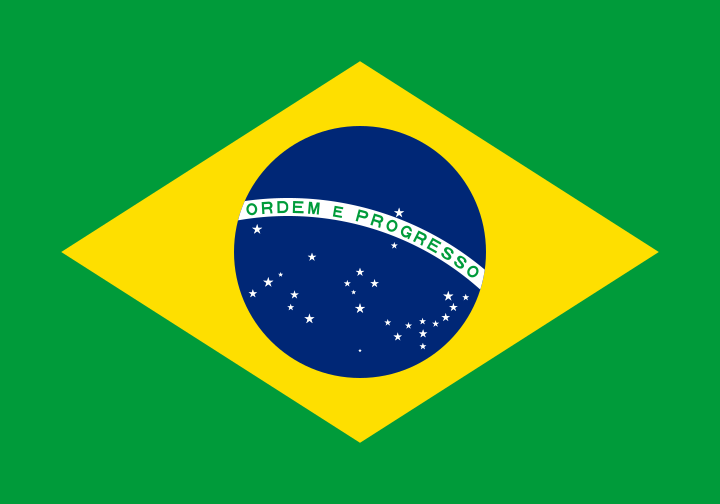
The Brazilian flag is green with a large yellow diamond in the center bearing a blue celestial globe with 27 white five-pointed stars. The globe has a white equatorial band with the motto ORDEM E PROGRESSO (Order and Progress). Green represents the forests of the country and the yellow rhombus its mineral wealth, while the diamond shape roughly mirrors that of the country. The blue circle and stars, which replaced the coat of arms of the original flag, depict the sky over Rio de Janeiro on the morning of 15 November 1889 – declaration of Republic of Brazil.
Map
Map
Check out the map of South Sudan!
Weather
Anthem
National Anthem
| Title | Hino Nacional Brasileiro (Brazilian National Anthem) |
| Composer | Joaquim Osorio Duque Estrada / Francisco Manoel Da Silva |
FAQ
FAQs
The Independence Day of Brazil, commonly called Sete de Setembro, is celebrated every September 7. The date celebrates Brazil’s Declaration of Independence from the United Kingdom of Portugal on September 7, 1822.
The flag is green, symbolic of Brazil’s lush fields and forests. Its primary feature is a large yellow diamond, symbolic of Brazil’s wealth in gold, and in the center floats a blue celestial globe.
The flag of Brazil was officially adopted on November 15, 1889.
Brazil is governed by Federal Presidential Republic.
Discover more fun facts of Solomon Islands.
Printable
Printable Brazilian Flag
Print another really cool flag. Why not the flag of Lesotho?

3D Glossy Render — Green field with a large yellow diamond and a dark blue globe with white stars and a curved white band. The flag of Brazil as a photorealistic 3D render. Green field with a large yellow diamond and a dark blue globe with white stars and a curved white band. The flag fabric hangs or drapes naturally but preserves exact proportions, colors, and all symbols perfectly — completely faithful to the real Brazil flag. Dramatic studio lighting, glossy silk material, soft shadows, subsurface scattering, perfect specular highlights. No text, no letters, no words, no writing of any kind.

Chalk on Blackboard — Green field with a large yellow diamond and a dark blue globe with white stars and a curved white band. The flag of Brazil drawn in chalk on a real blackboard. Green field with a large yellow diamond and a dark blue globe with white stars and a curved white band. Authentic blackboard — dark slate green surface with chalk dust and smudge marks. Soft, dusty white and colored chalk lines, imperfect edges, hand-drawn quality. Chalk dust particles visible in the air. The flag is immediately recognizable. No text, no letters, no words, no writing of any kind.

Embroidered Textile — Green field with a large yellow diamond and a dark blue globe with white stars and a curved white band. The flag of Brazil as intricate embroidery on linen fabric. Green field with a large yellow diamond and a dark blue globe with white stars and a curved white band. Dense satin stitches, French knots, chain stitch detail. The flag design is completely faithful — exact colors, geometry, and all symbols faithfully stitched, immediately recognizable as the Brazil flag. Visible thread texture, dimensional quality, warm handcrafted feel. No text, no letters, no words, no writing of any kind.

Flagpole in Capital — Green field with a large yellow diamond and a dark blue globe with white stars and a curved white band. Photorealistic photograph of the Brazil flag flying on a tall flagpole in front of an iconic government building in the capital city. Green field with a large yellow diamond and a dark blue globe with white stars and a curved white band. The flag ripples naturally in the wind, colors vivid and exact. Documentary photography style, sharp and realistic. Grand architecture in the background. Blue sky, dramatic clouds. No text, no letters, no words, no writing of any kind.

Golden Hour Reflection — Green field with a large yellow diamond and a dark blue globe with white stars and a curved white band. Photorealistic photograph of the Brazil flag reflected in still water at golden hour. Green field with a large yellow diamond and a dark blue globe with white stars and a curved white band. The flag flies on a pole at the water’s edge, its reflection shimmering on the surface below. Warm amber and orange sunset light. The flag colors and design are faithful and vivid. Serene, cinematic landscape photography. No text, no letters, no words, no writing of any kind.

Street Art / Graffiti — Green field with a large yellow diamond and a dark blue globe with white stars and a curved white band. The flag of Brazil as vibrant street art spray-painted on a brick wall. Green field with a large yellow diamond and a dark blue globe with white stars and a curved white band. Bold spray paint, dripping edges, stencil layers, overspray halos. The flag design is faithful and immediately recognizable — exact colors and symbols, just rendered in spray paint on urban concrete. No text, no letters, no words, no writing of any kind. No tags, no graffiti lettering.

Sci-Fi Hologram — Green field with a large yellow diamond and a dark blue globe with white stars and a curved white band. The flag of Brazil projected as a futuristic holographic display. Green field with a large yellow diamond and a dark blue globe with white stars and a curved white band. Translucent blue-white projection with scan lines, floating in dark space. Glitching edges, particle effects, data streams. The flag design is completely faithful and recognizable. Cyberpunk HUD elements framing the projection. No text, no letters, no words, no writing of any kind.

Hyperrealistic Wind — Green field with a large yellow diamond and a dark blue globe with white stars and a curved white band. Ultra-hyperrealistic photograph of the Brazil flag caught in a dramatic gust of wind. Green field with a large yellow diamond and a dark blue globe with white stars and a curved white band. Macro-level fabric detail — individual threads visible, fabric folds and tension lines crisp. Colors and design completely faithful to the real Brazil flag. High-speed shutter, razor-sharp focus, studio lighting. No text, no letters, no words, no writing of any kind.
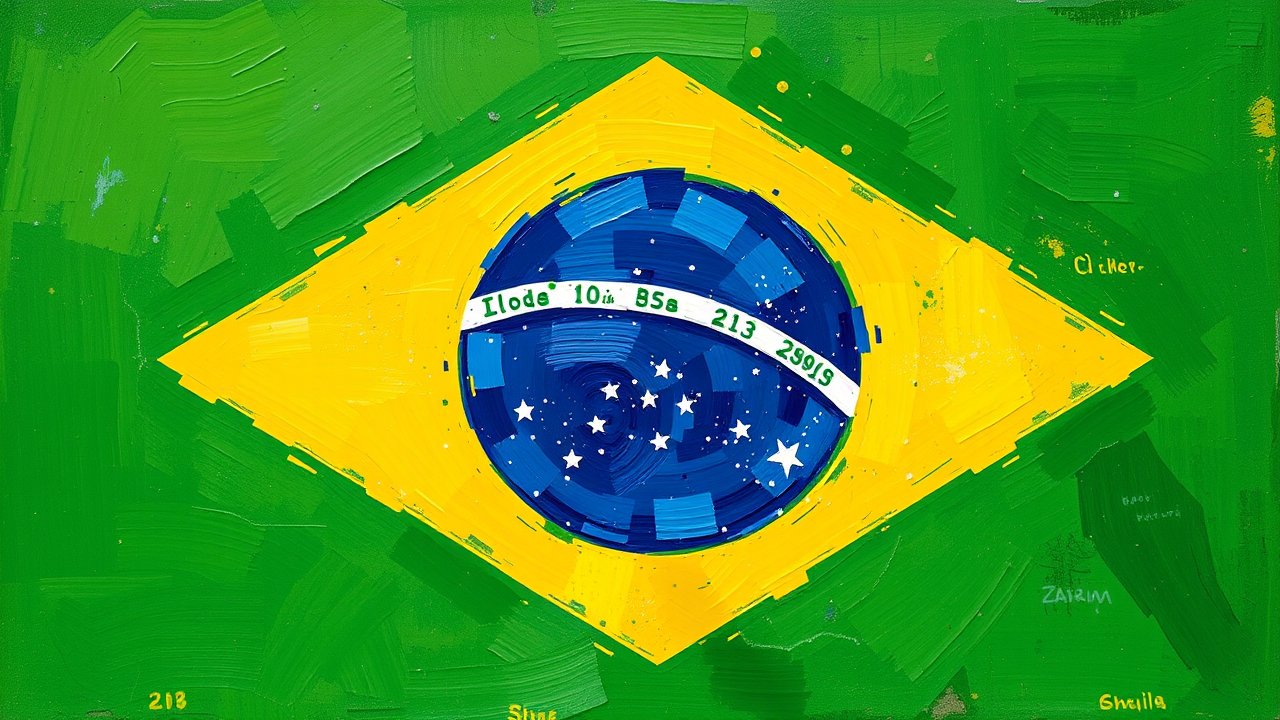
Impressionist Oil — Green field with a large yellow diamond and a dark blue globe with white stars and a curved white band. The flag of Brazil painted in French Impressionist oil on canvas. Green field with a large yellow diamond and a dark blue globe with white stars and a curved white band. Thick impasto brushstrokes, dappled light, vibrant broken color technique in the style of Monet. The flag is instantly recognizable — colors and design faithful to the real Brazil flag, interpreted with impressionist light and texture. No text, no letters, no words, no writing of any kind.
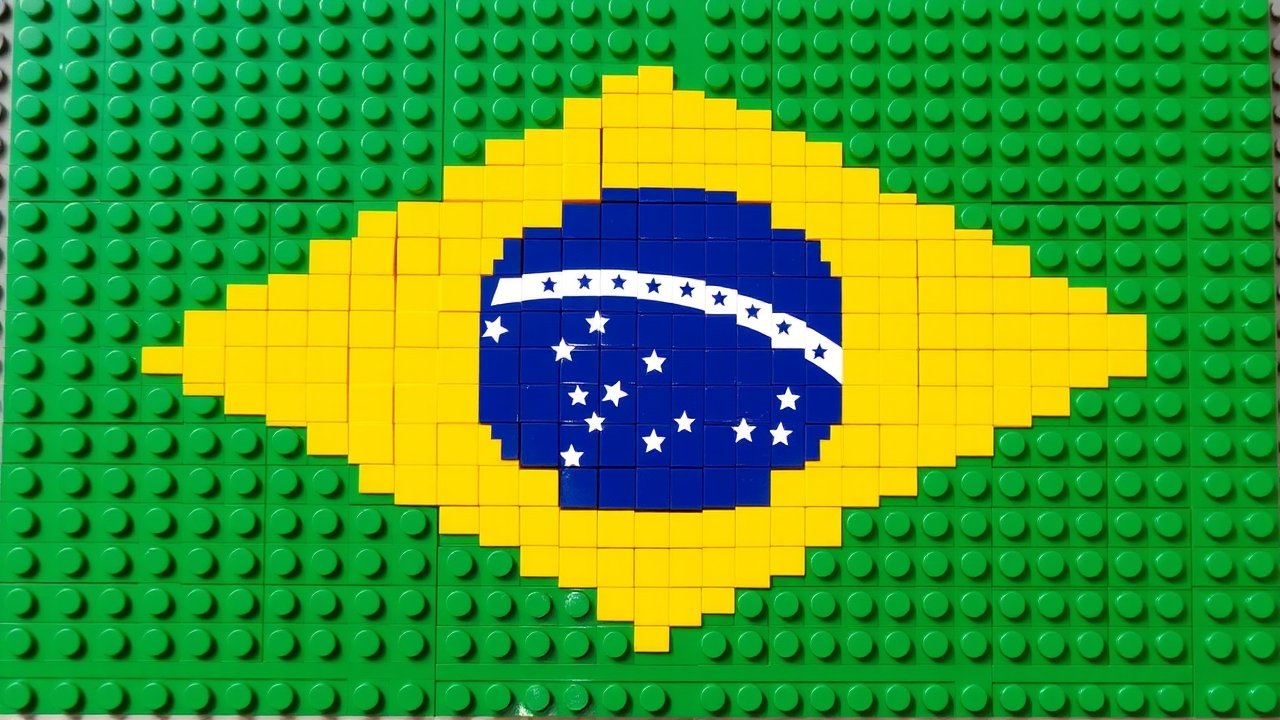
Lego Bricks — Green field with a large yellow diamond and a dark blue globe with white stars and a curved white band. The flag of Brazil built from Lego bricks, photographed as a real physical construction. Green field with a large yellow diamond and a dark blue globe with white stars and a curved white band. Visible studs and brick seams, slight plastic sheen. Standard Lego colors approximate the flag’s palette. Built on a gray Lego baseplate. Dramatic angle showing the three-dimensional brick texture. No text, no letters, no words, no writing of any kind.

Low-Poly Geometric — Green field with a large yellow diamond and a dark blue globe with white stars and a curved white band. The flag of Brazil constructed from low-polygon geometric triangles. Green field with a large yellow diamond and a dark blue globe with white stars and a curved white band. Aggressively faceted — each region broken into many visible triangular faces with subtle color variation across each polygon, creating real depth and dimensionality even in flat-color areas of the flag. Crystal-like, contemporary computational design. The flag is completely faithful and immediately recognizable. No text, no letters, no words, no writing of any kind.

Mosaic Tiles — Green field with a large yellow diamond and a dark blue globe with white stars and a curved white band. The flag of Brazil assembled as a Roman-style mosaic. Green field with a large yellow diamond and a dark blue globe with white stars and a curved white band. The flag is completely faithful to the real Brazil flag — exact proportions, colors, and all symbols, rendered in thousands of small stone and glass tesserae. Visible grout lines, rich earthy tones mixed with brilliant glass, slight historical weathering. No text, no letters, no words, no writing of any kind.

Native Landscape — Green field with a large yellow diamond and a dark blue globe with white stars and a curved white band. Photorealistic photograph of the Brazil flag flying in an iconic natural landscape native to Brazil — the terrain, flora, and environment characteristic of that country. Green field with a large yellow diamond and a dark blue globe with white stars and a curved white band. The flag is prominent and its colors are faithful and vivid. Remote, uninhabited wilderness. National Geographic photography style. No text, no letters, no words, no writing of any kind.

Neon Sign — Green field with a large yellow diamond and a dark blue globe with white stars and a curved white band. The flag of Brazil recreated as a real neon sign mounted on a dark wall. Green field with a large yellow diamond and a dark blue globe with white stars and a curved white band. Glowing glass neon tubes bent into the flag’s shapes — the colors of the flag rendered in actual neon light. Visible glass tube bends, metal mounting brackets on the wall. Warm neon glow and light bloom. Real neon, not digital. Photographed in a dark room. No text, no letters, no words, no writing of any kind.

Pencil Sketch — Green field with a large yellow diamond and a dark blue globe with white stars and a curved white band. The flag of Brazil as a bold, confident pencil sketch. Green field with a large yellow diamond and a dark blue globe with white stars and a curved white band. Strong graphite lines on cream paper — not delicate but bold and decisive. Heavy pressure on key outlines, dramatic cross-hatching for deep shadows and shading. Immediately recognizable as the Brazil flag. Artist’s confident hand, not tentative. No text, no letters, no words, no writing of any kind.

Pixel Art — Green field with a large yellow diamond and a dark blue globe with white stars and a curved white band. The flag of Brazil as detailed 16-bit pixel art. Green field with a large yellow diamond and a dark blue globe with white stars and a curved white band. Crisp pixel grid, limited palette with careful dithering, nostalgic retro game aesthetic. Clean grid-aligned design with subtle shading. Every element of the flag faithfully reproduced in pixels. No text, no letters, no words, no writing of any kind.
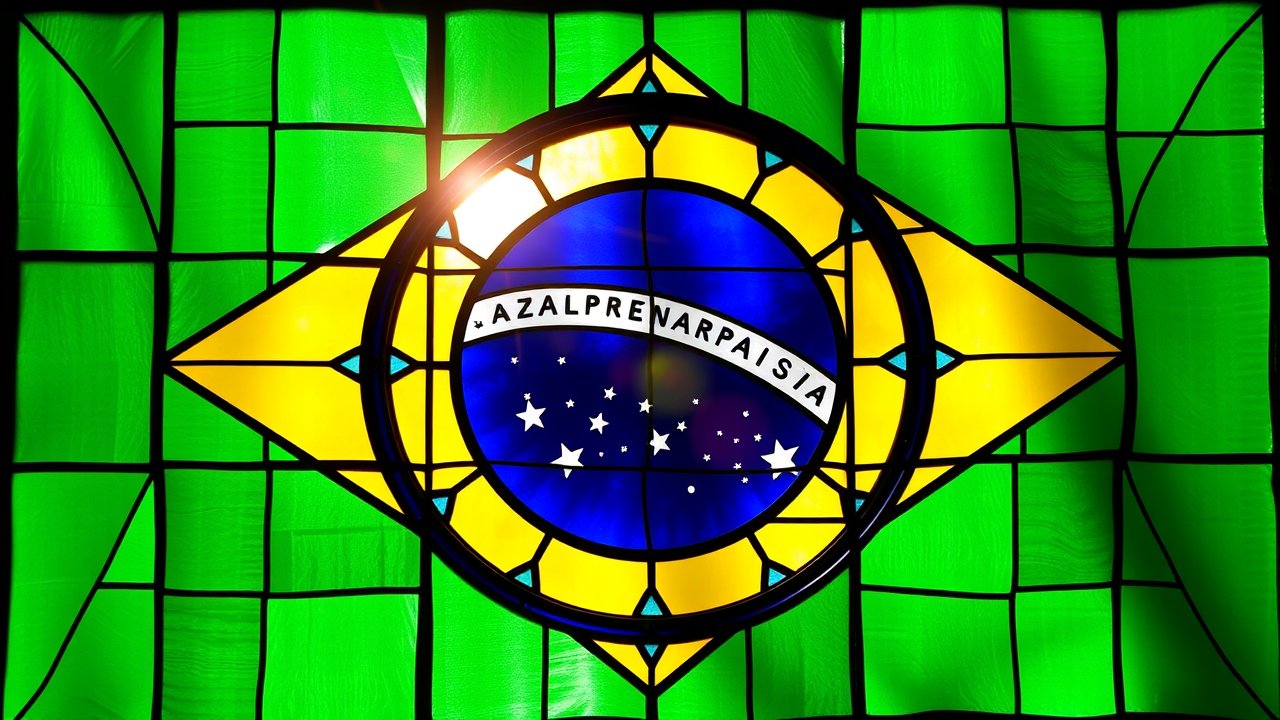
Stained Glass — Green field with a large yellow diamond and a dark blue globe with white stars and a curved white band. The flag of Brazil rendered as an ornate stained glass window. Green field with a large yellow diamond and a dark blue globe with white stars and a curved white band. The design is completely faithful to the real Brazil flag — exact colors, geometry, and all symbols preserved. Brilliant jewel-toned glass pieces separated by dark lead came lines. Warm sunlight streaming through, casting colored light. Gothic cathedral craftsmanship. No text, no letters, no words, no writing of any kind.

Ukiyo-e Woodblock — Green field with a large yellow diamond and a dark blue globe with white stars and a curved white band. The flag of Brazil as a traditional Japanese ukiyo-e woodblock print. Green field with a large yellow diamond and a dark blue globe with white stars and a curved white band. Bold outlines, flat areas of rich color, flowing organic forms. Wind and waves incorporated into the composition. Printed on washi paper with visible wood grain texture. The flag is the central focus and instantly recognizable. No text, no letters, no words, no writing of any kind.

Vintage Postage Stamp — Green field with a large yellow diamond and a dark blue globe with white stars and a curved white band. The flag of Brazil as a vintage 1950s postage stamp. Green field with a large yellow diamond and a dark blue globe with white stars and a curved white band. The flag fills most of the stamp — it is the primary subject, faithfully rendered in fine engraved intaglio style. Perforated edges, aged paper with slight foxing. The stamp may show a denomination numeral only — absolutely no other text or country names.
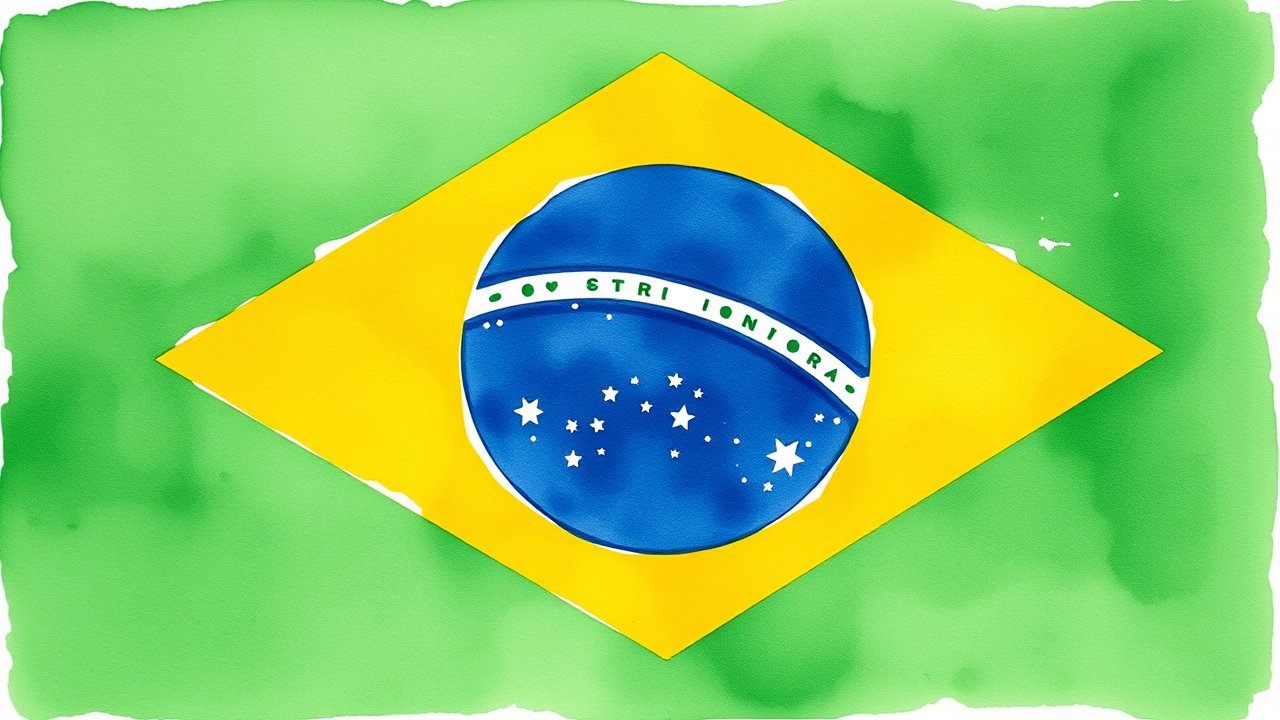
Watercolor — Green field with a large yellow diamond and a dark blue globe with white stars and a curved white band. The flag of Brazil painted in loose, expressive watercolor. Green field with a large yellow diamond and a dark blue globe with white stars and a curved white band. Wet-on-wet technique with soft color bleeds, visible brushstrokes, natural paper texture. Delicate splashes and drips at the edges. Luminous, translucent layers of pigment. No text, no letters, no words, no writing of any kind.
The Emerald Banner: Brazil’s Flag and the Ideals of a Nation
The flag of Brazil stands as one of the world’s most distinctive and symbolically rich national standards, featuring a vibrant green field with a prominent yellow diamond, within which rests a dark blue globe encircled by a white curved band. This design, established in 1889 following Brazil’s transition from monarchy to republic, represents far more than mere heraldic convention—it encodes the geographic, economic, and philosophical identity of South America’s largest nation. The flag’s elements, each carefully chosen to reflect Brazilian values and resources, tell the story of a nation abundant in natural wealth, guided by the motto “Ordem e Progresso” (Order and Progress), and proud of its multicultural heritage. Understanding the Brazilian flag requires examining its republican origins, decoding the precise symbolism embedded in its elements, tracing the historical modifications that shaped its modern appearance, and recognizing how this emblem continues to unite a diverse nation.
The Transition to Republic and Flag Origins
The modern Brazilian flag emerged from a period of profound political transformation. For nearly 70 years, Brazil had been an independent empire under the Portuguese royal house, symbolized by the imperial flag featuring the arms of the House of Braganza. However, in 1889, following decades of declining imperial authority, a military coup deposed Emperor Dom Pedro II and established the First Brazilian Republic. This dramatic shift from monarchy to republican government necessitated new national symbols that would reflect the values and aspirations of the emerging state.
The transition from empire to republic was not marked by violent revolution but rather by a relatively peaceful transfer of power, reflecting Brazil’s unique historical trajectory. Unlike many Latin American nations that had experienced violent independence wars against Spain in the early 19th century, Brazil had achieved independence through negotiation and remained united under Portuguese rule. The 1889 republican transition, while sudden, maintained institutional continuity and avoided the civil conflict that might have preceded such changes in other nations. This context shaped the new flag’s character—it was designed not to represent violent rupture but rather the orderly evolution of a nation toward modern republican ideals.
The new flag was officially adopted on November 15, 1889, though the design underwent a minor modification in 1960 to adjust the proportions and arrangement of its elements. The designers drew inspiration from both the imperial flag and contemporary European heraldic traditions, while introducing distinctly Brazilian elements that would distinguish the new symbol from other national flags and emphasize Brazil’s unique geographic and economic identity.
The Emerald Green Field: Amazon and Agricultural Wealth
The bright green background of the Brazilian flag represents the lush vegetation of Brazil, particularly the Amazon rainforest—one of the world’s most significant ecosystems and a source of profound national pride. Brazil contains approximately 60 percent of the Amazon, a vast region that has shaped the nation’s environmental character, economic potential, and cultural identity for centuries. The choice of this vivid emerald green signals Brazil’s relationship with its natural resources and environmental heritage.
Beyond the Amazon, the green also symbolizes Brazil’s broader agricultural abundance. From sugarcane plantations in the southeast to coffee plantations that once dominated the economy to the diverse crops cultivated across the vast interior, agriculture has been central to Brazil’s development. The color serves as a reminder that Brazil’s wealth and prosperity have historically been rooted in its natural advantages—fertile soil, favorable climate, and vast territory. In this sense, the green field is not merely decorative but ideological, expressing a fundamental truth about what Brazil is and has been.
The Yellow Diamond: Gold and Wealth
Positioned prominently at the center of the green field is a large yellow diamond, an unmistakable reference to Brazil’s mineral wealth, particularly gold. During the 18th century, Brazil experienced a gold rush that attracted miners, merchants, and administrators from across the Portuguese world and beyond. Gold discoveries in the interior regions transformed the colony’s economic geography, shifted wealth production away from the coastal sugar plantations, and funded much of the colonial and early independence period infrastructure.
The yellow diamond shape itself has heraldic significance. Unlike circular or shield-shaped emblems common in other national flags, the diamond creates a striking geometric form that gives the Brazilian flag its distinctive visual character. The diamond is mathematically precise—not decorative or organic but deliberately geometric, suggesting order and rationality. This formal geometry reflects the flag’s design philosophy and the republican ideal of rational, ordered progress that would characterize the new Brazilian state.
The yellow color also represents the riches more broadly—not just gold but all valuable resources that Brazil possessed and could exploit. In the context of the late 19th century, when industrial nations competed for access to raw materials and natural resources worldwide, Brazil’s yellow diamond served as a statement of economic power and potential, promising that this nation possessed material wealth that would fund its development into a modern, prosperous state.
The Blue Globe: Celestial Symbolism and National Unity
Within the yellow diamond rests the most complex element of the flag: a dark blue globe or sphere representing Earth, with a white curved band crossing it. This celestial sphere evokes multiple layers of meaning. On the most literal level, it represents Brazil itself—a globe within the diamond within the green field, a representation of the nation’s place on Earth. The blue color traditionally symbolizes the sky and has represented truth and loyalty in heraldic tradition across cultures and centuries.
The white curved band crossing the globe displays the motto “Ordem e Progresso” (Order and Progress) in the green and yellow colors of the flag. This phrase, adopted from the positivist philosophy that influenced Brazilian intellectual circles in the late 19th century, expresses the republican ideology that guided Brazil’s transformation. Order represented the rational administration of the state, the rule of law, and institutional stability. Progress represented modernization, economic development, technological advancement, and social evolution. Together, these ideals encapsulated the vision of what the Brazilian Republic aspired to achieve.
The design of the globe includes a constellation of stars arranged in a specific pattern. Originally, the flag contained 21 stars representing the states of Brazil at the time of its adoption in 1889. However, as Brazil added new states, the flag was updated to include additional stars, with the most recent addition occurring in 1992 when Roraima and Amapá achieved statehood, bringing the total to 27 stars (26 states plus the Federal District, now renamed Brasília as a federal capital).
These stars are arranged according to the celestial map of the night sky as it appears from Rio de Janeiro, the capital at the time the flag was designed. Each star represents a different Brazilian state, positioned in the locations where they would appear in the night sky above Rio de Janeiro. This astronomical arrangement transforms the flag from a simple heraldic design into a sophisticated representation of Brazil’s geographic distribution and territorial unity. The stars remind viewers that Brazil comprises diverse states, each represented equally in the national symbol, united under the same sky.
Historical Evolution and Design Modifications
While the fundamental design of the Brazilian flag has remained constant since 1889, the flag has undergone subtle but significant modifications. The most notable change occurred in 1960, when Brazil’s president ordered a redesign to improve the flag’s proportions and artistic balance. The 1960 revision adjusted the relative sizes of the diamond and the arrangement of elements to create a more aesthetically pleasing composition that would remain recognizable even when reduced to very small sizes or viewed from a distance.
Additional modifications occurred as Brazil expanded and added new states. Rather than completely redesigning the flag, Brazil added new stars to the celestial sphere within the diamond, maintaining continuity with the original design while reflecting the nation’s political expansion. This approach demonstrates how a national flag can evolve to accommodate territorial changes while preserving its essential character and historical continuity.
It is important to note that the current Brazilian flag represents the modern Brazilian state exclusively. While Brazil had an imperial flag prior to 1889, that symbol is no longer used officially, though it remains part of historical and cultural memory. The flag Brazilians rally around today is unambiguously the flag of the republic, established in 1889 and refined over subsequent decades.
Symbolism and National Identity
The Brazilian flag operates as a multidimensional symbol that communicates multiple ideas simultaneously. At the most immediate visual level, it is unmistakably Brazilian—no other national flag combines this specific arrangement of colors and geometric shapes. The combination of emerald green, bright yellow, and dark blue creates a distinctive color palette that Brazilian citizens recognize instantly and that appears across the nation’s cultural landscape.
The flag represents territorial unity among Brazil’s diverse regions. The massive geographic territory of Brazil encompasses distinct regions—the tropical northeast, the forested north, the industrial southeast, the agricultural center-west, and the temperate south. These regions have different climates, economies, cultures, and historical experiences. Yet the flag, with its unified field and its constellation of stars each representing a state, proclaims that all these regions belong to one nation. The celestial arrangement of stars reinforces that Brazil is not a collection of separate territories but a coordinated whole, just as stars in the night sky form constellations despite their vast separations in space.
The flag also conveys Brazil’s historical relationship with nature and natural resources. The green and yellow evoke agricultural and mineral wealth, making explicit that Brazil’s identity is intertwined with its environment and its capacity to exploit that environment for human benefit. This was a straightforward assertion in 1889, when environmental concerns were not part of global political discourse. Today, the flag’s environmental imagery takes on additional resonance as debates about deforestation, sustainability, and environmental preservation have become central to global politics and to Brazil’s international reputation.
The motto “Ordem e Progresso” embedded in the flag expresses a philosophical commitment. These were not arbitrary words chosen for aesthetic purposes but rather a deliberate statement of ideology. The founders of the Brazilian Republic embraced positivist philosophy, which emphasized the application of scientific rationality to social organization. By inscribing these words on the flag itself, Brazil’s founders declared that their republic would be guided by reason, order, and the pursuit of progress—concepts that would modernize the state and elevate the nation.
The Flag in Contemporary Brazil
Today, the Brazilian flag appears everywhere in Brazilian life—on government buildings, in schools, at sporting events, and in the homes of citizens. The flag particularly resonates during World Cup celebrations, Carnival, and Independence Day (September 7), when green and yellow clothing and decorations blanket the nation. International athletes representing Brazil carry the flag, and the flag’s appearance in contexts of national triumph or celebration reinforces its connection to Brazilian pride and identity.
The flag’s simplicity and distinctiveness have made it remarkably durable as a symbol. Unlike flags that must be frequently updated to remain recognizable, the Brazilian flag’s core design remains as striking and immediately identifiable as it was when first adopted. The arrangement of elements—the diagonal or off-center positioning of the diamond within the green field—creates visual dynamism even in a static image.
Conclusion: An Enduring Emblem
The flag of Brazil, with its emerald green field, brilliant yellow diamond, and sophisticated celestial sphere, represents far more than a simple national symbol. It encodes centuries of Brazilian history, expresses the geographic and economic realities that have shaped the nation, and articulates ideals of order, progress, and rational governance that continue to guide Brazilian aspirations. From its adoption in 1889 as the symbol of a newly republican Brazil through its evolution to accommodate the nation’s geographic expansion, the flag has remained constant in its essential character while adapting to changing circumstances. Whether displayed during moments of national celebration, worn by athletes representing Brazil on the world stage, or carried by Brazilians living abroad as a symbol of their identity, the green, yellow, and blue banner remains the most powerful emblem of Brazilian nationhood and the enduring expression of a people united by territory, by shared symbols, and by the aspiration toward a future of order and progress.
Related Products
Vibrant Brazilian flag for display.
Sweeping history from discovery to modern era.
In-depth travel guide to Brazil.
As an Amazon Associate, we earn from qualifying purchases.
Free Printable: Flags of the World Reference Card
Get a beautiful printable poster with 50 flag emojis, Unicode codes, and fun facts. Perfect for classrooms and desks!
No spam, ever. Unsubscribe anytime.