
Flags are not just decorations – they symbolize a nation’s identity, history, and values. Every flag element, from colors to patterns, carries meaning. For example:
- Colors: Red often represents sacrifice; blue, justice; green, prosperity; and white, peace.
- Patterns: Tricolors, stripes, or crosses reflect historical or regional narratives.
- Symbols: Stars, animals, plants, and tools tell stories of unity, strength, or struggle.
Flags evolve with history, reflecting revolutions, independence, or political changes. They’re also central in daily life (e.g., schools, sports, crises) and global events like the Olympics or United Nations meetings. While flags unite, they can also spark debates over identity and historical context. Learning about flags, such as through tools like Flag Emoji Quizzes, offers a deeper understanding of nations and their stories.
Why Do National Flags Matter? Uncovering Their Rich History and Meaning | 1.1
What Flag Design Elements Mean
Flags serve as visual storytellers, capturing the essence of a nation’s history, values, and aspirations. Every element – colors, patterns, and symbols – has a purpose, weaving together a narrative that reflects identity and heritage. Let’s dive into these design elements to uncover their deeper meanings.
Flag Colors and Their Significance
Colors form the backbone of flag design, each carrying a message that resonates with a nation’s character and history. For instance:
- Red often symbolizes the blood shed in struggles for independence, as well as courage and sacrifice. You’ll see it prominently on flags like those of the United States, China, and Switzerland.
- White stands for peace, purity, or unity, frequently serving as a neutral or harmonious backdrop.
- Blue conveys ideals like freedom and justice or represents natural elements like the sky and water. In the U.S. flag, blue signifies vigilance, perseverance, and justice.
- Green connects to the land, agriculture, and prosperity. Many African nations use green to highlight their natural wealth and farming heritage.
- Yellow or gold represents wealth, sunshine, or generosity.
- Black often symbolizes the people, their strength and determination, or reflects historical struggles that shaped the nation.
Color combinations also tell stories. For example, the pan-African colors – red, yellow, and green – appear across many African flags, symbolizing a shared history of colonization and independence movements.
Patterns That Speak Volumes
Beyond colors, the layout of a flag adds another layer of meaning. Patterns often reflect historical, cultural, or political narratives:
- Tricolor patterns, with three horizontal or vertical bands, are among the most common. France’s vertical tricolor of blue, white, and red inspired numerous nations during revolutionary periods.
- Horizontal stripes can represent regions, ethnic groups, or historical milestones, such as the thirteen stripes on the U.S. flag symbolizing the original colonies.
- Vertical stripes often signify forward momentum or unity among political ideologies.
Certain motifs are tied to specific regions. Crosses, for example, dominate European flags, reflecting Christian heritage. The Nordic cross design, seen on flags of Denmark, Sweden, Norway, Finland, and Iceland, points to their shared Scandinavian roots. Meanwhile, crescents and stars are common in flags of Muslim-majority nations, with the crescent symbolizing progress or Islamic faith and stars representing unity or guidance.
Cantons, the rectangular sections in the upper corner of some flags, hold special meaning. The American flag’s blue canton with 50 stars represents its states and federal structure. Many former British colonies include the Union Jack in their canton, signifying historical ties to the United Kingdom.
Symbols That Add Depth
Symbols on flags provide a rich tapestry of meaning, offering insight into a nation’s values, history, and aspirations:
- Stars are widely used to represent unity, independence, or ideals. The five-pointed star appears on many flags, each with its own unique interpretation.
- Animals often embody qualities a nation admires. Eagles, for instance, symbolize strength, freedom, and vision. Mexico’s flag features an eagle perched on a cactus with a snake in its beak, a nod to an Aztec legend about the founding of Tenochtitlan. Lions, meanwhile, are associated with courage and royalty in various regions.
- Plants and natural features connect flags to their landscapes. Canada’s maple leaf reflects the country’s natural beauty and resources, while palm trees, cedar trees, and other vegetation highlight unique environmental elements.
- Weapons and tools speak to a nation’s struggles or readiness to defend itself. Swords, rifles, and even agricultural tools like hammers and sickles tell stories of independence and labor, though they can carry polarizing political undertones.
- Geometric shapes like circles, triangles, and chevrons organize flag designs and carry symbolic meanings. Circles often represent unity or eternity, while triangles can signify equality or progress.
Finally, shields and coats of arms condense complex histories into intricate designs. These heraldic elements combine animals, plants, weapons, and sometimes text to narrate a nation’s origins and values. While many modern flags lean toward simplicity, some still feature elaborate heraldic details that reflect their identity.
Flags are far more than just colorful pieces of fabric; they’re carefully constructed narratives. Every stripe, symbol, and shade is a deliberate choice, telling a story of heritage, values, and the journey of a nation.
How Historical Events Changed Flag Designs
National flags are more than just colorful pieces of fabric – they’re living symbols of a nation’s history, identity, and values. Over time, they evolve to reflect major historical events, shifts in government, or changes in a country’s borders. Whether it’s a revolution, a unification, or a separation, these moments often leave their mark on a flag, reshaping it to mirror new realities.
Flags Born from Revolutions and Independence
When nations gain independence or emerge from revolutions, they often create new flags to signal a fresh start. These designs break away from the past, embodying the ideals and values of a new era. For example, flags adopted after independence frequently feature symbols or colors that represent freedom, unity, or the struggles that led to liberation.
Flags Transformed by Unification or Separation
When countries unite or separate, their flags often change to reflect the new political landscape. A unified nation might design a flag that incorporates elements from all its regions, symbolizing shared heritage and unity. Conversely, a newly independent region may craft a flag to assert its unique identity and distinguish itself on the global stage.
Flags Altered by Shifts in Government
Changes in government can also lead to updates in flag design. Whether through the addition of new symbols or the removal of old ones, these modifications aim to align the flag with the current political ideology or leadership. Such changes are a visual representation of a nation’s evolving governance and priorities.
Flags are deeply tied to a nation’s story, capturing both its history and its hopes for the future. Their designs serve as a bridge between the past and what lies ahead, making them powerful symbols in both everyday life and on the international stage.
sbb-itb-c170c49
How Flags Are Used in Daily Life and International Events
Flags are everywhere – on public buildings, in schools, and even hanging from porches. They’re not just reserved for holidays or ceremonies. Flags serve as a constant reminder of national identity, visible in both everyday life and global events, where they represent entire nations and their people.
How Flags Are Used Within Countries
Take a walk through any American town, and you’re bound to see the Stars and Stripes waving proudly outside government buildings. Schools across the country start the day with the Pledge of Allegiance, where students face the flag and recite words of loyalty and unity. This tradition, dating back to the early 20th century, reinforces the flag’s role in shaping a sense of belonging and patriotism from a young age.
Flags often appear during moments of collective emotion. In times of crisis, like after September 11, 2001, or during the COVID-19 pandemic, flag displays surged as symbols of solidarity. On celebratory occasions like the Fourth of July, flags are everywhere – on streets, in parades, and even decorating backyard barbecues, painting the nation red, white, and blue.
For military families, flags hold deeply personal meaning. Service flags displayed in windows often feature blue stars for active-duty members, while gold stars honor those who have made the ultimate sacrifice. These symbols connect national pride to individual stories of service and loss.
Sports events provide another setting where flags bring people together. Before games in baseball, football, or basketball, the national anthem plays as the flag is presented, a tradition rooted in World War I. This shared moment, with thousands standing hand over heart, underscores the flag’s role as a unifying symbol.
While flags play a key role domestically, their impact extends far beyond borders.
Flags at International Events
The Olympic Games offer one of the most striking displays of flags on the global stage. During the opening ceremony, athletes parade behind their national flags in the Parade of Nations, a tradition that began at the 1908 London Olympics. When athletes win gold, their country’s flag is raised as the national anthem plays – a powerful moment shared by viewers worldwide. At the Tokyo 2020 Olympics, held in 2021, flags from nearly every participating nation were proudly displayed, each serving as a symbol of its people and heritage.
At the United Nations headquarters in New York City, 193 member state flags are lined up in alphabetical order along the plaza. This arrangement, updated whenever a new member joins, is a visual statement of international cooperation. Each flag flies at the same height, symbolizing equality among nations, regardless of size or power. When a new country joins the UN, the flag-raising ceremony marks its official entry into the global community.
Diplomatic events and summits also rely on flag protocol. At meetings like the G7 or G20, flags are carefully positioned behind world leaders during press conferences and photo ops. These arrangements follow strict rules, whether organized alphabetically, by seniority, or with the host nation’s flag in a place of honor.
The World Cup is another example of how flags unite people across borders. During the 2022 FIFA World Cup in Qatar, fans waved flags, painted them on their faces, and even wore them as capes. TV cameras often zoomed in on crowds, capturing a sea of national colors – a universal language of pride and passion.
Different Views of the Same Flag
Flags are more than just symbols; they carry multiple meanings, often sparking debate. For some, a flag represents unity and opportunity. For others, it may serve as a reminder of historical struggles. In the U.S., these differing views are evident in debates over flag etiquette. Actions like kneeling during the national anthem are seen by some as disrespectful, while others view them as expressions of the freedoms the flag itself represents.
Indigenous communities often have complex relationships with national flags. In Canada, for instance, some First Nations fly their own flags alongside – or instead of – the national flag, asserting their sovereignty and unique identity.
Political movements frequently adopt flag imagery to further their causes. However, when opposing groups claim the same flag, it can become a point of contention. This tension reveals the flag’s dual role as both a unifying and divisive symbol.
For immigrants and naturalized citizens, flags often take on a deeply personal meaning. In the U.S., naturalization ceremonies prominently feature the flag, with new citizens often waving small versions as they take the oath of allegiance. These ceremonies, which welcome hundreds of thousands of new citizens each year, highlight how flags can symbolize belonging and hope.
Generational differences also shape how flags are viewed. Older generations may see flag displays as a patriotic duty, while younger people often approach them with a more critical lens. These differing perspectives reflect evolving ideas about national identity in a world that’s increasingly interconnected.
Whether displayed at home or on the global stage, flags are powerful symbols. They bring people together, spark debate, and shape how we see ourselves – both as individuals and as part of a larger community. From small-town courthouses to Olympic podiums, flags remain at the heart of how we express identity and belonging.
Using Flags to Learn About National Identity
Flags provide a fascinating way to delve into the stories of nations and their people. Each design tells a tale – of revolutions, values, and the individuals who shaped a country’s identity. This makes flags an engaging and powerful tool for learning, both in classrooms and beyond.
Teaching with Flags in the Classroom
Flags have a unique ability to grab students’ attention in ways that textbooks often can’t. Their vibrant designs create a perfect entry point for lessons on geography, history, and cultural studies. Take Ireland’s tricolor flag, for instance. Researching its history introduces students to themes like reconciliation and historical transformation. Similarly, Kenya’s flag, with its Maasai shield and spears, opens up discussions about its journey to independence.
A popular classroom activity involves students researching and presenting the history behind different flags. Through this, abstract concepts like national identity become tangible. For example, students might discover that the 50 stars on the American flag represent the states and that the flag’s design has changed over time as the country grew.
Mapping exercises can also reveal fascinating patterns. Teachers might ask students to create a world map, coloring each country based on the dominant color of its flag. Such activities often highlight trends – like the prevalence of red on national flags – and spark discussions about what these colors symbolize in different contexts.
Comparing flags from neighboring countries further deepens understanding. For example, the flags of Colombia, Ecuador, and Venezuela share yellow, blue, and red horizontal stripes, reflecting their shared history of independence movements in the early 19th century. These connections help students see geography as more than just memorizing borders – it’s about understanding relationships between nations.
Classroom debates around flag symbolism can also encourage critical thinking. Students might discuss whether a flag should change when a country’s government or values shift, or how different groups within a nation might view the same flag differently. Such conversations emphasize that national identity is fluid, evolving alongside society.
Outside the classroom, interactive tools can make flag learning even more engaging.
Learning Flags with Flag Emoji Quizzes
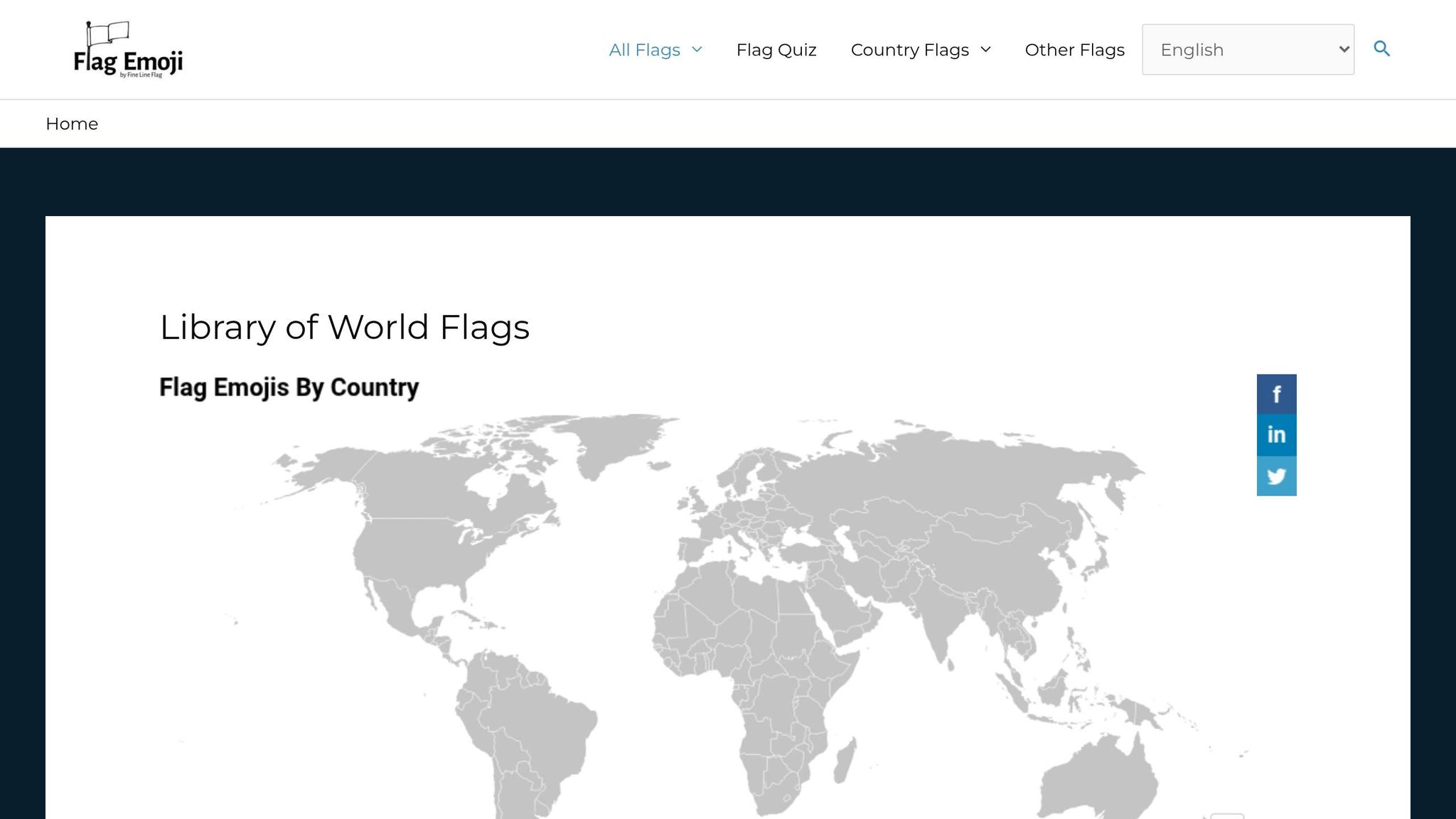
Flag Emoji Quizzes offer a fun and interactive way to learn about flags. These quizzes are organized by region – North America, South America, Europe, Asia, Africa, and Oceania – allowing learners to focus on specific areas or explore them one at a time.
The format is simple: a flag appears, and users match it to the correct country. Immediate feedback after each guess helps reinforce learning by correcting mistakes on the spot. This approach not only makes learning active but also encourages repeated practice. For example, users might notice subtle details like the slight difference in blue shades between Romania’s and Chad’s flags – an observation that requires a closer look.
By starting with smaller, more manageable regions, learners can gradually build their confidence before tackling larger, more complex areas like Africa, which has 54 recognized nations. The quizzes don’t just test recognition – they spark curiosity. A flag with a white dragon, like Bhutan’s, often prompts learners to dig deeper into its meaning, discovering its ties to the country’s name, Druk Yul, or "Land of the Thunder Dragon."
Understanding Culture Through Flags
Flags are rich in symbolism, offering a window into a nation’s culture and values. Take Canada’s flag, where the maple leaf reflects national pride and its connection to nature. Many flags also feature religious or philosophical symbols. Turkey’s crescent and star highlight its Islamic heritage, while India’s Ashoka Chakra – a 24-spoke wheel – represents law and progress.
Some flags embody both a nation’s aspirations and its history. After apartheid, South Africa adopted a flag that avoided traditional heraldic symbols. Its Y-shape signifies unity, and its six colors reflect inclusion and reconciliation.
Nature often plays a central role in flag designs. Lebanon’s cedar tree, deeply rooted in the country’s history, symbolizes resilience and strength. Similarly, political stances can influence flag designs. Neutral nations like Switzerland emphasize their independence with simple yet distinctive designs. Switzerland’s square flag, featuring a white cross on a red background, underscores its unique status globally.
Studying multiple flags together can reveal broader historical and cultural trends. Many former British colonies, such as Australia and New Zealand, incorporate the Union Jack into their flags, reflecting their colonial ties. Meanwhile, nations that gained independence through revolution often choose bold, straightforward designs that reflect their struggles. Vietnam’s single star or Mozambique’s inclusion of an AK-47 are clear examples of this.
Colors on flags also carry different meanings depending on the context. White, for instance, often symbolizes peace in Western traditions but can represent mourning in others. Recognizing these nuances helps explain recurring patterns and the messages flags convey to both citizens and the global community.
Flags also tell stories through absences. Some nations deliberately avoid certain symbols or colors to distance themselves from colonial or oppressive pasts. These choices provide yet another perspective on how countries define themselves over time.
Conclusion
Flags are much more than pieces of fabric – they’re visual storytellers, weaving together a nation’s history, values, and identity into a single design. Every color, pattern, and symbol is chosen with care, reflecting the journey of a country and how it has evolved over time. As history unfolds, flags adapt, serving as bridges between the past, present, and future.
Beyond their symbolic significance, flags are woven into the fabric of daily life and global events. You’ll see them outside government buildings, cheering on athletes at sporting events, or hanging in classrooms as students learn about their country’s heritage. On the world stage – at events like the Olympics or United Nations meetings – flags represent entire nations, acting as instantly recognizable symbols loaded with meaning.
Exploring flags offers a fascinating way to connect with national stories. Whether through classroom discussions or hands-on activities, studying flag designs transforms abstract history and geography into something tangible. This approach turns rote memorization into meaningful discovery, helping learners uncover the rich details hidden in every flag. Tools like Flag Emoji Quizzes make this exploration even more interactive, deepening our understanding of the stories flags tell and their influence on culture.
FAQs
What do the colors on a national flag symbolize about a country’s identity?
National flags aren’t just pieces of fabric – they’re powerful symbols, rich with meaning. The colors on a flag often carry deep significance, reflecting a nation’s history, identity, and values. For instance, red might stand for courage or the sacrifices made by its people, while green could represent the land’s fertility or a hope for growth.
Each color is chosen thoughtfully, weaving a story about the country’s heritage and aspirations. Flags act as visual reminders of these shared ideals, inspiring pride and strengthening the bond among citizens.
How do historical events shape the design and meaning of national flags?
Flags are deeply tied to the history and identity of the nations they represent. Many designs stem from transformative moments such as revolutions, independence movements, or major societal changes. Take the French Tricolore, for example – it embodies the principles of liberty, equality, and fraternity, ideals born from the French Revolution. Similarly, the U.S. flag tells the story of the country’s founding, with its 13 stripes honoring the original colonies that broke away from British rule.
These symbols go beyond mere decoration. They stand as powerful reminders of a nation’s struggles, victories, and core values, inspiring unity and pride among its people.
How does learning about flags help us understand a nation’s identity and heritage?
Flags are more than just decorative pieces of fabric – they’re rich with meaning and history. Each flag, with its specific colors, symbols, and designs, reflects a nation’s identity, struggles, achievements, and ideals. They serve as powerful emblems of unity and pride, offering a glimpse into the stories that define a country.
Learning about flags opens the door to understanding a nation’s heritage and traditions on a deeper level. Beyond their symbolic significance, flags play an important role in global events, education, and promoting awareness of different cultures. They help bridge connections and foster a better understanding of the diverse identities that make up our world.
Related Blog Posts
- Flags and Their Colors: What Do They Mean?
- Flag Identifier Tool
- Flag Knowledge Checker
- How Flag Quizzes Improve Geography Skills
Free Printable: Flags of the World Reference Card
Get a beautiful printable poster with 50 flag emojis, Unicode codes, and fun facts. Perfect for classrooms and desks!
No spam, ever. Unsubscribe anytime.