
Interactive flag games are a fun and effective way to learn geography. These games challenge you to match flags with their countries or locations, improving memory, recognition, and spatial awareness. Whether you’re a student preparing for exams or a teacher looking for classroom activities, flag games offer a practical approach to mastering world geography.
Key Benefits of Flag Games:
- Boost Memory and Recognition: Learn to associate colors, symbols, and patterns with specific countries.
- Improve Map Skills: Connect flags to their locations on a map for a better understanding of global geography.
- Practice Under Pressure: Timed challenges help simulate test conditions and build confidence.
How to Get Started:
- Begin with simple flag quizzes for a specific region (e.g., North America or Europe).
- Gradually increase difficulty with timed or map-based games.
- Use a mix of online tools, flashcards, and group activities for variety.
Study Tips:
- Dedicate 10–15 minutes daily to practice.
- Focus on one region at a time.
- Track your progress and revisit challenging flags.
Flag games aren’t just about memorization – they make learning geography engaging and interactive. Start with a short quiz today and build your skills step by step.
Skills You’ll Develop Through Flag Games
Boosting Recognition and Memory
Flag games are a fantastic way to sharpen your ability to recognize and remember details. By connecting specific colors, symbols, and patterns to particular countries, you train your brain to retain information more effectively. For instance, identifying the Canadian flag involves noting its red and white color scheme along with the iconic maple leaf design. With repeated practice, these details are stored in your long-term memory.
Unlike passive studying, this method actively engages your brain. It taps into visual pattern recognition, links colors to specific meanings, and interprets symbols – all of which help solidify what you’ve learned. Over time, this improved recall makes it easier to associate flags with their respective countries and geographic contexts.
Linking Flags to Geographic Locations
Flag games that focus on specific regions help you build spatial awareness by connecting flags to their locations on a map. By studying one continent at a time – like Africa or Asia – you create a strong link between the flag’s design, the country’s name, and its position on the globe.
For example, working through a "North America" category helps you identify flags for Canada, Mexico, and the United States, while also reinforcing their placement on the map. Similarly, focusing on "Africa" allows you to match flags like Nigeria, Egypt, and South Africa to their correct locations. These exercises not only improve recognition but also enhance your understanding of global geography. Timed challenges can add an extra layer of difficulty, testing how quickly and accurately you can make these connections.
Performing Under Time Pressure
Timed flag challenges are a great way to simulate high-pressure situations, such as exams. These activities require you to make quick, accurate decisions, training your brain to work efficiently under a ticking clock.
Over time, this kind of practice helps you develop automaticity – the ability to recall information effortlessly. Many students find that repeated exposure to timed challenges boosts their confidence and improves their performance in real test scenarios. It’s a simple but effective way to prepare for situations where both speed and precision are essential.
How to Set Up and Play Flag Games
Getting Started
To kick things off, you’ll need a few simple materials. For offline play, grab some index cards (or print out flag sheets), a world map with clear country borders, and a timer. If you’re practicing online, all you need is a device – like a laptop, tablet, or smartphone – with a reliable internet connection. Most flag quiz platforms are browser-friendly and don’t require downloads, so you’re good to go.
Start by focusing on easily recognizable flags, such as those of the United States, Canada, Japan, Brazil, and the United Kingdom. This will help you build confidence. Then, narrow your focus to one region at a time. For example, choose a single continent – like North America, Europe, or Asia – and work through 10–20 flags from that area before branching out. Many online platforms are organized by continent, making it simple to pick a starting point. Begin with multiple-choice quizzes to ease into the game, and once you’re comfortable, challenge yourself with map-based activities.
As you get more familiar with the flags, set aside time for regular practice to reinforce what you’ve learned.
Building a Study Schedule
Consistency is key. Aim for short, focused practice sessions – about 10–15 minutes – four to five days a week. This approach helps your brain retain information better than cramming for an hour once a week. Here’s an example schedule:
- Monday: Focus on North America
- Tuesday: Move on to South America
- Wednesday: Do a mixed timed review
- Thursday: Study Europe
- Friday: Take a comprehensive quiz
Take it step by step. Start with multiple-choice quizzes that offer three or four answer options. Once you can consistently hit a 90% accuracy rate three times in a row, add more flags to your study set or switch to timed challenges. When you’re ready for a tougher challenge, try open-map games where you identify the correct country location based on a flag. This builds both your flag recognition and your geography skills.
Running Flag Games in the Classroom
Teachers can easily bring flag games into the classroom with quick, engaging activities. Use 5–10 minutes at the start or end of a class for warm-ups. Project a browser-based flag quiz onto the screen and let students call out answers, write them on whiteboards, or vote using classroom response tools. Tailor the quizzes to match the region you’re studying – if the class is learning about Africa, use African flag quizzes to connect symbols with locations.
For longer activities, try team competitions. Divide the class into small groups with mixed skill levels, project a quiz, and give each team 30 seconds per flag to discuss and write their answer. After revealing the correct answer, award points to keep things exciting. Rotate roles within each group – like reader, recorder, and locator – to ensure everyone gets involved.
You can also set up activity stations for variety. For example, one station could feature a digital flag quiz, another could use flashcards for matching, and a third might involve labeling countries on printed maps. This setup accommodates different learning styles and keeps students engaged while reinforcing both individual and group learning.
Using Online Flag Quizzes for Better Learning
Adding Flag Emoji Quizzes to Your Study Plan
Online quizzes bring convenience and flexibility to your flag studies. With platforms like Flag Emoji Quizzes, you can practice flags by region – North America, South America, Europe, Asia, Africa, and Oceania. This makes it easy to focus on specific areas you’re covering in class or preparing for in exams. Start with a diagnostic quiz for each region to figure out where you need the most improvement.
One of the best features of online quizzes is the instant feedback. Each question shows you right away if your answer is correct, so you can learn from mistakes on the spot instead of waiting for a graded test. If you miss a flag, take a moment to figure out why. Did you confuse it with a similar-looking flag? Or was it one you’ve never encountered before? Jot down the flags you missed and make a "problem flags" list to revisit later. Retake quizzes for the same region every few days to track your progress – aim to reach at least 90% accuracy before moving on to new regions or adding more flags to your study rotation.
Applying Spaced Repetition for Long-Term Memory
Instead of cramming all your flag practice into one marathon session, try spaced repetition. This technique involves reviewing material at gradually increasing intervals, helping move information from short-term to long-term memory. For example, review the flags you missed the next day, then three days later, a week later, and so on.
Spaced repetition ensures you revisit flags before you forget them. For flags you’ve mastered – those you consistently identify correctly three or more times – you can stretch the review intervals to once a month. However, for flags that continue to trip you up, stick to more frequent practice. Many students find it helpful to create flashcards for their "problem flags" and review them in between online quizzes.
Monitoring Your Progress
Tracking your performance is a great way to see how far you’ve come and pinpoint areas that need more work. You don’t need a fancy system – a simple notebook or spreadsheet will do. After each quiz session, log the date, region, score, and the three flags that gave you the most trouble. Over time, patterns will emerge. You might notice, for instance, that you often mix up flags with similar color schemes or confuse flags from neighboring countries.
Review your log weekly to guide your next study sessions. If your accuracy on European flags jumps from 65% to 88% over a few weeks, that’s clear progress and a sign your methods are working. But if you’re stuck at the same score despite repeated attempts, it might be time to try something different. For example, you could research the history of tricky flags or study them alongside a map to connect them with their countries’ locations. Also, compare your performance on timed versus untimed quizzes. If you do well without time pressure but struggle with timed tests, you may need more speed practice to get exam-ready. Use these insights to adjust your study plan and keep improving.
sbb-itb-c170c49
Guess The Flag In 3 Seconds 🚩🌍🧠 | Easy, Medium, Hard, Impossible 🤯
Preparing for Geography Exams with Flag Games
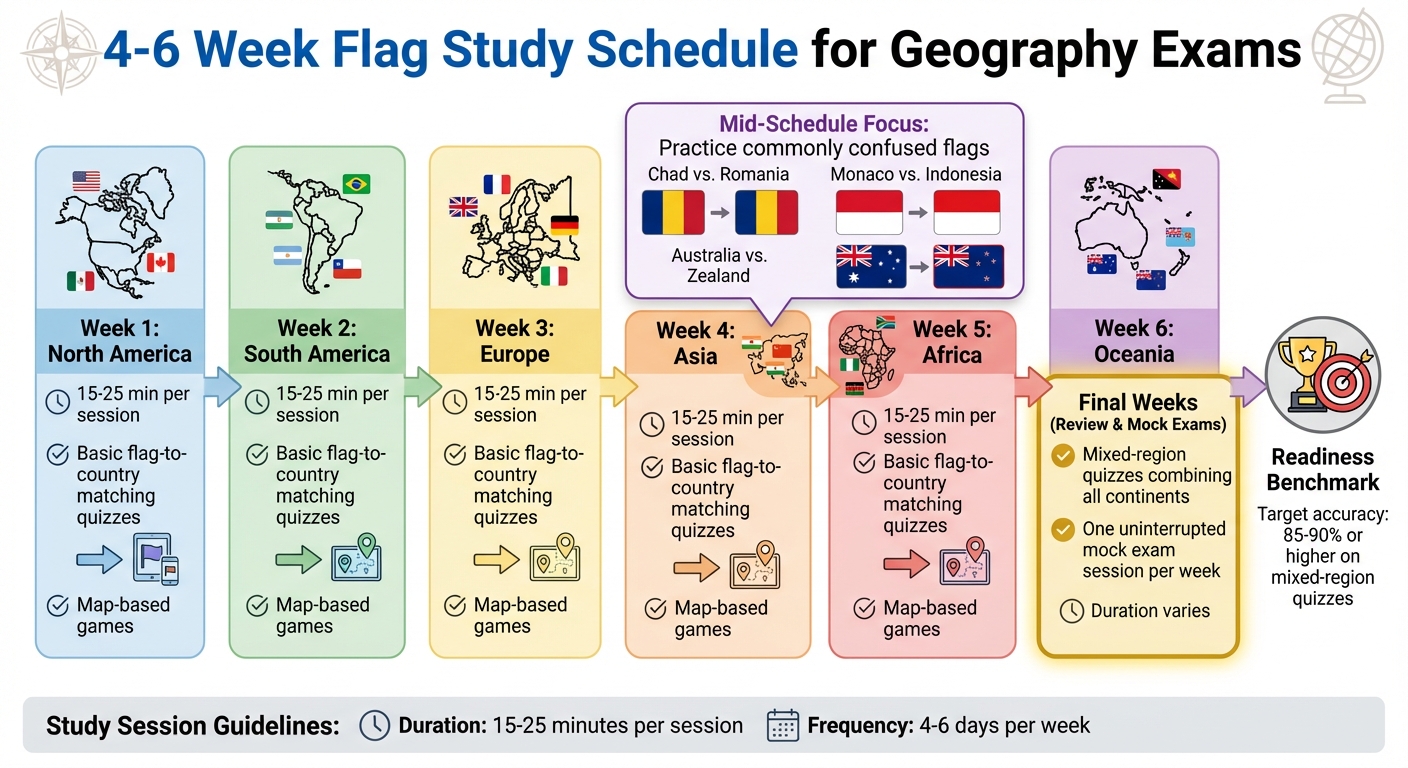
4-6 Week Flag Study Schedule for Geography Exam Preparation
Setting Up a Review Schedule
Creating a focused 4–6 week schedule can help you systematically cover all regions before your exam. Start by dedicating each week to a specific region – Week 1 for North America, Week 2 for South America, Week 3 for Europe, and so on, working through Asia, Africa, and Oceania. Begin each week with basic flag-to-country matching quizzes to get familiar with the flags. Once you’re comfortable, move on to map-based games where you click the correct country when a flag appears. This approach enhances both recognition and spatial memory.
As your exam gets closer, shift your focus to flags that are commonly confused, like Chad and Romania, Monaco and Indonesia, or Australia and New Zealand. These flags often share similar colors or layouts, so practicing them side by side can help you quickly spot the differences. Wrap up your schedule with mixed-region quizzes that combine flags from all continents. These sessions mimic the cumulative nature of geography exams and help you prepare for the real test format. Aim for 15–25 minute study sessions, 4–6 days a week, to fit into your routine without overwhelming yourself.
Once your review schedule is in place, it’s time to practice under exam-like conditions.
Practicing Under Test Conditions
To simulate exam scenarios, transition from region-specific drills to mixed-region quizzes that include flags from all over the world. This mirrors the cumulative format of U.S. geography exams. Use a timer – 30–45 seconds per question for written tests or faster if you’re preparing for buzzer-style competitions – to match the pace of the actual exam.
For map-based tests, try games where a flag appears, and you must click on the correct country on a world map. These activities help you combine flag recognition with location knowledge, skills that are crucial for geography exams. Make timed quizzes and mock exams a regular part of your routine. Set aside one uninterrupted mock exam session each week to build the focus and stamina required for the test.
Evaluating Your Readiness
After practicing under timed conditions, measure your progress by tracking key metrics. Monitor your accuracy percentage, average response time, and performance by region to gauge whether you’re ready for the exam. A good benchmark is consistently scoring 85–90% or higher on mixed-region quizzes while maintaining or improving your speed. Long streaks of correct answers are a strong indicator of automatic recall. If you notice weaker performance in certain regions, like Central Africa or Oceania, that’s a sign you need to dedicate more time to those areas.
Keep a record of your weekly scores and adjust your study plan accordingly. If your accuracy is high but your response time is slow, focus on timed, mixed-region quizzes to improve your speed. Use these evaluations to fine-tune your study schedule as the exam approaches. With consistent adjustments and targeted practice, you’ll be well-prepared by test day.
Conclusion
Main Points to Remember
Flag matching games offer geography students an effective way to sharpen visual recognition, link symbols to specific locations, and practice recalling information under time constraints – all of which can lead to better test results. By incorporating interactive quizzes into your routine, you’re doing more than just memorizing flags; you’re actively training your brain to quickly and accurately recall countries, regions, and capitals. The game format transforms what could be monotonous memorization into an engaging and rewarding challenge, complete with instant feedback, scores, and progress tracking. Many students report noticeable improvements after just two weeks of daily practice for 10–15 minutes, progressing from recognizing only a few familiar flags to confidently identifying most countries within a region, such as South America or Europe. This tangible progress often serves as a strong motivator to continue practicing.
Getting Started with Flag Games
If you’re ready to enhance your flag recognition skills, here’s how to get started. Choose one region – like North America or Europe – and take a short flag quiz today to establish a baseline score. A great resource to begin with is Flag Emoji Quizzes (https://flagemoji.com), which offers interactive quizzes sorted by region, including North America, South America, Europe, Asia, Africa, and Oceania. Each quiz provides immediate feedback by showing the correct answer after every question. Bookmark one or two quiz sites you enjoy and set reminders in your planner or phone calendar for regular practice sessions. To mix things up, combine online quizzes with offline methods like flashcards or quizzing with a friend. As your exam date gets closer, transition to full-length mixed-region quizzes in a quiet environment to simulate test conditions. Dedicating just 10–15 minutes a day to these activities – both online and offline – can significantly improve your flag recognition skills and overall exam readiness. Keep track of your weekly scores to identify weaker areas and adjust your focus accordingly.
FAQs
How can playing flag games help me do better on my geography exams?
Flag games offer an enjoyable and interactive way to brush up on your geography skills. By identifying flags and linking them to their corresponding countries, you not only get better at recognizing national symbols but also strengthen your understanding of world geography.
What makes these games so appealing is how they turn studying into a more engaging experience. They help you retain information for longer periods and build confidence when recalling details, whether for exams or casual conversations. Many flag games also provide instant feedback, making it easy to learn from mistakes and monitor your progress as you go.
What are some effective tips for remembering challenging flags?
To make remembering tricky flags easier, try breaking the process into fun, bite-sized steps. Start by zeroing in on the standout features of each flag – whether it’s unique colors, symbols, or patterns. Linking these features to a country’s history, geography, or culture can make them stick in your mind.
Another helpful approach is using interactive tools, like flag-matching games or quizzes. These tools let you repeatedly test your knowledge, which boosts memory over time. For instance, you can focus on one region at a time, like Europe or Asia, by taking quizzes specific to that area and then gradually expand your scope.
You might also want to try creating mnemonics or visual stories that tie a flag’s design to its country. This method not only keeps the learning process engaging but also makes the flags much easier to recall later.
How can I use flag games to make geography lessons more engaging?
Flag games bring an engaging twist to geography lessons, making learning both interactive and enjoyable. One popular approach is using quizzes where students match flags to their respective countries, grouped by regions such as North America, South America, Europe, Asia, Africa, and Oceania. These activities not only challenge students but also help reinforce their understanding of world geography.
You can easily weave these games into your teaching plan in creative ways. Use them as a warm-up activity to spark interest, a group challenge to encourage teamwork, or even as a fun method for exam prep. They’re a great way to help students retain information while keeping them actively engaged in the learning process.
Related Blog Posts
- World Flags Quiz Generator
- Flag Recognition Test
- Flag Knowledge Checker
- North American Flags Quiz: Test Your Knowledge
Free Printable: Flags of the World Reference Card
Get a beautiful printable poster with 50 flag emojis, Unicode codes, and fun facts. Perfect for classrooms and desks!
No spam, ever. Unsubscribe anytime.