
How To
How To
Time needed: 1 minute
Want the full printable classroom pack?
Take the flag reference from your screen to an offline pack for lessons, practice, and quiz time.
- Printable atlas with 230+ high-resolution flag flats
- Four regional quizzes with answer keys
- Flag Bingo boards and caller sheet
How to copy and paste the Flag of Nigeria Emoji to any device.
- Copy the Nigerian Flag Emoji
Go to flagemoji.com and press the copy button (above). This works on any device.
- Paste the Emoji
Go to your email/iMessage/SMS texting service/document and paste the emoji.
For mobile devices
— double-tap or tap-hold, then paste should appear. Tap it.
For desktop and laptops on Apple devices
— command-P / ⌘-P
For desktop and laptops on Windows devices
— control-p
Codes
Emoji Codes
Flag emojis are unicode symbols, like any other letter or number on your keyboard. This means you can copy and paste the emoji itself into your code, whatever the language (click the button above).
They actually count as two characters: the two-letter country code (the ISO international standard). The unicode and shortcode both represent country data which devices can interpret and display the emoji.
| Country Code | Unicode | Shortcode |
| NG | U+1F1F3 U+1F1EC | :flag_NG: :NG: |
Emoji shortcodes are used on some platforms as a way for users to type in emojis from the keyboard. If you type the emoji shortcode on Github or Slack, the emoji will appear.
*The official name of the emoji is only the country name, not ‘Nigeria Flag’, for example.
Description
Description
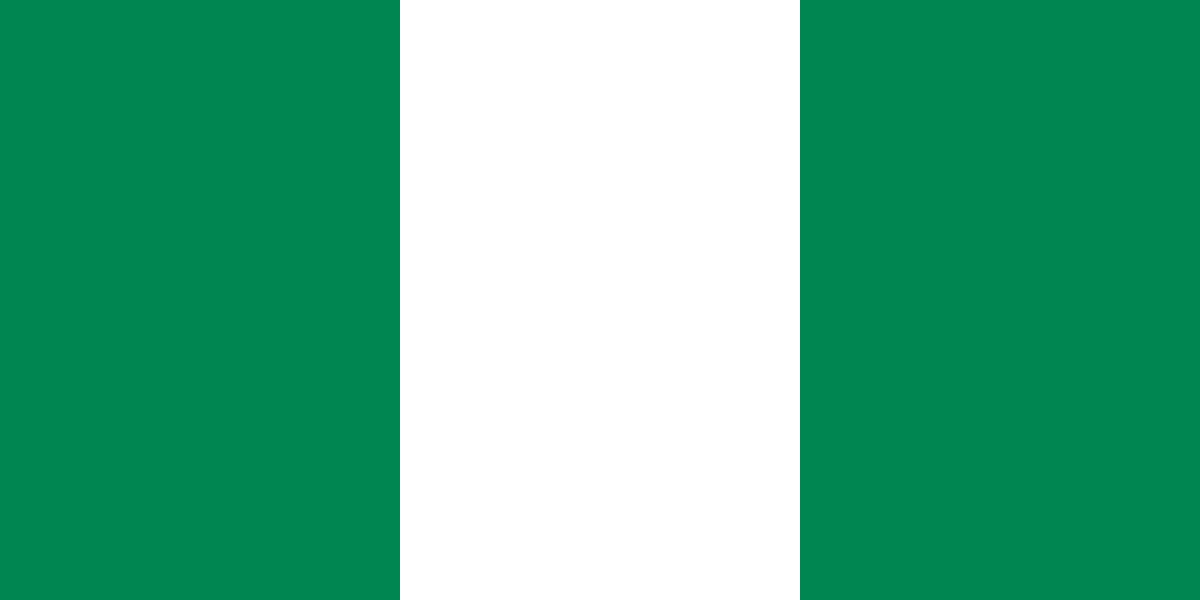
The flag of Nigeria is composed of three equal vertical bands of green (hoist side), white, and green. The color green represents the forests and abundant natural wealth of the country. White stands for peace and unity.
Map
Map
Check out the map of Ghana!
Weather
Anthem
National Anthem
| Title | Arise Oh Compatriots, Nigeria’s Call Obey |
| Composer | John A. Ilechukwu, Eme Etim Akpan, B.A. Ogunnaike, Sotu Omoigui and P.O. Aderibigbe / Benedict Elide Odiase |
FAQ
FAQs
Nigeria gained independence on October 1, 1960 from British rule.
The color green represents the forests and abundant natural wealth of the country, while white stands for peace and unity.
Nigeria’s national flag was officially adopted on October 1, 1960.
Nigeria is governed by a federal presidential republic.
Discover more fun facts of Cape Verde.
Printable
Printable Nigerian Flag
Print another really cool flag. Why not the flag of Mauritius?
History and Design Origins
Nigeria’s national flag is a striking vertical tricolor of green-white-green, a design that emerged from a pivotal moment in the nation’s independence movement. As Nigeria prepared for independence from British colonial rule in 1959, a national planning committee established a design competition to select a distinctive national flag. From nearly 3,000 submissions, the winning design was selected for its elegance, simplicity, and powerful symbolic clarity. The flag was officially adopted at midnight on October 1, 1960, the precise moment Nigeria gained independence, making it an enduring symbol of the nation’s sovereignty and unity.
The Designer: Michael Taiwo Akinkunmi
The Nigerian flag was designed by Michael Taiwo Akinkunmi, a 23-year-old engineering student at the University of London at the time of the 1959 competition. Akinkunmi’s design triumphed over thousands of entries, and he was awarded £100 for his winning submission—a modest sum that belied the lasting global significance of his creation. Born on May 10, 1936, Akinkunmi would go on to have a distinguished career in civil service, receiving the honour of Officer of the Federal Republic (OFR) for his contributions to Nigeria. He remained a celebrated figure in Nigerian history until his death on August 29, 2023, at the age of 87, remembered as the creative mind behind one of Africa’s most recognizable national symbols.
Symbolism of Colors and Elements
The Nigerian flag’s design is deceptively simple yet profoundly symbolic. The two green vertical bands represent Nigeria’s abundant natural resources, particularly its agricultural heritage and lush vegetation. Green evokes the fertile landscapes that have sustained Nigerian communities for centuries, reflecting the nation’s economic foundation and connection to the land. The central white vertical stripe symbolizes peace, unity, and harmony—values the newly independent nation aspired to embody as it brought together over 250 distinct ethnic groups and cultures. This tri-color arrangement—green, white, green—creates a balanced, harmonious composition that visually reinforces the message of peaceful coexistence and national cohesion in a diverse society.
Evolution from Original Design
Akinkunmi’s original winning design included a notable feature that did not survive to the final flag: a red radiating sun centered on the white stripe. This sun symbolized hope and the dawn of a new era for independent Nigeria. However, during the final selection and approval process, the national committee decided to remove the sun element, opting for a cleaner, more universally appealing design. The decision reflected the committee’s deliberation that given Nigeria’s extraordinary cultural and religious diversity, a simpler flag without additional symbolic elements would be more representative of all Nigerians and less likely to alienate any community. The resulting green-white-green design thus became a canvas of unity through minimalism, allowing each Nigerian to project their own hopes and values onto the national symbol.
Colonial Era and Previous Flags
Before the independence flag, Nigeria had used different symbols under British colonial administration from 1914 to 1960. During this period, Nigeria was represented by a British Blue Ensign defaced with a red circle containing the letters “NIGERIA” and the colonial badge—a design that reflected subordination to British imperial authority. The transition from this colonial flag to Akinkunmi’s design thus marked not merely an aesthetic change but a profound statement of national independence and self-determination.
Flag Specifications and Proper Usage
The Nigerian National Flag is governed by regulations established in the Flag and Coat-of-Arms Ordinance of 1960. The flag’s dimensions follow a specific ratio, with the length of the flag precisely double its breadth—a 1:2 width-to-length proportion. Standard sizes include the Big flag at 1.2 meters in breadth by 2.4 meters in length, the Medium at 0.9 meters by 1.8 meters, and the Small at 0.6 meters by 1.2 meters. Proper usage protocols dictate that the National Flag should be hoisted briskly in the morning at sunrise (typically 6:00 a.m.) and lowered slowly in the evening at sunset (6:00 p.m.). The flag should be hung vertically as the preferred display method. In ceremonial processions, the Nigerian flag takes precedence, positioned in front and at the center of all other flags. During state funerals, remembrance days, or national catastrophes, the flag is flown at half-mast as a mark of respect and mourning. Worn, old, or damaged flags are never displayed publicly, as such a condition is considered disrespectful to the nation; instead, they are destroyed or replaced immediately to maintain the dignity of the national symbol.
Global Recognition and Legacy
Since its adoption in 1960, the Nigerian flag has become one of Africa’s most recognizable national symbols, instantly identifiable by its distinctive green-white-green vertical design. The flag’s straightforward yet meaningful aesthetic has influenced discussions of national identity across Africa and the world. Its adoption marked not just Nigeria’s independence but served as an inspiration for African nations seeking their own symbolic representations of sovereignty and unity. Today, more than sixty years after its creation, the flag continues to represent Nigeria’s commitment to peace, unity, and agricultural prosperity, standing as a testament to Michael Taiwo Akinkunmi’s enduring artistic legacy and Nigeria’s journey as an independent nation.
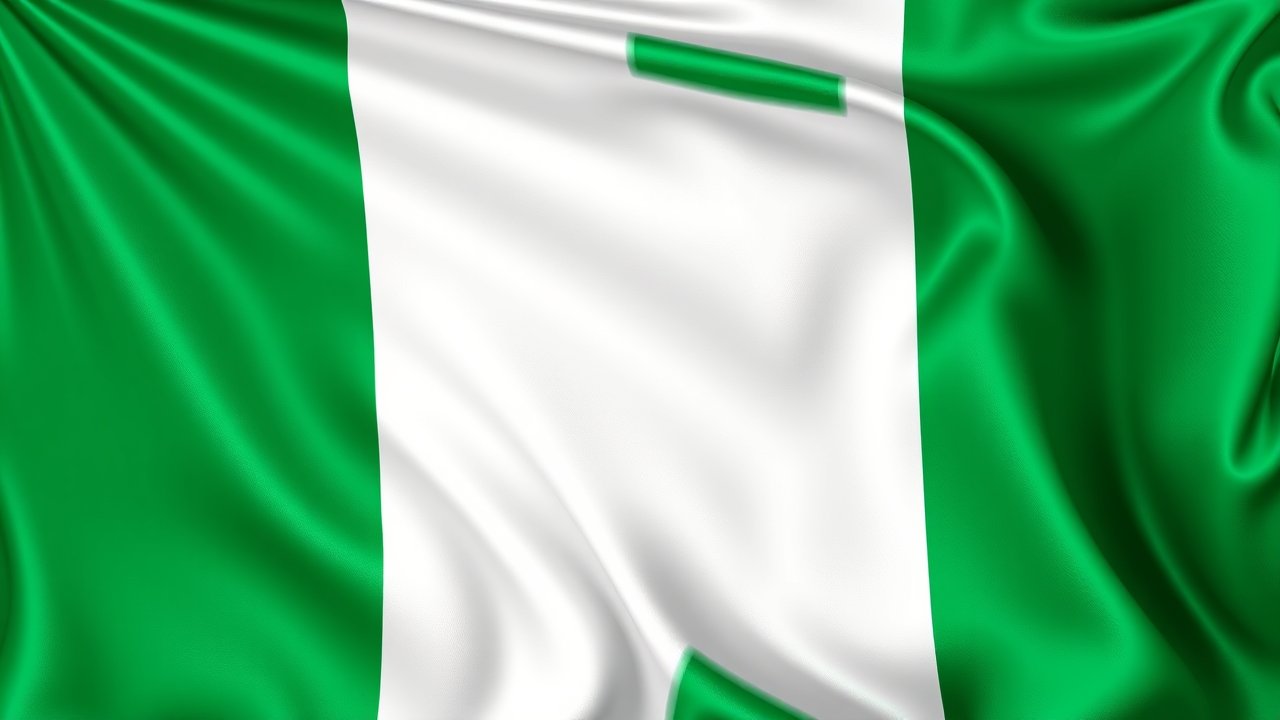
3D Glossy Render — Three vertical stripes of green, white, and green. The flag of Nigeria as a photorealistic 3D render. Three vertical stripes of green, white, and green. The flag fabric hangs or drapes naturally but preserves exact proportions, colors, and all symbols perfectly — completely faithful to the real Nigeria flag. Dramatic studio lighting, glossy silk material, soft shadows, subsurface scattering, perfect specular highlights. No text, no letters, no words, no writing of any kind.
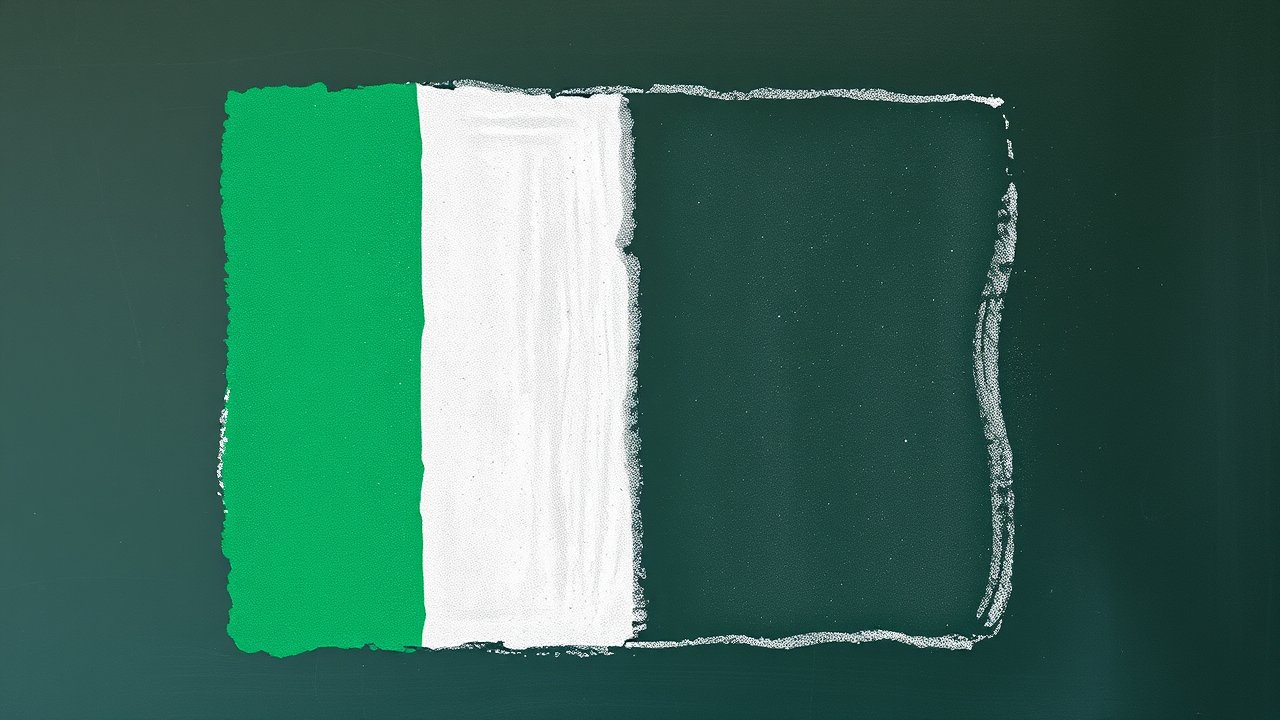
Chalk on Blackboard — Three vertical stripes of green, white, and green. The flag of Nigeria drawn in chalk on a real blackboard. Three vertical stripes of green, white, and green. Authentic blackboard — dark slate green surface with chalk dust and smudge marks. Soft, dusty white and colored chalk lines, imperfect edges, hand-drawn quality. Chalk dust particles visible in the air. The flag is immediately recognizable. No text, no letters, no words, no writing of any kind.
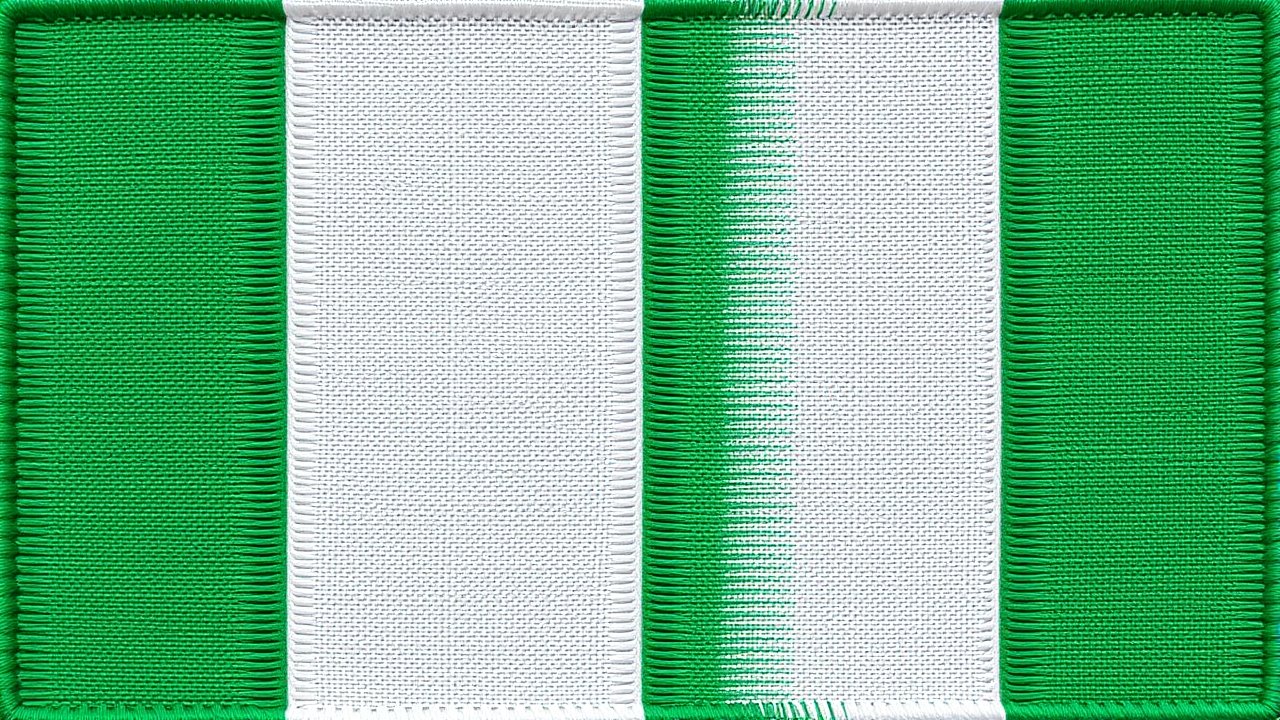
Embroidered Textile — Three vertical stripes of green, white, and green. The flag of Nigeria as intricate embroidery on linen fabric. Three vertical stripes of green, white, and green. Dense satin stitches, French knots, chain stitch detail. The flag design is completely faithful — exact colors, geometry, and all symbols faithfully stitched, immediately recognizable as the Nigeria flag. Visible thread texture, dimensional quality, warm handcrafted feel. No text, no letters, no words, no writing of any kind.
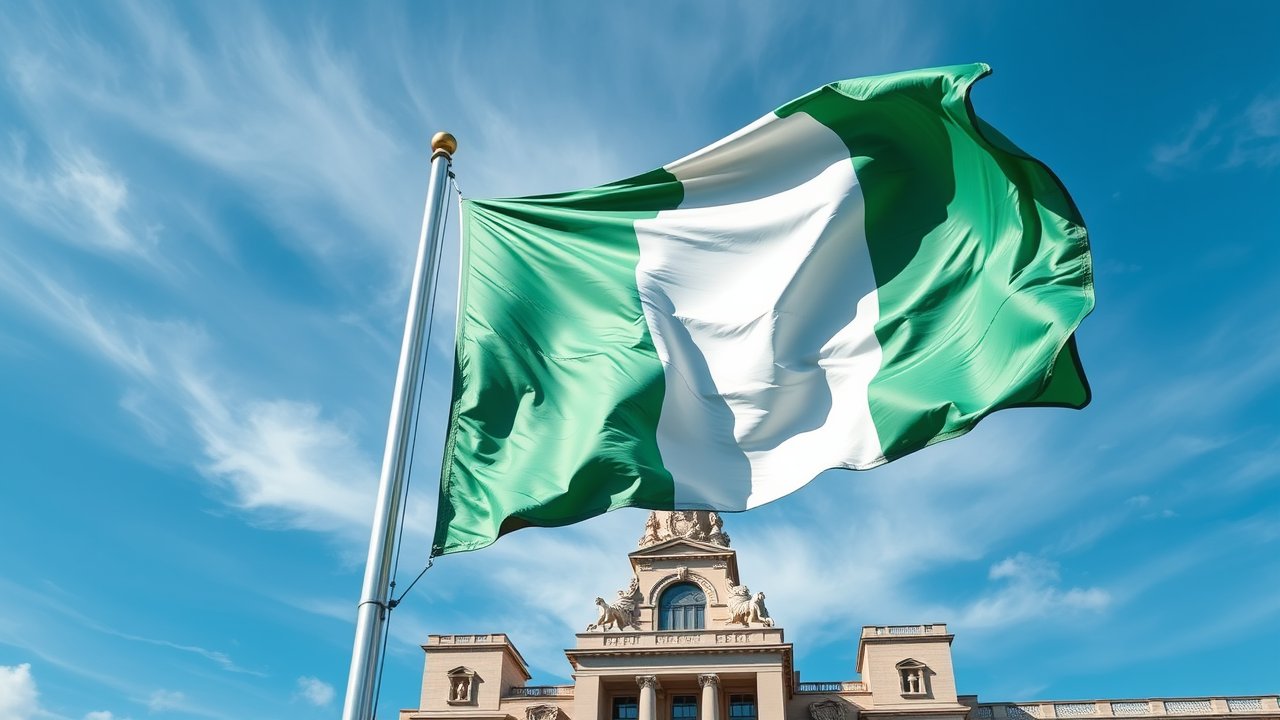
Flagpole in Capital — Three vertical stripes of green, white, and green. Photorealistic photograph of the Nigeria flag flying on a tall flagpole in front of an iconic government building in the capital city. Three vertical stripes of green, white, and green. The flag ripples naturally in the wind, colors vivid and exact. Documentary photography style, sharp and realistic. Grand architecture in the background. Blue sky, dramatic clouds. No text, no letters, no words, no writing of any kind.
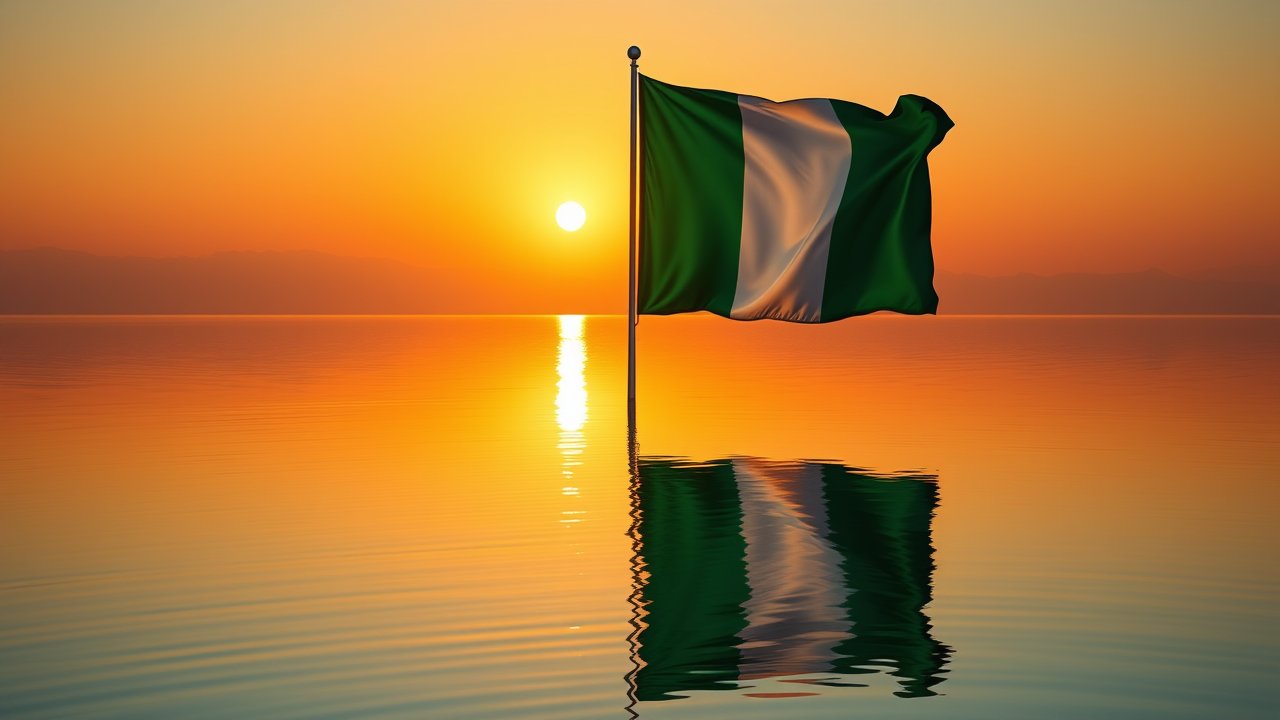
Golden Hour Reflection — Three vertical stripes of green, white, and green. Photorealistic photograph of the Nigeria flag reflected in still water at golden hour. Three vertical stripes of green, white, and green. The flag flies on a pole at the water’s edge, its reflection shimmering on the surface below. Warm amber and orange sunset light. The flag colors and design are faithful and vivid. Serene, cinematic landscape photography. No text, no letters, no words, no writing of any kind.
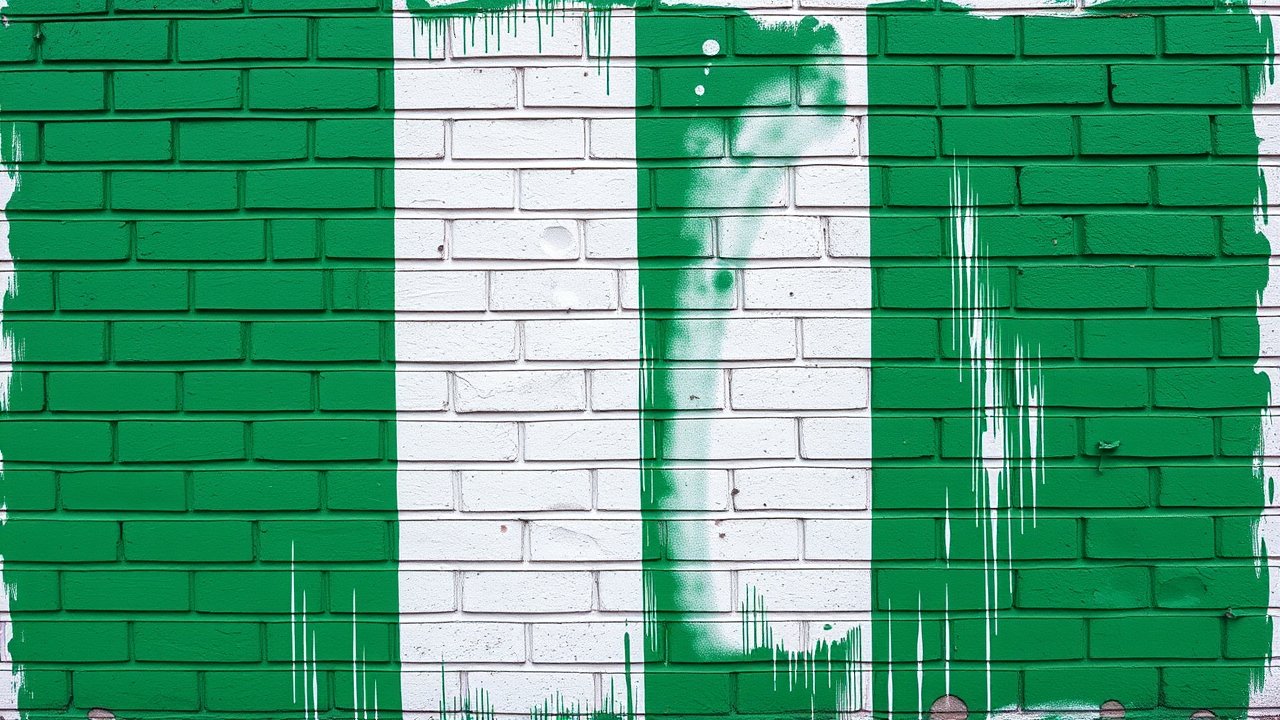
Street Art / Graffiti — Three vertical stripes of green, white, and green. The flag of Nigeria as vibrant street art spray-painted on a brick wall. Three vertical stripes of green, white, and green. Bold spray paint, dripping edges, stencil layers, overspray halos. The flag design is faithful and immediately recognizable — exact colors and symbols, just rendered in spray paint on urban concrete. No text, no letters, no words, no writing of any kind. No tags, no graffiti lettering.
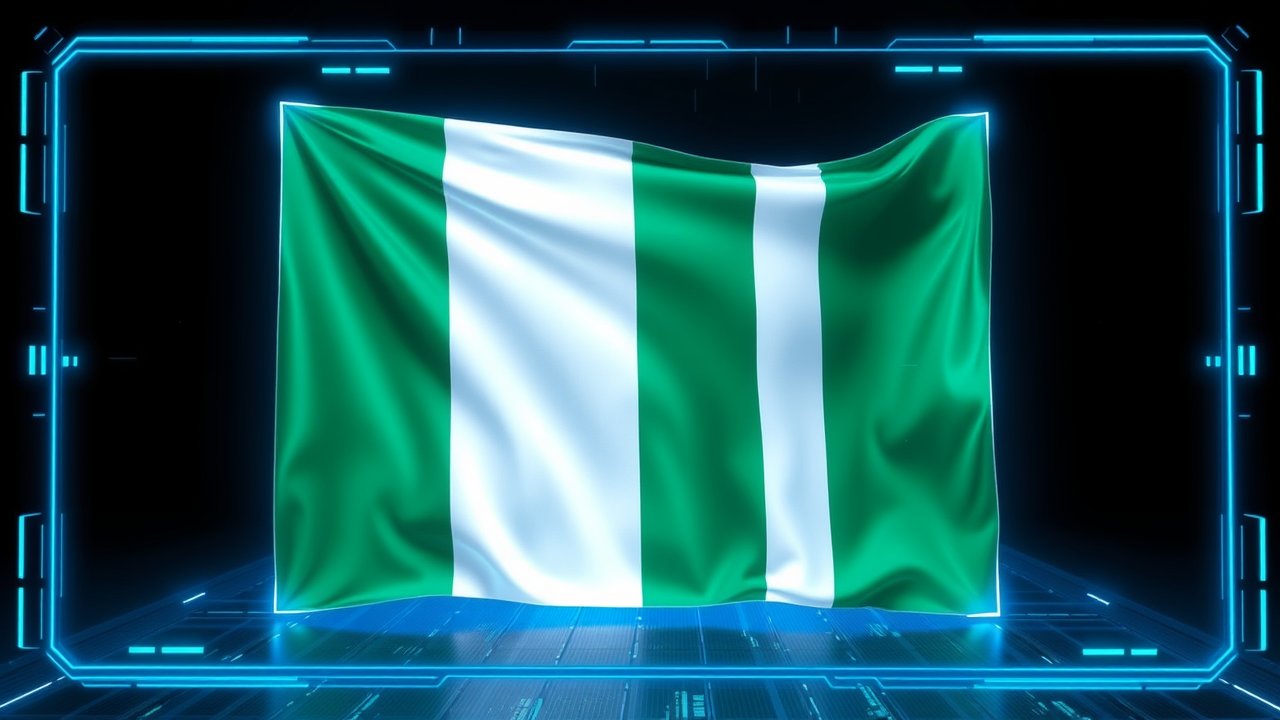
Sci-Fi Hologram — Three vertical stripes of green, white, and green. The flag of Nigeria projected as a futuristic holographic display. Three vertical stripes of green, white, and green. Translucent blue-white projection with scan lines, floating in dark space. Glitching edges, particle effects, data streams. The flag design is completely faithful and recognizable. Cyberpunk HUD elements framing the projection. No text, no letters, no words, no writing of any kind.
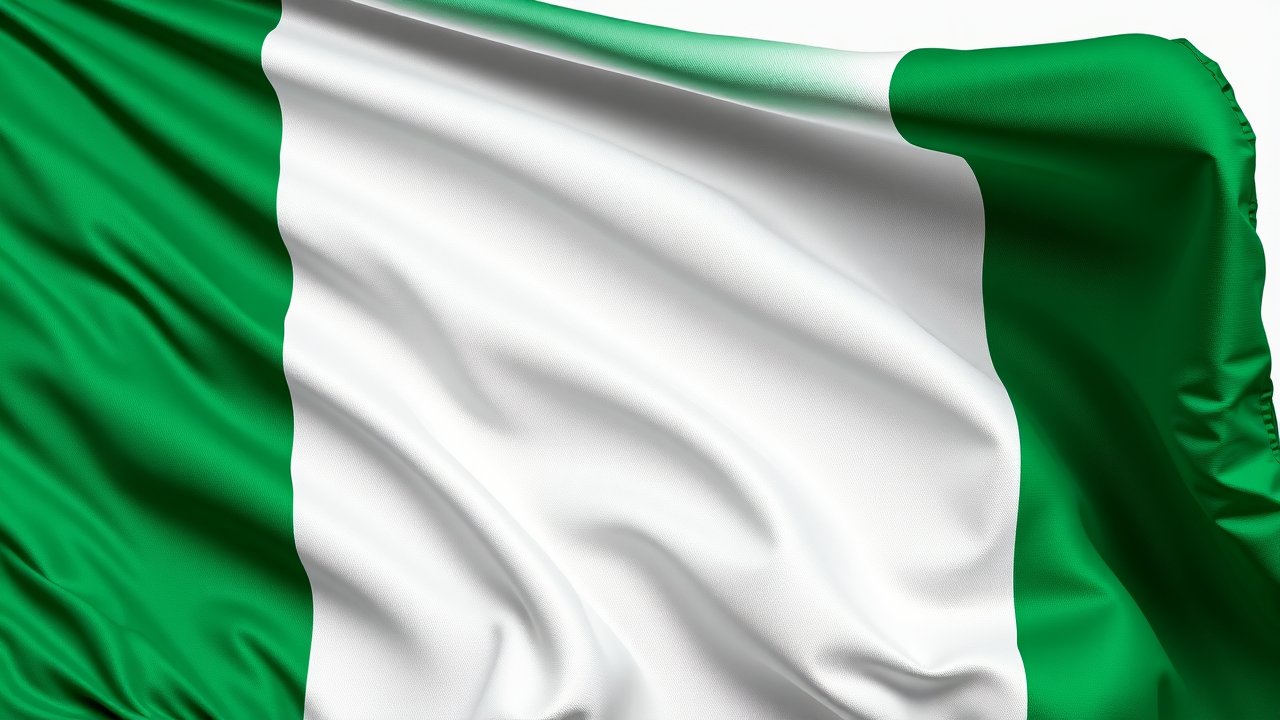
Hyperrealistic Wind — Three vertical stripes of green, white, and green. Ultra-hyperrealistic photograph of the Nigeria flag caught in a dramatic gust of wind. Three vertical stripes of green, white, and green. Macro-level fabric detail — individual threads visible, fabric folds and tension lines crisp. Colors and design completely faithful to the real Nigeria flag. High-speed shutter, razor-sharp focus, studio lighting. No text, no letters, no words, no writing of any kind.
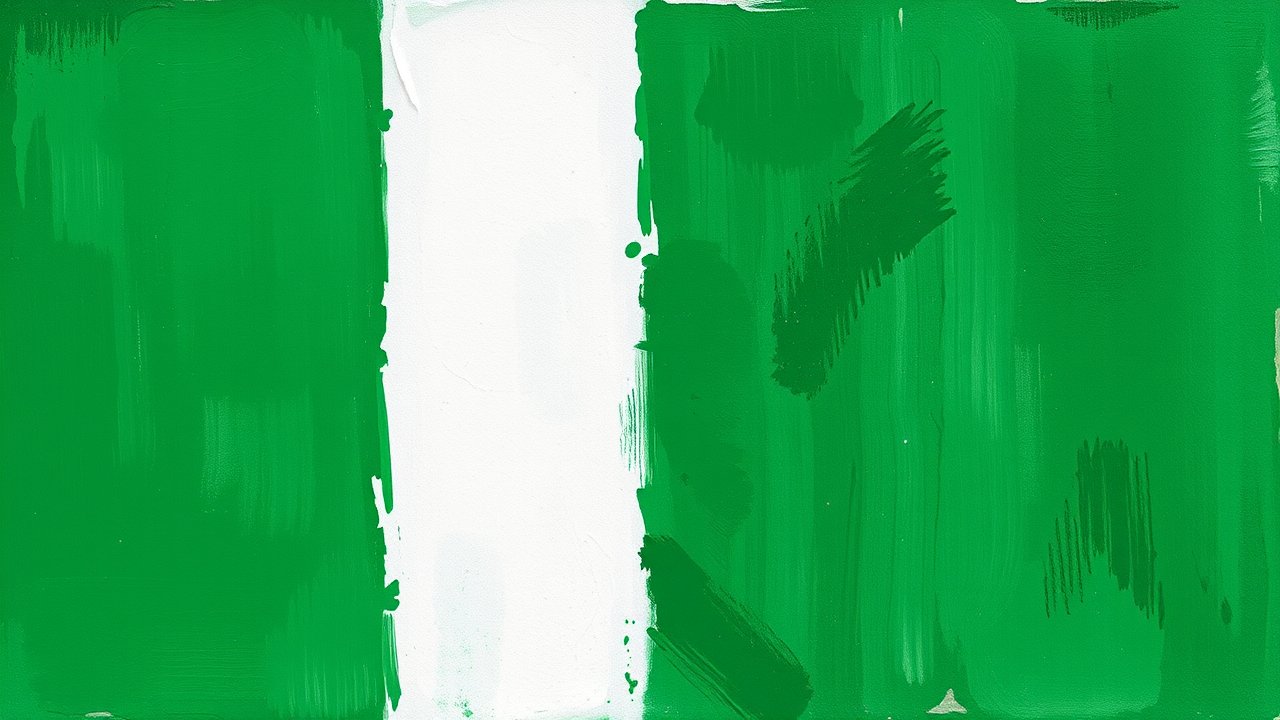
Impressionist Oil — Three vertical stripes of green, white, and green. The flag of Nigeria painted in French Impressionist oil on canvas. Three vertical stripes of green, white, and green. Thick impasto brushstrokes, dappled light, vibrant broken color technique in the style of Monet. The flag is instantly recognizable — colors and design faithful to the real Nigeria flag, interpreted with impressionist light and texture. No text, no letters, no words, no writing of any kind.
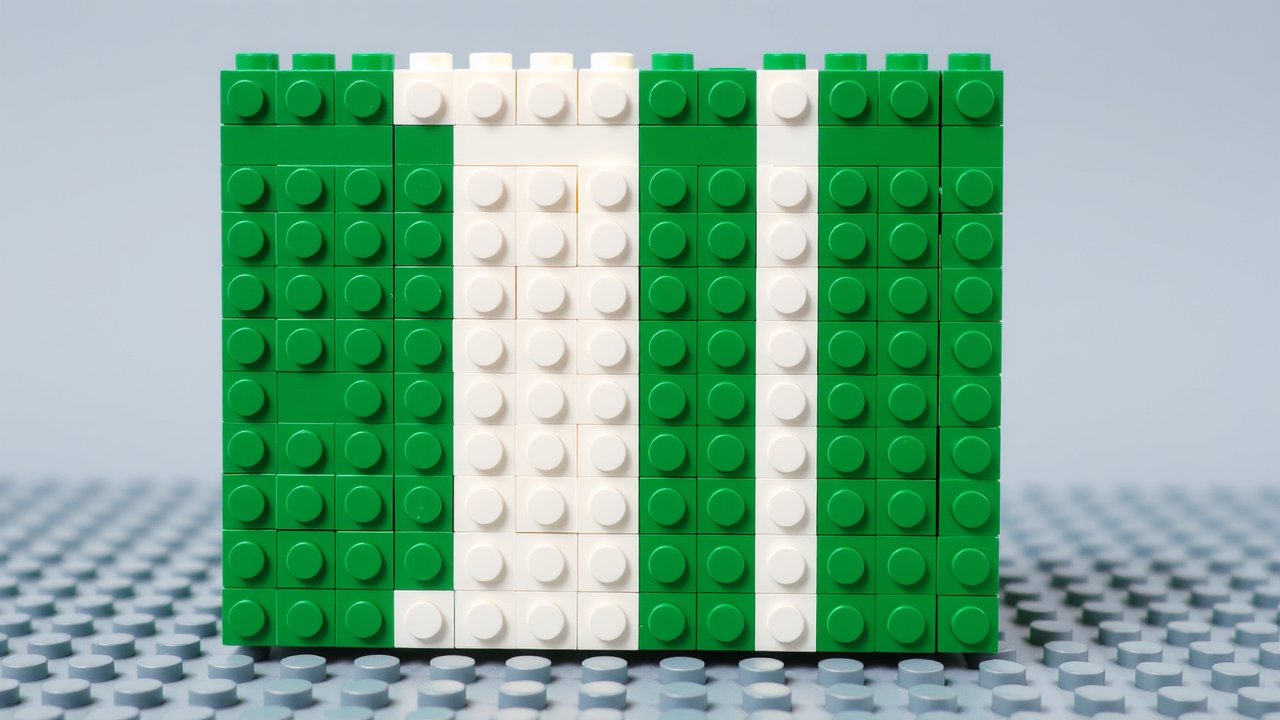
Lego Bricks — Three vertical stripes of green, white, and green. The flag of Nigeria built from Lego bricks, photographed as a real physical construction. Three vertical stripes of green, white, and green. Visible studs and brick seams, slight plastic sheen. Standard Lego colors approximate the flag’s palette. Built on a gray Lego baseplate. Dramatic angle showing the three-dimensional brick texture. No text, no letters, no words, no writing of any kind.

Low-Poly Geometric — Three vertical stripes of green, white, and green. The flag of Nigeria constructed from low-polygon geometric triangles. Three vertical stripes of green, white, and green. Aggressively faceted — each region broken into many visible triangular faces with subtle color variation across each polygon, creating real depth and dimensionality even in flat-color areas of the flag. Crystal-like, contemporary computational design. The flag is completely faithful and immediately recognizable. No text, no letters, no words, no writing of any kind.
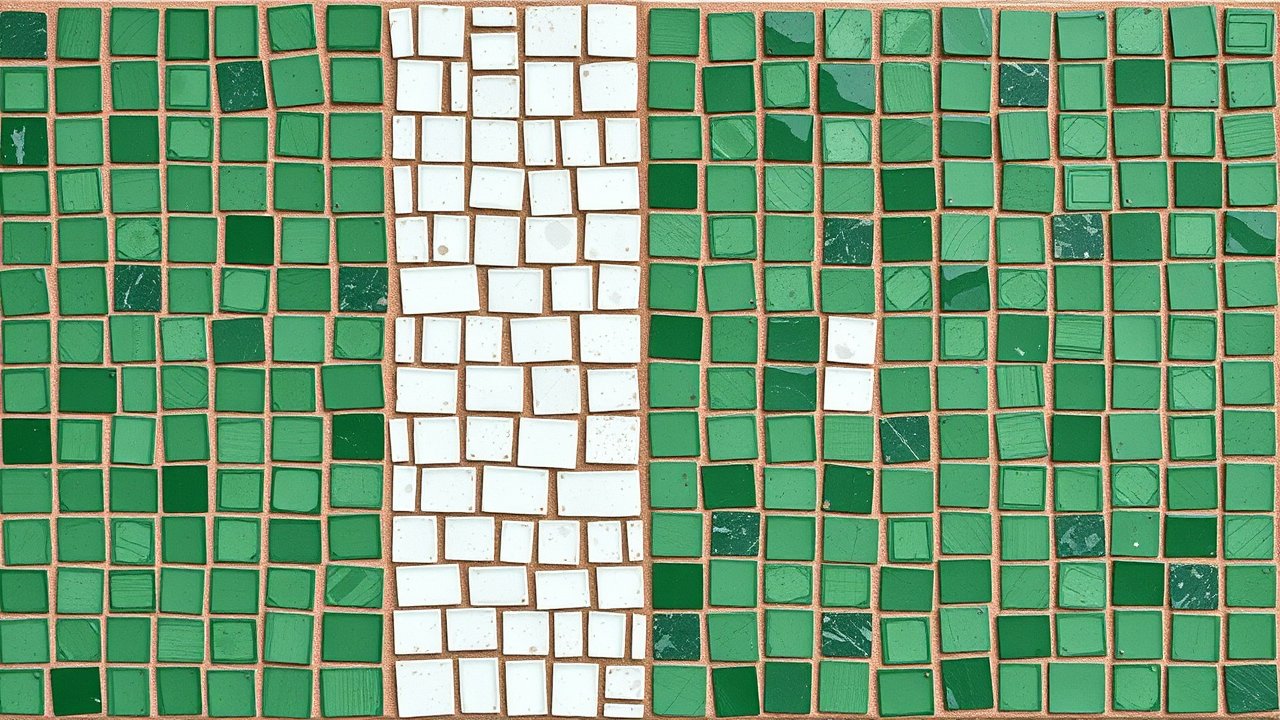
Mosaic Tiles — Three vertical stripes of green, white, and green. The flag of Nigeria assembled as a Roman-style mosaic. Three vertical stripes of green, white, and green. The flag is completely faithful to the real Nigeria flag — exact proportions, colors, and all symbols, rendered in thousands of small stone and glass tesserae. Visible grout lines, rich earthy tones mixed with brilliant glass, slight historical weathering. No text, no letters, no words, no writing of any kind.
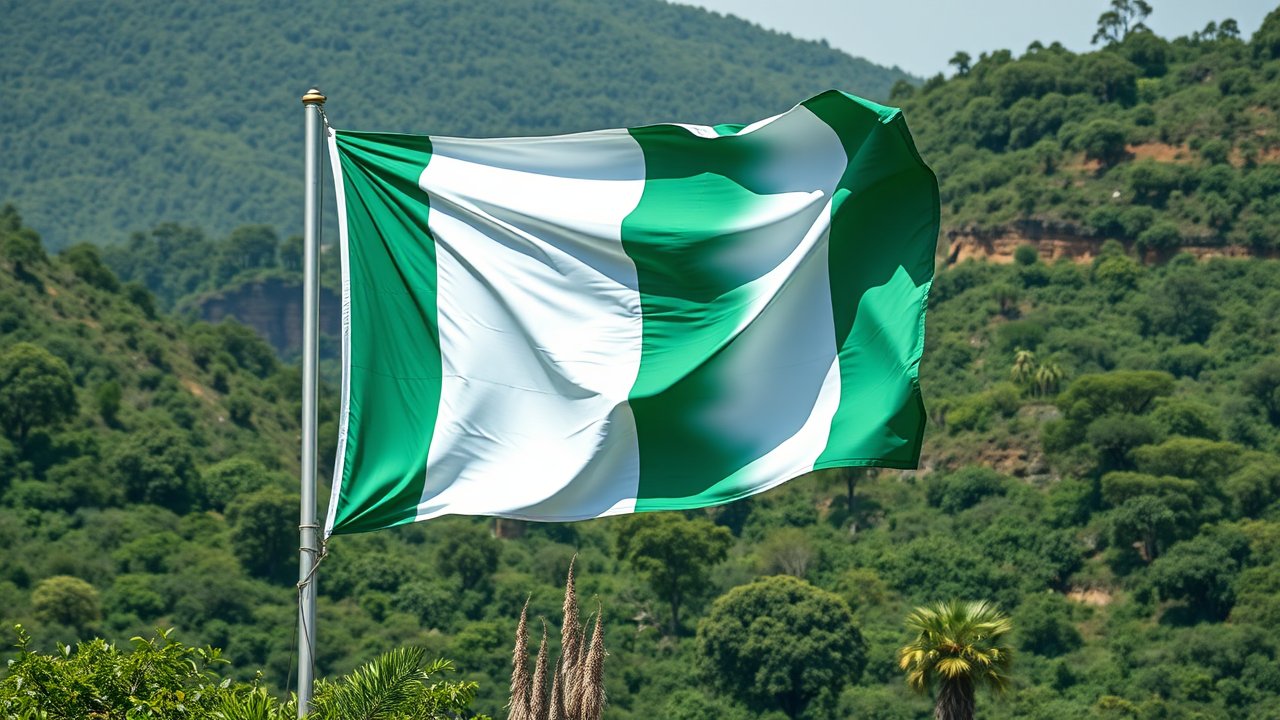
Native Landscape — Three vertical stripes of green, white, and green. Photorealistic photograph of the Nigeria flag flying in an iconic natural landscape native to Nigeria — the terrain, flora, and environment characteristic of that country. Three vertical stripes of green, white, and green. The flag is prominent and its colors are faithful and vivid. Remote, uninhabited wilderness. National Geographic photography style. No text, no letters, no words, no writing of any kind.
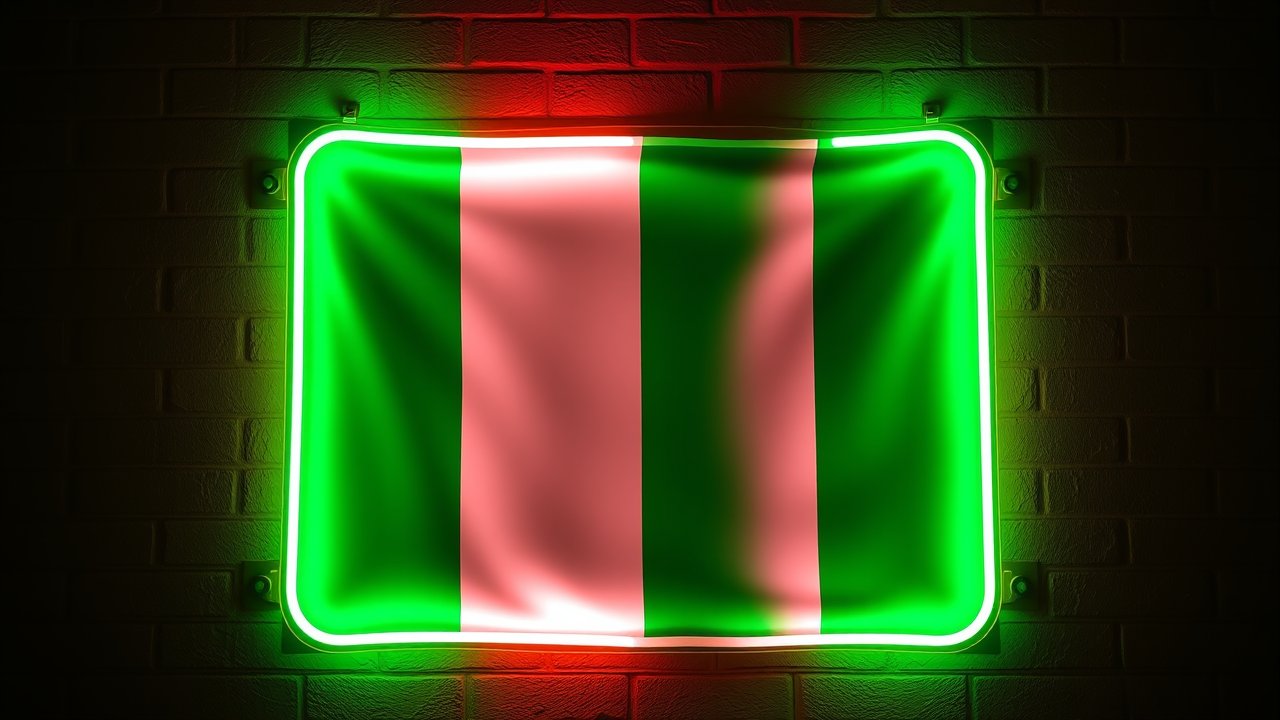
Neon Sign — Three vertical stripes of green, white, and green. The flag of Nigeria recreated as a real neon sign mounted on a dark wall. Three vertical stripes of green, white, and green. Glowing glass neon tubes bent into the flag’s shapes — the colors of the flag rendered in actual neon light. Visible glass tube bends, metal mounting brackets on the wall. Warm neon glow and light bloom. Real neon, not digital. Photographed in a dark room. No text, no letters, no words, no writing of any kind.
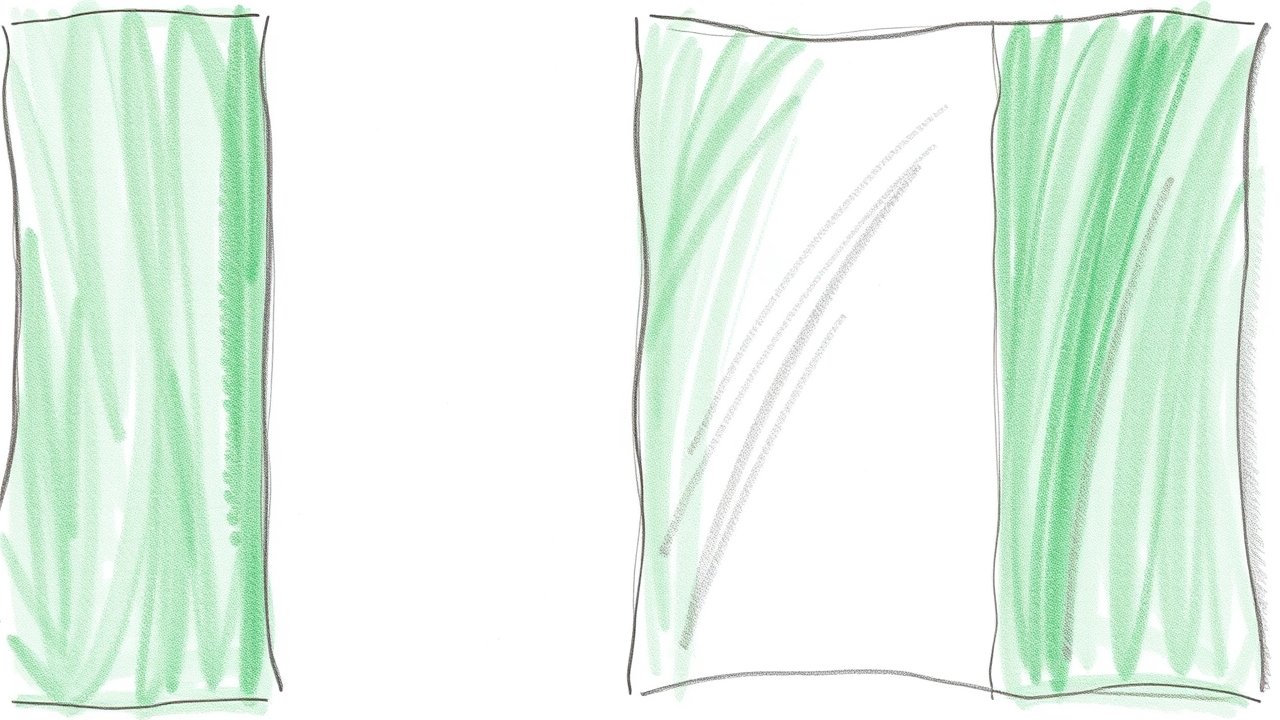
Pencil Sketch — Three vertical stripes of green, white, and green. The flag of Nigeria as a bold, confident pencil sketch. Three vertical stripes of green, white, and green. Strong graphite lines on cream paper — not delicate but bold and decisive. Heavy pressure on key outlines, dramatic cross-hatching for deep shadows and shading. Immediately recognizable as the Nigeria flag. Artist’s confident hand, not tentative. No text, no letters, no words, no writing of any kind.

Pixel Art — Three vertical stripes of green, white, and green. The flag of Nigeria as detailed 16-bit pixel art. Three vertical stripes of green, white, and green. Crisp pixel grid, limited palette with careful dithering, nostalgic retro game aesthetic. Clean grid-aligned design with subtle shading. Every element of the flag faithfully reproduced in pixels. No text, no letters, no words, no writing of any kind.
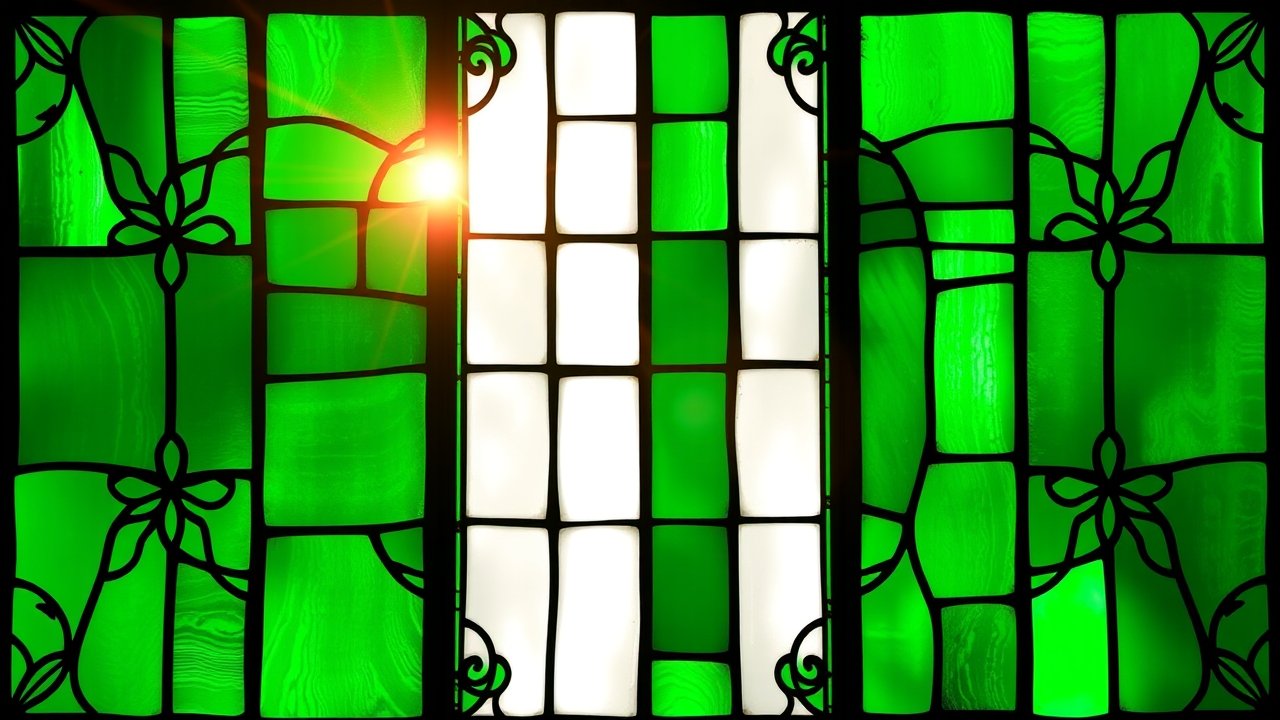
Stained Glass — Three vertical stripes of green, white, and green. The flag of Nigeria rendered as an ornate stained glass window. Three vertical stripes of green, white, and green. The design is completely faithful to the real Nigeria flag — exact colors, geometry, and all symbols preserved. Brilliant jewel-toned glass pieces separated by dark lead came lines. Warm sunlight streaming through, casting colored light. Gothic cathedral craftsmanship. No text, no letters, no words, no writing of any kind.
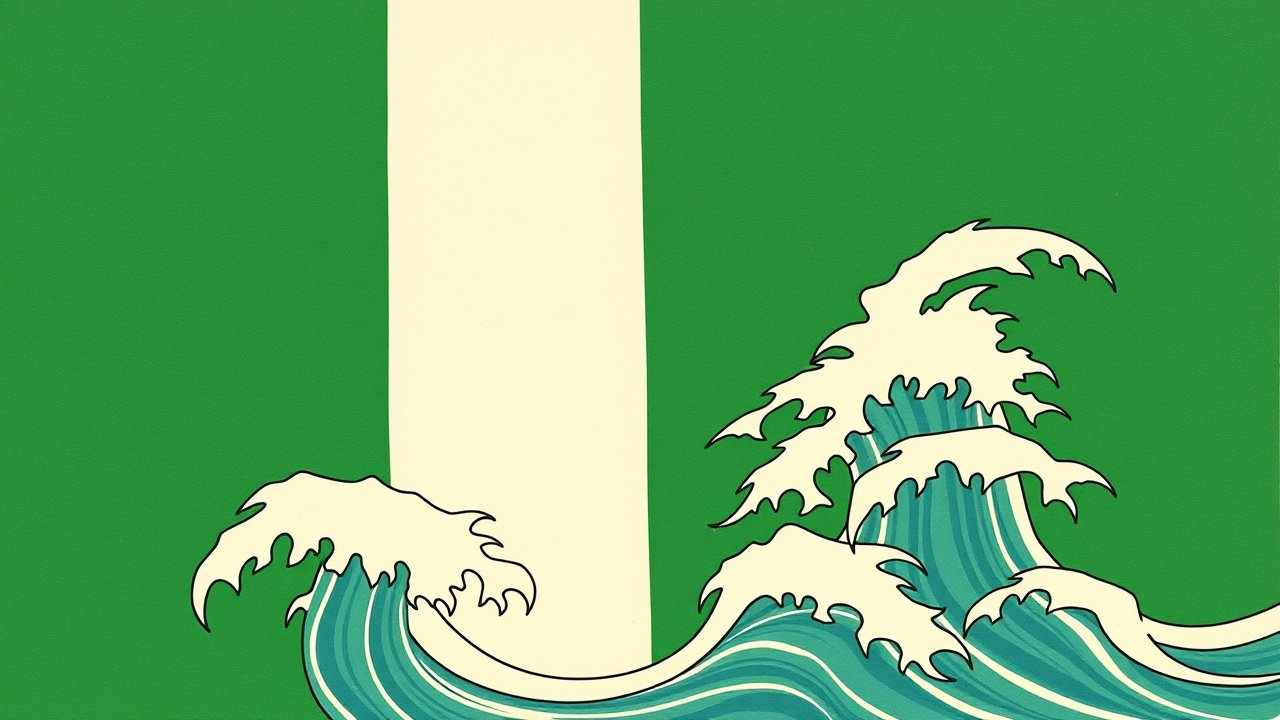
Ukiyo-e Woodblock — Three vertical stripes of green, white, and green. The flag of Nigeria as a traditional Japanese ukiyo-e woodblock print. Three vertical stripes of green, white, and green. Bold outlines, flat areas of rich color, flowing organic forms. Wind and waves incorporated into the composition. Printed on washi paper with visible wood grain texture. The flag is the central focus and instantly recognizable. No text, no letters, no words, no writing of any kind.
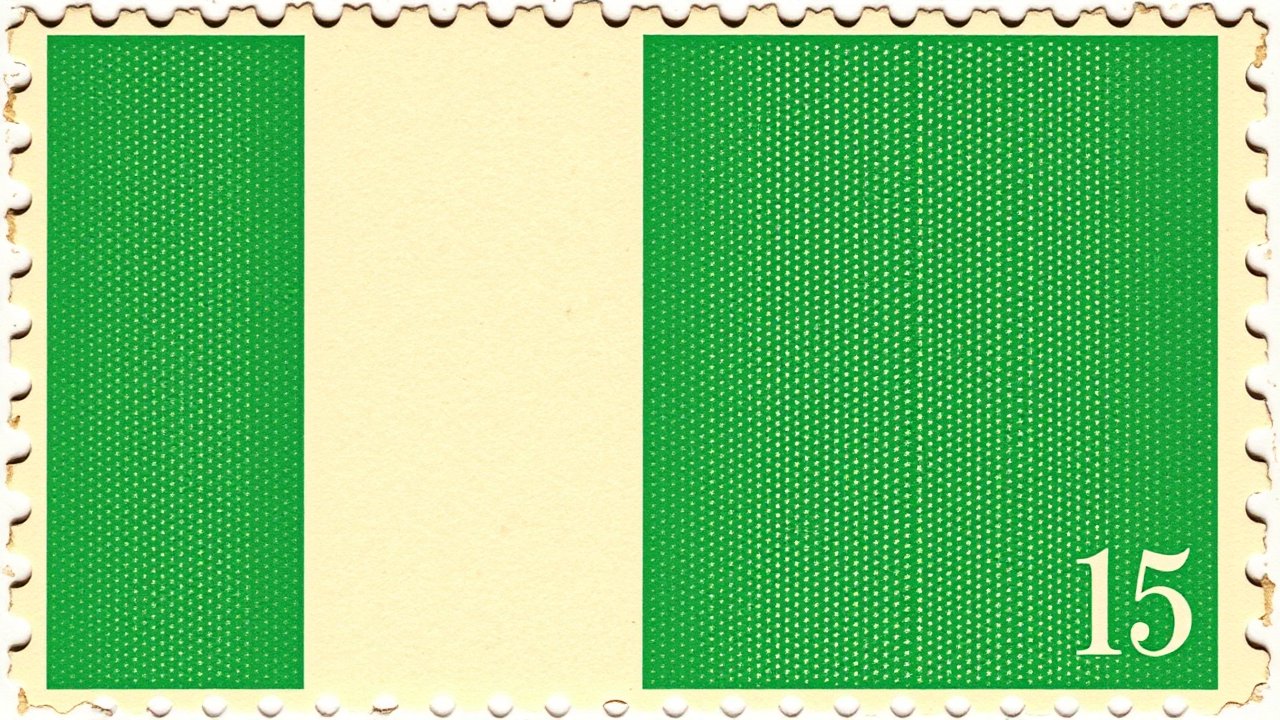
Vintage Postage Stamp — Three vertical stripes of green, white, and green. The flag of Nigeria as a vintage 1950s postage stamp. Three vertical stripes of green, white, and green. The flag fills most of the stamp — it is the primary subject, faithfully rendered in fine engraved intaglio style. Perforated edges, aged paper with slight foxing. The stamp may show a denomination numeral only — absolutely no other text or country names.
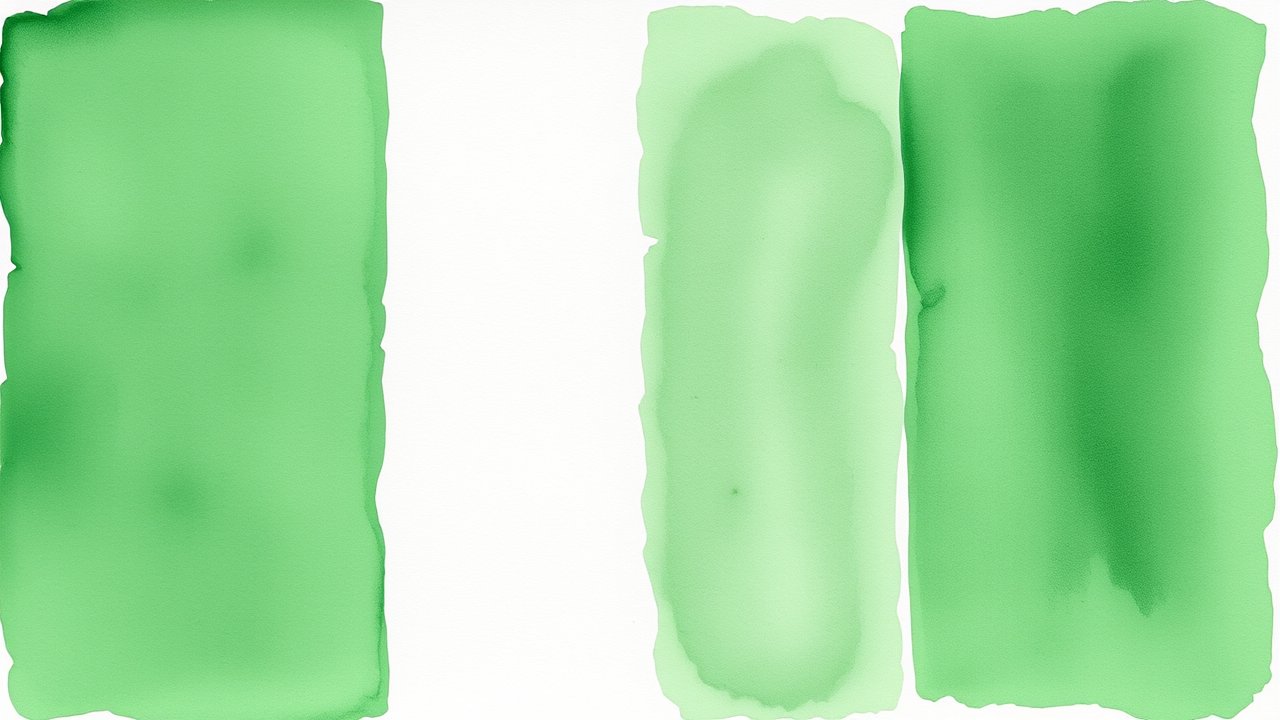
Watercolor — Three vertical stripes of green, white, and green. The flag of Nigeria painted in loose, expressive watercolor. Three vertical stripes of green, white, and green. Wet-on-wet technique with soft color bleeds, visible brushstrokes, natural paper texture. Delicate splashes and drips at the edges. Luminous, translucent layers of pigment. No text, no letters, no words, no writing of any kind.
History and Design Origins
Nigeria’s national flag is a striking vertical tricolor of green-white-green, a design that emerged from a pivotal moment in the nation’s independence movement. As Nigeria prepared for independence from British colonial rule in 1959, a national planning committee established a design competition to select a distinctive national flag. From nearly 3,000 submissions, the winning design was selected for its elegance, simplicity, and powerful symbolic clarity. The flag was officially adopted at midnight on October 1, 1960, the precise moment Nigeria gained independence, making it an enduring symbol of the nation’s sovereignty and unity.
The Designer: Michael Taiwo Akinkunmi
The Nigerian flag was designed by Michael Taiwo Akinkunmi, a 23-year-old engineering student at the University of London at the time of the 1959 competition. Akinkunmi’s design triumphed over thousands of entries, and he was awarded £100 for his winning submission—a modest sum that belied the lasting global significance of his creation. Born on May 10, 1936, Akinkunmi would go on to have a distinguished career in civil service, receiving the honour of Officer of the Federal Republic (OFR) for his contributions to Nigeria. He remained a celebrated figure in Nigerian history until his death on August 29, 2023, at the age of 87, remembered as the creative mind behind one of Africa’s most recognizable national symbols.
Symbolism of Colors and Elements
The Nigerian flag’s design is deceptively simple yet profoundly symbolic. The two green vertical bands represent Nigeria’s abundant natural resources, particularly its agricultural heritage and lush vegetation. Green evokes the fertile landscapes that have sustained Nigerian communities for centuries, reflecting the nation’s economic foundation and connection to the land. The central white vertical stripe symbolizes peace, unity, and harmony—values the newly independent nation aspired to embody as it brought together over 250 distinct ethnic groups and cultures. This tri-color arrangement—green, white, green—creates a balanced, harmonious composition that visually reinforces the message of peaceful coexistence and national cohesion in a diverse society.
Evolution from Original Design
Akinkunmi’s original winning design included a notable feature that did not survive to the final flag: a red radiating sun centered on the white stripe. This sun symbolized hope and the dawn of a new era for independent Nigeria. However, during the final selection and approval process, the national committee decided to remove the sun element, opting for a cleaner, more universally appealing design. The decision reflected the committee’s deliberation that given Nigeria’s extraordinary cultural and religious diversity, a simpler flag without additional symbolic elements would be more representative of all Nigerians and less likely to alienate any community. The resulting green-white-green design thus became a canvas of unity through minimalism, allowing each Nigerian to project their own hopes and values onto the national symbol.
Colonial Era and Previous Flags
Before the independence flag, Nigeria had used different symbols under British colonial administration from 1914 to 1960. During this period, Nigeria was represented by a British Blue Ensign defaced with a red circle containing the letters “NIGERIA” and the colonial badge—a design that reflected subordination to British imperial authority. The transition from this colonial flag to Akinkunmi’s design thus marked not merely an aesthetic change but a profound statement of national independence and self-determination.
Flag Specifications and Proper Usage
The Nigerian National Flag is governed by regulations established in the Flag and Coat-of-Arms Ordinance of 1960. The flag’s dimensions follow a specific ratio, with the length of the flag precisely double its breadth—a 1:2 width-to-length proportion. Standard sizes include the Big flag at 1.2 meters in breadth by 2.4 meters in length, the Medium at 0.9 meters by 1.8 meters, and the Small at 0.6 meters by 1.2 meters. Proper usage protocols dictate that the National Flag should be hoisted briskly in the morning at sunrise (typically 6:00 a.m.) and lowered slowly in the evening at sunset (6:00 p.m.). The flag should be hung vertically as the preferred display method. In ceremonial processions, the Nigerian flag takes precedence, positioned in front and at the center of all other flags. During state funerals, remembrance days, or national catastrophes, the flag is flown at half-mast as a mark of respect and mourning. Worn, old, or damaged flags are never displayed publicly, as such a condition is considered disrespectful to the nation; instead, they are destroyed or replaced immediately to maintain the dignity of the national symbol.
Global Recognition and Legacy
Since its adoption in 1960, the Nigerian flag has become one of Africa’s most recognizable national symbols, instantly identifiable by its distinctive green-white-green vertical design. The flag’s straightforward yet meaningful aesthetic has influenced discussions of national identity across Africa and the world. Its adoption marked not just Nigeria’s independence but served as an inspiration for African nations seeking their own symbolic representations of sovereignty and unity. Today, more than sixty years after its creation, the flag continues to represent Nigeria’s commitment to peace, unity, and agricultural prosperity, standing as a testament to Michael Taiwo Akinkunmi’s enduring artistic legacy and Nigeria’s journey as an independent nation.
Free Printable: Flags of the World Reference Card
Get a beautiful printable poster with 50 flag emojis, Unicode codes, and fun facts. Perfect for classrooms and desks!
No spam, ever. Unsubscribe anytime.