
Think you know North American flags? This quiz challenges you to match 23 countries’ flags – like the U.S., Canada, and Mexico – and up to 41 when territories are included. You’ll face tricky designs like Haiti, Belize, and Saint Kitts and Nevis. Features include real-time scoring, instant feedback, and hints to help you learn as you play. The fastest players complete the 39-flag version in just 0.3 minutes, while the average is 1.4 minutes. Whether you’re a geography enthusiast or just curious, this is a fun way to sharpen your flag knowledge and learn their history and symbolism.
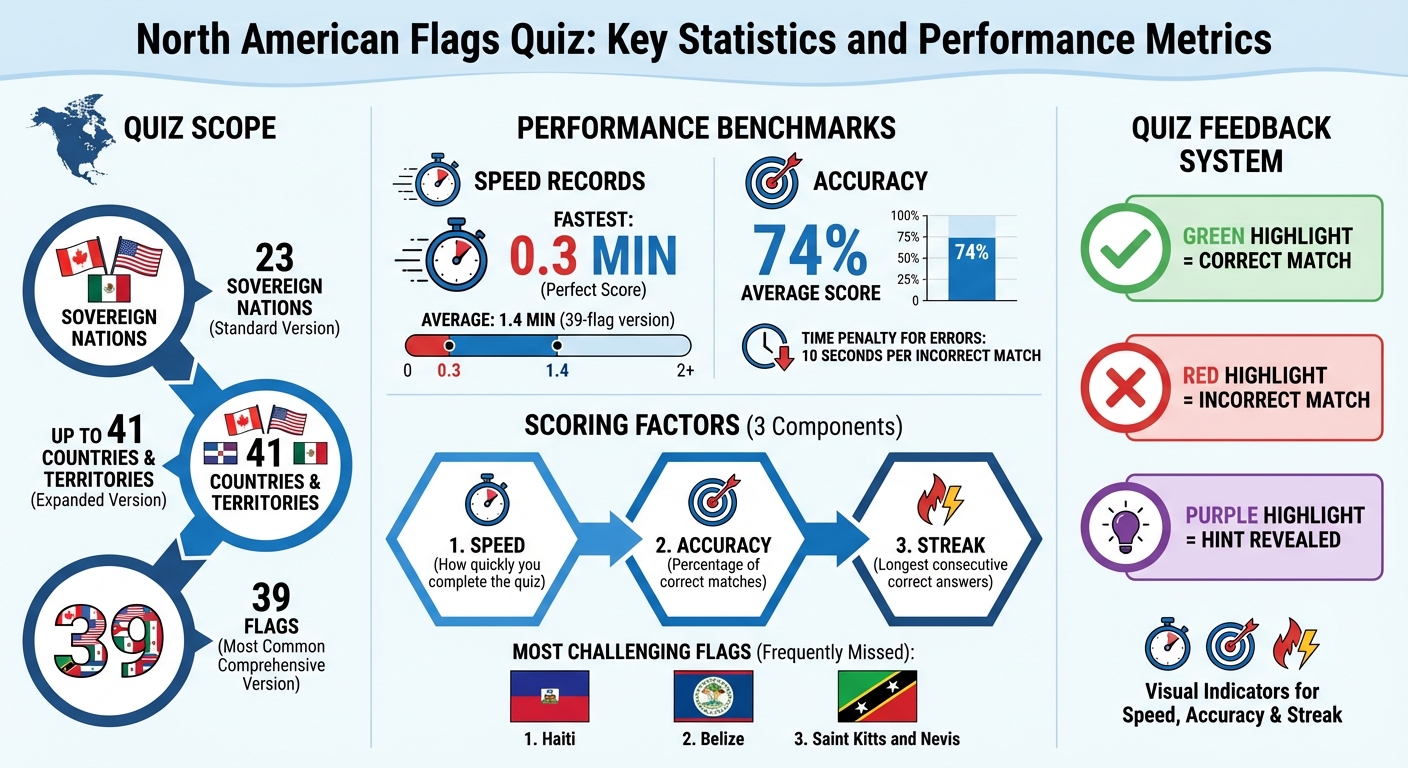
North American Flags Quiz Statistics and Performance Metrics
Guess All Flags In North America – Quiz Guess The Flag
sbb-itb-c170c49
How the Quiz Works
The quiz features two columns: country names on the left and flag images or emojis (like 🇨🇦 or 🇲🇽) on the right. Your goal is to match each country with its correct flag until all pairs are identified. The interface is designed for ease of use, especially on mobile devices, where multi-touch support lets you match flags faster with multiple fingers. To make it even simpler, the quiz provides immediate visual feedback as you play.
Here’s how it works: when you make a correct match, both the country and flag highlight in green. If you make a mistake, they turn red. Feeling stuck? You can tap the Show Hint button, which reveals the correct match in purple. Be mindful, though – some versions of the quiz impose a 10-second time penalty for incorrect matches, so accuracy is key.
Each flag also links to a dedicated page that explains its history and symbolism.
Countries and Territories Covered
The quiz adapts its scope depending on the version you’re playing. Some editions focus exclusively on the 23 sovereign nations of North America. Others take it a step further, including up to 41 countries and territories. This expanded list features dependencies like Greenland and Bermuda, as well as Caribbean nations such as the Bahamas, Barbados, and Saint Lucia. These additions make for a more challenging and varied experience.
How Scoring Works
Your score is based on three factors: how quickly you complete the quiz, your match accuracy, and your longest streak of correct answers. Keep in mind, making a mistake resets your streak, which can impact your leaderboard ranking. For reference, the fastest perfect score ever recorded is just 0.3 minutes, while the average player finishes a 39-flag quiz in about 1.4 minutes.
Once you complete the quiz, you’ll see a detailed summary of all your correct and incorrect answers. This breakdown helps you pinpoint where you can improve for your next attempt. By analyzing these insights, you’ll be better prepared to climb the leaderboard and achieve your personal best.
Sample Quiz Questions
After understanding the quiz mechanics, test your skills with these sample questions. The samples below require matching flag descriptions to countries across mainland North America and the Caribbean.
Mainland Country Flags
Question 1: This flag features a red field with a white square at its center – a layout known as the "Canadian pale" because the white center is twice the width of the red borders. A stylized red maple leaf with 11 points sits prominently in the middle. The 11 points were chosen not for symbolic meaning, but because they remain clearly visible even when the flag is flapping in high winds. Which country does this flag represent?
Question 2: Look for three horizontal stripes: turquoise blue, white, and turquoise blue. In the center of the white stripe, you’ll see five turquoise stars arranged in a quincunx pattern – like the five dots on a die. These stars represent the five original members of the Central American Federation: Costa Rica, El Salvador, Guatemala, Honduras, and Nicaragua. In January 2022, this nation officially updated its flag’s color to turquoise blue to match the original 1866 decree. Can you identify this Central American country?
Question 3: This flag features three horizontal stripes – blue, white, and a distinct red stripe in the center. Unlike its neighboring countries that stick to a blue and white pattern, this nation’s flag makes a distinctive statement with its added red element. Which country breaks the pattern?
Caribbean Nation Flags
Question 4: This Caribbean flag is known as one of the more challenging designs for quiz-takers. It features two equal horizontal bands – blue on the top and red on the bottom. In its official state version, the national coat of arms is centered on a white panel. Which island nation does this flag represent?
Question 5: Another flag that consistently stumps players displays a diagonal yellow stripe running from the lower left to the upper right. This stripe divides the flag into two contrasting triangles – a green triangle above and a red triangle below. Can you name this Caribbean country?
Answer Key and Flag Details
Want to check how you did? Here’s a detailed look at each sample question, along with the historical and symbolic highlights of the flags.
Question 1: Canada
The Canadian flag, with its iconic 11-pointed maple leaf, was officially adopted on February 15, 1965. It replaced the Canadian Red Ensign. The red and white colors are often seen as representing courage and peace.
Question 2: Honduras
The flag of Honduras features blue and white stripes with five stars arranged in a quincunx pattern. These stars symbolize the five nations of the former Federal Republic of Central America: Costa Rica, El Salvador, Guatemala, Honduras, and Nicaragua.
Question 3: Costa Rica
Costa Rica’s flag is instantly recognizable with its bold red stripe, flanked by blue and white bands. Adopted in 1906, the red stripe is thought to reflect the warmth and generosity of the Costa Rican people.
Question 4: Haiti
Haiti’s state flag consists of horizontal blue and red bands, with the national coat of arms displayed on a white panel in the center. Its unique design makes it one of the trickier flags to identify in quizzes.
Question 5: Grenada
Grenada’s flag, adopted on February 7, 1974, is known for its vibrant red and green sections divided by a diagonal yellow stripe. It includes seven yellow stars and a nutmeg symbol, a nod to Grenada’s reputation as the "Spice Isle."
For a quick overview, the table below summarizes the key elements of each flag.
Flag Comparison Table
| Country | Key Colors/Symbols | Adoption Year |
|---|---|---|
| Canada | Red & white; 11-pointed maple leaf | 1965 |
| Honduras | Blue & white; 5 stars in quincunx | 1866 |
| Costa Rica | Blue, white & red horizontal stripes | 1906 |
| Haiti | Blue & red horizontal bands; coat of arms | – |
| Grenada | Green, yellow & red; diagonal stripe; nutmeg | 1974 |
Understanding Your Results
Your quiz score is a combination of two key factors: accuracy and speed. Accuracy measures how solid your knowledge is, while your completion time shows whether you’re relying on quick recall or taking a more thoughtful approach. On average, players score about 74% on a comprehensive North American flags quiz and finish in roughly 1.4 minutes.
A long streak usually signals strong flag recognition skills rather than guesswork. The quiz provides immediate feedback – correct answers light up in green, and incorrect ones in red – so you can monitor your performance as you go. Flags like Haiti, Belize, and Saint Kitts and Nevis often trip people up, making them good candidates for focused study. On the other hand, recognizing the flags of the United States, Canada, and Mexico is considered basic knowledge, while identifying Caribbean nations shows an advanced level of expertise.
Many platforms also include global leaderboards, where you can compare your performance with players worldwide. These benchmarks can help you identify areas to improve and give you a clearer sense of how you stack up.
How to Improve Your Score
To boost your score, start by zeroing in on the flags you missed. It’s more productive to focus on your weak spots rather than revisiting flags you already know. Since flags like Haiti, Belize, and Saint Kitts and Nevis are frequently missed, pay extra attention to their unique characteristics.
Mix up your practice by exploring different quiz formats on Flag Emoji Quizzes. The North America category offers a variety of challenges that go beyond simple matching, helping you create stronger memory connections. Use hints if you’re stuck, but aim to wean yourself off them over time to improve both accuracy and streaks.
Another effective strategy is learning the history and symbolism behind each flag. This added context can help cement the images in your memory. After each quiz, review the explanations for any flags you got wrong. The more meaning you attach to each flag, the easier it will be to remember them.
Why Learn North American Flags?
Learning North American flags is a fun and effective way to sharpen your geography skills while diving into the region’s rich diversity. Using a quiz format makes it interactive and budget-friendly, offering instant feedback that helps reinforce what you learn. North America is home to 23 sovereign nations – and even more if you include territories – and each flag carries a unique story. For example, Canada’s 11-point maple leaf symbolizes unity.
This approach is ideal for students and geography enthusiasts who want to expand their knowledge while practicing skills like identifying capitals or pinpointing countries on a map. The interactive nature of quizzes makes it easier to connect with the material and gain a deeper understanding of the region’s history and culture.
Adding trivia and a competitive edge makes the experience even more engaging. It’s a great way to challenge yourself, track your progress, and stay motivated over time.
But it’s not just about the quiz. Exploring flags can enhance cultural awareness. Flags aren’t just designs – they reflect historical connections and core national values. Whether you’re planning a trip, improving your trivia skills, or simply satisfying your curiosity, recognizing flags lays the groundwork for a broader understanding of geography and the world.
FAQs
Which North American flags are the hardest to recognize?
The flags of El Salvador and Nicaragua are known for being some of the most difficult to identify in North America. Their designs, which both feature horizontal white stripes, are so alike that they’re often mistaken for one another. Unsurprisingly, they consistently rank high on lists of challenging flags in quizzes.
Do hints or wrong matches affect my score or time?
Hints and incorrect guesses won’t affect your score or the time it takes to complete the quiz. Most people play this in practice mode, which is untimed and lets you review answers without any penalties. It’s an excellent way to brush up on your knowledge of North American flags while learning at your own pace.
How can I improve my speed without losing accuracy?
To improve your speed without losing accuracy in flag quizzes, begin with untimed practice sessions. This helps you get comfortable recognizing and remembering flags at your own pace. Once you feel more confident, start incorporating timed quizzes to challenge yourself. Interactive platforms like Flag Emoji Quizzes are great tools – they provide instant feedback, allowing you to learn from mistakes right away. Regular practice with increasingly challenging quizzes will steadily enhance both your recall speed and precision.
Related Blog Posts
Free Printable: Flags of the World Reference Card
Get a beautiful printable poster with 50 flag emojis, Unicode codes, and fun facts. Perfect for classrooms and desks!
No spam, ever. Unsubscribe anytime.