
The United Nations flag, adopted on December 7, 1946, represents global peace and unity. Its light blue background and central emblem – a world map surrounded by olive branches – symbolize neutrality and the commitment to resolving international conflicts. Designed during the 1945 San Francisco Conference, the flag’s elements were carefully chosen to avoid highlighting any single country and to emphasize fairness. The olive branches signify peace, while the azimuthal equidistant projection map reflects global balance.
The flag serves both symbolic and practical purposes. In conflict zones, it identifies UN personnel and equipment, ensuring safety. Beyond its operational use, the flag has influenced national designs, such as Somalia’s and Cyprus’s, and remains a powerful symbol at diplomatic events. Its design also inspires logos for UN agencies like UNICEF and WHO. Since its first official use in 1947, the flag has stood as a beacon of international cooperation and the shared pursuit of peace.
The United Nations Flag🚩 – History📜 and Mysteries🔍. Peace☮️ or War⚔️?
sbb-itb-c170c49
History of the United Nations Flag
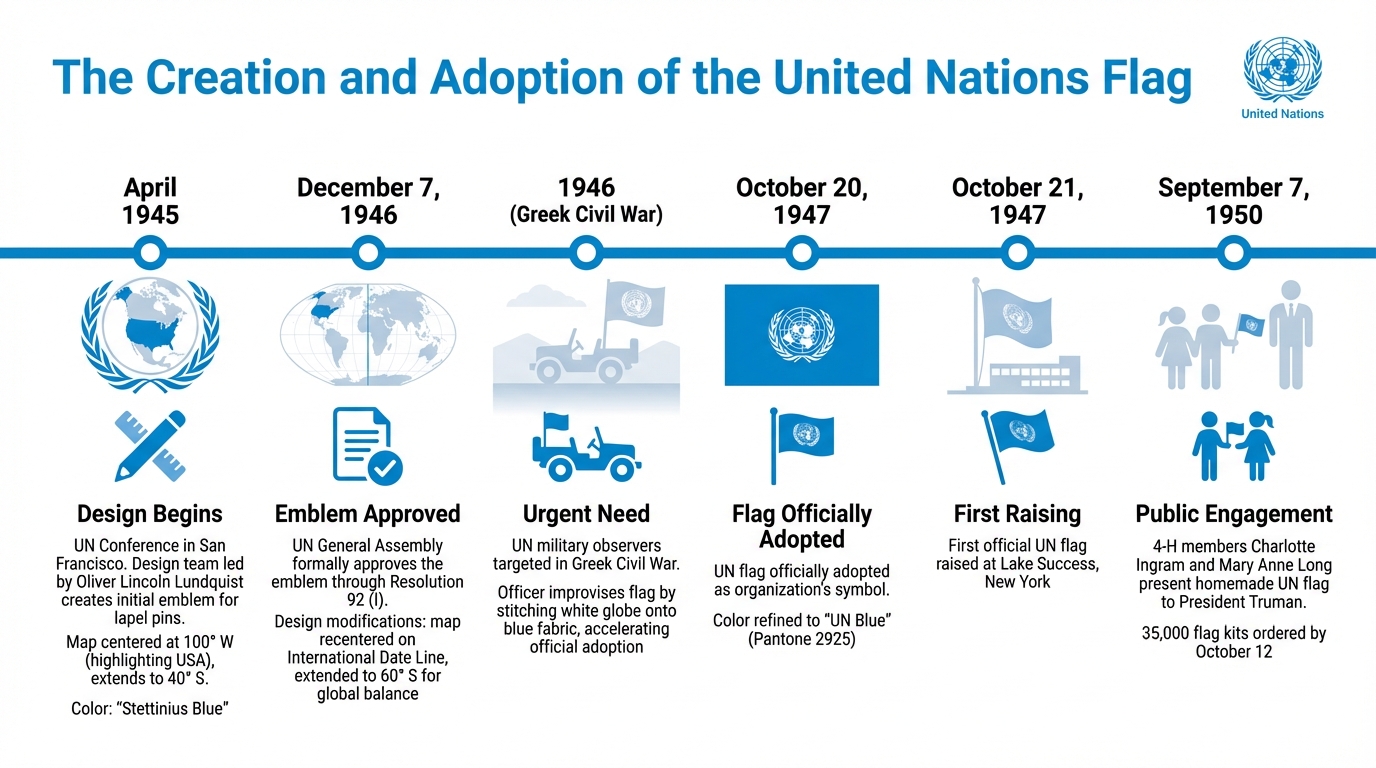
United Nations Flag History Timeline 1945-1950
How the Design Was Created
The origins of the United Nations flag trace back to the 1945 UN Conference in San Francisco. In April of that year, U.S. Secretary of State Edward Stettinius, Jr., who led the U.S. delegation, tasked a design team with creating official lapel pins.
Architect Oliver Lincoln Lundquist headed the design committee, while Donal McLaughlin, chief of graphics for the Office of Strategic Services, developed the actual design. The team drew heavily from the work of cartographer Richard Edes Harrison, whose World War II maps utilized the azimuthal equidistant projection. This perspective, offering a bird’s-eye view from the North Pole, emphasized global interconnectedness.
The olive branches in the design were chosen to symbolize peace. A gray-blue color, informally called "Stettinius Blue", was selected for its neutrality – it didn’t appear on any national flags at the time and contrasted sharply with red, a color often linked to conflict.
"The design was in shades of blue, a purposeful choice to contrast with red, a color traditionally associated with war." – CIA News
Interestingly, the initial design placed the world map at 100° W longitude, centering the United States – the host nation – on the map. The southern boundary only extended to 40° S, reflecting the limits of the available cartographic references. These early choices laid the groundwork for the flag’s eventual adoption.
Official Adoption
The journey from concept to official emblem took time and adaptation. The United Nations General Assembly formally approved the emblem on December 7, 1946, through Resolution 92 (I). The flag itself was officially adopted as the UN’s symbol on October 20, 1947.
The need for an official flag became urgent during the 1946 Greek Civil War. UN military observers, lacking clear identification, were often targeted. In response, a UN officer improvised a flag by stitching a white globe onto blue fabric and mounting it on a jeep. This practical necessity accelerated the flag’s formal adoption.
Between the prototype created in 1945 and the finalized version, several changes were made to ensure fairness and inclusivity. The map was recentered on the International Date Line and Prime Meridian, ensuring no single country was highlighted. Additionally, the southern boundary was extended to 60° S for broader global representation. The original "Stettinius Blue" was refined into "UN Blue", officially designated as Pantone 2925. These adjustments reinforced the UN’s mission of peace and equality.
The first official UN flag was raised at Lake Success, New York, on October 21, 1947. By 1950, public enthusiasm for the flag had grown significantly. A project launched by the National Committee on Boys and Girls Club Work (4-H) encouraged young people to make their own UN flags. On September 7, 1950, two 4-H members, Charlotte Ingram and Mary Anne Long, presented a homemade UN flag to President Harry Truman in the White House Rose Garden. The initiative was a hit, with 35,000 flag kits ordered by October 12 that year.
Design Elements of the United Nations Flag
The Light Blue Background
The light blue background of the UN flag was carefully chosen to represent peace and neutrality. This shade, officially known as Pantone 2925, was selected in 1945 because it wasn’t featured on any national flag at the time. The decision highlighted the organization’s impartiality and independence. The color itself, often associated with calmness and tranquility, serves as a visual reminder of the UN’s mission to foster global harmony. Interestingly, the original shade in 1945 was a darker "gray blue" or "smoke blue", informally called "Stettinius Blue", after U.S. Secretary of State Edward R. Stettinius, Jr.. Over time, the brighter blue we see today has become an integral part of the UN’s identity, particularly in identifying personnel and materials in conflict zones. Alongside this iconic color, the emblem at the center of the flag further amplifies the message of peace and unity.
The World Map and Olive Branches
At the heart of the flag lies its emblem, which carries a profound message of global unity. The map, displayed in an azimuthal equidistant projection, centers on the International Date Line and includes all continents (except Antarctica) extending to 60° south. This design ensures a sense of global balance. As Catherine Lyons from the United Nations Association noted, "the east and west were in balance". Surrounding the map is a wreath of olive branches, a universal symbol of peace that reflects the UN’s mission of fostering unity across nations. The emblem itself is meticulously proportioned, measuring exactly half the width of the flag, creating a harmonious and balanced design. This thoughtful composition reinforces the UN’s dedication to impartiality and has become a widely recognized symbol of international peacekeeping efforts.
The UN Flag as a Symbol of Global Unity
How the UN Flag Is Used in International Events
The UN flag holds a prominent place at major diplomatic events, peacekeeping missions, and humanitarian efforts across the globe. It’s a powerful emblem of international cooperation and the shared dedication to the principles of the UN Charter. When UN officials meet with representatives from Member States, the flag underscores their mutual commitment to fostering global collaboration. In conflict zones, it serves a protective role, ensuring the safety of UN personnel and assets under the Convention on the Safety of United Nations and Associated Personnel.
The flag is also used on official UN vehicles and vessels operating in high-risk areas, signaling neutrality to all involved parties. During periods of mourning, the flag is lowered as a gesture of global solidarity. A revision to the UN Flag Code in 2020 extended its use to additional diplomatic settings, further emphasizing the organization’s role in fostering international cooperation. At UN duty stations, the flag is flown alongside national flags, often adjusted in size to respect local customs while maintaining its unique identity.
Educational Impact of the UN Flag
The influence of the UN flag extends beyond its operational roles, shaping design and symbolism in various global contexts. For instance, some nations have drawn inspiration from the flag during periods of transition or conflict. Somalia’s flag, introduced in 1954, adopts the UN’s blue and white colors as a tribute to the organization’s support during its journey to independence. Similarly, Cyprus incorporated a map and olive branches into its design, directly inspired by the UN emblem, while Eritrea also included olive branches, reflecting the same influence.
Even within specialized UN agencies like UNICEF and WHO, the iconic blue background and olive branches remain central while their emblems are adapted to reflect their specific missions. This consistent visual identity makes it easier for people worldwide to recognize and associate these symbols with efforts for peace and cooperation. The UN flag’s cultural significance is evident in unexpected places too – such as Sweden’s 1,000 SEK banknote, which features the flag alongside former Secretary-General Dag Hammarskjöld. This highlights its enduring role as a global symbol of unity and peace.
Ways to Learn About Flags
Flag Quizzes for Geography Enthusiasts
Interactive quizzes offer an engaging way to dive into the symbolism and history behind flags. If you’re eager to expand your knowledge of world flags, check out Flag Emoji Quizzes (https://flagemoji.com). This platform organizes quizzes by region – North America, South America, Europe, Asia, Africa, and Oceania – where you match flags to their respective countries and get instant feedback. Along the way, you’ll uncover fascinating details, like how the UN flag has influenced national designs in countries such as Somalia, Eritrea, and Cyprus. These quizzes even help you recognize the unique symbols used by international agencies, like the Rod of Asclepius for the WHO or the Parthenon for UNESCO. With 193 member states in the United Nations, each represented by their own flag, this is an excellent way to sharpen your geography skills while exploring global diversity.
For those who prefer a more traditional approach, the Dag Hammarskjöld Library offers detailed research guides on "Maps, Flags, and Boundaries." These guides include procedural histories and official descriptions of international symbols, making them a valuable resource for anyone curious about the stories behind the world’s flags. Together, these interactive and traditional methods offer diverse ways to deepen your understanding of flags and their significance.
Conclusion
The Lasting Impact of the UN Flag
With its deep-rooted history and instantly recognizable design, the UN flag stands as a powerful symbol of global solidarity.
Adopted on October 20, 1947, the flag has played a pivotal role in international diplomacy. It has influenced national flag designs and serves as a clear identifier for UN personnel operating in conflict areas, ensuring their presence is unmistakable.
Beyond its immediate use, the flag’s design has left its mark on the branding of specialized UN agencies like WHO, UNICEF, and UNESCO, which incorporate elements of the UN’s visual identity into their own logos. Even Sweden has paid homage to this emblem by featuring the UN flag on its 1,000 SEK banknote, a tribute to former Secretary-General Dag Hammarskjöld.
Representing 193 member states, the UN flag continues to symbolize a collective ambition for peace and unity – a vision that has endured for more than seven decades. Its design resonates across borders and generations, reinforcing its role as a beacon of hope and cooperation.
FAQs
Why is the United Nations flag light blue?
The light blue shade of the United Nations flag, commonly known as "Stettinius Blue", was selected to signify neutrality and avoid resembling the flag of any member nation. This color is named after Edward Stettinius Jr., an influential figure in the UN’s creation. However, the color itself does not carry any particular symbolic significance.
How has the UN flag influenced the design of national flags?
The United Nations flag, with its light-blue background, world map encircled by olive branches, and focus on peace, has influenced the design of several national flags. Many nations that achieved independence with UN support incorporated elements of its flag to represent their link to the international community and their dedication to peace.
Take Somalia, for instance. Its flag adopts the UN’s light-blue background, symbolizing the organization’s role in its journey to independence. Bosnia and Herzegovina’s flag, introduced after the UN-facilitated Dayton Agreement, features stars and a diagonal design that reflect themes of unity and peace akin to the UN’s ideals. Cambodia’s flag, revised in 1993, also draws inspiration from the olive branches, underscoring the UN’s peacekeeping efforts during the country’s transition.
These examples highlight how the UN flag has become a global emblem of cooperation and harmony, leaving a meaningful mark on the visual identities of nations worldwide.
What changes were made to the United Nations flag before it was officially adopted?
Before the flag’s final adoption, a few adjustments were made to its initial design from the San Francisco Conference. The laurel branches were swapped out for olive branches, a universal symbol of peace. The accompanying text was removed, and the background was updated to the now-famous light blue shade, often called “Stettinius blue.” These changes shaped the enduring flag we see today, a symbol of worldwide unity and peace.
Related Blog Posts
- Top 5 Fun Facts About National Flags
- The Evolution of Flags: A Historical Perspective
- Flags and Their Colors: What Do They Mean?
- How Flags Represent National Identity
Free Printable: Flags of the World Reference Card
Get a beautiful printable poster with 50 flag emojis, Unicode codes, and fun facts. Perfect for classrooms and desks!
No spam, ever. Unsubscribe anytime.