
How To
How To
Time needed: 1 minute
Want the full printable classroom pack?
Take the flag reference from your screen to an offline pack for lessons, practice, and quiz time.
- Printable atlas with 230+ high-resolution flag flats
- Four regional quizzes with answer keys
- Flag Bingo boards and caller sheet
How to copy and paste the Flag of Holy See Emoji to any device.
- Copy the Roman Flag Emoji
Go to flagemoji.com and press the copy button (above). This works on any device.
- Paste the Emoji
Go to your email/iMessage/SMS texting service/document and paste the emoji.
For mobile devices
— double-tap or tap-hold, then paste should appear. Tap it.
For desktop and laptops on Apple devices
— command-P / ⌘-P
For desktop and laptops on Windows devices
— control-p
Codes
Emoji Codes
Flag emojis are unicode symbols, like any other letter or number on your keyboard. This means you can copy and paste the emoji itself into your code, whatever the language (click the button above).
They actually count as two characters: the two-letter country code (the ISO international standard). The unicode and shortcode both represent country data which devices can interpret and display the emoji.
| Country Code | Unicode | Shortcode |
| VA | U+1F1FB U+1F1E6 | :flag_VA: :VA: |
Emoji shortcodes are used on some platforms as a way for users to type in emojis from the keyboard. If you type the emoji shortcode on Github or Slack, the emoji will appear.
*The official name of the emoji is only the country name, not ‘Holy See Flag’, for example.
Description
Description
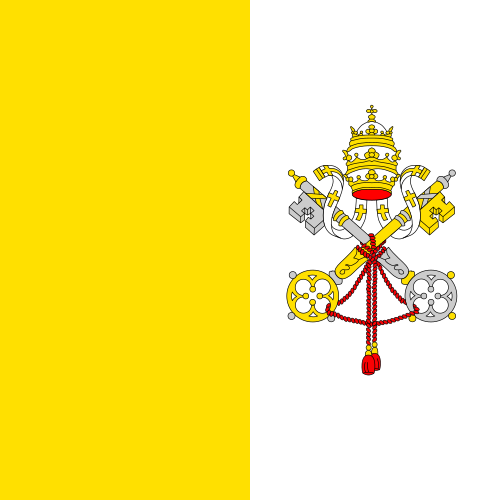
The flag of Holy See is composed of two vertical bands of yellow (hoist side) and white. The arms of the Holy See, consist of the crossed keys of Saint Peter surmounted by the three-tiered papal tiara, are centered in the white band. The yellow color represents the Pope’s spiritual power, the white his worldly power.
Map
Map
Check out the map of San Marino!
Weather
Anthem
National Anthem
| Title | Inno e Marcia Pontificale (Hymn and Pontifical March); often called The Pontifical Hymn |
| Composer | Raffaello Lavagna / Charles-Francois Gounod |
FAQ
FAQs
Holy See confirmed independence on February 11, 1929 signed in Italy.
The yellow color represents the Pope’s spiritual power, while the white refers to his worldly power.
The Vatican City (Holy See) flag was adopted on June 7, 1929.
Holy See (Vatican City) is an ecclesiastical elective Monarchy; Absolute Monarchy (self-described).
Discover more fun facts of Ukraine.
Printable
Printable Roman Flag
Print another really cool flag. Why not the flag of Guinea-Bissau?
The flag of Vatican City stands as one of the world’s most distinctive national symbols, representing both the spiritual and temporal authority of the Catholic Church. With its striking yellow and white vertical bicolor design and intricate papal emblem, the flag carries centuries of ecclesiastical tradition and symbolism. Uniquely, Vatican City’s flag is one of only two national flags in the world with a perfect square proportion of 1:1, the other being Switzerland’s flag, distinguishing it visually from all other nations.
The origins of Vatican City’s flag design trace back to the early nineteenth century, during a tumultuous period in European history. In 1808, Pope Pius VII faced a distinctive challenge when Napoleon’s forces reorganized European armies. To distinguish papal troops and guard units from the soldiers of Napoleon’s regime, the Pope made a revolutionary decision: he ordered the Papal States to replace the traditional red color in their flag with white. This pragmatic modification was born from military necessity, yet it would ultimately become a defining feature of Vatican City’s national symbol for centuries to come. The decision reflected the Pope’s commitment to maintaining papal independence and clear distinction from secular powers, principles that remain central to Vatican City’s identity to this day.
The formal establishment of Vatican City’s current flag design occurred in 1825, when Pope Leo XII adopted a yellow and white merchant flag as the official standard. The choice of these two colors was not arbitrary but deeply symbolic. The yellow represented gold, symbolizing the material of one of the papal keys, while white represented silver, the material of the other key. This color scheme connected the flag directly to one of the most important symbols of papal authority: the crossed keys of Saint Peter. This design remained in use until 1870, when it was temporarily discontinued following the loss of the Papal States’ temporal territories to the newly unified Italian kingdom. However, when Vatican City was formally established as an independent city-state through the Lateran Treaty in 1929, papal authorities deliberately revived the historical 1825–1870 design, choosing it as the nation’s official state flag on June 7, 1929, when the treaty came into effect.
The symbolism embedded within Vatican City’s flag runs far deeper than its color scheme alone. At the center of the white vertical stripe, positioned in the upper section, rests the papal coat of arms featuring two crossed keys of Saint Peter beneath a papal tiara. These elements are not merely decorative; they constitute the very essence of papal and Vatican City authority. The two keys represent the keys that Jesus Christ gave to Saint Peter, his chief apostle, with the words “I will give you the keys of the kingdom of heaven” (Matthew 16:19). Catholic tradition interprets these keys as symbolizing either the access that Saint Peter was granted to the kingdom of heaven or, in a broader interpretation, the Pope’s claim to authority over both spiritual and temporal matters. The gold key symbolizes heavenly or spiritual power, representing the Pope’s role as the head of the Catholic Church and spiritual leader to nearly two billion Catholics worldwide. The silver key, meanwhile, symbolizes earthly or temporal power, reflecting the Pope’s authority as the sovereign ruler of Vatican City State itself. Together, these crossed keys form a powerful visual statement of the Pope’s dual role as both a spiritual guide and a temporal ruler.
The papal tiara that sits above the crossed keys further enriches the flag’s symbolic meaning. This ornate triple-crowned headdress, known as the triregnum, has been a symbol of papal authority since medieval times. The tiara’s three levels carry multiple interpretations within Catholic theology. Most commonly, they represent the Pope’s threefold office: as the father of kings, as the governor of the world, and as the vicar of Christ on earth. Some interpretations also view the three crowns as representing the Pope’s authority over the Church (ecclesia), the state (imperium), and personal sanctity (sanctitas). The inclusion of the tiara on the flag thus extends Vatican City’s message of papal sovereignty and the Pope’s central role in both the Catholic Church and the international community. The papal tiara has been a recurring motif in Vatican City’s heraldic tradition since the nation’s modern inception, and it remains one of the most recognizable symbols of papal authority worldwide.
The color symbolism of Vatican City’s flag extends beyond the specific hues of the keys themselves. The yellow (or gold) stripe of the flag represents the spiritual power and authority of the papacy, reflecting the Church’s position as a spiritual institution guiding the souls and faith of its followers. White, the color of the larger vertical stripe, carries associations with purity, peace, holiness, and religious faith in Christian tradition. This combination of colors thus visually reinforces Vatican City’s identity as a state founded on and dedicated to spiritual principles, even as it maintains temporal sovereignty. The particular shade of yellow used in the flag—a bright, golden hue—connects directly to the precious metal gold, which throughout history has been associated with divine authority, wealth, and importance. The white, by contrast, suggests innocence and the moral purity that the Catholic Church strives to uphold.
A notable and widely-circulated historical error regarding Vatican City’s flag occurred in the early twenty-first century. Between 2006 and 2007, and again from 2017 to 2022, an incorrect version of the flag circulated extensively online, particularly through Wikimedia Commons, a major repository of free media. In this erroneous depiction, the papal tiara was rendered with red lines or red portions, a detail that has no basis in the official flag specifications. This incorrect version became surprisingly widespread, appearing in numerous online sources, educational materials, and databases. The error likely originated from inaccurate digital renderings uploaded to Wikimedia Commons, which, once posted, spread rapidly across the internet as various websites and platforms copied the image without verification. The incorrect version was eventually corrected in the official Wikimedia Commons repository, but not before it had influenced numerous online depictions of the flag, serving as a reminder of how easily misinformation can propagate in the digital age.
Vatican City’s flag design received its most recent official specification through the 2023 Fundamental Law of Vatican City State, which provided updated and detailed requirements for the flag’s construction and use. This modernization of the flag specifications ensures that the symbol continues to be rendered accurately across all applications, from governmental documents to international representations. The 2023 document included comprehensive visual models and precise specifications to eliminate any ambiguity in how the flag should be depicted, building upon nearly two centuries of historical development since the 1825 design was first adopted.
Sources:
Britannica: Flag of Vatican City
Wikipedia: Flag of Vatican City
The Flag Institute: Flag of the Vatican City
Vatican Tips: History and Meaning of the Vatican Flag
3D Glossy Render — Two vertical halves of gold and white with the papal tiara and crossed keys on the white half. The flag of Vatican City as a photorealistic 3D render. Two vertical halves of gold and white with the papal tiara and crossed keys on the white half. The flag fabric hangs or drapes naturally but preserves exact proportions, colors, and all symbols perfectly — completely faithful to the real Vatican City flag. Dramatic studio lighting, glossy silk material, soft shadows, subsurface scattering, perfect specular highlights. No text, no letters, no words, no writing of any kind.
Chalk on Blackboard — Two vertical halves of gold and white with the papal tiara and crossed keys on the white half. The flag of Vatican City drawn in chalk on a real blackboard. Two vertical halves of gold and white with the papal tiara and crossed keys on the white half. Authentic blackboard — dark slate green surface with chalk dust and smudge marks. Soft, dusty white and colored chalk lines, imperfect edges, hand-drawn quality. Chalk dust particles visible in the air. The flag is immediately recognizable. No text, no letters, no words, no writing of any kind.
Embroidered Textile — Two vertical halves of gold and white with the papal tiara and crossed keys on the white half. The flag of Vatican City as intricate embroidery on linen fabric. Two vertical halves of gold and white with the papal tiara and crossed keys on the white half. Dense satin stitches, French knots, chain stitch detail. The flag design is completely faithful — exact colors, geometry, and all symbols faithfully stitched, immediately recognizable as the Vatican City flag. Visible thread texture, dimensional quality, warm handcrafted feel. No text, no letters, no words, no writing of any kind.
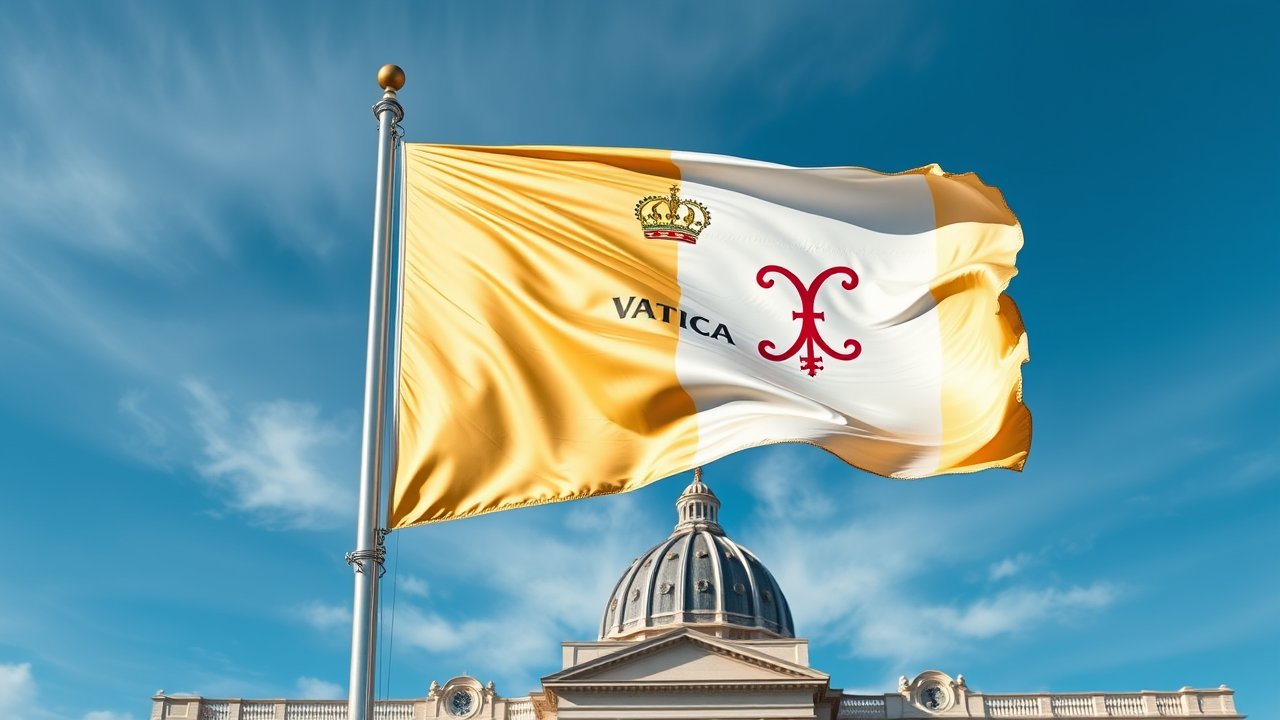
Flagpole in Capital — Two vertical halves of gold and white with the papal tiara and crossed keys on the white half. Photorealistic photograph of the Vatican City flag flying on a tall flagpole in front of an iconic government building in the capital city. Two vertical halves of gold and white with the papal tiara and crossed keys on the white half. The flag ripples naturally in the wind, colors vivid and exact. Documentary photography style, sharp and realistic. Grand architecture in the background. Blue sky, dramatic clouds. No text, no letters, no words, no writing of any kind.
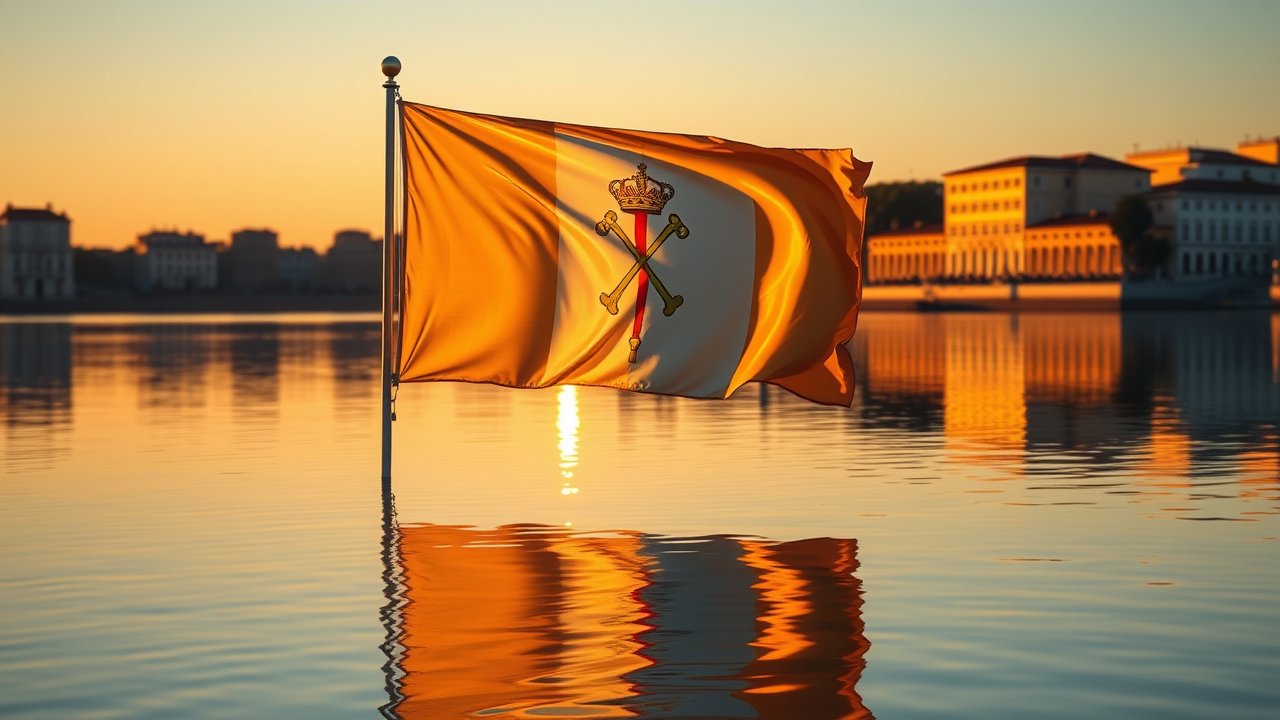
Golden Hour Reflection — Two vertical halves of gold and white with the papal tiara and crossed keys on the white half. Photorealistic photograph of the Vatican City flag reflected in still water at golden hour. Two vertical halves of gold and white with the papal tiara and crossed keys on the white half. The flag flies on a pole at the water’s edge, its reflection shimmering on the surface below. Warm amber and orange sunset light. The flag colors and design are faithful and vivid. Serene, cinematic landscape photography. No text, no letters, no words, no writing of any kind.
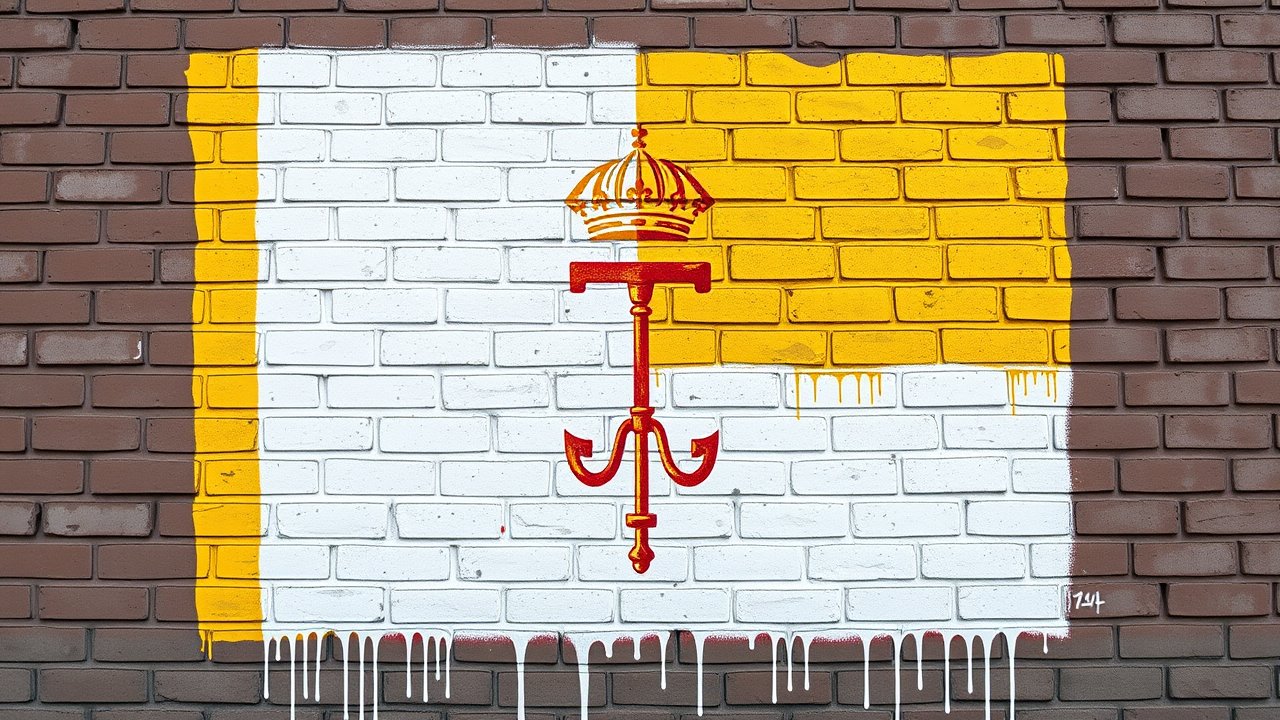
Street Art / Graffiti — Two vertical halves of gold and white with the papal tiara and crossed keys on the white half. The flag of Vatican City as vibrant street art spray-painted on a brick wall. Two vertical halves of gold and white with the papal tiara and crossed keys on the white half. Bold spray paint, dripping edges, stencil layers, overspray halos. The flag design is faithful and immediately recognizable — exact colors and symbols, just rendered in spray paint on urban concrete. No text, no letters, no words, no writing of any kind. No tags, no graffiti lettering.
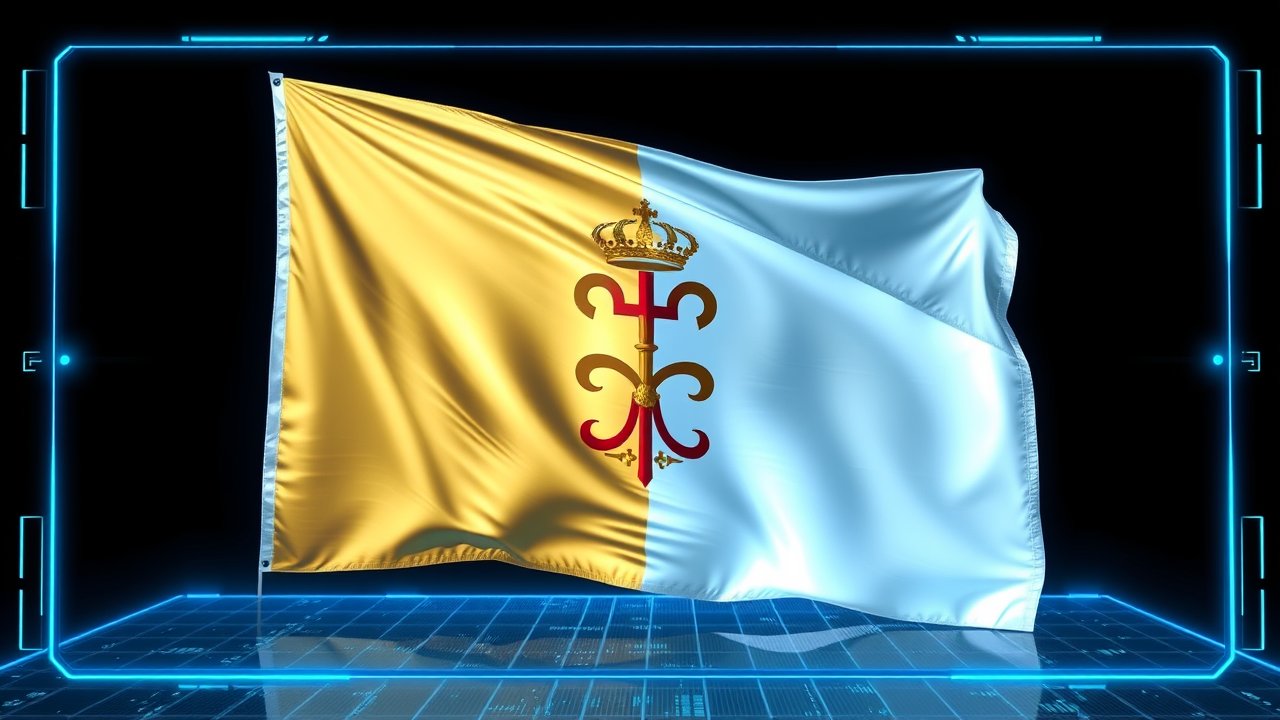
Sci-Fi Hologram — Two vertical halves of gold and white with the papal tiara and crossed keys on the white half. The flag of Vatican City projected as a futuristic holographic display. Two vertical halves of gold and white with the papal tiara and crossed keys on the white half. Translucent blue-white projection with scan lines, floating in dark space. Glitching edges, particle effects, data streams. The flag design is completely faithful and recognizable. Cyberpunk HUD elements framing the projection. No text, no letters, no words, no writing of any kind.
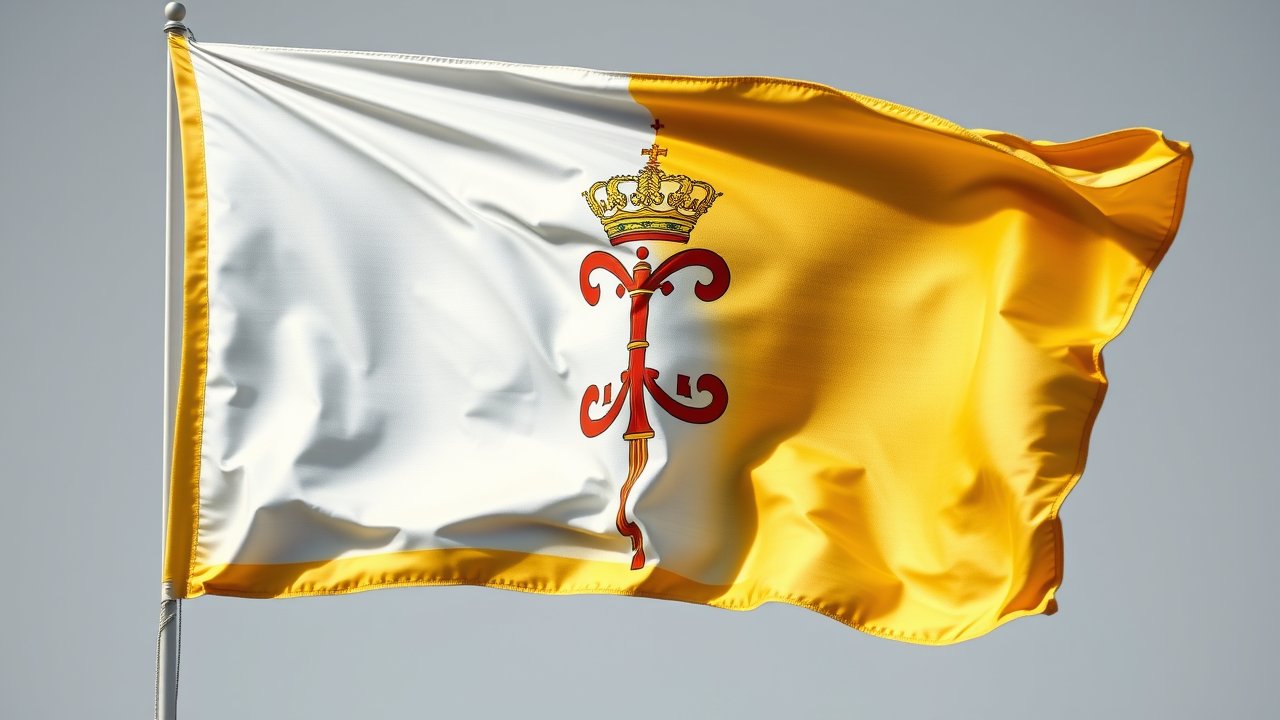
Hyperrealistic Wind — Two vertical halves of gold and white with the papal tiara and crossed keys on the white half. Ultra-hyperrealistic photograph of the Vatican City flag caught in a dramatic gust of wind. Two vertical halves of gold and white with the papal tiara and crossed keys on the white half. Macro-level fabric detail — individual threads visible, fabric folds and tension lines crisp. Colors and design completely faithful to the real Vatican City flag. High-speed shutter, razor-sharp focus, studio lighting. No text, no letters, no words, no writing of any kind.
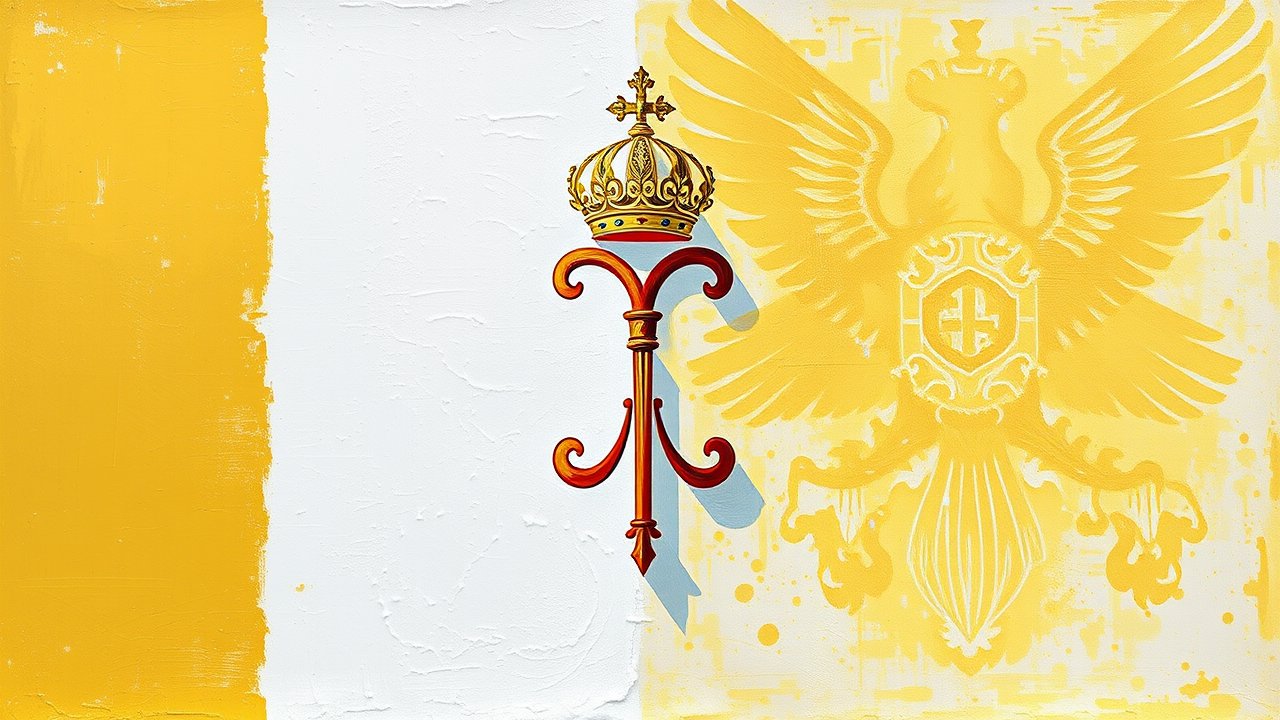
Impressionist Oil — Two vertical halves of gold and white with the papal tiara and crossed keys on the white half. The flag of Vatican City painted in French Impressionist oil on canvas. Two vertical halves of gold and white with the papal tiara and crossed keys on the white half. Thick impasto brushstrokes, dappled light, vibrant broken color technique in the style of Monet. The flag is instantly recognizable — colors and design faithful to the real Vatican City flag, interpreted with impressionist light and texture. No text, no letters, no words, no writing of any kind.
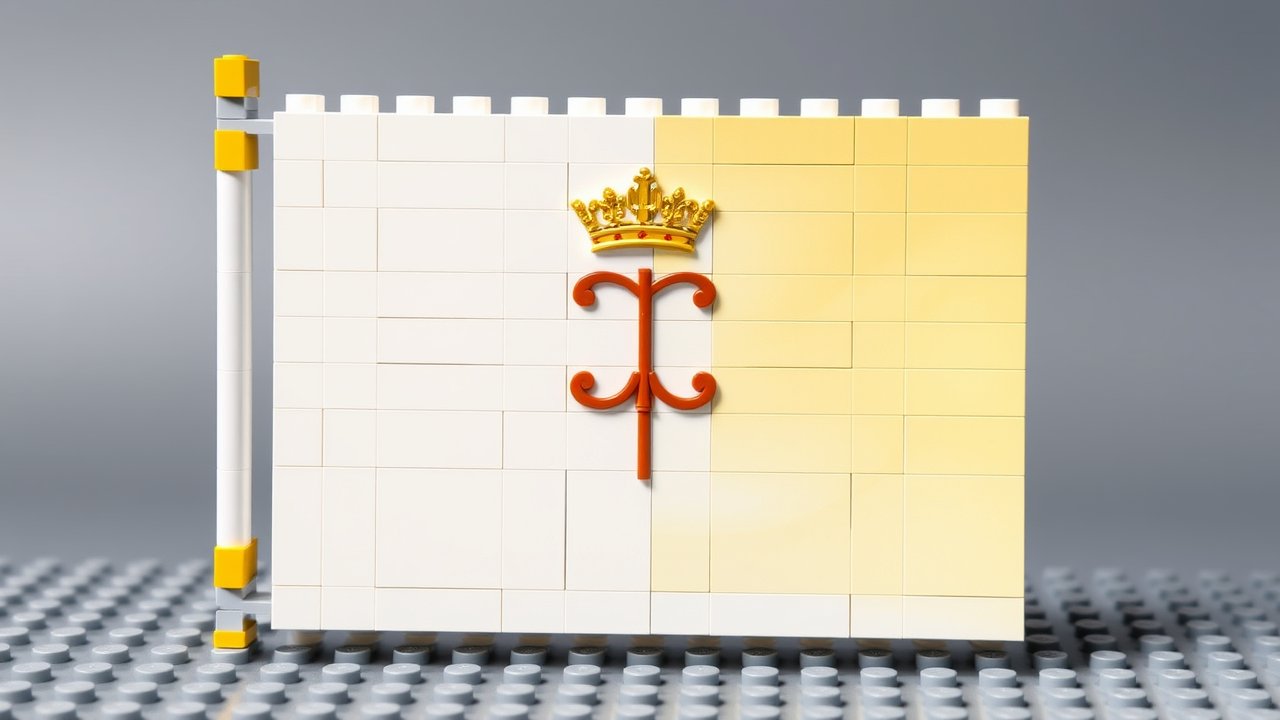
Lego Bricks — Two vertical halves of gold and white with the papal tiara and crossed keys on the white half. The flag of Vatican City built from Lego bricks, photographed as a real physical construction. Two vertical halves of gold and white with the papal tiara and crossed keys on the white half. Visible studs and brick seams, slight plastic sheen. Standard Lego colors approximate the flag’s palette. Built on a gray Lego baseplate. Dramatic angle showing the three-dimensional brick texture. No text, no letters, no words, no writing of any kind.

Low-Poly Geometric — Two vertical halves of gold and white with the papal tiara and crossed keys on the white half. The flag of Vatican City constructed from low-polygon geometric triangles. Two vertical halves of gold and white with the papal tiara and crossed keys on the white half. Aggressively faceted — each region broken into many visible triangular faces with subtle color variation across each polygon, creating real depth and dimensionality even in flat-color areas of the flag. Crystal-like, contemporary computational design. The flag is completely faithful and immediately recognizable. No text, no letters, no words, no writing of any kind.
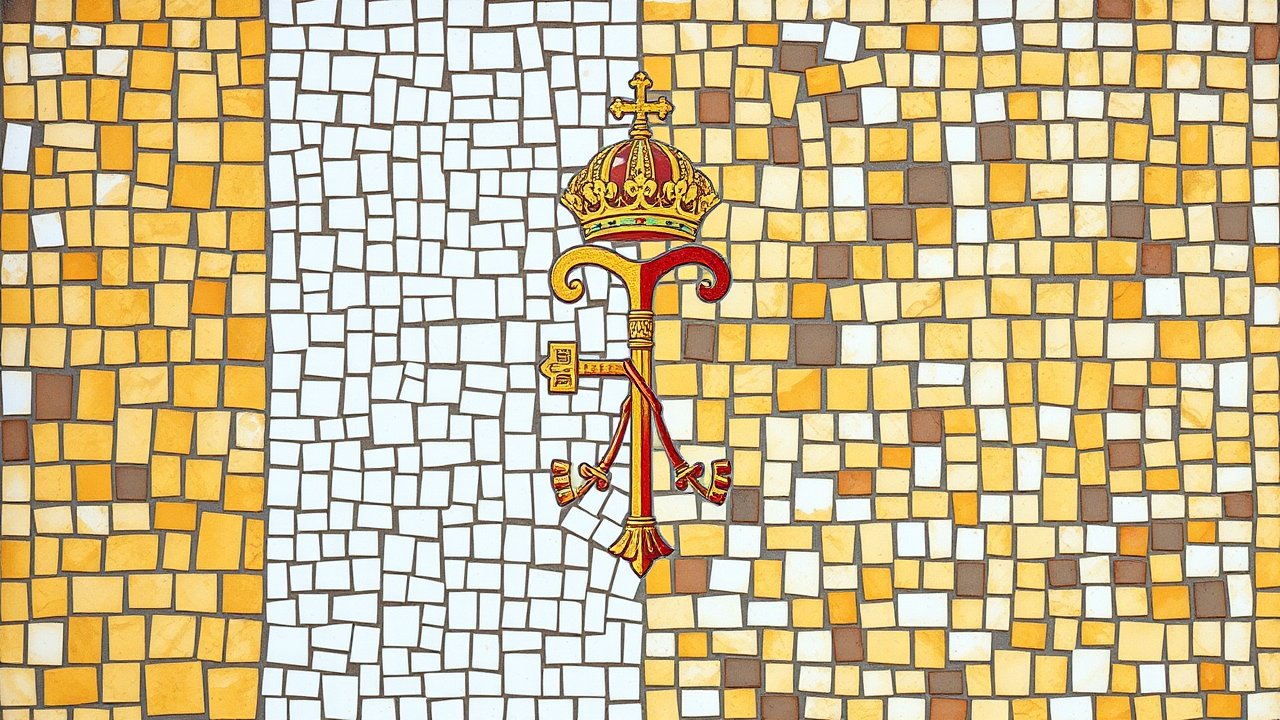
Mosaic Tiles — Two vertical halves of gold and white with the papal tiara and crossed keys on the white half. The flag of Vatican City assembled as a Roman-style mosaic. Two vertical halves of gold and white with the papal tiara and crossed keys on the white half. The flag is completely faithful to the real Vatican City flag — exact proportions, colors, and all symbols, rendered in thousands of small stone and glass tesserae. Visible grout lines, rich earthy tones mixed with brilliant glass, slight historical weathering. No text, no letters, no words, no writing of any kind.
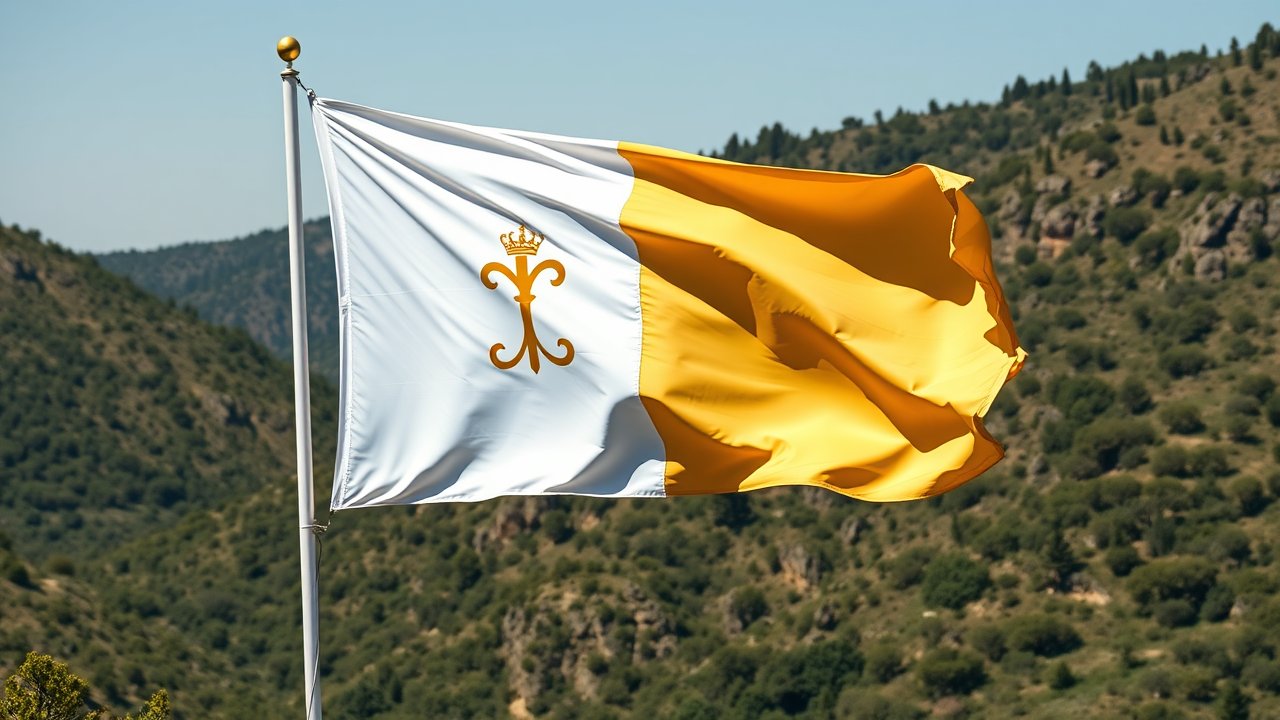
Native Landscape — Two vertical halves of gold and white with the papal tiara and crossed keys on the white half. Photorealistic photograph of the Vatican City flag flying in an iconic natural landscape native to Vatican City — the terrain, flora, and environment characteristic of that country. Two vertical halves of gold and white with the papal tiara and crossed keys on the white half. The flag is prominent and its colors are faithful and vivid. Remote, uninhabited wilderness. National Geographic photography style. No text, no letters, no words, no writing of any kind.
Neon Sign — Two vertical halves of gold and white with the papal tiara and crossed keys on the white half. The flag of Vatican City recreated as a real neon sign mounted on a dark wall. Two vertical halves of gold and white with the papal tiara and crossed keys on the white half. Glowing glass neon tubes bent into the flag’s shapes — the colors of the flag rendered in actual neon light. Visible glass tube bends, metal mounting brackets on the wall. Warm neon glow and light bloom. Real neon, not digital. Photographed in a dark room. No text, no letters, no words, no writing of any kind.
Pencil Sketch — Two vertical halves of gold and white with the papal tiara and crossed keys on the white half. The flag of Vatican City as a bold, confident pencil sketch. Two vertical halves of gold and white with the papal tiara and crossed keys on the white half. Strong graphite lines on cream paper — not delicate but bold and decisive. Heavy pressure on key outlines, dramatic cross-hatching for deep shadows and shading. Immediately recognizable as the Vatican City flag. Artist’s confident hand, not tentative. No text, no letters, no words, no writing of any kind.
Pixel Art — Two vertical halves of gold and white with the papal tiara and crossed keys on the white half. The flag of Vatican City as detailed 16-bit pixel art. Two vertical halves of gold and white with the papal tiara and crossed keys on the white half. Crisp pixel grid, limited palette with careful dithering, nostalgic retro game aesthetic. Clean grid-aligned design with subtle shading. Every element of the flag faithfully reproduced in pixels. No text, no letters, no words, no writing of any kind.
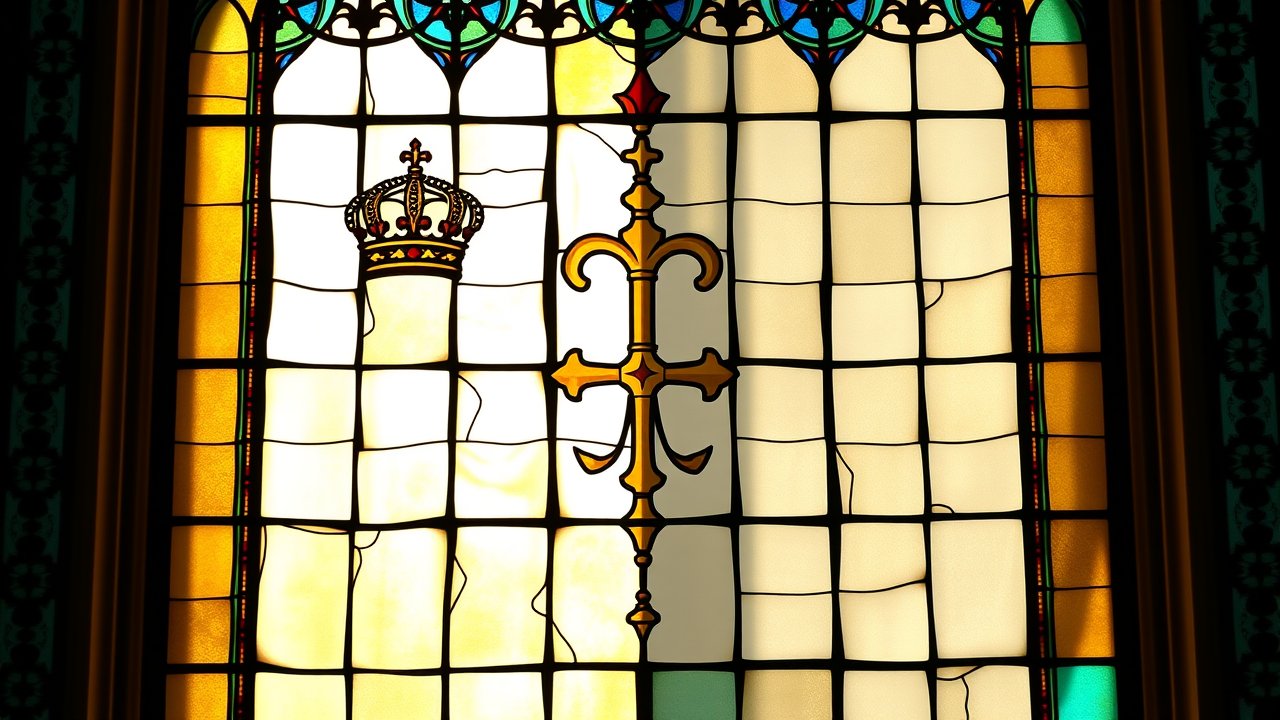
Stained Glass — Two vertical halves of gold and white with the papal tiara and crossed keys on the white half. The flag of Vatican City rendered as an ornate stained glass window. Two vertical halves of gold and white with the papal tiara and crossed keys on the white half. The design is completely faithful to the real Vatican City flag — exact colors, geometry, and all symbols preserved. Brilliant jewel-toned glass pieces separated by dark lead came lines. Warm sunlight streaming through, casting colored light. Gothic cathedral craftsmanship. No text, no letters, no words, no writing of any kind.
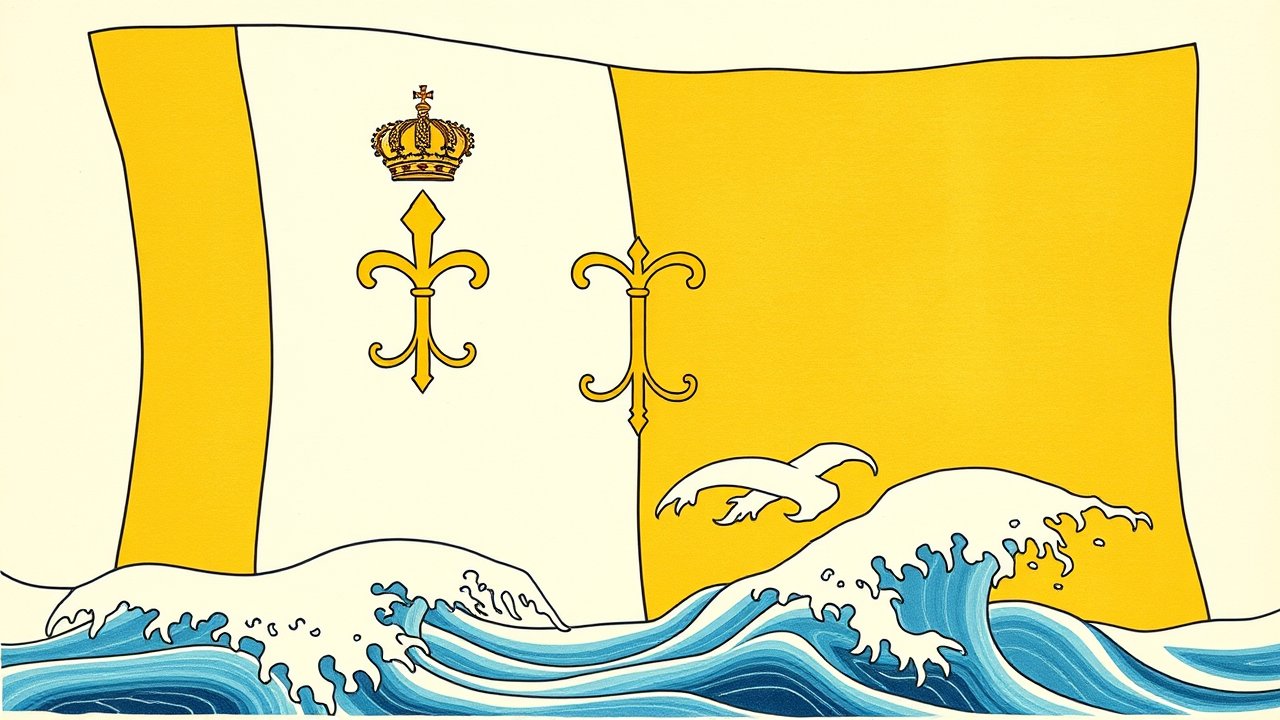
Ukiyo-e Woodblock — Two vertical halves of gold and white with the papal tiara and crossed keys on the white half. The flag of Vatican City as a traditional Japanese ukiyo-e woodblock print. Two vertical halves of gold and white with the papal tiara and crossed keys on the white half. Bold outlines, flat areas of rich color, flowing organic forms. Wind and waves incorporated into the composition. Printed on washi paper with visible wood grain texture. The flag is the central focus and instantly recognizable. No text, no letters, no words, no writing of any kind.
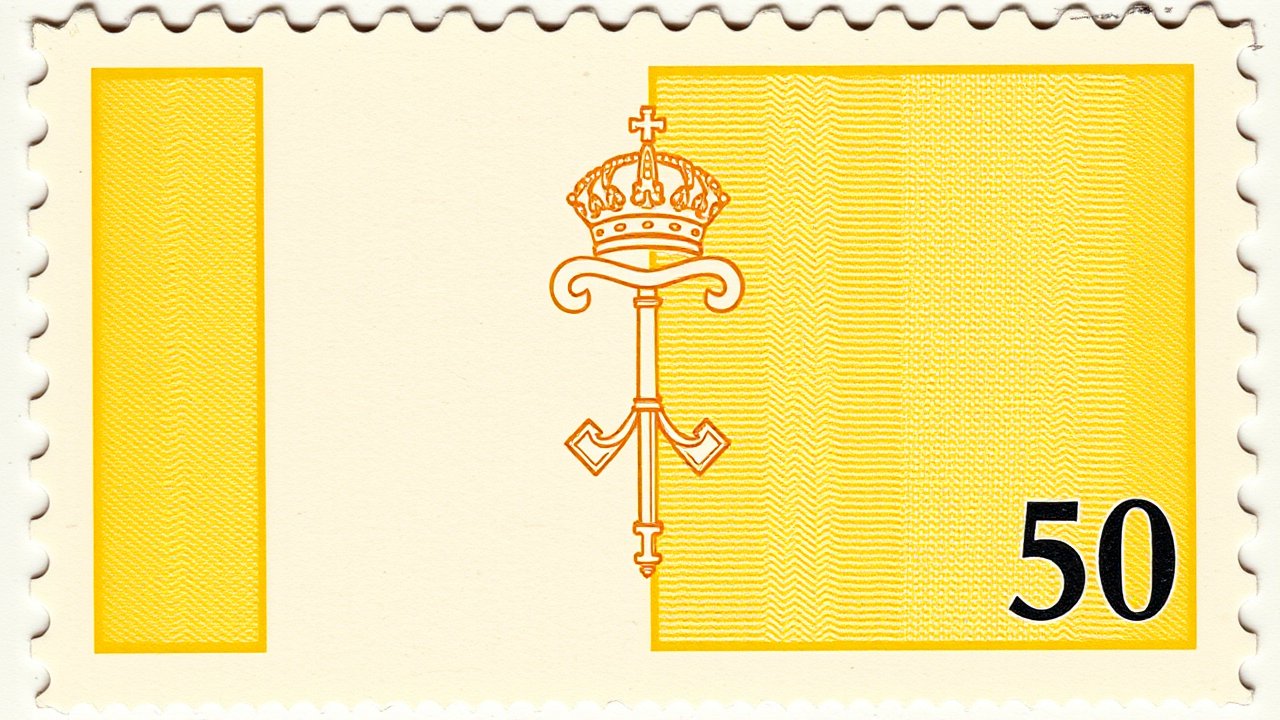
Vintage Postage Stamp — Two vertical halves of gold and white with the papal tiara and crossed keys on the white half. The flag of Vatican City as a vintage 1950s postage stamp. Two vertical halves of gold and white with the papal tiara and crossed keys on the white half. The flag fills most of the stamp — it is the primary subject, faithfully rendered in fine engraved intaglio style. Perforated edges, aged paper with slight foxing. The stamp may show a denomination numeral only — absolutely no other text or country names.
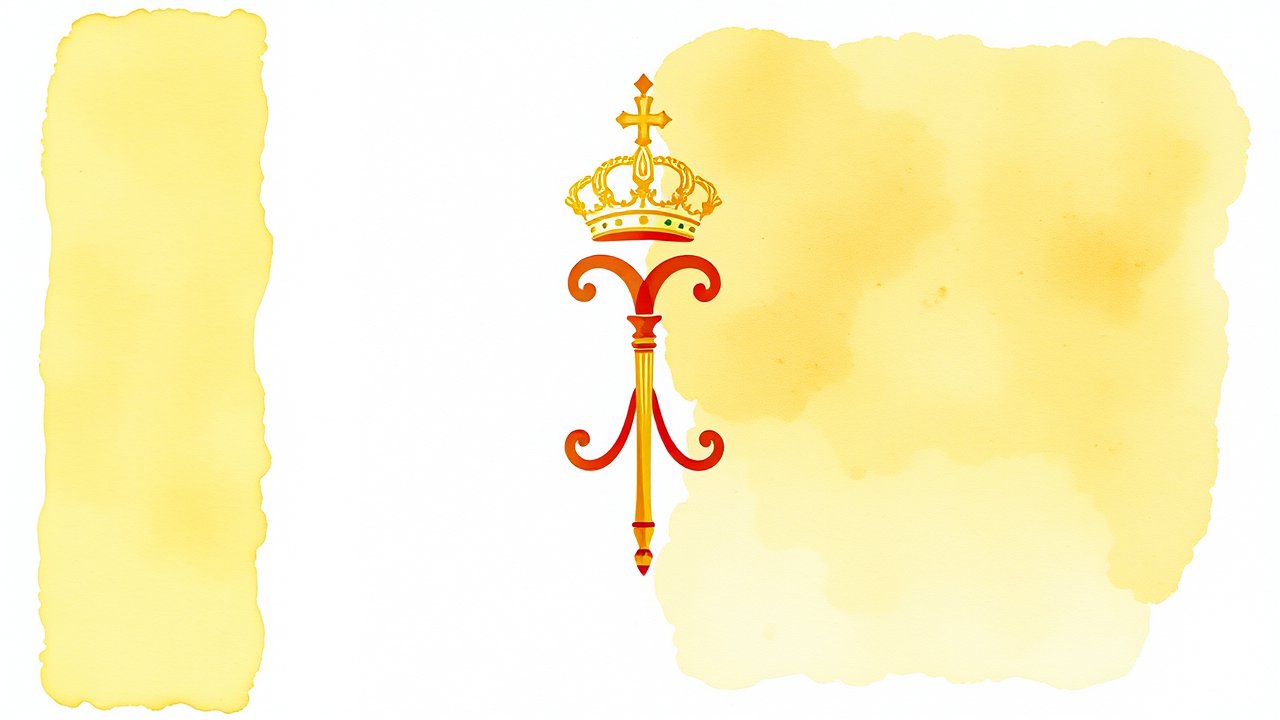
Watercolor — Two vertical halves of gold and white with the papal tiara and crossed keys on the white half. The flag of Vatican City painted in loose, expressive watercolor. Two vertical halves of gold and white with the papal tiara and crossed keys on the white half. Wet-on-wet technique with soft color bleeds, visible brushstrokes, natural paper texture. Delicate splashes and drips at the edges. Luminous, translucent layers of pigment. No text, no letters, no words, no writing of any kind.
The flag of Vatican City stands as one of the world’s most distinctive national symbols, representing both the spiritual and temporal authority of the Catholic Church. With its striking yellow and white vertical bicolor design and intricate papal emblem, the flag carries centuries of ecclesiastical tradition and symbolism. Uniquely, Vatican City’s flag is one of only two national flags in the world with a perfect square proportion of 1:1, the other being Switzerland’s flag, distinguishing it visually from all other nations.
The origins of Vatican City’s flag design trace back to the early nineteenth century, during a tumultuous period in European history. In 1808, Pope Pius VII faced a distinctive challenge when Napoleon’s forces reorganized European armies. To distinguish papal troops and guard units from the soldiers of Napoleon’s regime, the Pope made a revolutionary decision: he ordered the Papal States to replace the traditional red color in their flag with white. This pragmatic modification was born from military necessity, yet it would ultimately become a defining feature of Vatican City’s national symbol for centuries to come. The decision reflected the Pope’s commitment to maintaining papal independence and clear distinction from secular powers, principles that remain central to Vatican City’s identity to this day.
The formal establishment of Vatican City’s current flag design occurred in 1825, when Pope Leo XII adopted a yellow and white merchant flag as the official standard. The choice of these two colors was not arbitrary but deeply symbolic. The yellow represented gold, symbolizing the material of one of the papal keys, while white represented silver, the material of the other key. This color scheme connected the flag directly to one of the most important symbols of papal authority: the crossed keys of Saint Peter. This design remained in use until 1870, when it was temporarily discontinued following the loss of the Papal States’ temporal territories to the newly unified Italian kingdom. However, when Vatican City was formally established as an independent city-state through the Lateran Treaty in 1929, papal authorities deliberately revived the historical 1825–1870 design, choosing it as the nation’s official state flag on June 7, 1929, when the treaty came into effect.
The symbolism embedded within Vatican City’s flag runs far deeper than its color scheme alone. At the center of the white vertical stripe, positioned in the upper section, rests the papal coat of arms featuring two crossed keys of Saint Peter beneath a papal tiara. These elements are not merely decorative; they constitute the very essence of papal and Vatican City authority. The two keys represent the keys that Jesus Christ gave to Saint Peter, his chief apostle, with the words “I will give you the keys of the kingdom of heaven” (Matthew 16:19). Catholic tradition interprets these keys as symbolizing either the access that Saint Peter was granted to the kingdom of heaven or, in a broader interpretation, the Pope’s claim to authority over both spiritual and temporal matters. The gold key symbolizes heavenly or spiritual power, representing the Pope’s role as the head of the Catholic Church and spiritual leader to nearly two billion Catholics worldwide. The silver key, meanwhile, symbolizes earthly or temporal power, reflecting the Pope’s authority as the sovereign ruler of Vatican City State itself. Together, these crossed keys form a powerful visual statement of the Pope’s dual role as both a spiritual guide and a temporal ruler.
The papal tiara that sits above the crossed keys further enriches the flag’s symbolic meaning. This ornate triple-crowned headdress, known as the triregnum, has been a symbol of papal authority since medieval times. The tiara’s three levels carry multiple interpretations within Catholic theology. Most commonly, they represent the Pope’s threefold office: as the father of kings, as the governor of the world, and as the vicar of Christ on earth. Some interpretations also view the three crowns as representing the Pope’s authority over the Church (ecclesia), the state (imperium), and personal sanctity (sanctitas). The inclusion of the tiara on the flag thus extends Vatican City’s message of papal sovereignty and the Pope’s central role in both the Catholic Church and the international community. The papal tiara has been a recurring motif in Vatican City’s heraldic tradition since the nation’s modern inception, and it remains one of the most recognizable symbols of papal authority worldwide.
The color symbolism of Vatican City’s flag extends beyond the specific hues of the keys themselves. The yellow (or gold) stripe of the flag represents the spiritual power and authority of the papacy, reflecting the Church’s position as a spiritual institution guiding the souls and faith of its followers. White, the color of the larger vertical stripe, carries associations with purity, peace, holiness, and religious faith in Christian tradition. This combination of colors thus visually reinforces Vatican City’s identity as a state founded on and dedicated to spiritual principles, even as it maintains temporal sovereignty. The particular shade of yellow used in the flag—a bright, golden hue—connects directly to the precious metal gold, which throughout history has been associated with divine authority, wealth, and importance. The white, by contrast, suggests innocence and the moral purity that the Catholic Church strives to uphold.
A notable and widely-circulated historical error regarding Vatican City’s flag occurred in the early twenty-first century. Between 2006 and 2007, and again from 2017 to 2022, an incorrect version of the flag circulated extensively online, particularly through Wikimedia Commons, a major repository of free media. In this erroneous depiction, the papal tiara was rendered with red lines or red portions, a detail that has no basis in the official flag specifications. This incorrect version became surprisingly widespread, appearing in numerous online sources, educational materials, and databases. The error likely originated from inaccurate digital renderings uploaded to Wikimedia Commons, which, once posted, spread rapidly across the internet as various websites and platforms copied the image without verification. The incorrect version was eventually corrected in the official Wikimedia Commons repository, but not before it had influenced numerous online depictions of the flag, serving as a reminder of how easily misinformation can propagate in the digital age.
Vatican City’s flag design received its most recent official specification through the 2023 Fundamental Law of Vatican City State, which provided updated and detailed requirements for the flag’s construction and use. This modernization of the flag specifications ensures that the symbol continues to be rendered accurately across all applications, from governmental documents to international representations. The 2023 document included comprehensive visual models and precise specifications to eliminate any ambiguity in how the flag should be depicted, building upon nearly two centuries of historical development since the 1825 design was first adopted.
Sources:
Britannica: Flag of Vatican City
Wikipedia: Flag of Vatican City
The Flag Institute: Flag of the Vatican City
Vatican Tips: History and Meaning of the Vatican Flag
Free Printable: Flags of the World Reference Card
Get a beautiful printable poster with 50 flag emojis, Unicode codes, and fun facts. Perfect for classrooms and desks!
No spam, ever. Unsubscribe anytime.