
How To
How To
Time needed: 1 minute
Want the full printable classroom pack?
Take the flag reference from your screen to an offline pack for lessons, practice, and quiz time.
- Printable atlas with 230+ high-resolution flag flats
- Four regional quizzes with answer keys
- Flag Bingo boards and caller sheet
How to copy and paste the Flag of Iraq Emoji to any device.
- Copy the Iraqi Flag Emoji
Go to flagemoji.com and press the copy button (above). This works on any device.
- Paste the Emoji
Go to your email/iMessage/SMS texting service/document and paste the emoji.
For mobile devices
— double-tap or tap-hold, then paste should appear. Tap it.
For desktop and laptops on Apple devices
— Command-V (⌘-V)
For desktop and laptops on Windows devices
— Ctrl-V
Codes
Emoji Codes
Flag emojis are unicode symbols, like any other letter or number on your keyboard. This means you can copy and paste the emoji itself into your code, whatever the language (click the button above).
They actually count as two characters: the two-letter country code (the ISO international standard). The unicode and shortcode both represent country data which devices can interpret and display the emoji.
| Country Code | Unicode | Shortcode |
| IQ | U+1F1EE U+1F1F6 | :flag_IQ: :IQ: |
Emoji shortcodes are used on some platforms as a way for users to type in emojis from the keyboard. If you type the emoji shortcode on Github or Slack, the emoji will appear.
*The official name of the emoji is only the country name, not ‘Iraq Flag’, for example.
Description
Description
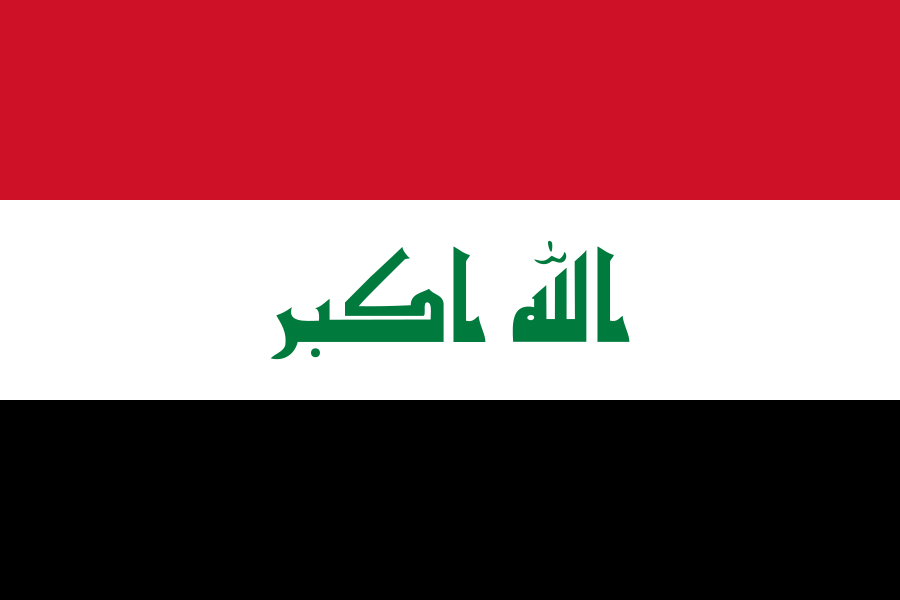
The flag of Iraq consists of three equal horizontal bands of red (top), white, and black. The Takbir (Arabic expression meaning “God is great”) in green Arabic script is centered on the white band. The band colors are derived from the Arab Liberation flag and represent oppression (black), overcoming obstacles through bloody struggle (red), to be replaced by a bright future (white).
Map
Map
Check out the map of Kazakhstan!
Weather
Anthem
National Anthem
| Title | Mawtini (My Homeland) |
| Composer | Ibrahim Touqan / Mohammad Flayfel |
FAQ
FAQs
Iraq was granted independence on October 3, 1932.
The centered phrase in green Arabic script reads: ALLAHU AKBAR (God is Great).
The current flag of Iraq was adopted in 2008.
Iraq is governed as a federal parliamentary republic.
Discover more fun facts of Micronesia.
Printable
Printable Iraqi Flag
Printing for a class? Get 230+ flags, regional posters, quizzes & 30 Flag Bingo boards in one PDF: World Flags Mega Print Pack · all printable flags
Print another really cool flag. Why not the flag of Austria?
The flag of Iraq represents a nation whose modern borders were drawn by European powers following World War I, yet whose identity draws deeply from Arab and Islamic heritage. The current official flag, adopted in 2008, consists of three equal horizontal stripes of red, white, and black, with the Arabic phrase “Allahu Akbar” (God is Great) inscribed in green Kufic script across the white central band. This design reflects centuries of Middle Eastern political change, colonial influence, and the competing visions of various Iraqi governments seeking to balance secular nationalism with Islamic identity. The flag’s evolution from 1921 to the present day tells the story of Iraq’s twentieth-century history, from the fall of the Ottoman Empire through British mandate, royal rule, military coups, dictatorship, invasion, and reconstruction. Understanding Iraq’s flag requires examining both its visual elements and the historical circumstances that shaped each iteration, revealing how flags serve not merely as symbols but as statements of political philosophy and national aspiration.
Design Origins and Pan-Arab Symbolism
Following World War I and the dissolution of the Ottoman Empire, the League of Nations mandated Iraq to Britain, and King Faisal I introduced the nation’s first modern flag in 1921. This initial design featured black, white, and green horizontal stripes with a red triangle at the hoist—a composition rooted in pan-Arab symbolism rather than uniquely Iraqi heritage. These colors derive from the broader Arab nationalist movement, which sought to unite diverse Arab populations under shared symbols following centuries of Ottoman rule. The black, white, green, and red would remain consistent across virtually every subsequent Iraqi flag design, demonstrating remarkable continuity despite radical political upheavals. By 1924, the design evolved to replace the red triangle with two green seven-pointed stars on the white band, symbols intended to represent the Arab and Kurdish peoples—a subtle acknowledgment of Iraq’s complex ethnic composition that would resurface in later flags. This early emphasis on pan-Arab colors rather than exclusively Iraqi imagery reflected the ideological currents of the 1920s and 1930s, when Arab nationalism sought to transcend the artificial borders drawn by European powers and unite the region’s populations around shared language and culture.
Republican Era and Symbol Evolution (1958–1991)
The Iraqi monarchy’s overthrow in 1958 triggered a period of radical political experimentation reflected in flag design. The First Republic (1959–1963) adopted a tricolor of black, white, and green bands topped with a central yellow sun bearing eight red rays—a symbol representing the Kurdish minority. When the Ba’athist Party consolidated power in 1963, they returned to a simpler three-color design and introduced three green stars on the white stripe, ostensibly representing Iraq’s desire to unite with Egypt and Syria in a broader Arab confederation. Throughout the 1960s and 1970s, this basic design remained relatively stable despite frequent political upheaval, providing continuity across an era of military coups and ideological shifts. However, in 1991, President Saddam Hussein ordered a significant modification: the addition of the Takbir—the Islamic phrase “Allahu Akbar”—inscribed in what appeared to be Hussein’s own handwriting between the three green stars. This change marked a strategic pivot toward Islamic symbolism, a response to the religious fervor mobilized during Iraq’s invasion of Kuwait and the subsequent Gulf War. The decision to add Islamic script to a predominantly secular nationalist flag signaled an attempt to strengthen domestic support by appealing to religious identity, demonstrating how flags adapt to serve the propaganda needs of ruling regimes.
Color Meanings and Symbolic Depth
The colors adorning Iraq’s flag carry meanings rooted in classical Arabic poetry and Islamic tradition. According to a thirteenth-century poem by the Arab poet Safi al-Din al-Hilli, the four pan-Arab colors represent specific virtues: red symbolizes the willingness of the people to shed their blood in defense of the nation; white represents the purity of their motives and deeds; black evokes the battles and struggles through which Arab nations have passed; and green represents the fertile fields of the Arab lands and holds special significance in Islamic tradition as the Prophet Muhammad’s favorite color. These poetic associations lend the flag a depth beyond mere political symbolism, connecting Iraq’s modern national identity to medieval Islamic civilization and classical Arab literary traditions. The use of green for the Takbir inscription is particularly significant, as green holds profound spiritual meaning in Islam, appearing frequently in the Quran and Islamic art. This layering of meanings—combining pan-Arab nationalism, Islamic spirituality, and poetic tradition—demonstrates how the Iraqi flag attempts to synthesize multiple sources of legitimacy and identity.
The 2004 and 2008 Modifications
Following the 2003 American invasion and the overthrow of Saddam Hussein, Iraq entered a transitional period that necessitated flag redesign. In 2004, the Iraqi Governing Council modified the Takbir from Hussein’s cursive handwriting to a traditional stylized Kufic script—an elegant medieval Arabic calligraphy style. This change symbolically divorced the flag from association with Hussein’s dictatorship while maintaining the Islamic element introduced during his regime. The modification satisfied both secular nationalists and religious conservatives by adopting a historically-rooted artistic tradition rather than a contemporary handwriting style. Four years later, on January 22, 2008, the Iraqi Council of Representatives voted to further modify the flag by removing the three green stars entirely, leaving only the horizontal tricolor with the Kufic Takbir. This final significant change eliminated the last explicit reference to Kurdish representation, though the decision was made by an Iraqi parliament with substantial Kurdish participation. The revised design achieved greater visual simplicity while maintaining the pan-Arab colors and Islamic inscription, creating a flag that appeals to broader Iraqi nationalism while avoiding the specific ethnic symbolism that had characterized earlier versions.
Notable Facts and Current Status
Iraq’s flag has undergone more dramatic transformations than the flags of most nations, reflecting the country’s extraordinarily turbulent twentieth-century history. The consistency of the pan-Arab color scheme across seven major flag designs—from 1921 through 2008—demonstrates remarkable ideological continuity despite revolutions, wars, and invasions. The 2008 version represents the longest period of flag stability in modern Iraqi history, having remained unchanged for over fifteen years. The transition from Hussein’s personalized Takbir to Kufic script represents not merely an aesthetic choice but a deliberate de-personalization of the flag, symbolizing Iraq’s attempt to transition from dictatorship to constitutional democracy. Today, the Iraqi flag flies over a nation still navigating the challenges of establishing stable democratic institutions, managing ethnic and religious diversity, and recovering from decades of conflict. The flag itself, with its elegant simplicity and layered historical references, stands as a visible reminder of Iraq’s complex identity—neither purely Arab nor purely Islamic, neither wholly secular nor wholly religious, but rather a synthesis of multiple traditions attempting to coexist within the borders established by colonial powers a century ago.
Sources: Wikipedia: Flag of Iraq; Britannica: Flag of Iraq; Flags Database: Iraq; FOTW: Evolution of the Iraqi Flag
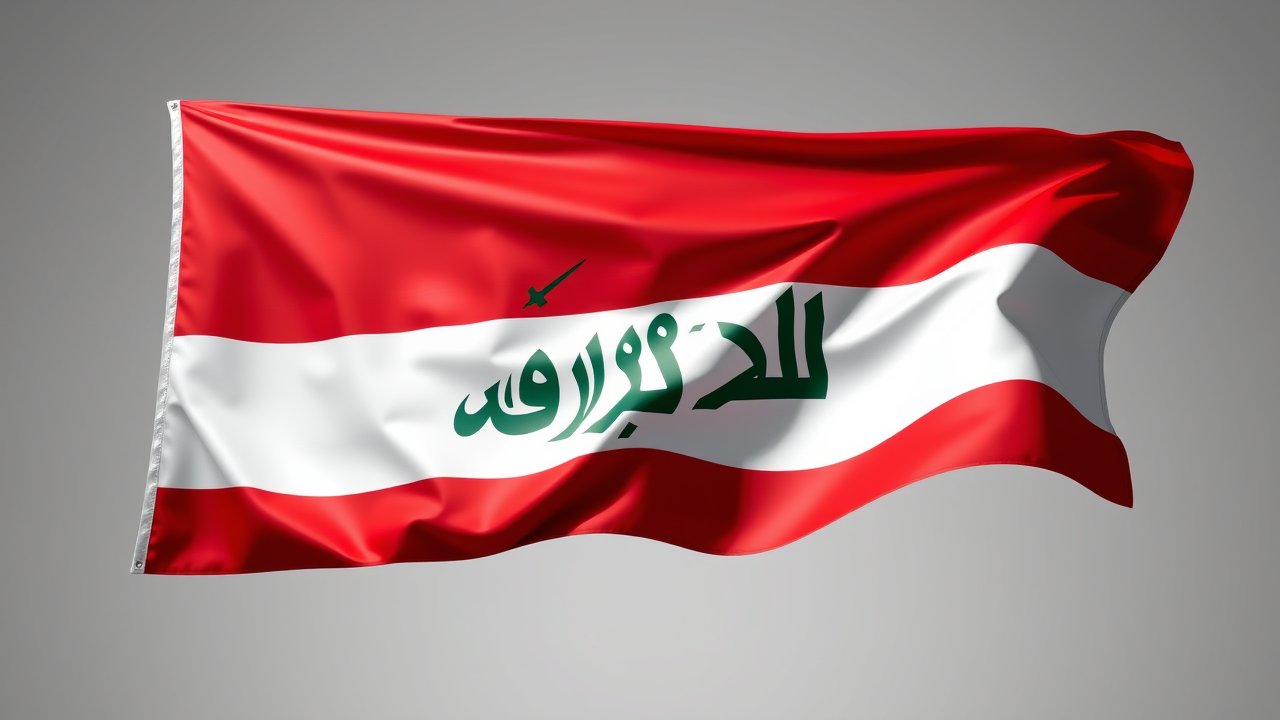
3D Glossy Render — The modern post-2008 flag: three horizontal stripes of red, white, and black with green Kufic script (Allahu Akbar) centered on the white stripe — not the Saddam-era flag with three stars. The flag of Iraq as a photorealistic 3D render. The modern post-2008 flag: three horizontal stripes of red, white, and black with green Kufic script (Allahu Akbar) centered on the white stripe — not the Saddam-era flag with three stars. The flag fabric hangs or drapes naturally but preserves exact proportions, colors, and all symbols perfectly — completely faithful to the real Iraq flag. Dramatic studio lighting, glossy silk material, soft shadows, subsurface scattering, perfect specular highlights. No text, no letters, no words, no writing of any kind.
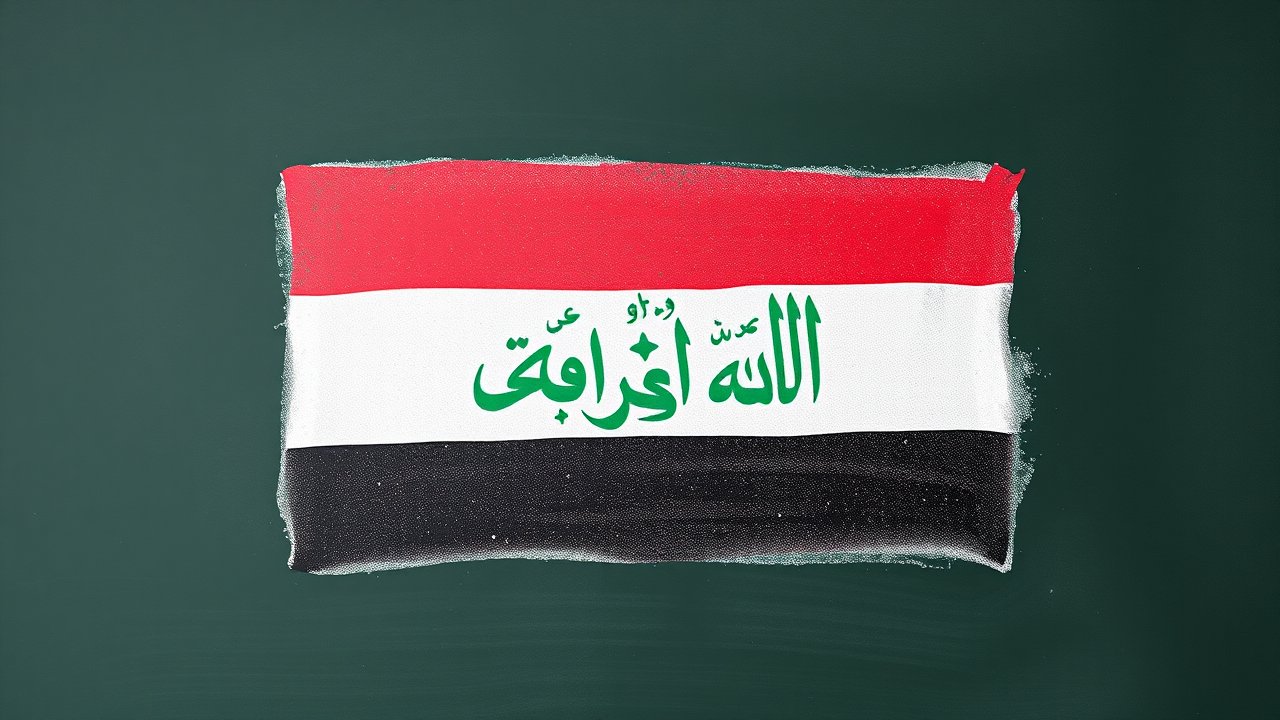
Chalk on Blackboard — The modern post-2008 flag: three horizontal stripes of red, white, and black with green Kufic script (Allahu Akbar) centered on the white stripe — not the Saddam-era flag with three stars. The flag of Iraq drawn in chalk on a real blackboard. The modern post-2008 flag: three horizontal stripes of red, white, and black with green Kufic script (Allahu Akbar) centered on the white stripe — not the Saddam-era flag with three stars. Authentic blackboard — dark slate green surface with chalk dust and smudge marks. Soft, dusty white and colored chalk lines, imperfect edges, hand-drawn quality. Chalk dust particles visible in the air. The flag is immediately recognizable. No text, no letters, no words, no writing of any kind.
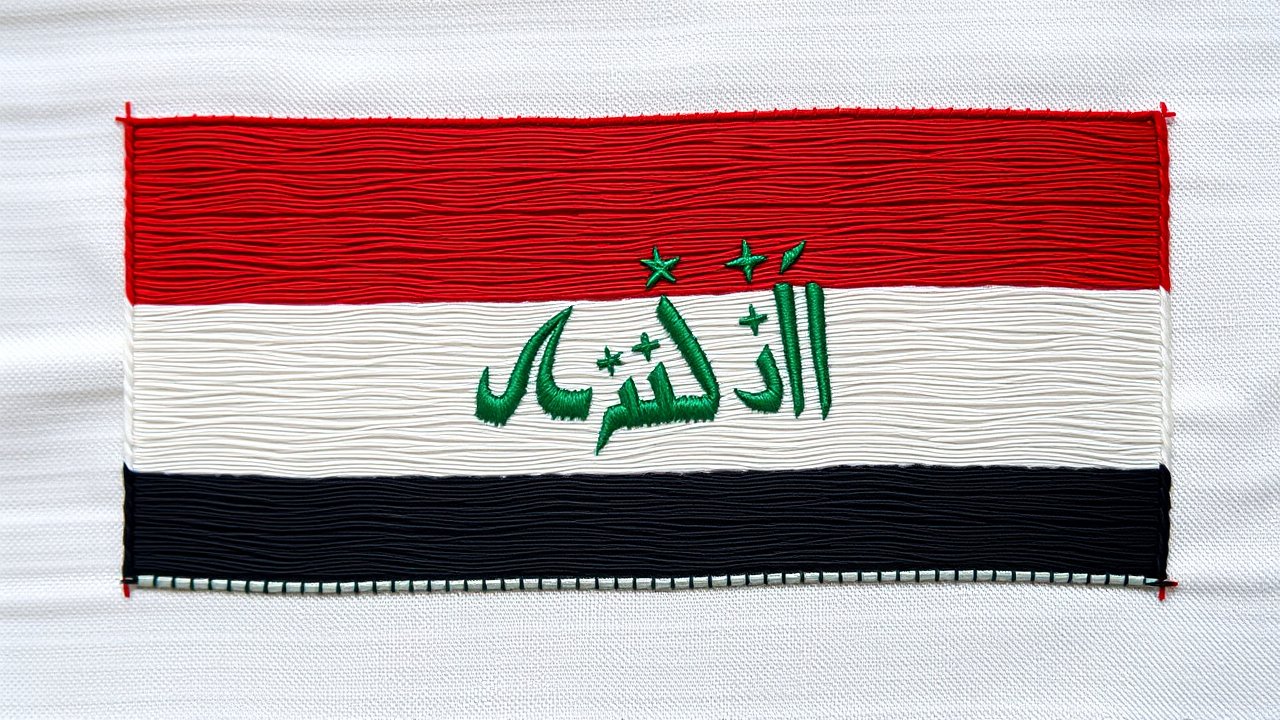
Embroidered Textile — The modern post-2008 flag: three horizontal stripes of red, white, and black with green Kufic script (Allahu Akbar) centered on the white stripe — not the Saddam-era flag with three stars. The flag of Iraq as intricate embroidery on linen fabric. The modern post-2008 flag: three horizontal stripes of red, white, and black with green Kufic script (Allahu Akbar) centered on the white stripe — not the Saddam-era flag with three stars. Dense satin stitches, French knots, chain stitch detail. The flag design is completely faithful — exact colors, geometry, and all symbols faithfully stitched, immediately recognizable as the Iraq flag. Visible thread texture, dimensional quality, warm handcrafted feel. No text, no letters, no words, no writing of any kind.
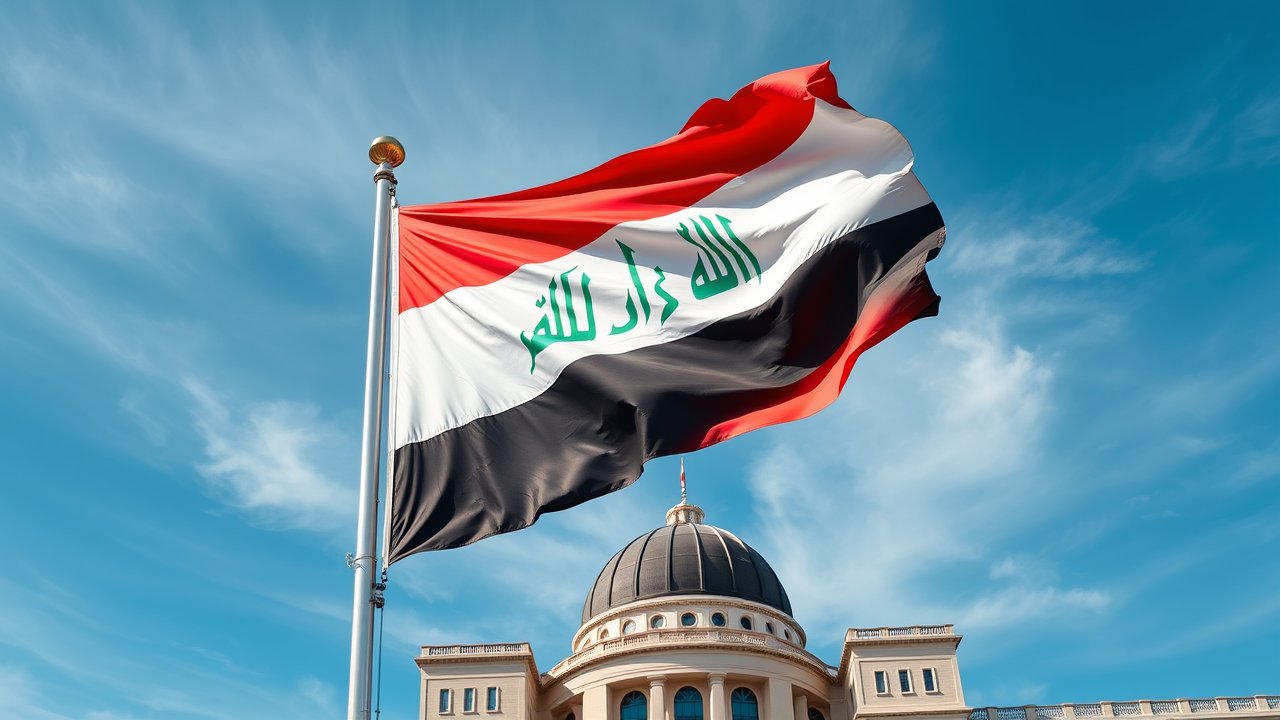
Flagpole in Capital — The modern post-2008 flag: three horizontal stripes of red, white, and black with green Kufic script (Allahu Akbar) centered on the white stripe — not the Saddam-era flag with three stars. Photorealistic photograph of the Iraq flag flying on a tall flagpole in front of an iconic government building in the capital city. The modern post-2008 flag: three horizontal stripes of red, white, and black with green Kufic script (Allahu Akbar) centered on the white stripe — not the Saddam-era flag with three stars. The flag ripples naturally in the wind, colors vivid and exact. Documentary photography style, sharp and realistic. Grand architecture in the background. Blue sky, dramatic clouds. No text, no letters, no words, no writing of any kind.
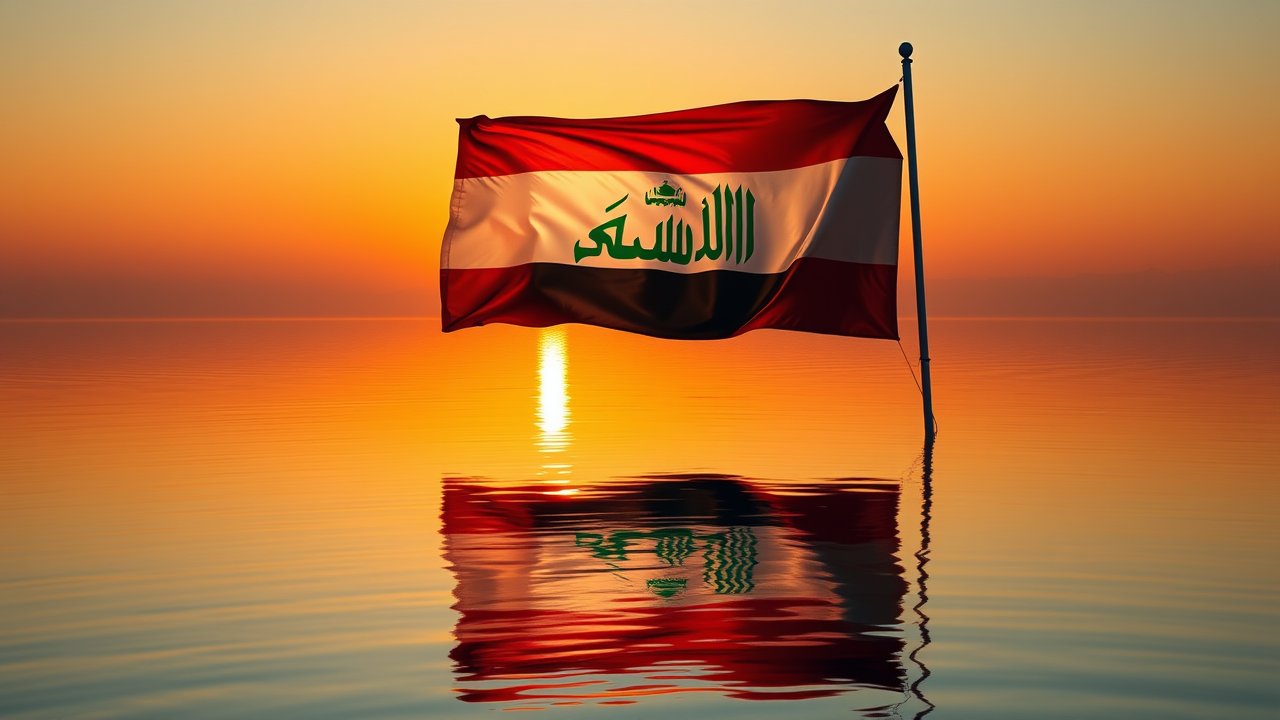
Golden Hour Reflection — The modern post-2008 flag: three horizontal stripes of red, white, and black with green Kufic script (Allahu Akbar) centered on the white stripe — not the Saddam-era flag with three stars. Photorealistic photograph of the Iraq flag reflected in still water at golden hour. The modern post-2008 flag: three horizontal stripes of red, white, and black with green Kufic script (Allahu Akbar) centered on the white stripe — not the Saddam-era flag with three stars. The flag flies on a pole at the water’s edge, its reflection shimmering on the surface below. Warm amber and orange sunset light. The flag colors and design are faithful and vivid. Serene, cinematic landscape photography. No text, no letters, no words, no writing of any kind.
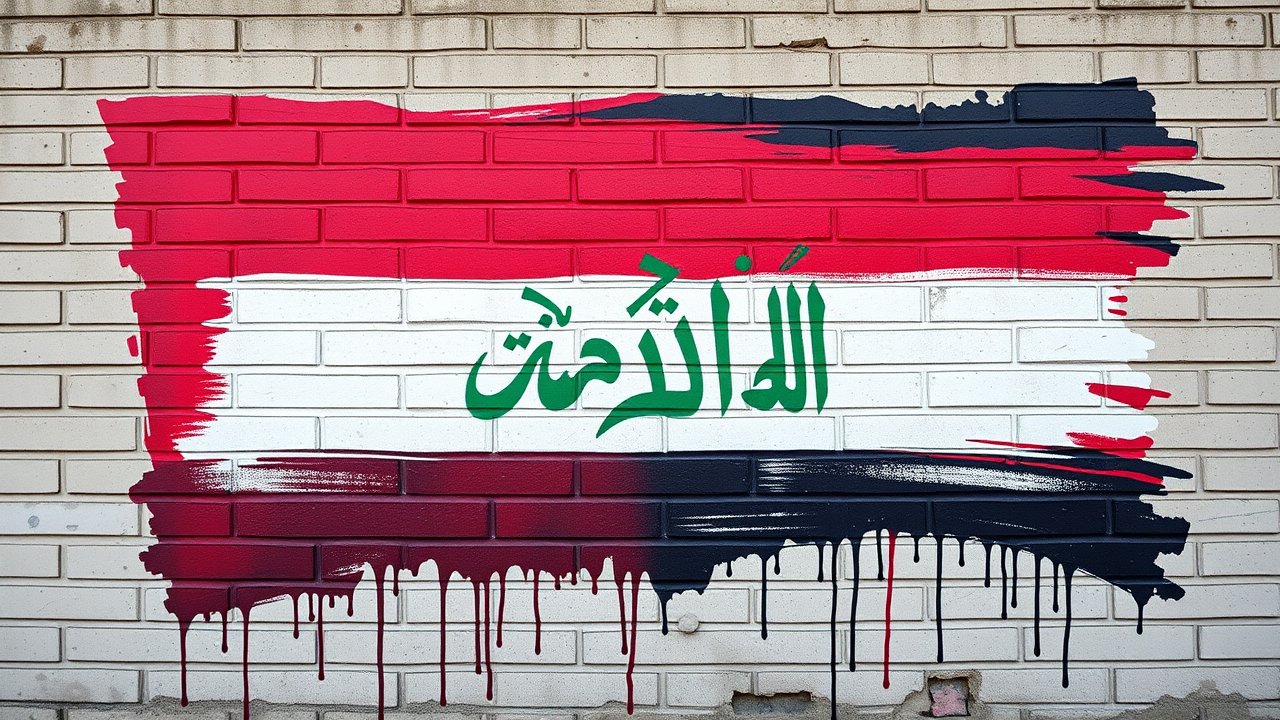
Street Art / Graffiti — The modern post-2008 flag: three horizontal stripes of red, white, and black with green Kufic script (Allahu Akbar) centered on the white stripe — not the Saddam-era flag with three stars. The flag of Iraq as vibrant street art spray-painted on a brick wall. The modern post-2008 flag: three horizontal stripes of red, white, and black with green Kufic script (Allahu Akbar) centered on the white stripe — not the Saddam-era flag with three stars. Bold spray paint, dripping edges, stencil layers, overspray halos. The flag design is faithful and immediately recognizable — exact colors and symbols, just rendered in spray paint on urban concrete. No text, no letters, no words, no writing of any kind. No tags, no graffiti lettering.
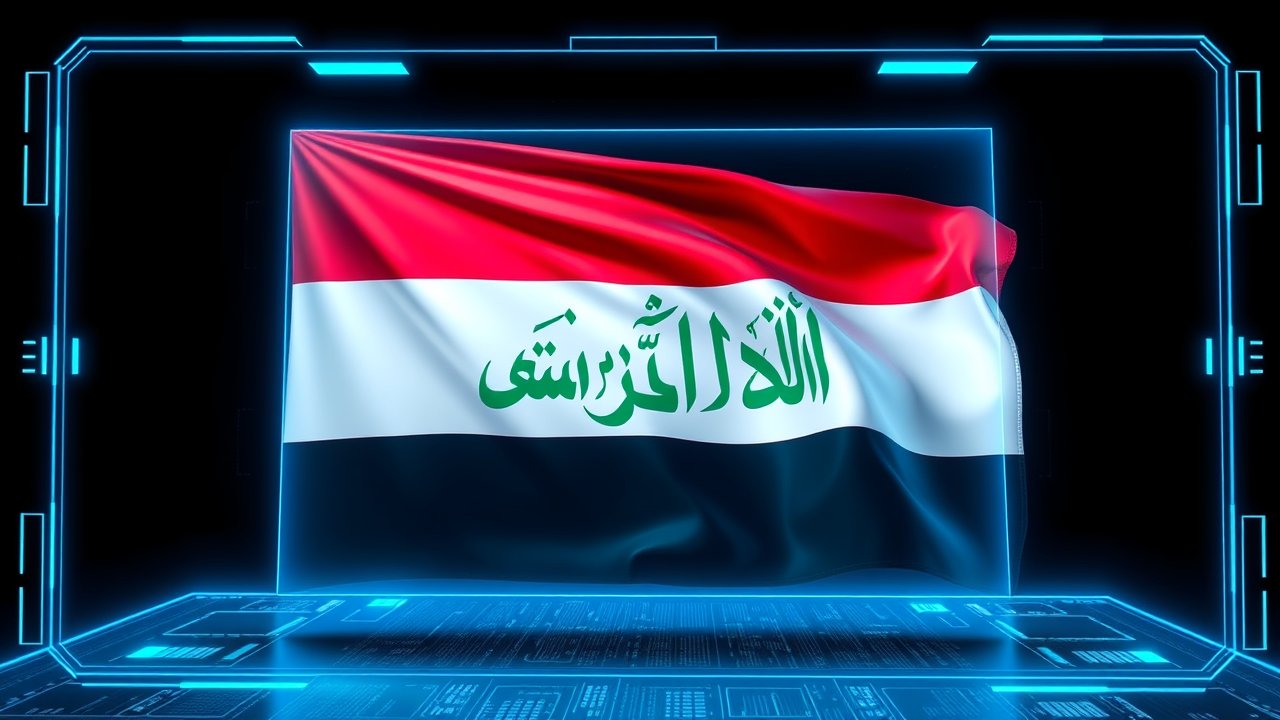
Sci-Fi Hologram — The modern post-2008 flag: three horizontal stripes of red, white, and black with green Kufic script (Allahu Akbar) centered on the white stripe — not the Saddam-era flag with three stars. The flag of Iraq projected as a futuristic holographic display. The modern post-2008 flag: three horizontal stripes of red, white, and black with green Kufic script (Allahu Akbar) centered on the white stripe — not the Saddam-era flag with three stars. Translucent blue-white projection with scan lines, floating in dark space. Glitching edges, particle effects, data streams. The flag design is completely faithful and recognizable. Cyberpunk HUD elements framing the projection. No text, no letters, no words, no writing of any kind.
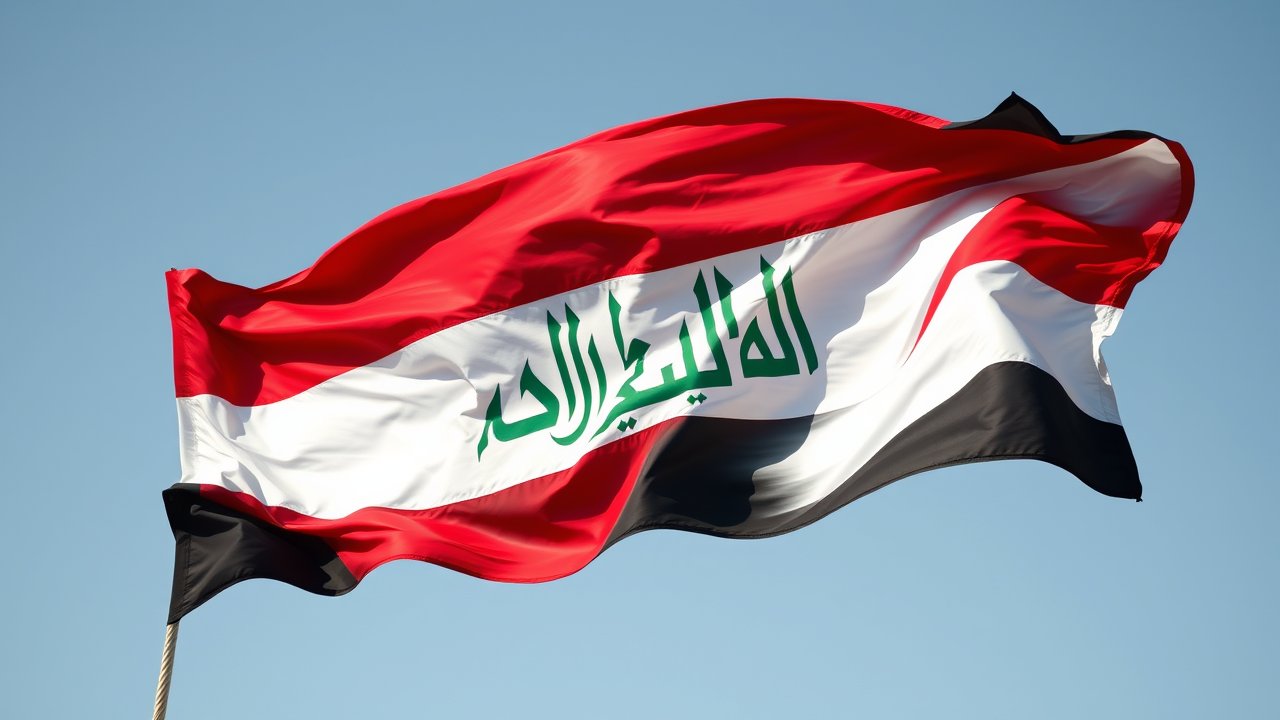
Hyperrealistic Wind — The modern post-2008 flag: three horizontal stripes of red, white, and black with green Kufic script (Allahu Akbar) centered on the white stripe — not the Saddam-era flag with three stars. Ultra-hyperrealistic photograph of the Iraq flag caught in a dramatic gust of wind. The modern post-2008 flag: three horizontal stripes of red, white, and black with green Kufic script (Allahu Akbar) centered on the white stripe — not the Saddam-era flag with three stars. Macro-level fabric detail — individual threads visible, fabric folds and tension lines crisp. Colors and design completely faithful to the real Iraq flag. High-speed shutter, razor-sharp focus, studio lighting. No text, no letters, no words, no writing of any kind.
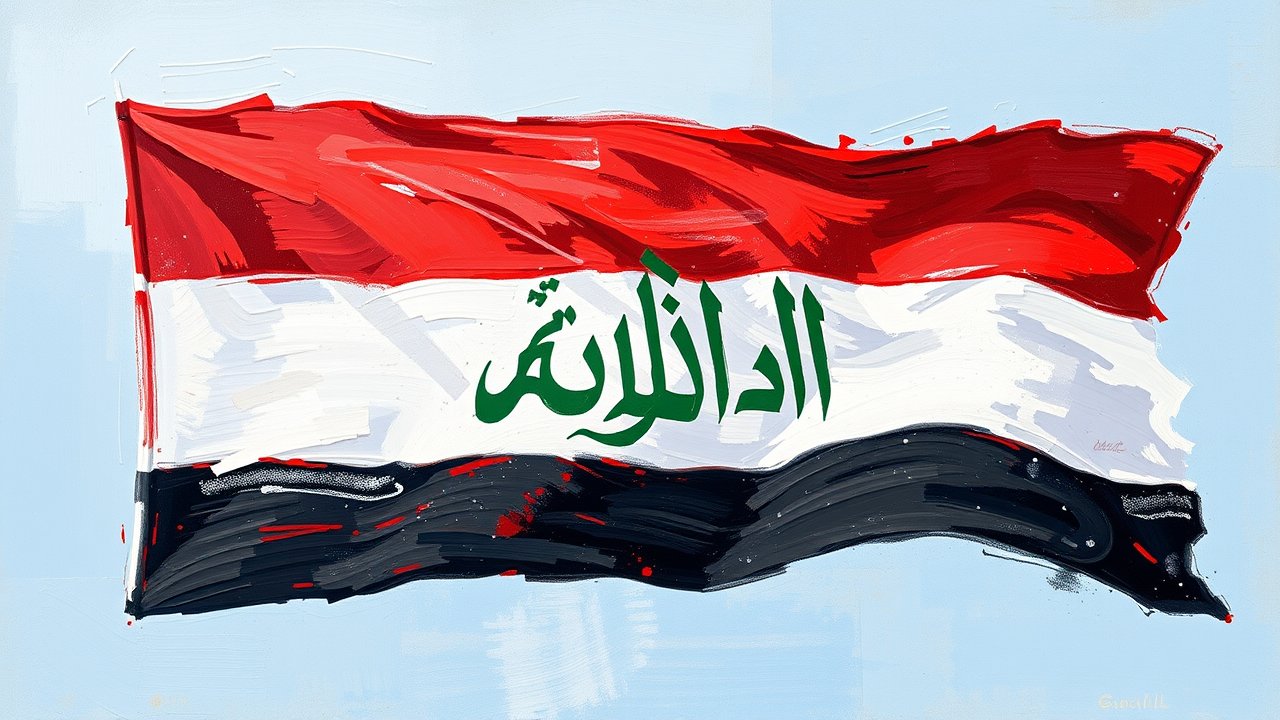
Impressionist Oil — The modern post-2008 flag: three horizontal stripes of red, white, and black with green Kufic script (Allahu Akbar) centered on the white stripe — not the Saddam-era flag with three stars. The flag of Iraq painted in French Impressionist oil on canvas. The modern post-2008 flag: three horizontal stripes of red, white, and black with green Kufic script (Allahu Akbar) centered on the white stripe — not the Saddam-era flag with three stars. Thick impasto brushstrokes, dappled light, vibrant broken color technique in the style of Monet. The flag is instantly recognizable — colors and design faithful to the real Iraq flag, interpreted with impressionist light and texture. No text, no letters, no words, no writing of any kind.
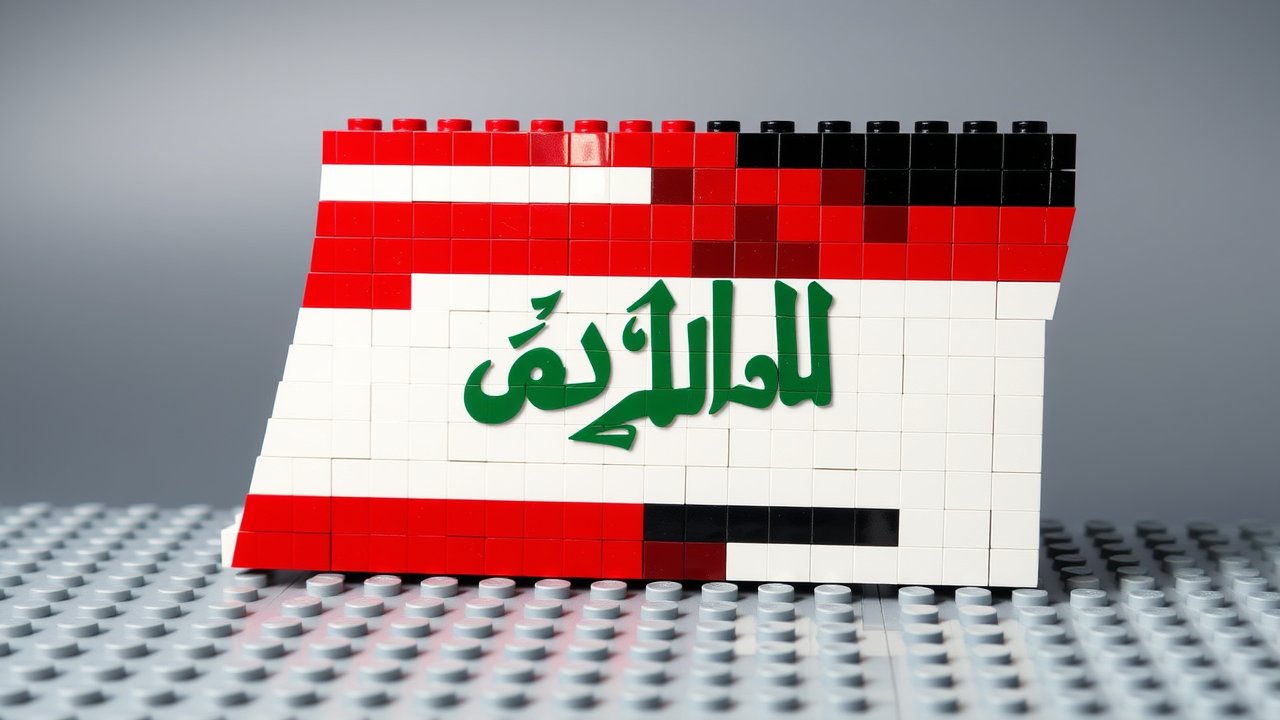
Lego Bricks — The modern post-2008 flag: three horizontal stripes of red, white, and black with green Kufic script (Allahu Akbar) centered on the white stripe — not the Saddam-era flag with three stars. The flag of Iraq built from Lego bricks, photographed as a real physical construction. The modern post-2008 flag: three horizontal stripes of red, white, and black with green Kufic script (Allahu Akbar) centered on the white stripe — not the Saddam-era flag with three stars. Visible studs and brick seams, slight plastic sheen. Standard Lego colors approximate the flag’s palette. Built on a gray Lego baseplate. Dramatic angle showing the three-dimensional brick texture. No text, no letters, no words, no writing of any kind.
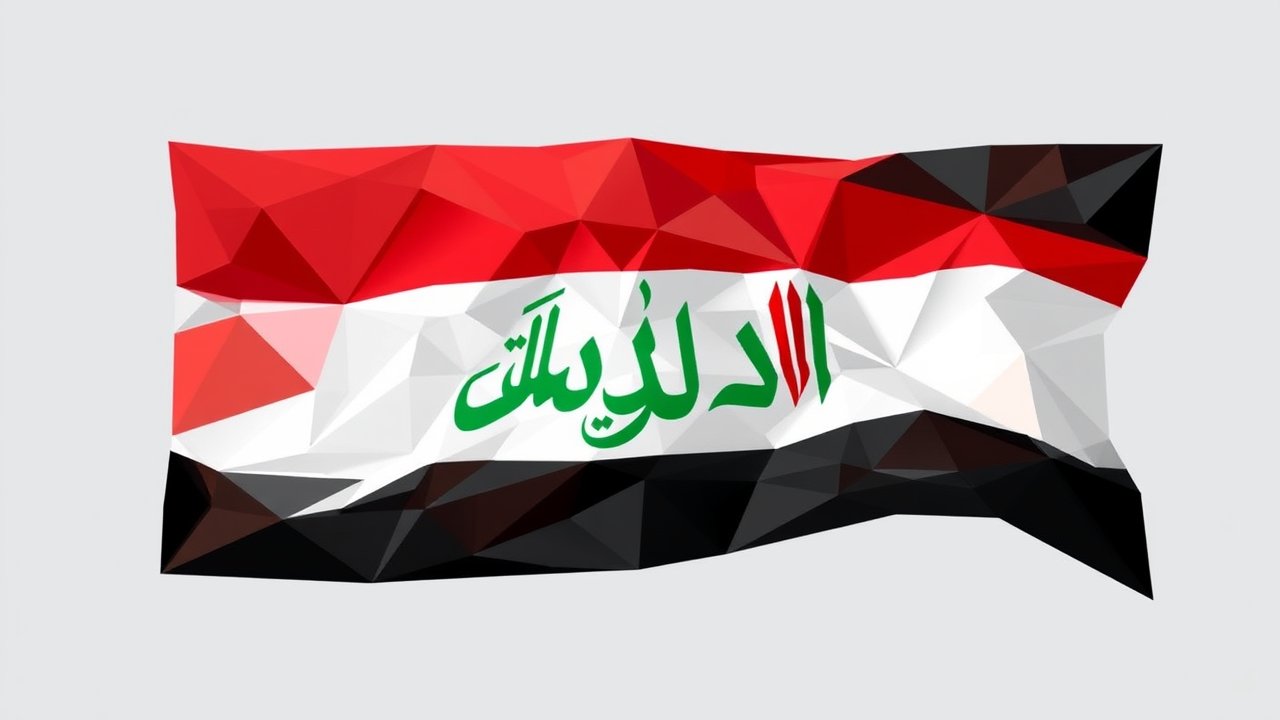
Low-Poly Geometric — The modern post-2008 flag: three horizontal stripes of red, white, and black with green Kufic script (Allahu Akbar) centered on the white stripe — not the Saddam-era flag with three stars. The flag of Iraq constructed from low-polygon geometric triangles. The modern post-2008 flag: three horizontal stripes of red, white, and black with green Kufic script (Allahu Akbar) centered on the white stripe — not the Saddam-era flag with three stars. Aggressively faceted — each region broken into many visible triangular faces with subtle color variation across each polygon, creating real depth and dimensionality even in flat-color areas of the flag. Crystal-like, contemporary computational design. The flag is completely faithful and immediately recognizable. No text, no letters, no words, no writing of any kind.
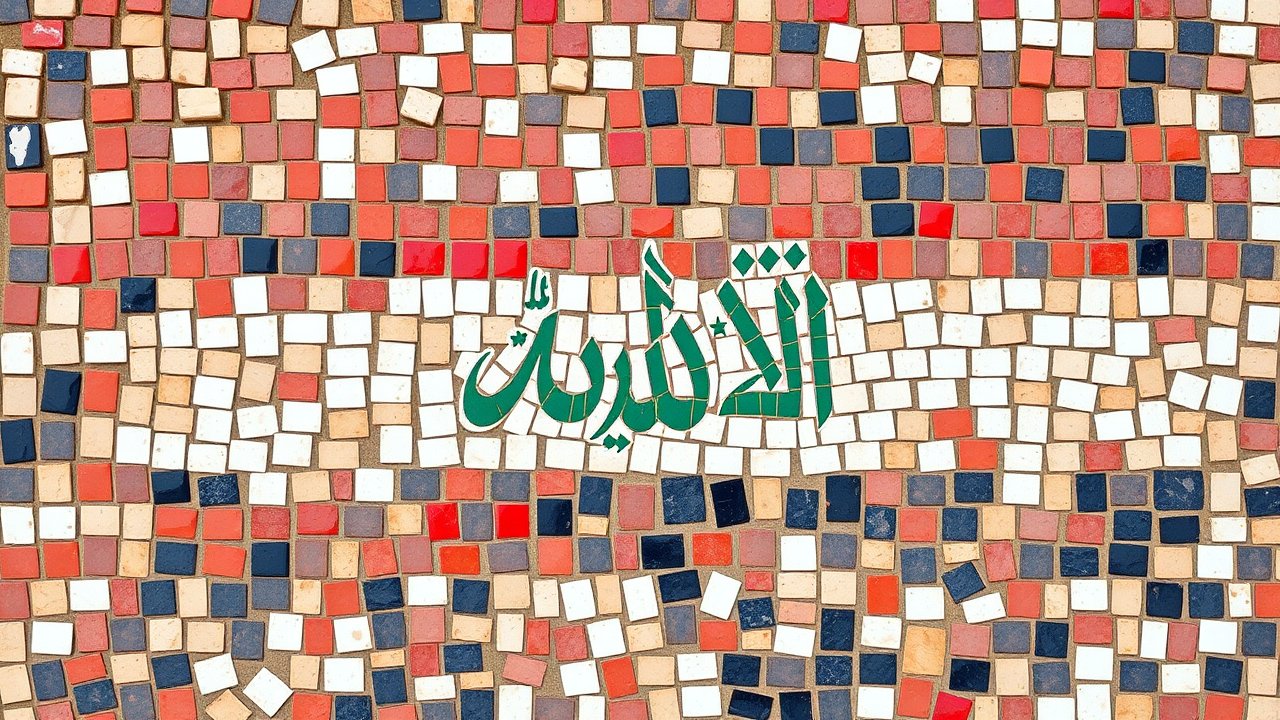
Mosaic Tiles — The modern post-2008 flag: three horizontal stripes of red, white, and black with green Kufic script (Allahu Akbar) centered on the white stripe — not the Saddam-era flag with three stars. The flag of Iraq assembled as a Roman-style mosaic. The modern post-2008 flag: three horizontal stripes of red, white, and black with green Kufic script (Allahu Akbar) centered on the white stripe — not the Saddam-era flag with three stars. The flag is completely faithful to the real Iraq flag — exact proportions, colors, and all symbols, rendered in thousands of small stone and glass tesserae. Visible grout lines, rich earthy tones mixed with brilliant glass, slight historical weathering. No text, no letters, no words, no writing of any kind.
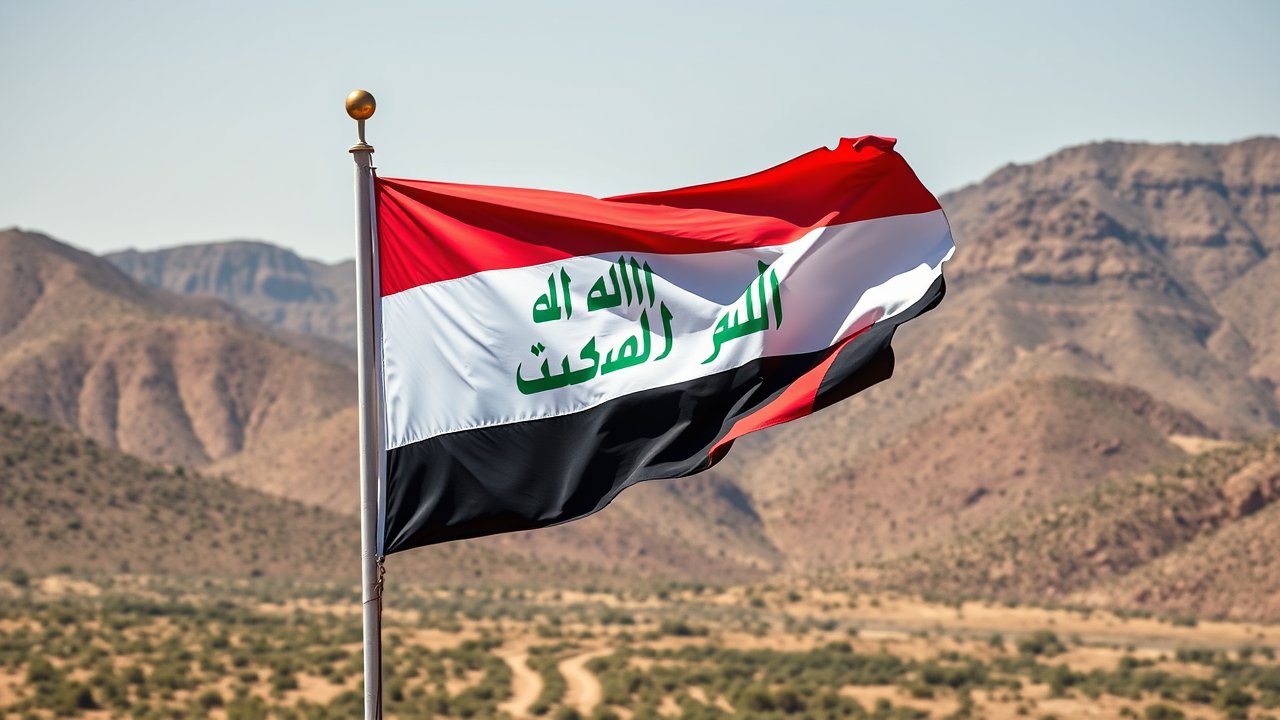
Native Landscape — The modern post-2008 flag: three horizontal stripes of red, white, and black with green Kufic script (Allahu Akbar) centered on the white stripe — not the Saddam-era flag with three stars. Photorealistic photograph of the Iraq flag flying in an iconic natural landscape native to Iraq — the terrain, flora, and environment characteristic of that country. The modern post-2008 flag: three horizontal stripes of red, white, and black with green Kufic script (Allahu Akbar) centered on the white stripe — not the Saddam-era flag with three stars. The flag is prominent and its colors are faithful and vivid. Remote, uninhabited wilderness. National Geographic photography style. No text, no letters, no words, no writing of any kind.
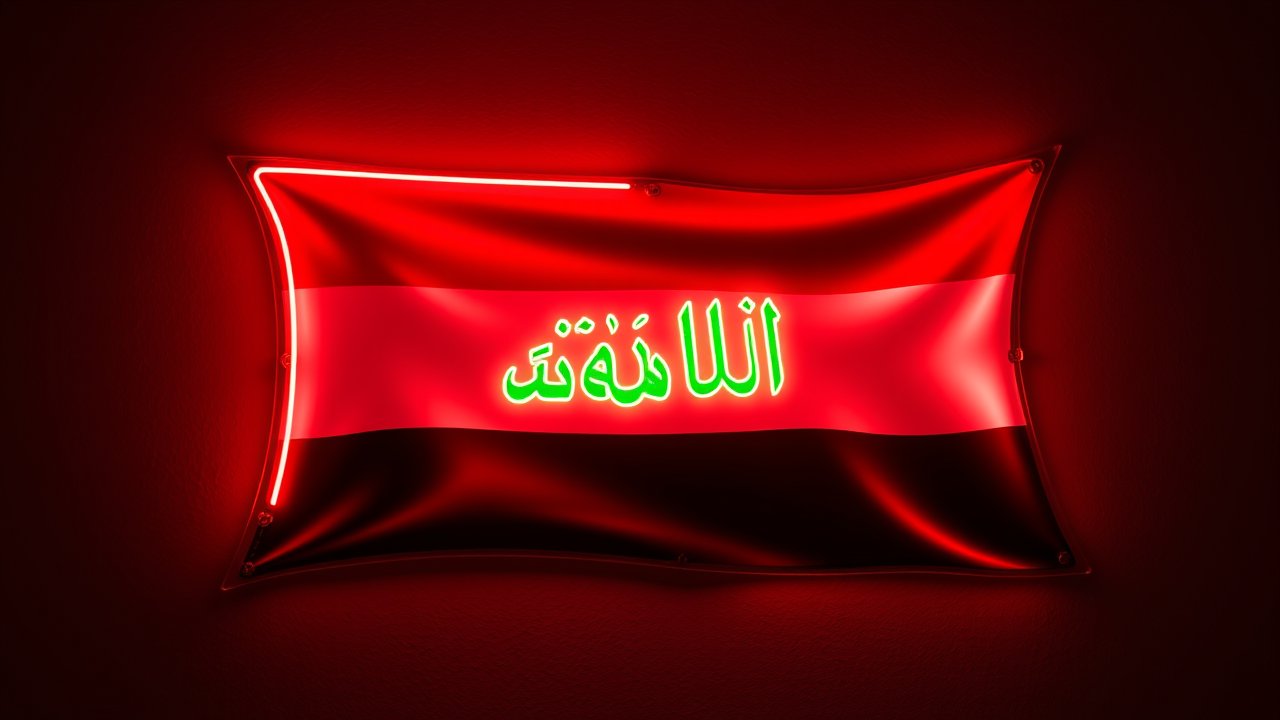
Neon Sign — The modern post-2008 flag: three horizontal stripes of red, white, and black with green Kufic script (Allahu Akbar) centered on the white stripe — not the Saddam-era flag with three stars. The flag of Iraq recreated as a real neon sign mounted on a dark wall. The modern post-2008 flag: three horizontal stripes of red, white, and black with green Kufic script (Allahu Akbar) centered on the white stripe — not the Saddam-era flag with three stars. Glowing glass neon tubes bent into the flag’s shapes — the colors of the flag rendered in actual neon light. Visible glass tube bends, metal mounting brackets on the wall. Warm neon glow and light bloom. Real neon, not digital. Photographed in a dark room. No text, no letters, no words, no writing of any kind.
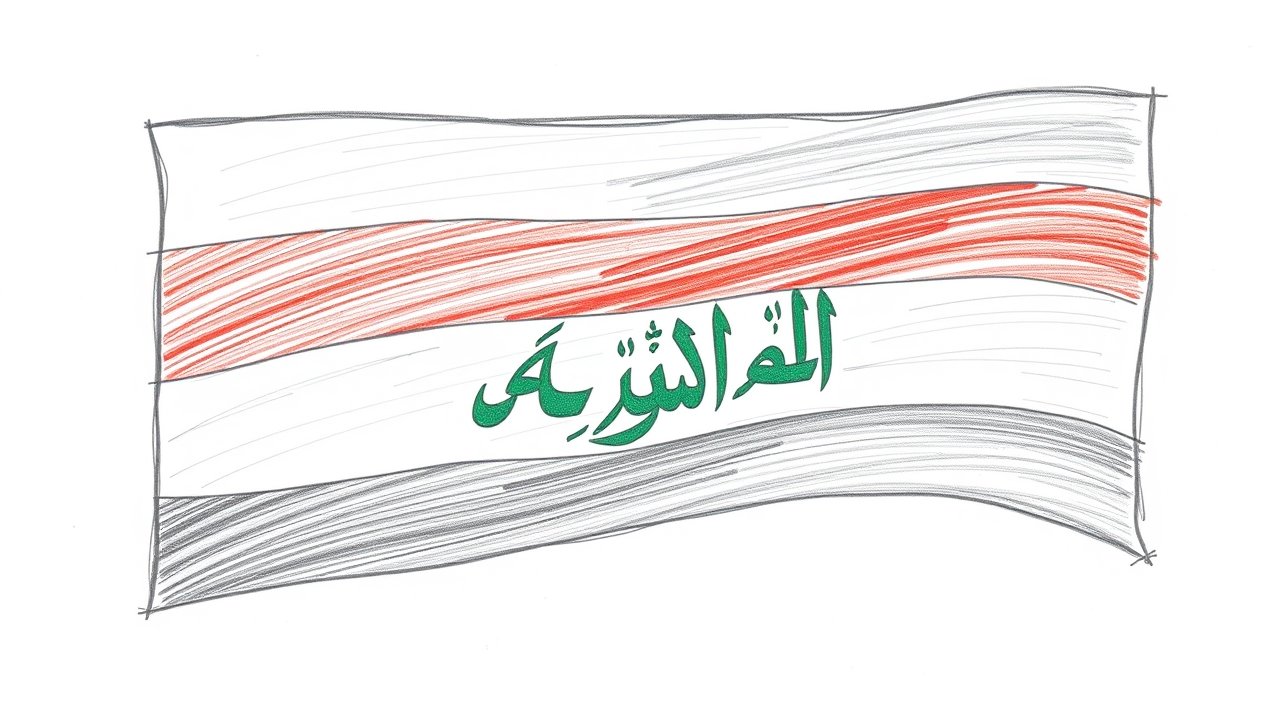
Pencil Sketch — The modern post-2008 flag: three horizontal stripes of red, white, and black with green Kufic script (Allahu Akbar) centered on the white stripe — not the Saddam-era flag with three stars. The flag of Iraq as a bold, confident pencil sketch. The modern post-2008 flag: three horizontal stripes of red, white, and black with green Kufic script (Allahu Akbar) centered on the white stripe — not the Saddam-era flag with three stars. Strong graphite lines on cream paper — not delicate but bold and decisive. Heavy pressure on key outlines, dramatic cross-hatching for deep shadows and shading. Immediately recognizable as the Iraq flag. Artist’s confident hand, not tentative. No text, no letters, no words, no writing of any kind.
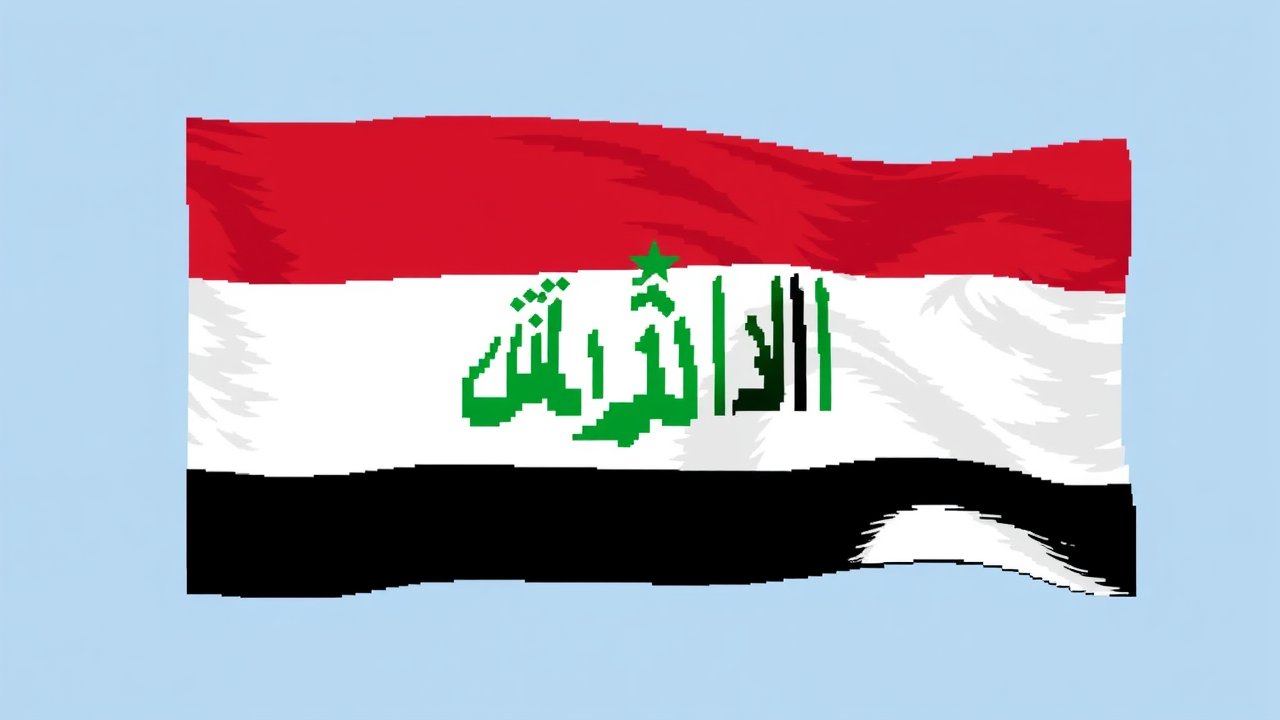
Pixel Art — The modern post-2008 flag: three horizontal stripes of red, white, and black with green Kufic script (Allahu Akbar) centered on the white stripe — not the Saddam-era flag with three stars. The flag of Iraq as detailed 16-bit pixel art. The modern post-2008 flag: three horizontal stripes of red, white, and black with green Kufic script (Allahu Akbar) centered on the white stripe — not the Saddam-era flag with three stars. Crisp pixel grid, limited palette with careful dithering, nostalgic retro game aesthetic. Clean grid-aligned design with subtle shading. Every element of the flag faithfully reproduced in pixels. No text, no letters, no words, no writing of any kind.
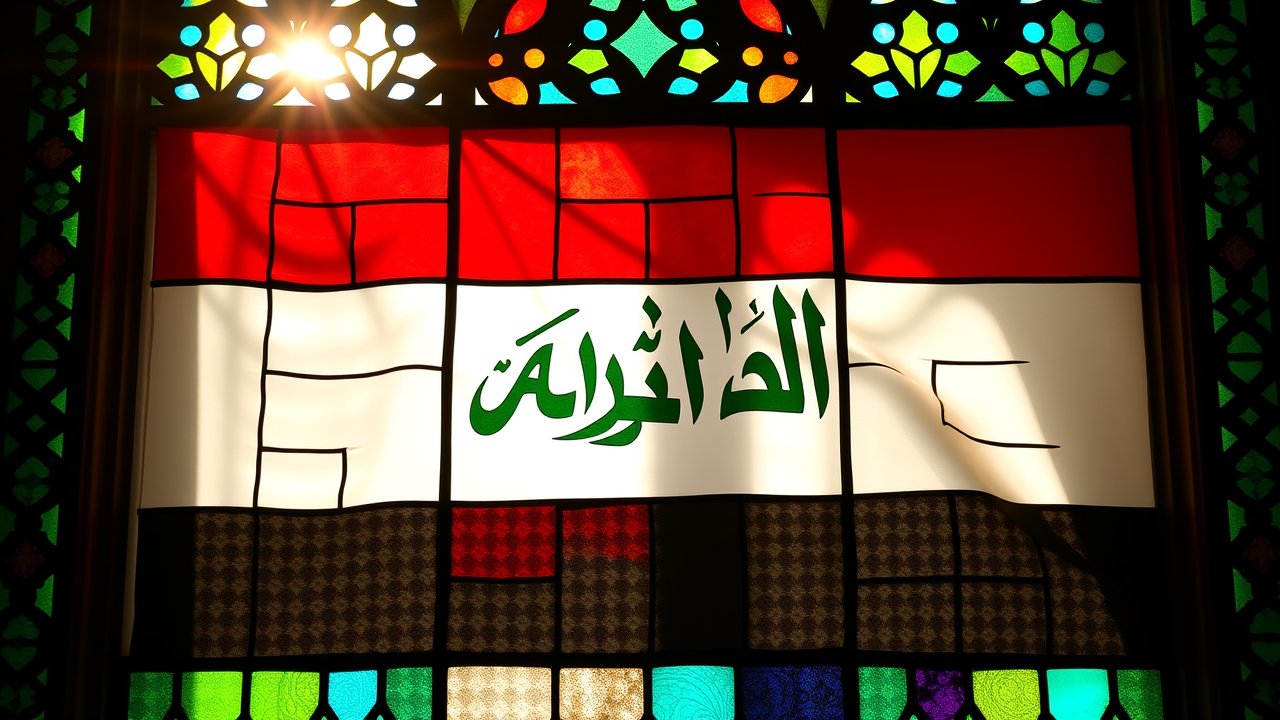
Stained Glass — The modern post-2008 flag: three horizontal stripes of red, white, and black with green Kufic script (Allahu Akbar) centered on the white stripe — not the Saddam-era flag with three stars. The flag of Iraq rendered as an ornate stained glass window. The modern post-2008 flag: three horizontal stripes of red, white, and black with green Kufic script (Allahu Akbar) centered on the white stripe — not the Saddam-era flag with three stars. The design is completely faithful to the real Iraq flag — exact colors, geometry, and all symbols preserved. Brilliant jewel-toned glass pieces separated by dark lead came lines. Warm sunlight streaming through, casting colored light. Gothic cathedral craftsmanship. No text, no letters, no words, no writing of any kind.
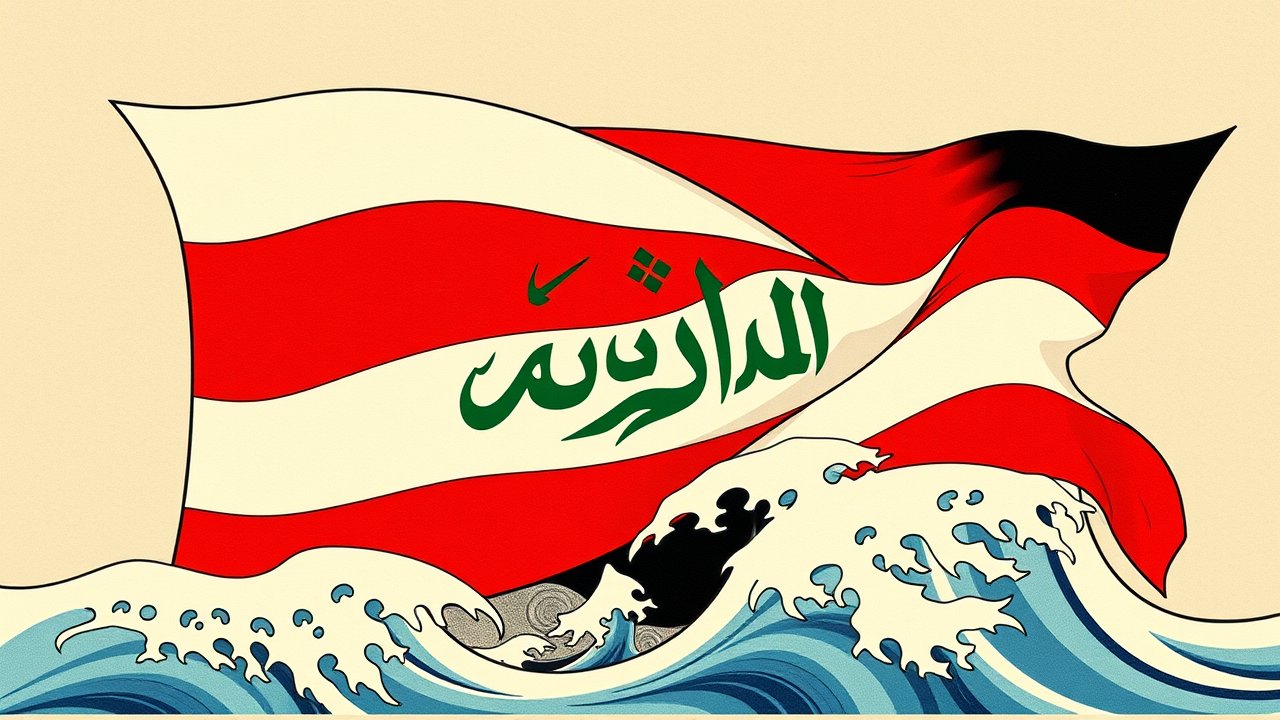
Ukiyo-e Woodblock — The modern post-2008 flag: three horizontal stripes of red, white, and black with green Kufic script (Allahu Akbar) centered on the white stripe — not the Saddam-era flag with three stars. The flag of Iraq as a traditional Japanese ukiyo-e woodblock print. The modern post-2008 flag: three horizontal stripes of red, white, and black with green Kufic script (Allahu Akbar) centered on the white stripe — not the Saddam-era flag with three stars. Bold outlines, flat areas of rich color, flowing organic forms. Wind and waves incorporated into the composition. Printed on washi paper with visible wood grain texture. The flag is the central focus and instantly recognizable. No text, no letters, no words, no writing of any kind.
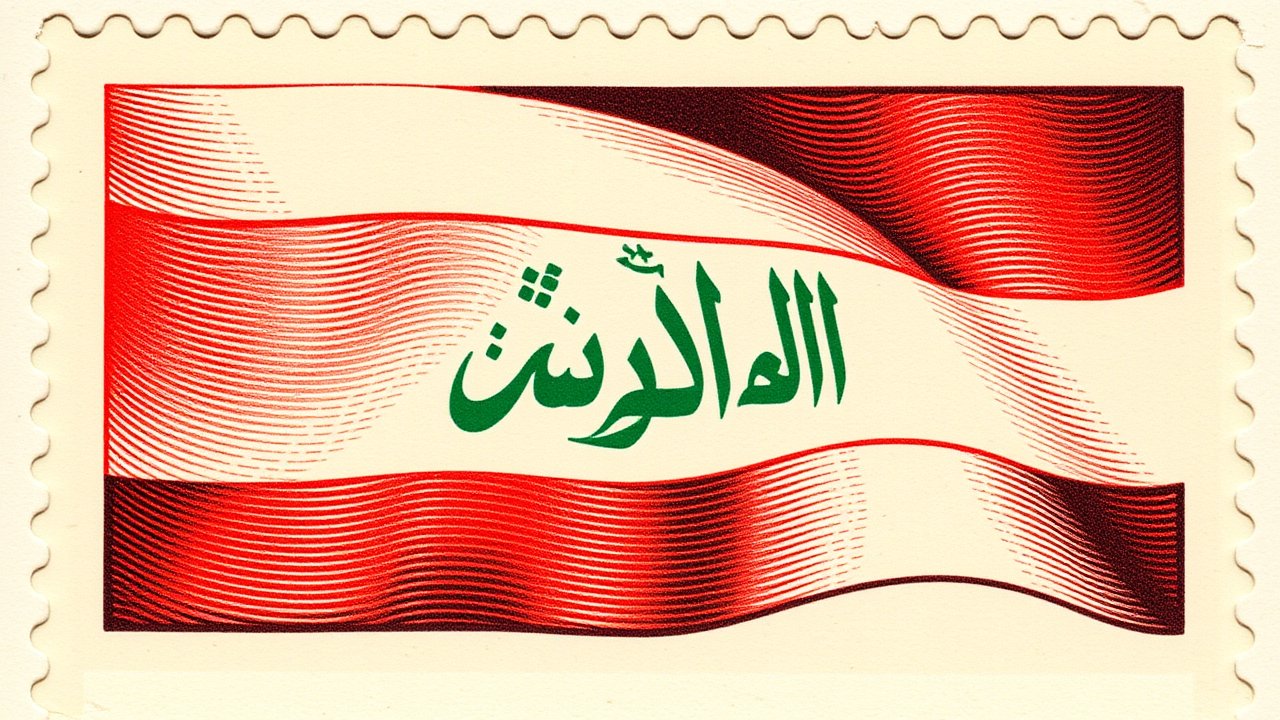
Vintage Postage Stamp — The modern post-2008 flag: three horizontal stripes of red, white, and black with green Kufic script (Allahu Akbar) centered on the white stripe — not the Saddam-era flag with three stars. The flag of Iraq as a vintage 1950s postage stamp. The modern post-2008 flag: three horizontal stripes of red, white, and black with green Kufic script (Allahu Akbar) centered on the white stripe — not the Saddam-era flag with three stars. The flag fills most of the stamp — it is the primary subject, faithfully rendered in fine engraved intaglio style. Perforated edges, aged paper with slight foxing. The stamp may show a denomination numeral only — absolutely no other text or country names.
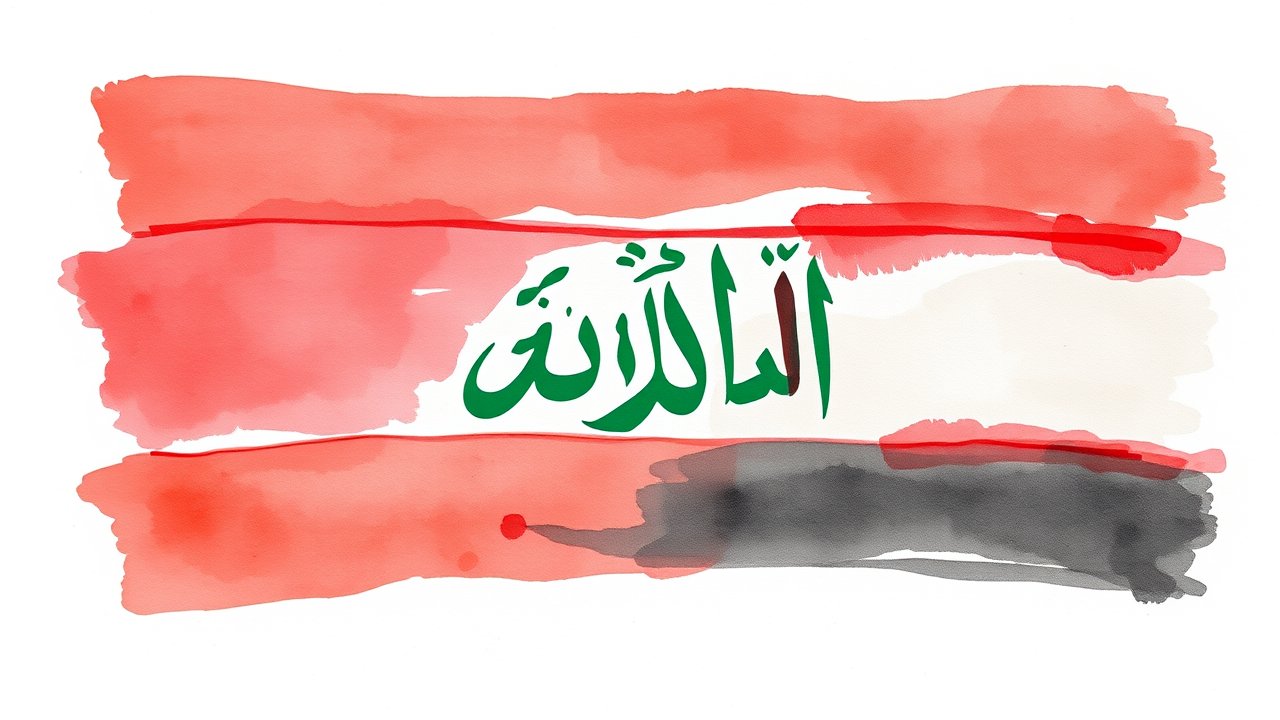
Watercolor — The modern post-2008 flag: three horizontal stripes of red, white, and black with green Kufic script (Allahu Akbar) centered on the white stripe — not the Saddam-era flag with three stars. The flag of Iraq painted in loose, expressive watercolor. The modern post-2008 flag: three horizontal stripes of red, white, and black with green Kufic script (Allahu Akbar) centered on the white stripe — not the Saddam-era flag with three stars. Wet-on-wet technique with soft color bleeds, visible brushstrokes, natural paper texture. Delicate splashes and drips at the edges. Luminous, translucent layers of pigment. No text, no letters, no words, no writing of any kind.
The flag of Iraq represents a nation whose modern borders were drawn by European powers following World War I, yet whose identity draws deeply from Arab and Islamic heritage. The current official flag, adopted in 2008, consists of three equal horizontal stripes of red, white, and black, with the Arabic phrase “Allahu Akbar” (God is Great) inscribed in green Kufic script across the white central band. This design reflects centuries of Middle Eastern political change, colonial influence, and the competing visions of various Iraqi governments seeking to balance secular nationalism with Islamic identity. The flag’s evolution from 1921 to the present day tells the story of Iraq’s twentieth-century history, from the fall of the Ottoman Empire through British mandate, royal rule, military coups, dictatorship, invasion, and reconstruction. Understanding Iraq’s flag requires examining both its visual elements and the historical circumstances that shaped each iteration, revealing how flags serve not merely as symbols but as statements of political philosophy and national aspiration.
Design Origins and Pan-Arab Symbolism
Following World War I and the dissolution of the Ottoman Empire, the League of Nations mandated Iraq to Britain, and King Faisal I introduced the nation’s first modern flag in 1921. This initial design featured black, white, and green horizontal stripes with a red triangle at the hoist—a composition rooted in pan-Arab symbolism rather than uniquely Iraqi heritage. These colors derive from the broader Arab nationalist movement, which sought to unite diverse Arab populations under shared symbols following centuries of Ottoman rule. The black, white, green, and red would remain consistent across virtually every subsequent Iraqi flag design, demonstrating remarkable continuity despite radical political upheavals. By 1924, the design evolved to replace the red triangle with two green seven-pointed stars on the white band, symbols intended to represent the Arab and Kurdish peoples—a subtle acknowledgment of Iraq’s complex ethnic composition that would resurface in later flags. This early emphasis on pan-Arab colors rather than exclusively Iraqi imagery reflected the ideological currents of the 1920s and 1930s, when Arab nationalism sought to transcend the artificial borders drawn by European powers and unite the region’s populations around shared language and culture.
Republican Era and Symbol Evolution (1958–1991)
The Iraqi monarchy’s overthrow in 1958 triggered a period of radical political experimentation reflected in flag design. The First Republic (1959–1963) adopted a tricolor of black, white, and green bands topped with a central yellow sun bearing eight red rays—a symbol representing the Kurdish minority. When the Ba’athist Party consolidated power in 1963, they returned to a simpler three-color design and introduced three green stars on the white stripe, ostensibly representing Iraq’s desire to unite with Egypt and Syria in a broader Arab confederation. Throughout the 1960s and 1970s, this basic design remained relatively stable despite frequent political upheaval, providing continuity across an era of military coups and ideological shifts. However, in 1991, President Saddam Hussein ordered a significant modification: the addition of the Takbir—the Islamic phrase “Allahu Akbar”—inscribed in what appeared to be Hussein’s own handwriting between the three green stars. This change marked a strategic pivot toward Islamic symbolism, a response to the religious fervor mobilized during Iraq’s invasion of Kuwait and the subsequent Gulf War. The decision to add Islamic script to a predominantly secular nationalist flag signaled an attempt to strengthen domestic support by appealing to religious identity, demonstrating how flags adapt to serve the propaganda needs of ruling regimes.
Color Meanings and Symbolic Depth
The colors adorning Iraq’s flag carry meanings rooted in classical Arabic poetry and Islamic tradition. According to a thirteenth-century poem by the Arab poet Safi al-Din al-Hilli, the four pan-Arab colors represent specific virtues: red symbolizes the willingness of the people to shed their blood in defense of the nation; white represents the purity of their motives and deeds; black evokes the battles and struggles through which Arab nations have passed; and green represents the fertile fields of the Arab lands and holds special significance in Islamic tradition as the Prophet Muhammad’s favorite color. These poetic associations lend the flag a depth beyond mere political symbolism, connecting Iraq’s modern national identity to medieval Islamic civilization and classical Arab literary traditions. The use of green for the Takbir inscription is particularly significant, as green holds profound spiritual meaning in Islam, appearing frequently in the Quran and Islamic art. This layering of meanings—combining pan-Arab nationalism, Islamic spirituality, and poetic tradition—demonstrates how the Iraqi flag attempts to synthesize multiple sources of legitimacy and identity.
The 2004 and 2008 Modifications
Following the 2003 American invasion and the overthrow of Saddam Hussein, Iraq entered a transitional period that necessitated flag redesign. In 2004, the Iraqi Governing Council modified the Takbir from Hussein’s cursive handwriting to a traditional stylized Kufic script—an elegant medieval Arabic calligraphy style. This change symbolically divorced the flag from association with Hussein’s dictatorship while maintaining the Islamic element introduced during his regime. The modification satisfied both secular nationalists and religious conservatives by adopting a historically-rooted artistic tradition rather than a contemporary handwriting style. Four years later, on January 22, 2008, the Iraqi Council of Representatives voted to further modify the flag by removing the three green stars entirely, leaving only the horizontal tricolor with the Kufic Takbir. This final significant change eliminated the last explicit reference to Kurdish representation, though the decision was made by an Iraqi parliament with substantial Kurdish participation. The revised design achieved greater visual simplicity while maintaining the pan-Arab colors and Islamic inscription, creating a flag that appeals to broader Iraqi nationalism while avoiding the specific ethnic symbolism that had characterized earlier versions.
Notable Facts and Current Status
Iraq’s flag has undergone more dramatic transformations than the flags of most nations, reflecting the country’s extraordinarily turbulent twentieth-century history. The consistency of the pan-Arab color scheme across seven major flag designs—from 1921 through 2008—demonstrates remarkable ideological continuity despite revolutions, wars, and invasions. The 2008 version represents the longest period of flag stability in modern Iraqi history, having remained unchanged for over fifteen years. The transition from Hussein’s personalized Takbir to Kufic script represents not merely an aesthetic choice but a deliberate de-personalization of the flag, symbolizing Iraq’s attempt to transition from dictatorship to constitutional democracy. Today, the Iraqi flag flies over a nation still navigating the challenges of establishing stable democratic institutions, managing ethnic and religious diversity, and recovering from decades of conflict. The flag itself, with its elegant simplicity and layered historical references, stands as a visible reminder of Iraq’s complex identity—neither purely Arab nor purely Islamic, neither wholly secular nor wholly religious, but rather a synthesis of multiple traditions attempting to coexist within the borders established by colonial powers a century ago.
Sources: Wikipedia: Flag of Iraq; Britannica: Flag of Iraq; Flags Database: Iraq; FOTW: Evolution of the Iraqi Flag
Free Printable: Flags of the World Reference Card
Get a beautiful printable poster with 50 flag emojis, Unicode codes, and fun facts. Perfect for classrooms and desks!
No spam, ever. Unsubscribe anytime.