
Flags are more than colorful designs – they’re symbols packed with history, identity, and meaning. Some flags, like Turkmenistan’s intricate carpet motifs or New Mexico’s Zia sun symbol, go beyond simplicity to share rich stories through their detailed designs. These "complex flags" use multiple symbols, colors, and patterns to reflect their origins and values. Here’s a quick look at seven flags with fascinating details:
- Turkmenistan: Features five carpet patterns representing tribes, a crescent moon, and olive branches for peace.
- United States: 50 stars and 13 stripes symbolizing states and original colonies.
- Barbados: The Broken Trident signifies independence and democratic principles.
- Iroquois Confederacy: Inspired by the Hiawatha Belt, with symbols of unity and peace.
- Ireland: Green, white, and orange for Catholic-Protestant unity.
- Oglala Sioux: Nine tipis representing tribal districts, arranged in a circle for unity.
- New Mexico: A Zia sun symbol reflecting harmony and balance, tied to Pueblo traditions.
These flags tell stories of independence, heritage, and unity through their designs. Dive into their unique elements for a deeper understanding of the histories they represent.
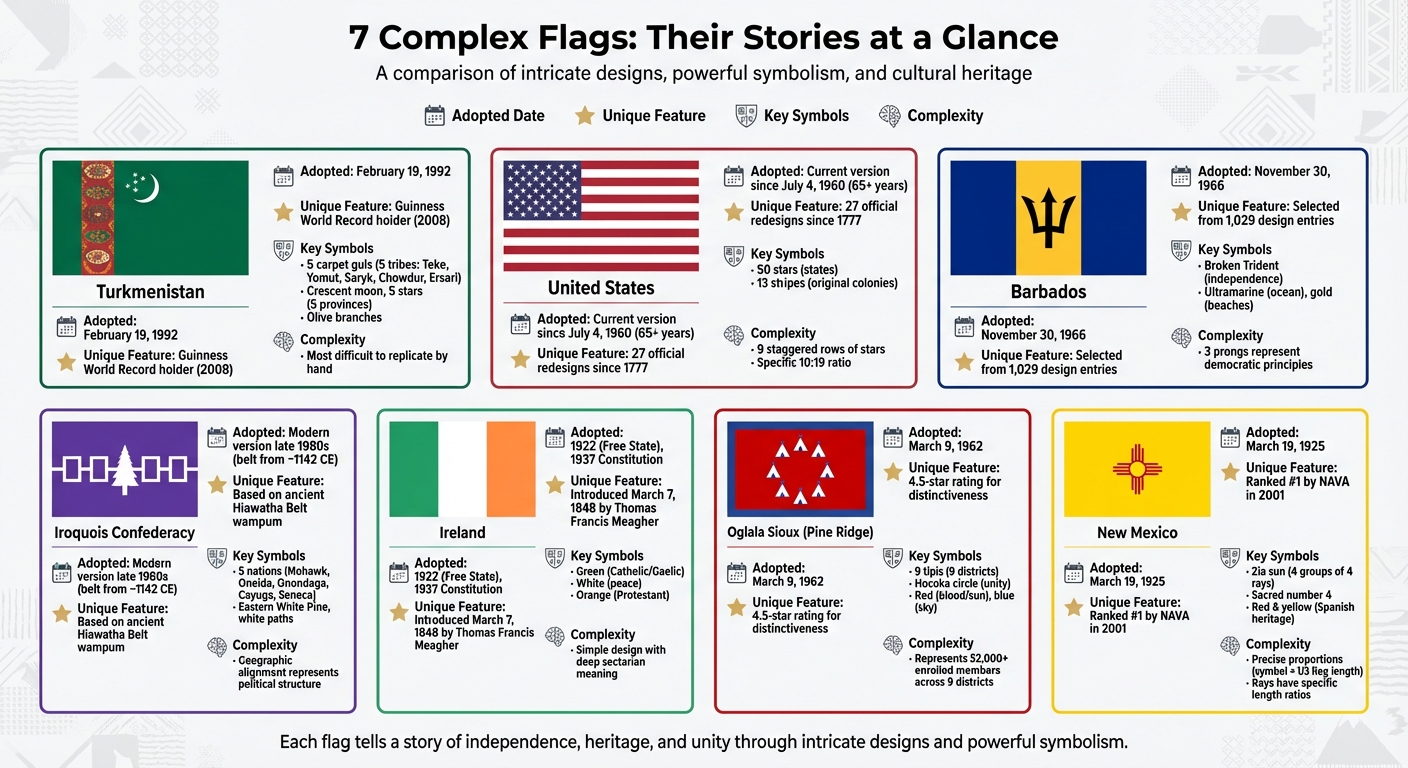
7 Complex Flags: Designs, Symbols, and Cultural Meanings Compared
1. Flag of Turkmenistan
Complexity of Design
Turkmenistan’s flag stands out for its highly detailed vertical red stripe adorned with five stacked carpet guls (traditional motifs). Experts often point out how this intricate design makes it extremely difficult to replicate by hand.
Want the full printable classroom pack?
Take the flag reference from your screen to an offline pack for lessons, practice, and quiz time.
- Printable atlas with 230+ high-resolution flag flats
- Four regional quizzes with answer keys
- Flag Bingo boards and caller sheet
The flag’s background is a rich green, symbolizing life, prosperity, and a connection to Islam. In the upper right corner, a white crescent moon and five white stars are prominently displayed. Beneath the red stripe, two crossed golden olive branches echo the design seen on the United Nations flag, symbolizing the nation’s commitment to permanent neutrality – a feature added in 1997. Interestingly, the flag achieved a Guinness World Record in 2008 when it was hoisted in Ashgabat.
Symbolism and Cultural Significance
The five guls on the flag represent the five main tribes of Turkmenistan: Teke, Yomut, Saryk, Chowdur, and Ersari. These motifs are deeply tied to the country’s centuries-old carpet-making tradition, which UNESCO recognizes as part of the Intangible Cultural Heritage of Humanity. The five stars symbolize the nation’s five provinces – Ahal, Balkan, Daşoguz, Lebap, and Mary – while the crescent moon signifies hope for a bright future.
Historical Context Behind the Design
First adopted on February 19, 1992, the flag replaced its Soviet-era predecessor, incorporating native motifs to reflect Turkmenistan’s cultural identity. In 2001, further refinements were made to emphasize its traditional heritage. The country celebrates State Flag and Constitution Day every year on May 18, honoring this iconic national emblem. With its rich history and layered meaning, Turkmenistan’s flag is a striking example of a design that carries deep cultural and historical significance.
sbb-itb-c170c49
2. Flag of the United States
Complexity of Design
While it may appear straightforward, the American flag carries a surprisingly intricate design. The current version features 50 white stars, arranged in nine staggered rows (alternating five rows of six stars with four rows of five stars), set against a blue field. Beneath this, 13 horizontal stripes – seven red and six white – run the full length of the flag. Since 1777, the flag has undergone 27 official redesigns, with the present version’s 10:19 width-to-length ratio officially adopted on October 29, 1912. Earlier iterations experimented with various star arrangements, including circular patterns and the "Great Star" layout. Interestingly, the precise shades of red, white, and blue were not standardized until 1934.
Symbolism and Cultural Significance
The flag’s design is steeped in meaning. The 50 stars represent the unity of all U.S. states, while the 13 stripes honor the original colonies that declared independence from Britain. Although the flag’s colors were initially undefined, Charles Thomson, Secretary of the Continental Congress, clarified their symbolism in 1782 during the creation of the Great Seal. He stated: "White signifies purity and innocence, Red, hardiness & valour, and Blue… signifies vigilance, perseverance & justice".
Over time, the flag evolved from its military origins to become a powerful national symbol, especially during the Civil War. Historian Adam Goodheart noted that the flag transformed into a tangible representation of the Union cause, stating: "The abstraction of the Union cause was transfigured into a physical thing: strips of cloth that millions of people would fight for, and many thousands die for". Notably, President Abraham Lincoln insisted that the stars of the seceded Southern states remain on the flag, reinforcing his belief that their departure was not legally valid. This deepened the flag’s symbolic resonance and set the foundation for future design regulations.
Historical Context Behind the Design
The 1818 Flag Act permanently fixed the number of stripes at 13 while introducing a system to add one star for each new state, effective the July 4 following its admission. This replaced the impractical 15-stripe design used from 1795. The current 50-star flag, in use since July 4, 1960, holds the distinction of being the longest-serving version, with over 65 years of history. During the 1950s, as Alaska and Hawaii approached statehood, the Eisenhower administration received over 3,000 public design submissions. Although legend credits Betsy Ross with sewing the first flag, historical evidence suggests that Francis Hopkinson, a signer of the Declaration of Independence, likely designed it.
3. Flag of Barbados
Complexity of Design
The flag of Barbados features a vertical triband design, with two outer bands of ultramarine and a central band of gold. At its center lies the black trident head, famously known as the Broken Trident. What makes this emblem stand out is the absence of its staff, giving it a distinctive and memorable appearance.
This design was created by Grantley W. Prescod, an art teacher from Saint Philip. His submission was selected as the winner from an impressive 1,029 entries in a national competition. The flag adheres to official proportions of 2:3 and uses specific colors: Ultramarine (British Standard BCC 148) and Gold (BS O/002). Together, these elements form a design that is both visually striking and deeply symbolic.
Symbolism and Cultural Significance
The Broken Trident at the center of the flag holds deep meaning. It signifies Barbados’ break from British colonial rule and the establishment of its independence. The trident itself, tied to Neptune, the Roman god of the sea, reflects the island’s strong maritime heritage. Its three prongs represent the key principles of democracy: government of the people, by the people, and for the people.
The colors of the flag are equally meaningful. Ultramarine symbolizes the surrounding Atlantic Ocean and the expansive Caribbean sky, while gold represents the island’s iconic sandy beaches. Together, these elements connect the flag to both the natural beauty of Barbados and its democratic ideals.
Historical Context Behind the Design
Barbados officially adopted its flag at midnight on November 30, 1966, marking the moment of its independence. Prime Minister Errol Barrow personally tasked Prescod with creating the first seven physical flags. The flag was raised for the first time by Lieutenant Hartley Dottin of the Barbados Regiment during the independence ceremony at Garrison Savannah.
Before independence, the colonial flag featured Britannia holding a complete trident on a Blue Ensign. The new design’s Broken Trident was a deliberate choice to symbolize the end of colonial rule and the beginning of self-governance. The flag of Barbados encapsulates the nation’s journey of transformation, independence, and identity.
4. Flag of the Iroquois Confederacy
Complexity of Design
The flag of the Iroquois Confederacy is a modern representation of the Hiawatha Belt, an ancient wampum belt made of whelk shells and steeped in history. Its design features a rich purple background (Pantone 2685) with four white squares and a central Eastern White Pine tree. These elements are arranged to reflect the geographic alignment of the five original nations from east to west: Mohawk (far right, known as the Eastern Doorkeepers), Oneida (inner right), Onondaga (center tree, serving as the Firekeepers), Cayuga (inner left), and Seneca (far left, the Western Doorkeepers). The flag’s 3:5 ratio and the Eastern White Pine – whose needles naturally cluster in groups of five – symbolize the unity and shared purpose of the original five nations.
Symbolism and Cultural Significance
Every detail of the flag reflects the principles of the Great Law of Peace (Kaianere’kó:wa). The white lines connecting the squares represent the "unbroken paths of peace" and mutual support that unite the nations under a shared longhouse political system. The central tree marks the historic site where the nations came together to establish peace. An Onondaga source explains:
"The Peacemaker told us to think of us all living together under one longhouse… they will govern their people under one common law, one heart, and one mind."
Although the Tuscarora joined the Confederacy in 1722 as the sixth nation, the flag retains the original five-symbol design to honor its historical roots. The deep purple color carries particular importance. As Rick Hill, a Tuscarora artist who helped design the modern flag, noted, "Purple is considered ‘the color of the Iroquois,’ as it is the color derived from the mollusk shells used in making the wampum".
Historical Context Behind the Design
The origins of the Hiawatha Belt are traced through oral tradition to around 1142 CE. In the late 1980s, Tuscarora artist Rick Hill collaborated with Mohawk artists Harold and Tim Johnson to adapt the belt’s symbolism into a modern flag for international representation. This reimagined flag became a powerful symbol of independence. In July 2010, its significance was highlighted when the Iroquois Nationals lacrosse team refused to travel to the World Lacrosse Championship in Manchester, England, using U.S. or Canadian passports. Instead, they insisted on traveling with Haudenosaunee passports featuring the Hiawatha Belt motifs. British authorities denied them entry, underscoring the flag’s ongoing role in sovereignty and self-determination debates.
5. Flag of Ireland
Simplicity in Design
The Irish flag is made up of three vertical stripes – green, white, and orange – arranged in a 1:2 ratio. Compared to earlier Irish banners, which often displayed detailed heraldic symbols like the harp, this design is much more straightforward. The colors are specified as Pantone 347 U for green, Safe for white, and 151 U for orange, with the green stripe always positioned closest to the flagstaff.
Meaning and Cultural Importance
The colors of the flag carry deep historical and cultural meaning. Green represents Ireland’s Roman Catholic majority and its Gaelic heritage, while orange stands for the Protestant minority. The white stripe in the center symbolizes the hope for peace and unity between these two communities. Thomas Francis Meagher, a leader of the Young Ireland movement, explained this vision when he first presented the flag on March 7, 1848:
"The white in the centre signifies a lasting truce between Orange and Green and I trust that beneath its folds the hands of Irish Protestants and Irish Catholics may be clasped in generous and heroic brotherhood".
However, the flag remains a source of division in Northern Ireland. Nationalists frequently display it, while Loyalists often burn it during July 12th bonfires, highlighting the ongoing tensions around its symbolism.
Historical Origins and Adoption
The flag’s design was influenced by the French tricolor and introduced by Meagher in 1848. It gained broader recognition during the Easter Rising of 1916, when it flew over Dublin’s General Post Office, solidifying its role as a national emblem. The Irish Free State officially adopted the flag in 1922, and its status was later cemented in Article 7 of the 1937 Constitution of Ireland, which describes it as "the tricolour of green, white and orange". Interestingly, Irish merchant ships were not allowed to use the tricolor at sea until the Merchant Shipping Act of 1947 formally granted it maritime status.
6. Flag of the Oglala Sioux (Pine Ridge Reservation)
Complexity of Design
The Oglala Sioux flag is a striking example of how visual elements can capture deep cultural and historical meaning. It features a red field with a dark blue border and a central circle of nine white, stylized tipis, each pointing outward. These tipis are detailed with elements like poles, smoke flaps, and triangular doorways, creating a unique effect where the central red circle appears to have nine triangular points.
Unlike many tribal flags that incorporate letters or numbers, this flag relies entirely on symbolic imagery. The Center for American Indian Research and Native Studies gave it a 4.5-star rating, emphasizing its distinctiveness:
"From a distance this flag is easily recognizable among all the national flags of the world!"
For ceremonial or parade purposes, a deep-blue fringe is often added to the flag.
Symbolism and Cultural Significance
The nine tipis on the flag represent the nine political districts of Pine Ridge: Eagle Nest, Pass Creek, LaCreek, Oglala, Wounded Knee, Porcupine, Medicine Root, Pine Ridge Village, and Wakpamni. Arranged in a circle, this hocoka (camp circle) symbolizes unity and continuity for the tribe’s more than 52,000 enrolled members.
The flag’s colors carry deep meaning. Red signifies the blood shed to protect tribal lands and relates to Wi (the Sun) and the direction South. Blue connects to Skan (the Sky) and the direction East, while white represents the direction North and the traditional homeland of the Oglala people. Flag expert Donald Healy highlights its broader significance:
"often flown as a generic Native American flag"
at powwows, extending its symbolism beyond just Sioux gatherings.
Historical Context Behind the Design
First displayed during Sun Dance ceremonies in 1961, the flag was officially adopted on March 9, 1962. The tipis reflect the nine districts recognized by the modern tribal government, evolving from earlier versions that featured only eight tipis. This design change underscores the flag’s role in representing the current structure and unity of the Oglala Sioux people.
7. Flag of New Mexico
Complexity of Design
At first glance, New Mexico’s flag might seem simple: a red sun symbol set against a golden yellow background. But its design is anything but casual. The flag’s proportions are carefully defined by law. The Zia sun symbol, central to the flag, must occupy precisely one-third of the flag’s length. It features four groups of four rays, with the two inner rays in each group being one-fifth longer than the outer rays.
This attention to detail hasn’t gone unnoticed. In 2001, the North American Vexillological Association (NAVA) ranked New Mexico’s flag as the best among 72 U.S. and Canadian flags. Its design is also unique in other ways – it’s one of only four U.S. state flags that omit blue, and it’s the only one that excludes both blue and white. This design replaced the chaotic "Twitchell Flag" of 1915, which featured a blue field, the U.S. flag in the canton, the state seal, the number "47", and the words "New Mexico" embroidered diagonally. The current flag’s clean, bold design not only makes it stand out but also opens the door to a deeper cultural story.
Symbolism and Cultural Significance
The flag’s elements carry a wealth of meaning. At its heart is the Zia sun symbol, which reflects the sacred number four in Zia Pueblo culture. The four groups of rays represent several sets of four: the cardinal directions, the seasons, the times of day, and the stages of life. The symbol also highlights four spiritual duties: maintaining physical strength, mental clarity, spiritual purity, and a commitment to helping others.
The colors – red and yellow – pay homage to New Mexico’s Spanish colonial past, echoing the hues associated with Queen Isabella of Castile and traditional Spanish flags. This connection is celebrated in the state’s official salute:
"I salute the flag of the state of New Mexico, the Zia symbol of perfect friendship among united cultures." (New Mexico Statutes, Section 12-3-3)
Historical Context Behind the Design
The flag’s origin story adds another layer to its significance. Dr. Harry Mera, an anthropologist and physician, designed the flag in 1925 and won a $25 prize for his effort (about $350 in today’s dollars). His inspiration came from a 19th-century Zia Pueblo water jar displayed at the Laboratory of Anthropology in Santa Fe. The flag was officially adopted on March 19, 1925.
However, the history of the Zia symbol’s use is complicated. The water jar that inspired the design was taken from the Zia people in 1890 by an anthropologist working for the Smithsonian Institution. For decades, New Mexico used this sacred symbol without permission from the Zia Pueblo. In 2012, the state formally acknowledged this appropriation. While the symbol entered the public domain on January 1, 2021, the state now encourages those using the symbol to seek permission from the Zia Pueblo and contribute to their educational funds. Southwest Airlines, for example, supports a scholarship fund for Zia children and features the symbol on its "New Mexico One" aircraft.
Ultra-High Definition: The Hidden Art Of Flags
Why Complex Flags Draw Our Attention
Complex flags grab our attention because they tell stories through their designs. Unlike simpler flags, these intricate ones pack layers of history, culture, and symbolism into a single image. Every detail, from patterns to symbols, reflects a piece of a community’s identity. As Jeremy Burge, Founder of Emojipedia, puts it:
"Flags act as a rallying icon for communities of people".
Take the Turkmenistan flag, for example, with its detailed carpet patterns, or New Mexico’s Zia sun symbol, which holds deep cultural meaning. Even the Iroquois Confederacy flag carries a wealth of heritage in its design. These intricate elements aren’t just eye-catching – they’re deeply tied to the cultural identity they represent, both offline and in digital spaces.
Online, complex flags play a powerful role in reinforcing community identity. Their presence in digital formats, like emoji keyboards, isn’t just symbolic – it’s a mark of recognition and respect. Burge highlights this, saying:
"Appearing on the emoji keyboard of any major platform is a sign of legitimacy".
This recognition has driven the number of flag emojis to skyrocket – from just 10 on the iPhone in 2008 to a whopping 268 today. Indigenous groups, regional communities, and others continue pushing for equal representation in this space.
The complexity of these designs also serves a functional purpose. Unicode now supports over 3,000 subdivision flags, each representing a unique regional or cultural identity. These flags allow people to celebrate their specific community, not just their nation, showcasing pride in their heritage through the details of the design. In this way, the intricate elements of these flags go beyond decoration – they symbolize the diversity and richness of the communities they represent.
If you want to dive deeper into these fascinating designs, check out Flag Emoji Quizzes. Organized by region – like North America, Asia, and Oceania – these quizzes are a fun way to test your knowledge and appreciate the stories behind these complex flags.
Conclusion
Complex flags act as visual storytellers, capturing the histories, values, and identities of the communities they represent. Take the detailed carpet patterns on Turkmenistan’s flag or the Zia sun symbol on New Mexico’s banner – each design ties people to their heritage in powerful ways. As Josh Fjelstad aptly puts it:
"It’s rare to find a flag that conveys a deep history in only three colors and shapes."
Understanding their symbolism reveals stories of struggle, independence, and enduring traditions. Vexillology transforms these designs into narratives that carry layers of historical and cultural significance. These meanings encourage us to explore and appreciate our shared global heritage.
From the indigenous sovereignty highlighted by the Iroquois Confederacy flag to the cultural blend reflected in New Mexico’s banner, these intricate designs offer a chance to connect with the richness of global traditions. Dive deeper into these fascinating stories and test your knowledge with Flag Emoji Quizzes.
FAQs
What makes a flag “complex” in vexillology?
Flags in vexillology are labeled as "complex" when they include intricate designs, detailed symbols, multiple colors, or elements such as lettering or seals. These characteristics often make them harder to reproduce accurately or identify at a glance.
How do designers decide what symbols belong on a flag?
Flag designers select symbols with care, focusing on their meaning, relevance, and how they connect to the flag’s purpose. These symbols often represent values, historical moments, or cultural identity. To create a strong design, simplicity is key. Symbols should be easy to recognize and interpret at a glance.
This simplicity extends to the choice of colors and imagery. By limiting the number of colors and avoiding overly detailed designs, flags can convey their message clearly and remain visually impactful, even from a distance.
Why is New Mexico’s Zia symbol considered controversial?
The Zia symbol featured on New Mexico’s state flag has sparked controversy due to its origins in the Zia Pueblo. For the Zia people, this symbol carries deep spiritual and cultural importance. However, its adoption and widespread use without the Pueblo’s consent have drawn criticism, with many viewing it as an act of cultural appropriation and a disregard for the heritage of the Puebloan community.
Related Blog Posts
- Top 5 Fun Facts About National Flags
- Flags and Their Colors: What Do They Mean?
- How Flags Represent National Identity
- The Role of Flags in International Events
Free Printable: Flags of the World Reference Card
Get a beautiful printable poster with 50 flag emojis, Unicode codes, and fun facts. Perfect for classrooms and desks!
No spam, ever. Unsubscribe anytime.