
How To
How To
Time needed: 1 minute
Want the full printable classroom pack?
Take the flag reference from your screen to an offline pack for lessons, practice, and quiz time.
- Printable atlas with 230+ high-resolution flag flats
- Four regional quizzes with answer keys
- Flag Bingo boards and caller sheet
How to copy and paste the Flag of Denmark Emoji to any device.
- Copy the Danish Flag Emoji
Go to flagemoji.com and press the copy button (above). This works on any device.
- Paste the Emoji
Go to your email/iMessage/SMS texting service/document and paste the emoji.
For mobile devices
— double-tap or tap-hold, then paste should appear. Tap it.
For desktop and laptops on Apple devices
— command-P / ⌘-P
For desktop and laptops on Windows devices
— control-p
Codes
Emoji Codes
Flag emojis are unicode symbols, like any other letter or number on your keyboard. This means you can copy and paste the emoji itself into your code, whatever the language (click the button above).
They actually count as two characters: the two-letter country code (the ISO international standard). The unicode and shortcode both represent country data which devices can interpret and display the emoji.
| Country Code | Unicode | Shortcode |
| DK | U+1F1E9 U+1F1F0 | :flag_DK: :DK: |
Emoji shortcodes are used on some platforms as a way for users to type in emojis from the keyboard. If you type the emoji shortcode on Github or Slack, the emoji will appear.
*The official name of the emoji is only the country name, not ‘Denmark Flag’, for example.
Description
Description
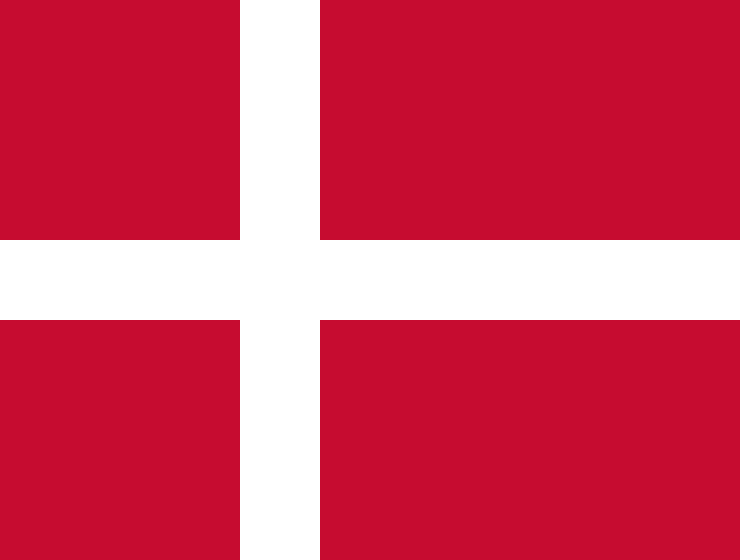
The flag of Denmark is red with a white cross that extends to the edges of the flag. The vertical part of the cross is shifted to the hoist side. The banner is referred to as the Dannebrog (Danish flag). The best known origin of the flag is a legend that the banner fell from the sky during a 13th century battle. Caught by the Danish king before it ever touched the earth, this heavenly talisman inspired the royal army to victory. In actuality, the flag may derive from a crusade banner or ensign.
Map
Map
Check out the map of Malaysia!
Weather
Anthem
National Anthem
| Title | Der er et yndigt land (There is a Lovely Country); “Kong Christian” (King Christian) |
| Composer | Adam Gottlob Oehlenschlager / Hans Ernst Kroyer; Johannes Ewald |
FAQ
FAQs
Denmark peacefully became a parliamentary constitutional monarchy on June 5, 1849.
Explanations of the origin of the flag design vary, but the best known is a legend that the banner fell from the sky during an early 13th century battle. As the tale goes, it was caught up by the Danish king before it ever touched the earth, and this heavenly talisman inspired the royal army to victory. In actuality, the flag may derive from a crusade banner or ensign.
Denmark’s flag (known as the Dannebrog) is the oldest European flag, officially adopted in 1625.
Denmark’s is governed by Parliamentary Constitutional Monarchy.
Discover more fun facts of Malaysia.
Printable
Printable Danish Flag
Print another really cool flag. Why not the flag of Kiribati?
The Dannebrog, meaning “the cloth of the Danes,” stands as one of the world’s oldest continuously used national flags, holding the Guinness World Record since 1625. Its origins are steeped in both legend and historical complexity. According to popular Danish folklore, the flag miraculously fell from the sky on June 15, 1219, during the Battle of Lyndanisse (present-day Tallinn, Estonia), when King Waldemar II led Danish forces against Estonian defenders. While the legendary account captures the national imagination and is celebrated annually on Valdemar’s Day, historical evidence suggests the Dannebrog’s actual adoption occurred around the mid-14th century under King Valdemar Atterdag, likely inspired by the Holy Roman Emperor Louis IV of Bavaria’s similar design. During the European Crusades of the 11th to 13th centuries, various rulers employed red flags with white crosses, but Denmark’s distinctive Nordic cross design emerged as uniquely Danish during this transitional period. This historical ambiguity—between miraculous legend and documented adoption—has become integral to Danish national identity, with both narratives contributing to the flag’s profound cultural significance.
The Dannebrog’s design embodies profound Christian and national symbolism through its distinctive visual elements. The flag features a red field adorned with a white Nordic cross that extends to all four edges of the banner, with the vertical arm offset toward the hoist side—a characteristic feature shared among Scandinavian flags that Denmark pioneered. The white cross represents Christianity, reflecting Denmark’s religious heritage and the maritime traditions of the 18th century when the flag served as a crucial identification symbol for Danish vessels at sea. The red background traditionally symbolizes strength, bravery, and the enduring vitality of the Danish people throughout their long history. The cross’s width comprises one-seventh of the flag’s height, maintaining precise proportions that have remained consistent since the flag’s official standardization. This elegant simplicity makes the Dannebrog instantly recognizable while carrying centuries of accumulated meaning—the white cross cutting through the red field serves as a visual representation of faith intersecting with national identity. The Nordic cross design itself became a template for other Scandinavian nations, with Sweden, Norway, Iceland, and Finland later adopting similar cross-based flags, making Denmark the originator of a distinctive regional design that spans the Nordic world. This pioneering design makes the Dannebrog far more than a mere national symbol but rather an embodiment of Danish values, continuity, and cultural influence across the North.
The evolution of the Dannebrog from royal monopoly to democratic symbol reflects broader transformations in Danish society and national consciousness. For centuries, the flag remained exclusively the domain of Danish royalty, serving as a symbol of kingly authority and power. This exclusivity persisted until 1834, when the Danish crown even prohibited ordinary citizens from displaying the national colors—a regulation that would have been virtually unthinkable in the modern era. The watershed moment came during the First Schleswig War (1848-1851), a military conflict between Denmark and the German Confederation over control of the contested Schleswig and Holstein duchies. When Danish soldiers returned home victorious, they found their country transformed—private homes throughout the kingdom flew red-and-white Dannebrog flags in celebration and solidarity. This spontaneous popular uprising of the flag marked a decisive shift in Danish culture: the Dannebrog ceased being merely a royal emblem and became the property of the people, a symbol of democratic aspiration, national unity, and civic pride. The Second Schleswig War (1864) further cemented the flag’s role as a democratic symbol, as it came to represent Danish resistance and national determination during periods of struggle. This transformation remains uniquely significant in European flag history, as few national symbols have undergone such a fundamental transition from exclusive royal monopoly to beloved democratic icon, emerging from popular grassroots movements rather than official governmental decree.
Today, the Dannebrog occupies a singular position in Danish daily life and cultural practice, distinguishing Denmark as a nation with an exceptionally intimate relationship with its national symbol. Unlike many countries where the flag appears primarily in formal, governmental, or ceremonial contexts, Danes incorporate the Dannebrog into virtually every celebration and special occasion. The flag appears at birthday parties, graduation ceremonies, weddings, and summer festivities with remarkable frequency—a cultural phenomenon that reflects the Danish concept of inclusive national pride rather than exclusive patriotism. Businesses, schools, and private residences display the Dannebrog during holidays and commemorative dates, transforming entire neighborhoods into seas of red and white. This widespread civilian use stems from deeply rooted cultural traditions and the concept of “hygge”—the Danish notion of comfort, warmth, and community—which the flag has come to represent. Since 1913, Danes have celebrated Valdemar’s Day on June 15 annually, remembering both the legendary 1219 battle and the historical significance of their national flag through parades, special decorations, and traditional festivities. The date has become a cultural touchstone when Dannebrog flags appear in extraordinary numbers and the legendary tale of the falling flag is retold in homes, schools, and public gatherings. The Dannebrog thus transcends its function as a state symbol, becoming instead a daily expression of Danish identity that connects contemporary Danes to their medieval past while affirming their shared values of democracy, strength, and Christian heritage. This unique cultural integration of the national flag into everyday life makes the Dannebrog not merely a historical artifact but a living symbol of what it means to be Danish—a bridge between the legendary and the real, the historical and the contemporary, the official and the personal.
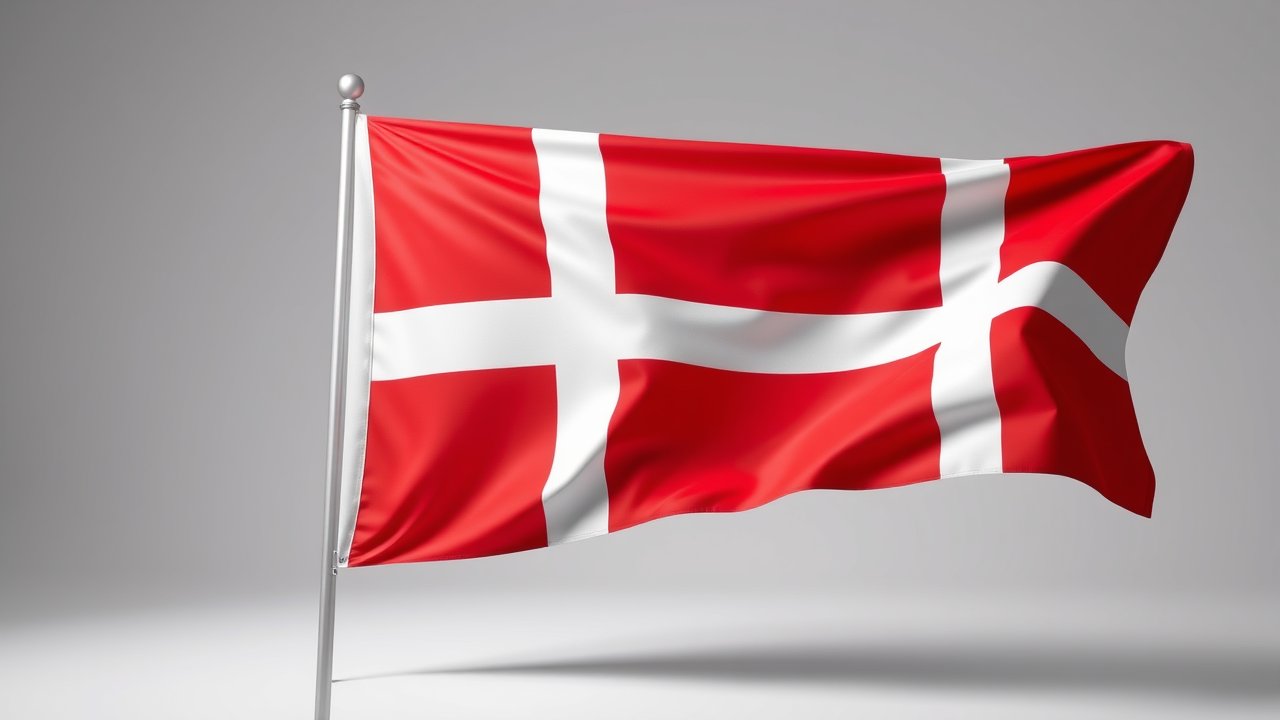
3D Glossy Render — Red field with a white Scandinavian cross offset to the hoist. The flag of Denmark as a photorealistic 3D render. Red field with a white Scandinavian cross offset to the hoist. The flag fabric hangs or drapes naturally but preserves exact proportions, colors, and all symbols perfectly — completely faithful to the real Denmark flag. Dramatic studio lighting, glossy silk material, soft shadows, subsurface scattering, perfect specular highlights. No text, no letters, no words, no writing of any kind.
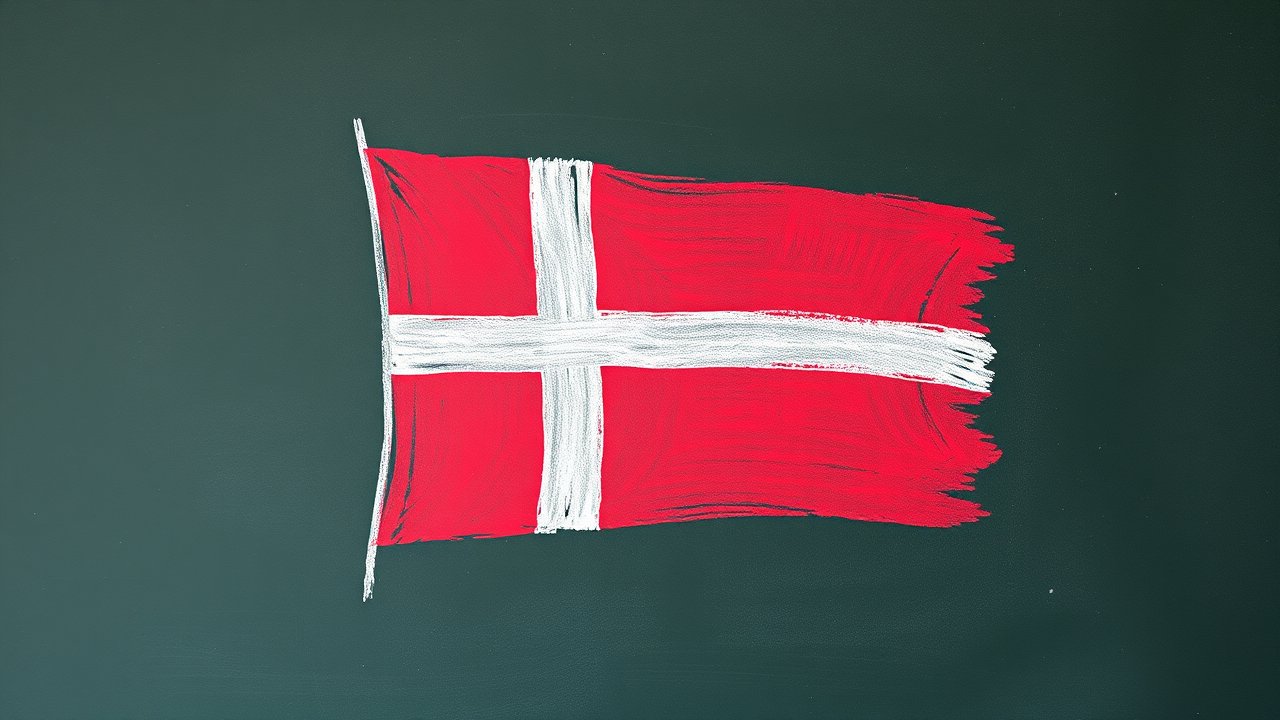
Chalk on Blackboard — Red field with a white Scandinavian cross offset to the hoist. The flag of Denmark drawn in chalk on a real blackboard. Red field with a white Scandinavian cross offset to the hoist. Authentic blackboard — dark slate green surface with chalk dust and smudge marks. Soft, dusty white and colored chalk lines, imperfect edges, hand-drawn quality. Chalk dust particles visible in the air. The flag is immediately recognizable. No text, no letters, no words, no writing of any kind.
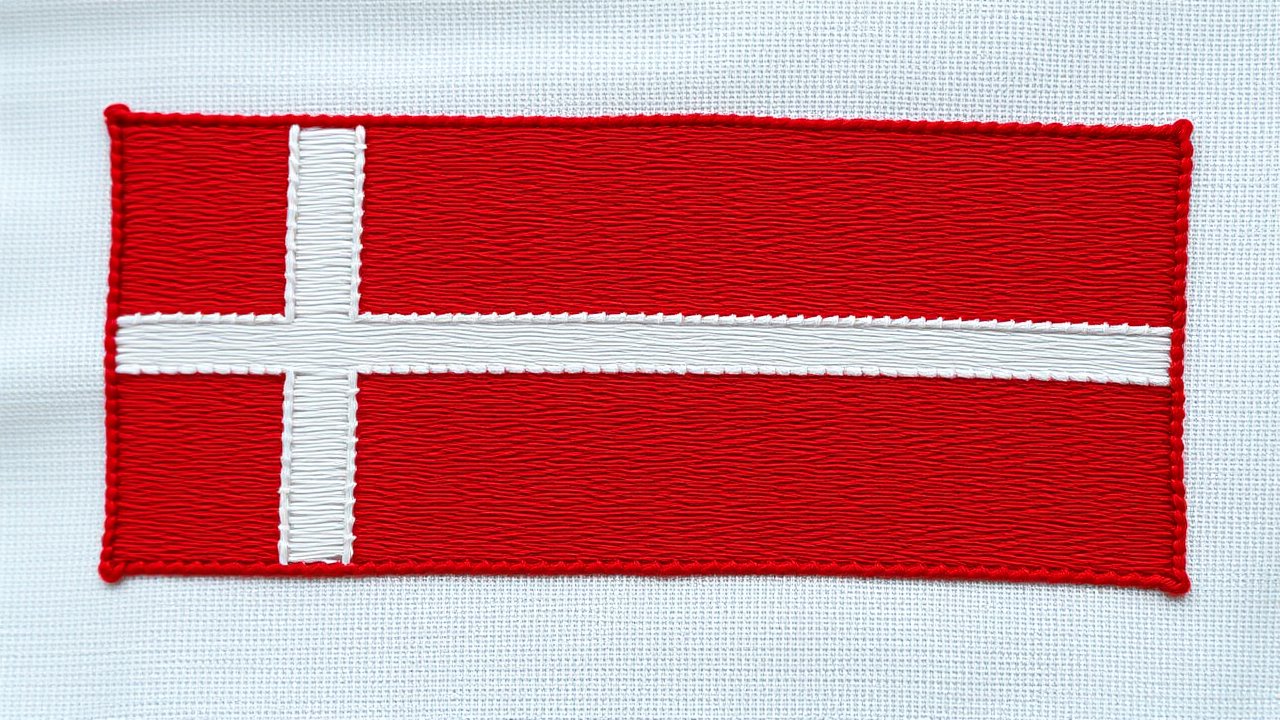
Embroidered Textile — Red field with a white Scandinavian cross offset to the hoist. The flag of Denmark as intricate embroidery on linen fabric. Red field with a white Scandinavian cross offset to the hoist. Dense satin stitches, French knots, chain stitch detail. The flag design is completely faithful — exact colors, geometry, and all symbols faithfully stitched, immediately recognizable as the Denmark flag. Visible thread texture, dimensional quality, warm handcrafted feel. No text, no letters, no words, no writing of any kind.
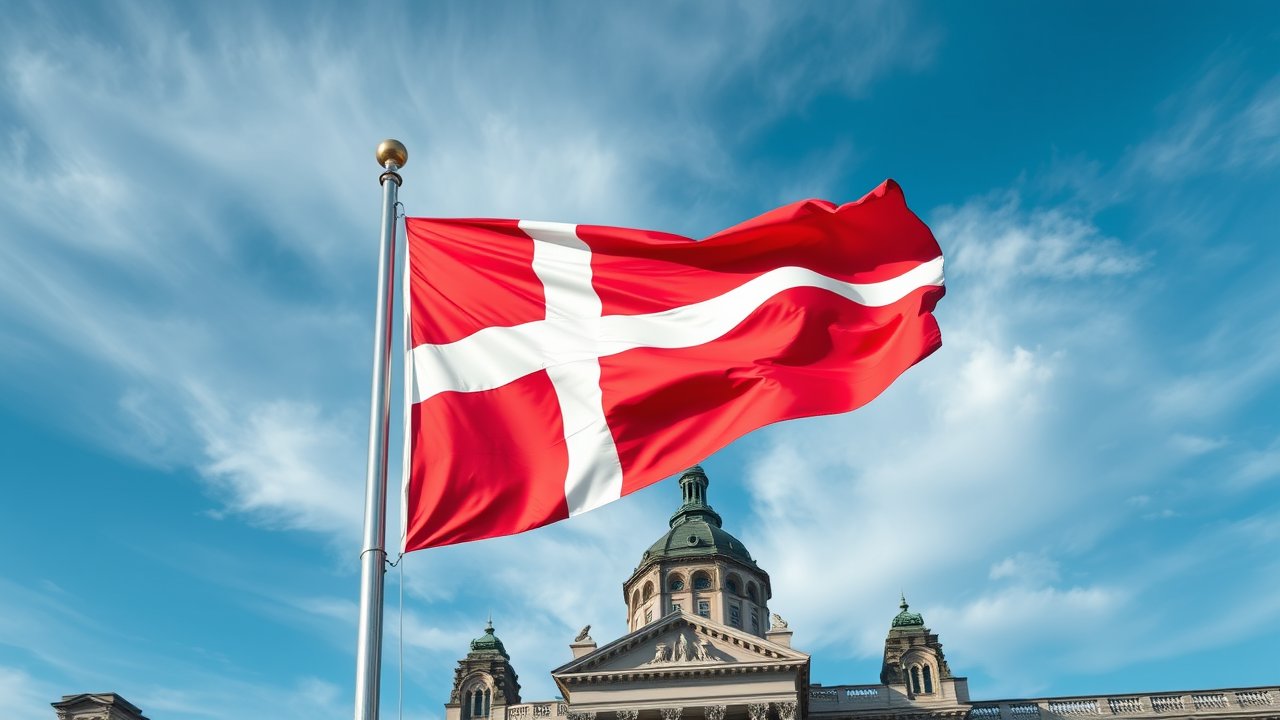
Flagpole in Capital — Red field with a white Scandinavian cross offset to the hoist. Photorealistic photograph of the Denmark flag flying on a tall flagpole in front of an iconic government building in the capital city. Red field with a white Scandinavian cross offset to the hoist. The flag ripples naturally in the wind, colors vivid and exact. Documentary photography style, sharp and realistic. Grand architecture in the background. Blue sky, dramatic clouds. No text, no letters, no words, no writing of any kind.
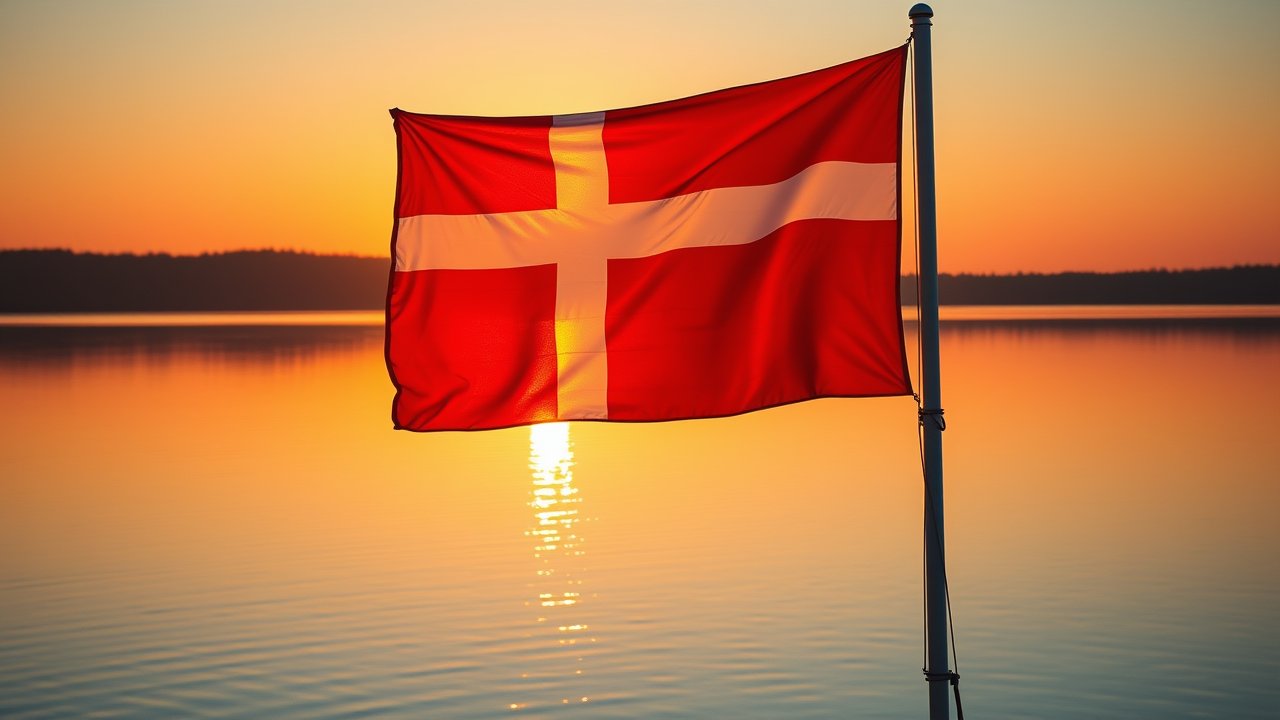
Golden Hour Reflection — Red field with a white Scandinavian cross offset to the hoist. Photorealistic photograph of the Denmark flag reflected in still water at golden hour. Red field with a white Scandinavian cross offset to the hoist. The flag flies on a pole at the water’s edge, its reflection shimmering on the surface below. Warm amber and orange sunset light. The flag colors and design are faithful and vivid. Serene, cinematic landscape photography. No text, no letters, no words, no writing of any kind.
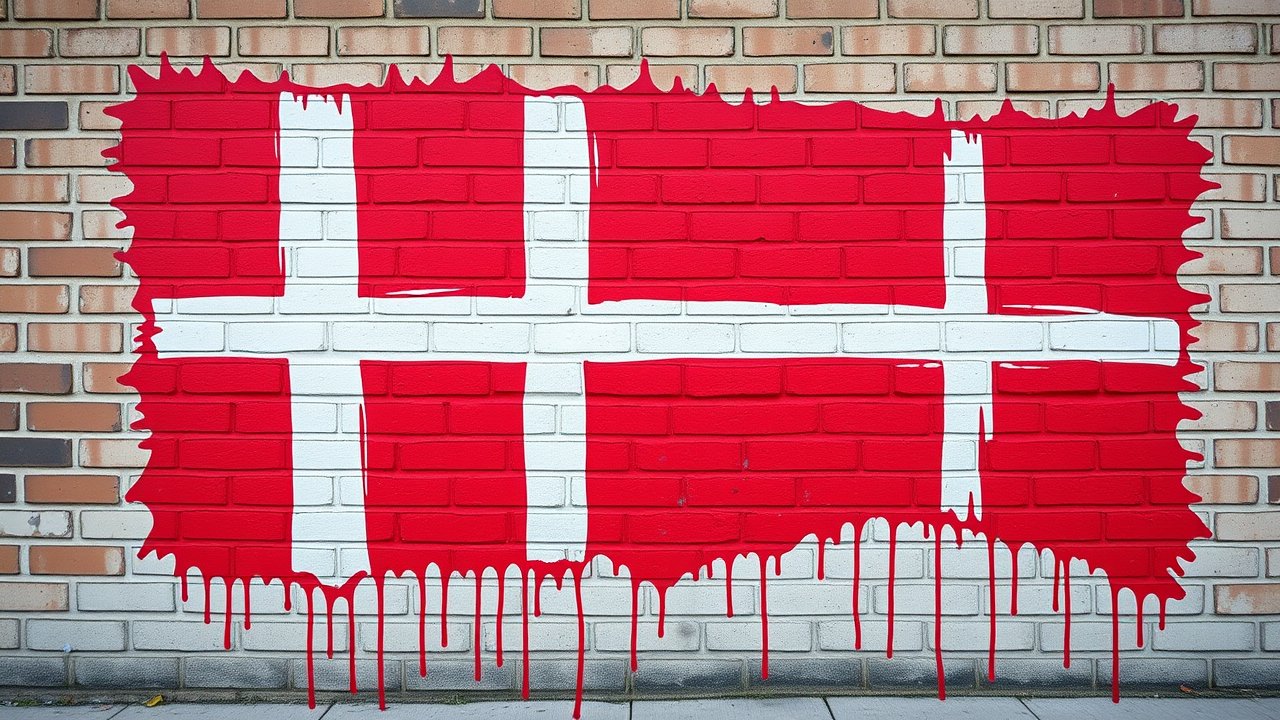
Street Art / Graffiti — Red field with a white Scandinavian cross offset to the hoist. The flag of Denmark as vibrant street art spray-painted on a brick wall. Red field with a white Scandinavian cross offset to the hoist. Bold spray paint, dripping edges, stencil layers, overspray halos. The flag design is faithful and immediately recognizable — exact colors and symbols, just rendered in spray paint on urban concrete. No text, no letters, no words, no writing of any kind. No tags, no graffiti lettering.
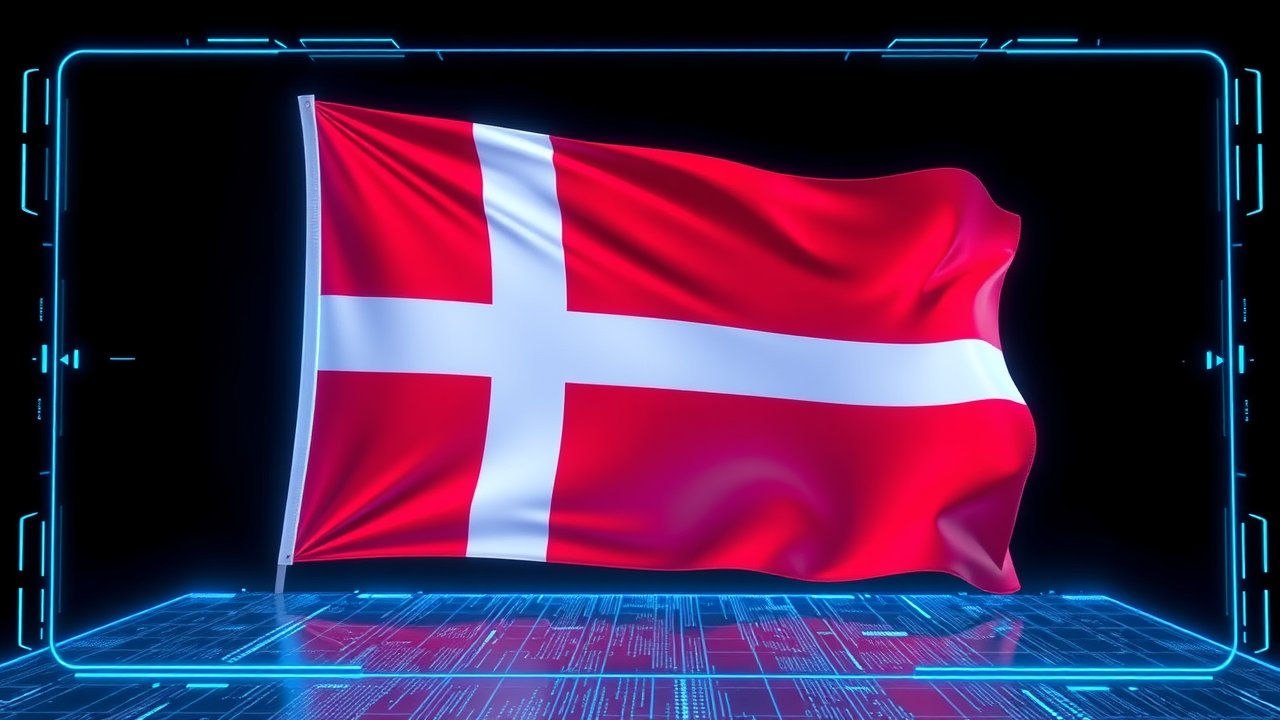
Sci-Fi Hologram — Red field with a white Scandinavian cross offset to the hoist. The flag of Denmark projected as a futuristic holographic display. Red field with a white Scandinavian cross offset to the hoist. Translucent blue-white projection with scan lines, floating in dark space. Glitching edges, particle effects, data streams. The flag design is completely faithful and recognizable. Cyberpunk HUD elements framing the projection. No text, no letters, no words, no writing of any kind.
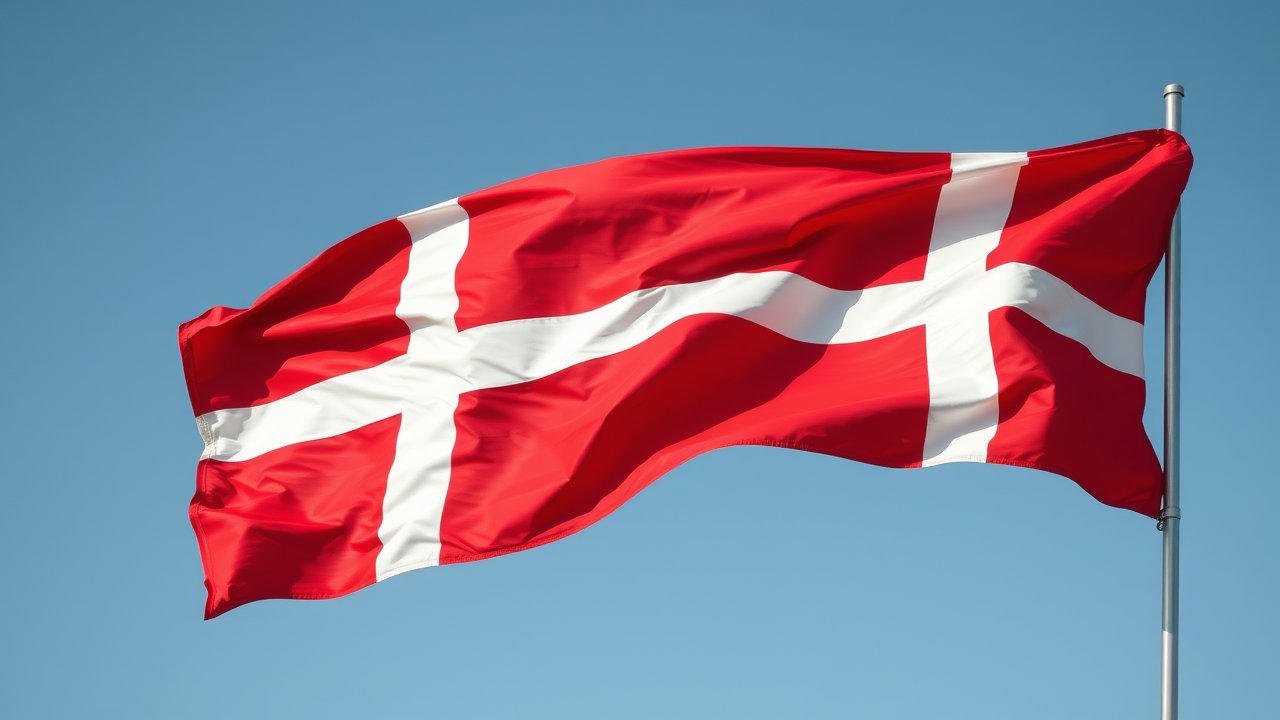
Hyperrealistic Wind — Red field with a white Scandinavian cross offset to the hoist. Ultra-hyperrealistic photograph of the Denmark flag caught in a dramatic gust of wind. Red field with a white Scandinavian cross offset to the hoist. Macro-level fabric detail — individual threads visible, fabric folds and tension lines crisp. Colors and design completely faithful to the real Denmark flag. High-speed shutter, razor-sharp focus, studio lighting. No text, no letters, no words, no writing of any kind.
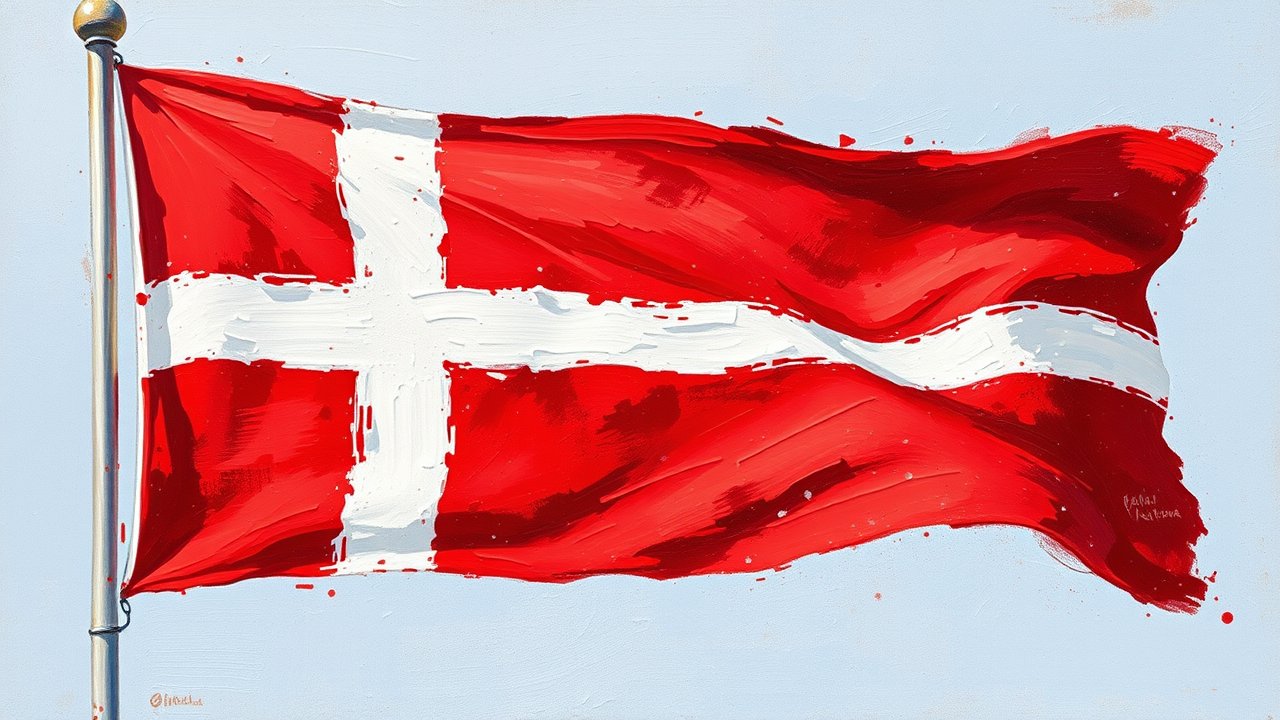
Impressionist Oil — Red field with a white Scandinavian cross offset to the hoist. The flag of Denmark painted in French Impressionist oil on canvas. Red field with a white Scandinavian cross offset to the hoist. Thick impasto brushstrokes, dappled light, vibrant broken color technique in the style of Monet. The flag is instantly recognizable — colors and design faithful to the real Denmark flag, interpreted with impressionist light and texture. No text, no letters, no words, no writing of any kind.
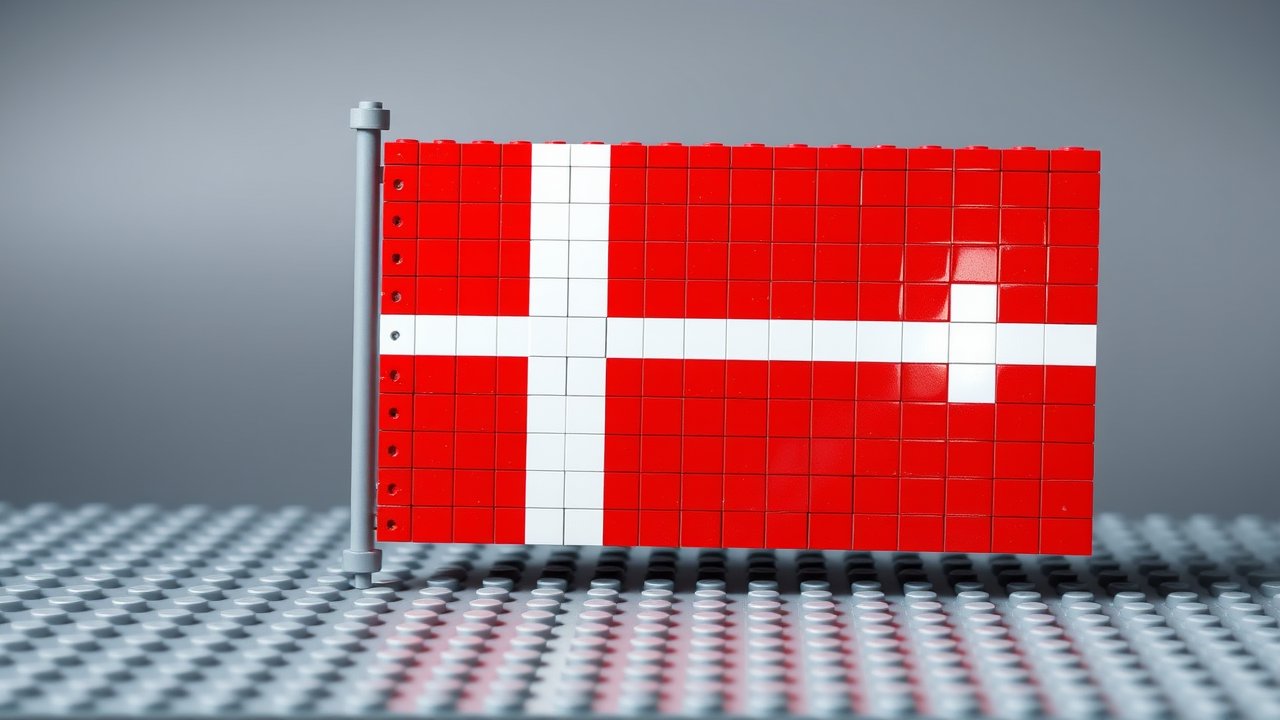
Lego Bricks — Red field with a white Scandinavian cross offset to the hoist. The flag of Denmark built from Lego bricks, photographed as a real physical construction. Red field with a white Scandinavian cross offset to the hoist. Visible studs and brick seams, slight plastic sheen. Standard Lego colors approximate the flag’s palette. Built on a gray Lego baseplate. Dramatic angle showing the three-dimensional brick texture. No text, no letters, no words, no writing of any kind.
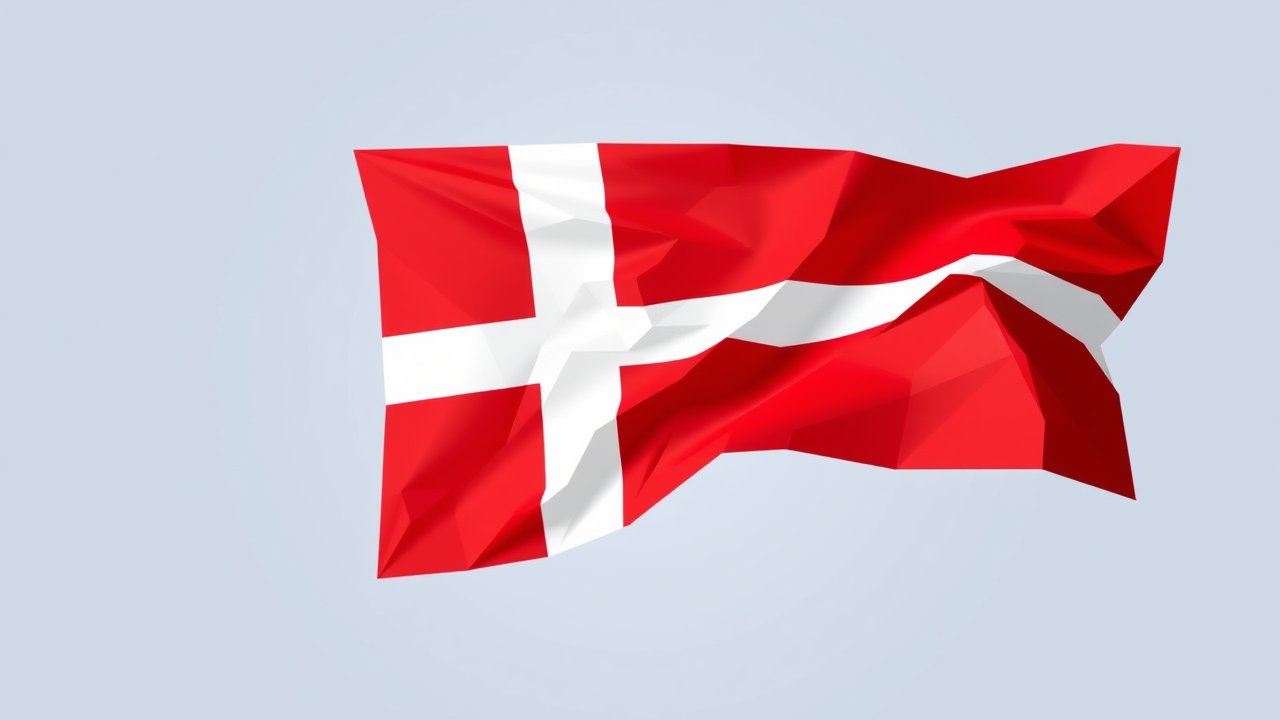
Low-Poly Geometric — Red field with a white Scandinavian cross offset to the hoist. The flag of Denmark constructed from low-polygon geometric triangles. Red field with a white Scandinavian cross offset to the hoist. Aggressively faceted — each region broken into many visible triangular faces with subtle color variation across each polygon, creating real depth and dimensionality even in flat-color areas of the flag. Crystal-like, contemporary computational design. The flag is completely faithful and immediately recognizable. No text, no letters, no words, no writing of any kind.
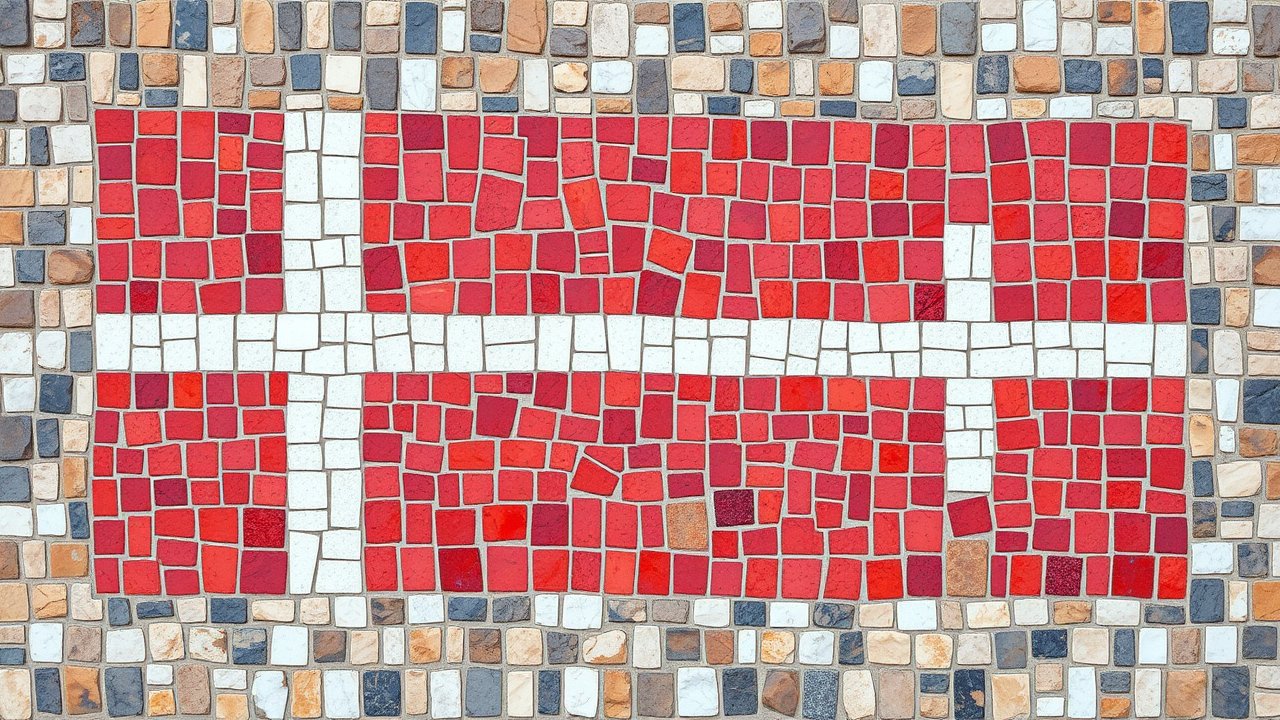
Mosaic Tiles — Red field with a white Scandinavian cross offset to the hoist. The flag of Denmark assembled as a Roman-style mosaic. Red field with a white Scandinavian cross offset to the hoist. The flag is completely faithful to the real Denmark flag — exact proportions, colors, and all symbols, rendered in thousands of small stone and glass tesserae. Visible grout lines, rich earthy tones mixed with brilliant glass, slight historical weathering. No text, no letters, no words, no writing of any kind.
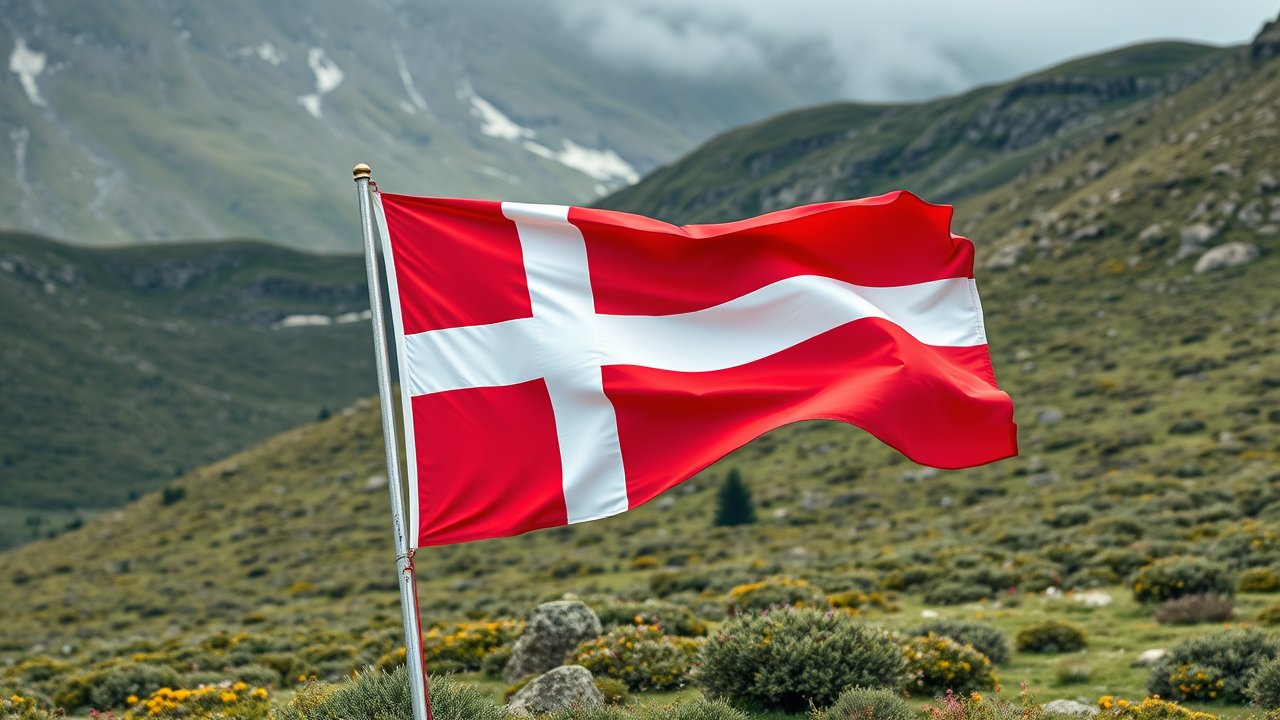
Native Landscape — Red field with a white Scandinavian cross offset to the hoist. Photorealistic photograph of the Denmark flag flying in an iconic natural landscape native to Denmark — the terrain, flora, and environment characteristic of that country. Red field with a white Scandinavian cross offset to the hoist. The flag is prominent and its colors are faithful and vivid. Remote, uninhabited wilderness. National Geographic photography style. No text, no letters, no words, no writing of any kind.
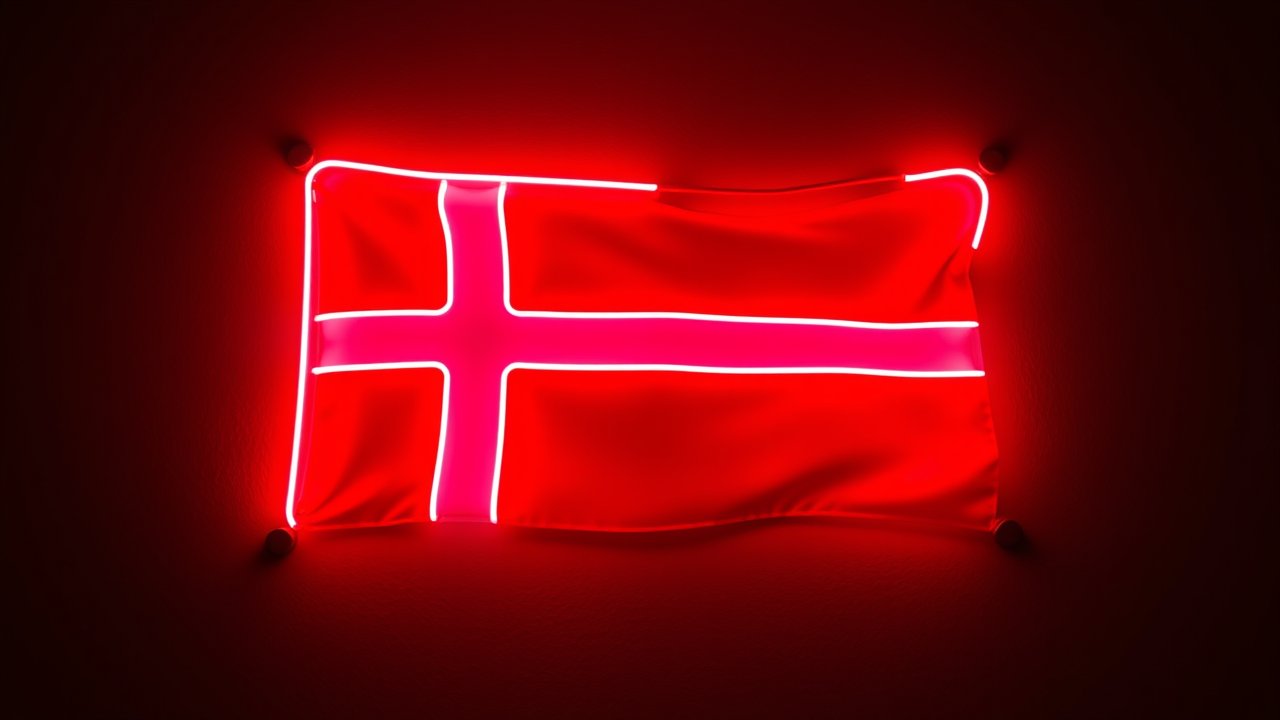
Neon Sign — Red field with a white Scandinavian cross offset to the hoist. The flag of Denmark recreated as a real neon sign mounted on a dark wall. Red field with a white Scandinavian cross offset to the hoist. Glowing glass neon tubes bent into the flag’s shapes — the colors of the flag rendered in actual neon light. Visible glass tube bends, metal mounting brackets on the wall. Warm neon glow and light bloom. Real neon, not digital. Photographed in a dark room. No text, no letters, no words, no writing of any kind.
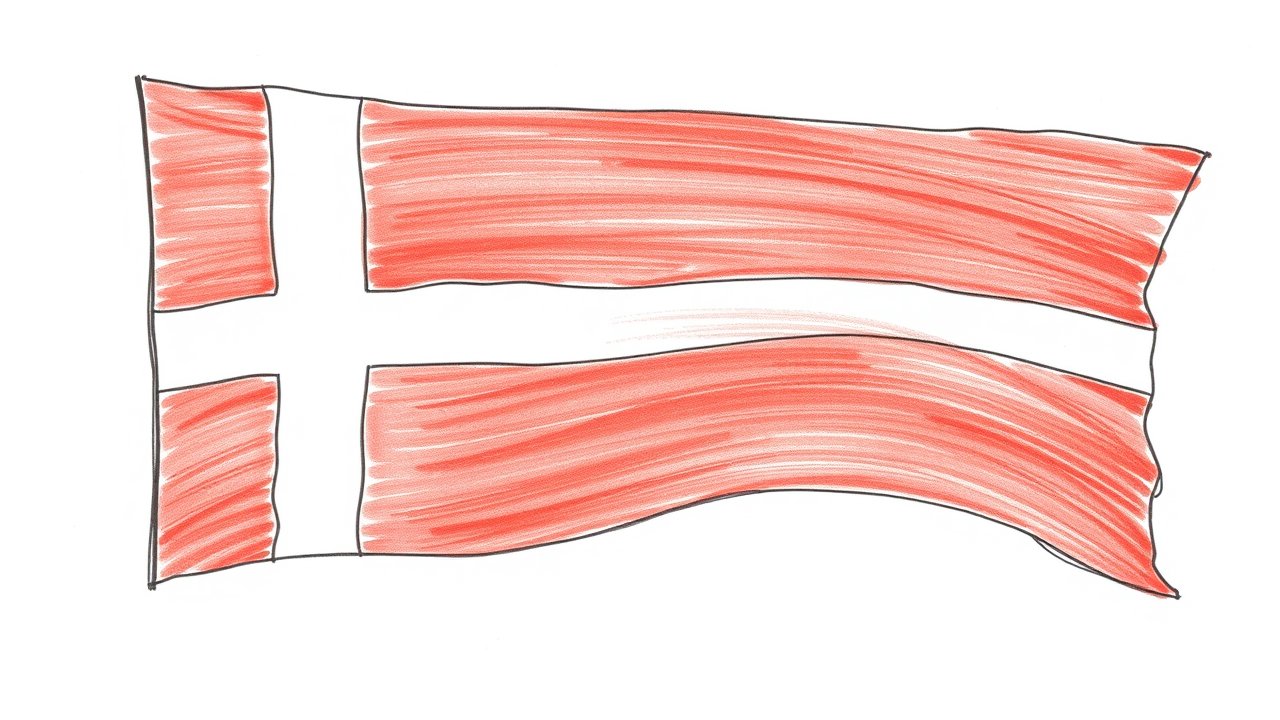
Pencil Sketch — Red field with a white Scandinavian cross offset to the hoist. The flag of Denmark as a bold, confident pencil sketch. Red field with a white Scandinavian cross offset to the hoist. Strong graphite lines on cream paper — not delicate but bold and decisive. Heavy pressure on key outlines, dramatic cross-hatching for deep shadows and shading. Immediately recognizable as the Denmark flag. Artist’s confident hand, not tentative. No text, no letters, no words, no writing of any kind.
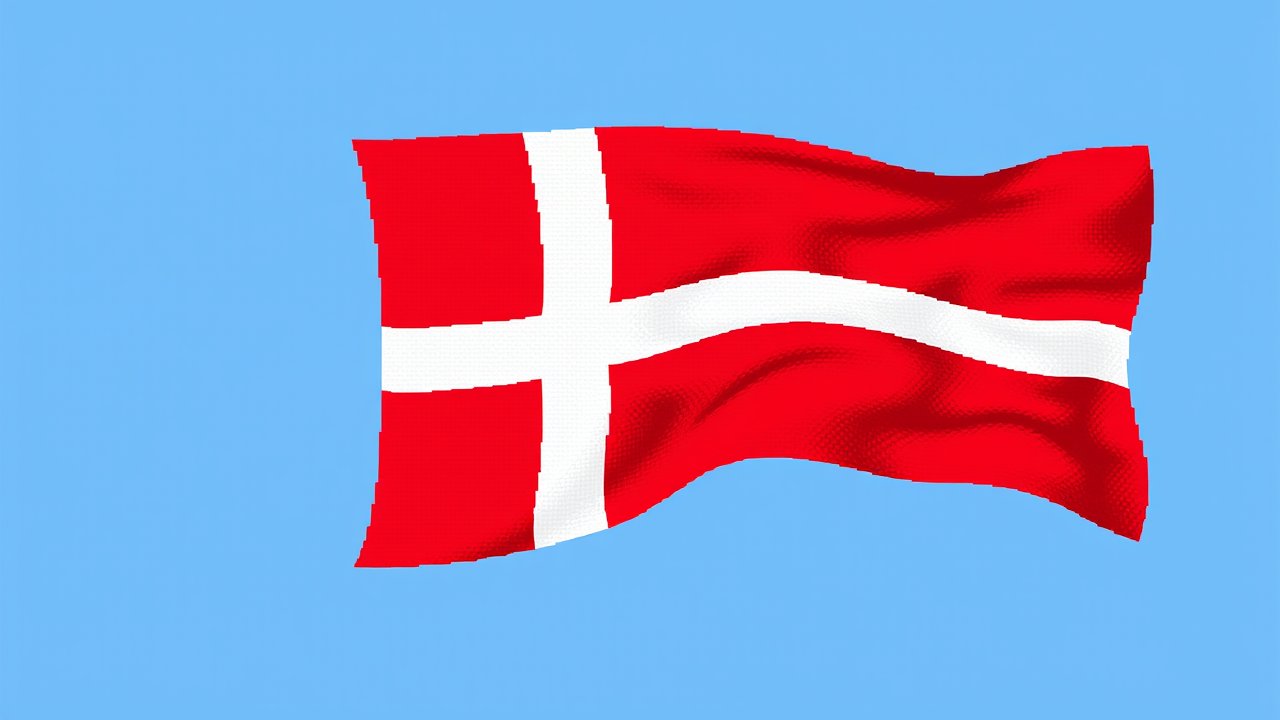
Pixel Art — Red field with a white Scandinavian cross offset to the hoist. The flag of Denmark as detailed 16-bit pixel art. Red field with a white Scandinavian cross offset to the hoist. Crisp pixel grid, limited palette with careful dithering, nostalgic retro game aesthetic. Clean grid-aligned design with subtle shading. Every element of the flag faithfully reproduced in pixels. No text, no letters, no words, no writing of any kind.
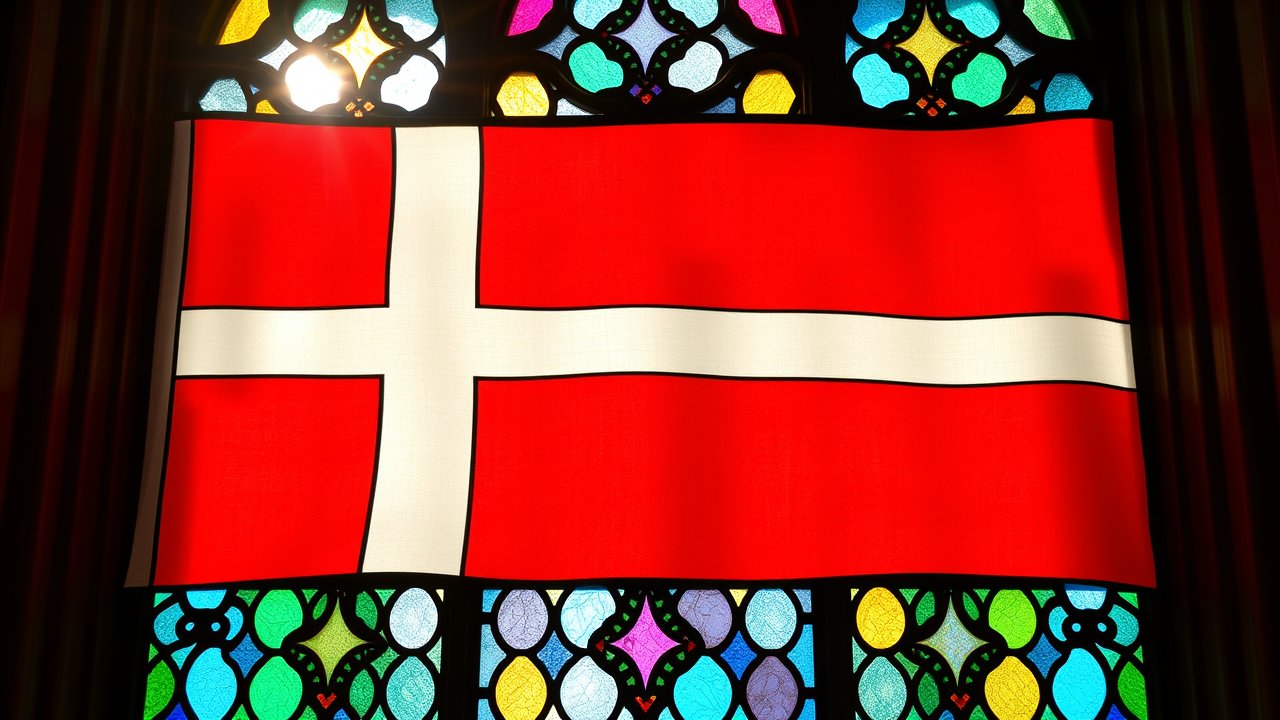
Stained Glass — Red field with a white Scandinavian cross offset to the hoist. The flag of Denmark rendered as an ornate stained glass window. Red field with a white Scandinavian cross offset to the hoist. The design is completely faithful to the real Denmark flag — exact colors, geometry, and all symbols preserved. Brilliant jewel-toned glass pieces separated by dark lead came lines. Warm sunlight streaming through, casting colored light. Gothic cathedral craftsmanship. No text, no letters, no words, no writing of any kind.
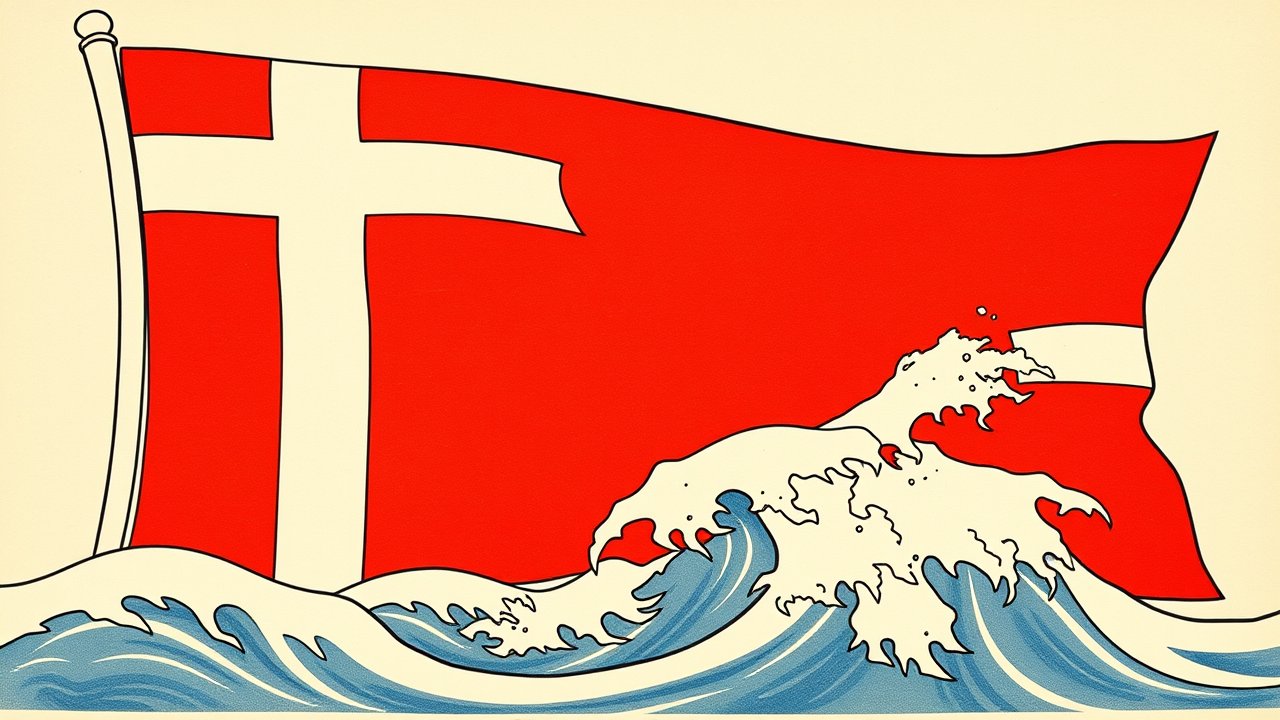
Ukiyo-e Woodblock — Red field with a white Scandinavian cross offset to the hoist. The flag of Denmark as a traditional Japanese ukiyo-e woodblock print. Red field with a white Scandinavian cross offset to the hoist. Bold outlines, flat areas of rich color, flowing organic forms. Wind and waves incorporated into the composition. Printed on washi paper with visible wood grain texture. The flag is the central focus and instantly recognizable. No text, no letters, no words, no writing of any kind.
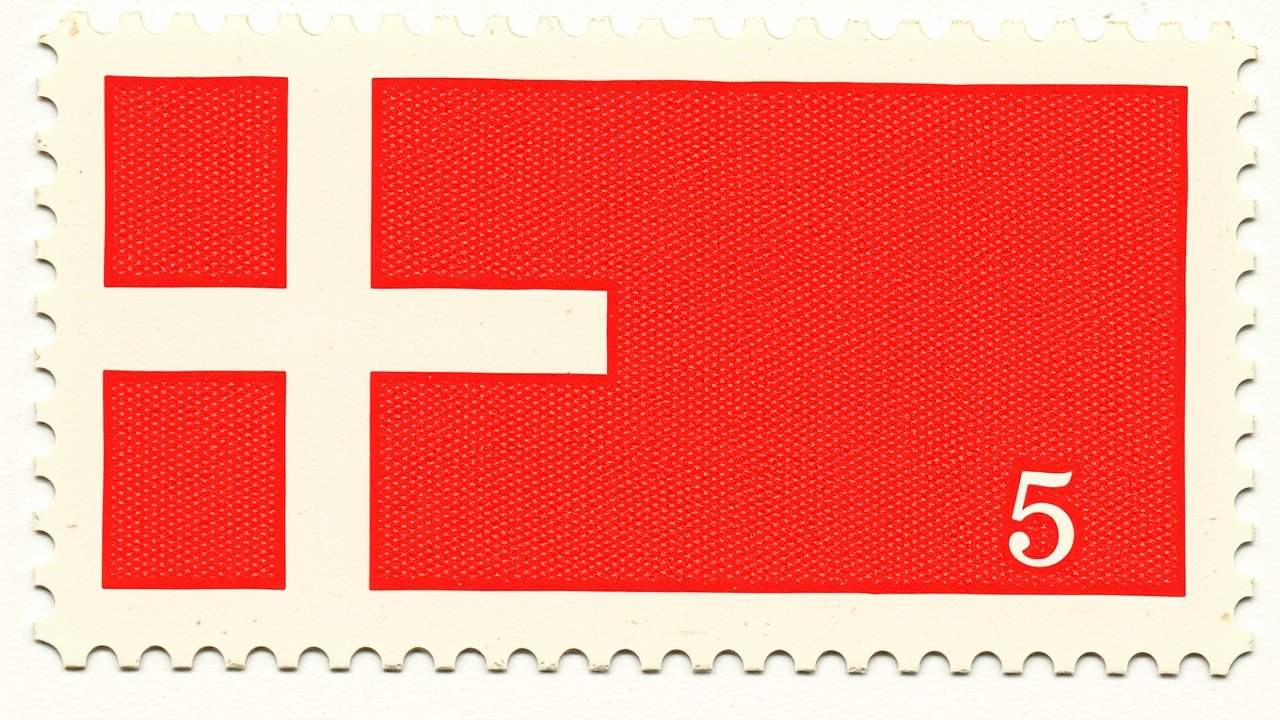
Vintage Postage Stamp — Red field with a white Scandinavian cross offset to the hoist. The flag of Denmark as a vintage 1950s postage stamp. Red field with a white Scandinavian cross offset to the hoist. The flag fills most of the stamp — it is the primary subject, faithfully rendered in fine engraved intaglio style. Perforated edges, aged paper with slight foxing. The stamp may show a denomination numeral only — absolutely no other text or country names.
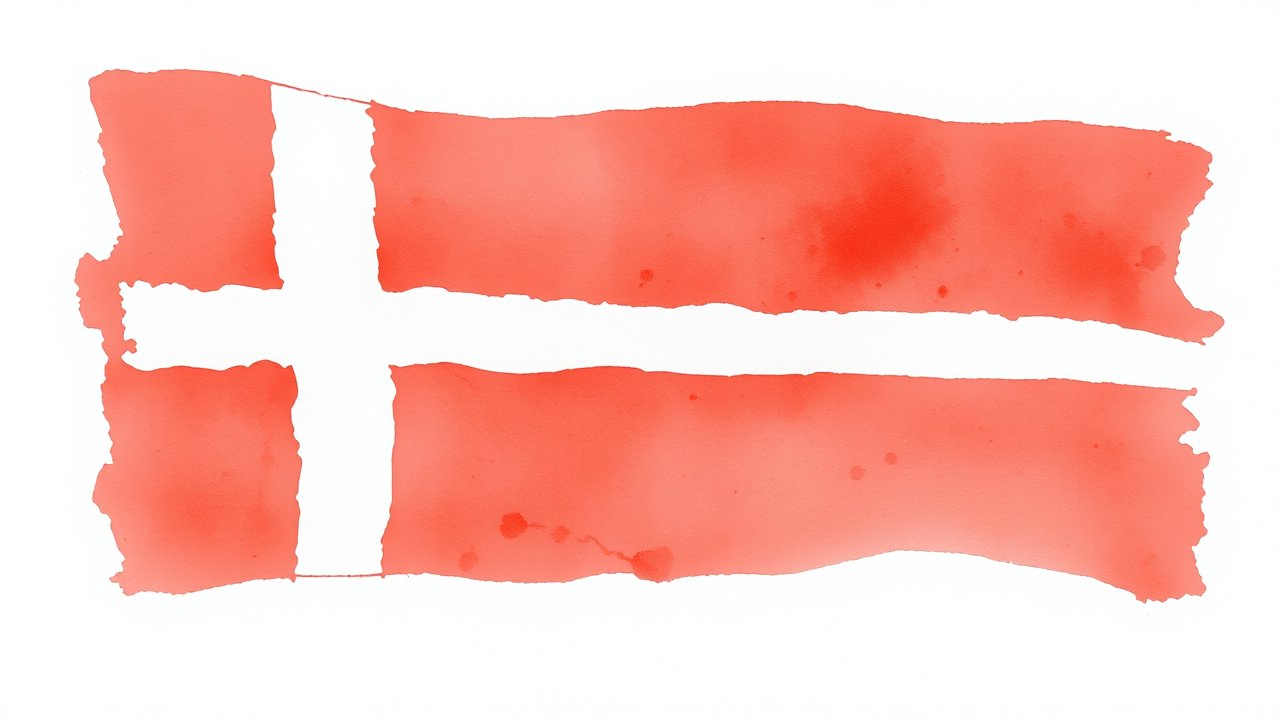
Watercolor — Red field with a white Scandinavian cross offset to the hoist. The flag of Denmark painted in loose, expressive watercolor. Red field with a white Scandinavian cross offset to the hoist. Wet-on-wet technique with soft color bleeds, visible brushstrokes, natural paper texture. Delicate splashes and drips at the edges. Luminous, translucent layers of pigment. No text, no letters, no words, no writing of any kind.
The Dannebrog, meaning “the cloth of the Danes,” stands as one of the world’s oldest continuously used national flags, holding the Guinness World Record since 1625. Its origins are steeped in both legend and historical complexity. According to popular Danish folklore, the flag miraculously fell from the sky on June 15, 1219, during the Battle of Lyndanisse (present-day Tallinn, Estonia), when King Waldemar II led Danish forces against Estonian defenders. While the legendary account captures the national imagination and is celebrated annually on Valdemar’s Day, historical evidence suggests the Dannebrog’s actual adoption occurred around the mid-14th century under King Valdemar Atterdag, likely inspired by the Holy Roman Emperor Louis IV of Bavaria’s similar design. During the European Crusades of the 11th to 13th centuries, various rulers employed red flags with white crosses, but Denmark’s distinctive Nordic cross design emerged as uniquely Danish during this transitional period. This historical ambiguity—between miraculous legend and documented adoption—has become integral to Danish national identity, with both narratives contributing to the flag’s profound cultural significance.
The Dannebrog’s design embodies profound Christian and national symbolism through its distinctive visual elements. The flag features a red field adorned with a white Nordic cross that extends to all four edges of the banner, with the vertical arm offset toward the hoist side—a characteristic feature shared among Scandinavian flags that Denmark pioneered. The white cross represents Christianity, reflecting Denmark’s religious heritage and the maritime traditions of the 18th century when the flag served as a crucial identification symbol for Danish vessels at sea. The red background traditionally symbolizes strength, bravery, and the enduring vitality of the Danish people throughout their long history. The cross’s width comprises one-seventh of the flag’s height, maintaining precise proportions that have remained consistent since the flag’s official standardization. This elegant simplicity makes the Dannebrog instantly recognizable while carrying centuries of accumulated meaning—the white cross cutting through the red field serves as a visual representation of faith intersecting with national identity. The Nordic cross design itself became a template for other Scandinavian nations, with Sweden, Norway, Iceland, and Finland later adopting similar cross-based flags, making Denmark the originator of a distinctive regional design that spans the Nordic world. This pioneering design makes the Dannebrog far more than a mere national symbol but rather an embodiment of Danish values, continuity, and cultural influence across the North.
The evolution of the Dannebrog from royal monopoly to democratic symbol reflects broader transformations in Danish society and national consciousness. For centuries, the flag remained exclusively the domain of Danish royalty, serving as a symbol of kingly authority and power. This exclusivity persisted until 1834, when the Danish crown even prohibited ordinary citizens from displaying the national colors—a regulation that would have been virtually unthinkable in the modern era. The watershed moment came during the First Schleswig War (1848-1851), a military conflict between Denmark and the German Confederation over control of the contested Schleswig and Holstein duchies. When Danish soldiers returned home victorious, they found their country transformed—private homes throughout the kingdom flew red-and-white Dannebrog flags in celebration and solidarity. This spontaneous popular uprising of the flag marked a decisive shift in Danish culture: the Dannebrog ceased being merely a royal emblem and became the property of the people, a symbol of democratic aspiration, national unity, and civic pride. The Second Schleswig War (1864) further cemented the flag’s role as a democratic symbol, as it came to represent Danish resistance and national determination during periods of struggle. This transformation remains uniquely significant in European flag history, as few national symbols have undergone such a fundamental transition from exclusive royal monopoly to beloved democratic icon, emerging from popular grassroots movements rather than official governmental decree.
Today, the Dannebrog occupies a singular position in Danish daily life and cultural practice, distinguishing Denmark as a nation with an exceptionally intimate relationship with its national symbol. Unlike many countries where the flag appears primarily in formal, governmental, or ceremonial contexts, Danes incorporate the Dannebrog into virtually every celebration and special occasion. The flag appears at birthday parties, graduation ceremonies, weddings, and summer festivities with remarkable frequency—a cultural phenomenon that reflects the Danish concept of inclusive national pride rather than exclusive patriotism. Businesses, schools, and private residences display the Dannebrog during holidays and commemorative dates, transforming entire neighborhoods into seas of red and white. This widespread civilian use stems from deeply rooted cultural traditions and the concept of “hygge”—the Danish notion of comfort, warmth, and community—which the flag has come to represent. Since 1913, Danes have celebrated Valdemar’s Day on June 15 annually, remembering both the legendary 1219 battle and the historical significance of their national flag through parades, special decorations, and traditional festivities. The date has become a cultural touchstone when Dannebrog flags appear in extraordinary numbers and the legendary tale of the falling flag is retold in homes, schools, and public gatherings. The Dannebrog thus transcends its function as a state symbol, becoming instead a daily expression of Danish identity that connects contemporary Danes to their medieval past while affirming their shared values of democracy, strength, and Christian heritage. This unique cultural integration of the national flag into everyday life makes the Dannebrog not merely a historical artifact but a living symbol of what it means to be Danish—a bridge between the legendary and the real, the historical and the contemporary, the official and the personal.
Free Printable: Flags of the World Reference Card
Get a beautiful printable poster with 50 flag emojis, Unicode codes, and fun facts. Perfect for classrooms and desks!
No spam, ever. Unsubscribe anytime.